Monplaisir Palace: Peter the Great’s Seaside Residence in Russia


Site at a Glance
- Rating
- 4.9
- Popularity
- Low
- Country
- Russia
- Primary era
- Early Modern
- External website
- Open
- Eras represented
- Early Modern
- Civilizations
- Russian
- Site type
- Domestic
- Remains
- Palace
On this page14 sections
History
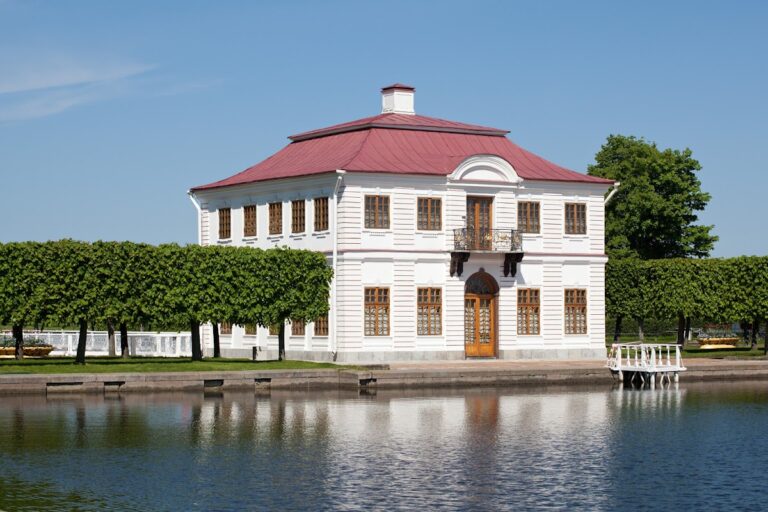
Monplaisir Palace is an early eighteenth-century palace in Russia, near Saint Petersburg, built under Peter I, also known as Peter the Great, between 1714 and 1723 in the Petrine Baroque style. The foundation was laid on 17 May 1714 on the southern shore of the Gulf of Finland, directly beside the water. Peter personally chose the location, planned the arrangement, and guided the interior decoration of the small residence.
Foundation and Imperial Residence
Peter intended Monplaisir, whose French name means “my pleasure,” to recall the Netherlands, a country he favored. He wanted views across the sea and a residence that would resemble a ship prepared for a long voyage. Its position expressed the change from marshland to an almost maritime landscape, with Kronstadt visible from the palace on clear days.
Monplaisir became Peter’s preferred country residence. He stayed there whenever he arrived at Peterhof, and the palace hosted court receptions, official celebrations, and meetings between the emperor and foreign ambassadors. Peter made his final visit in October 1724. In 1725, Empress Catherine I, who succeeded him, held a formal reception there for the first members of the Academy of Sciences.
The palace remained in active use until the reign of Catherine II, later known as Catherine the Great. She repeatedly held dinners for a small circle of close associates in the Parade Hall.
Design and Decoration
The architectural project is generally attributed to Johann Friedrich Braunstein, although Andreas Schlüter, Jean-Baptiste Alexandre Le Blond, and Niccolò Michetti are also associated with the palace. Another attribution proposes that the composition followed a project by Schlüter and that the complex was modeled on small Prussian palaces, including Monbijou near Berlin.
During his time in France in 1716, Peter invited Nicolas Pineau, a decorator and woodcarver, to Russia with Le Blond. Pineau worked on the interiors of Monplaisir and the Oak Study in the Peterhof Grand Palace before returning to France in 1726. The decoration brought together Dutch tiles, lacquer panels inspired by Chinese examples, textiles, carved oak, parquet, and marble.
Wartime Destruction and Restoration
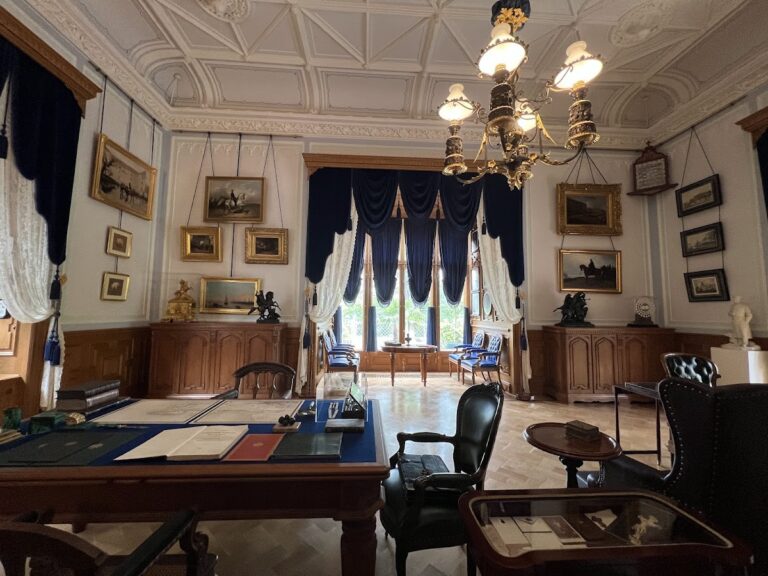
German forces destroyed the structures of Peterhof during the wartime occupation of 1941 to 1943. Between 1951 and 1978, restorers and students from specially established schools recreated Monplaisir’s lost interiors. The restored palace presents rooms including the Kitchen, Pantry, Bedroom, Study, and Marine Study, allowing the residence to be understood through both its architecture and its reconstructed decorative scheme.
Monplaisir is a federally protected cultural-heritage site in Russia. It also forms part of the UNESCO World Heritage designation for the “Historic Centre of Saint Petersburg and Related Groups of Monuments,” inscribed in 1990.
Remains
Palace Complex and Exterior
Central Pavilion and Galleries
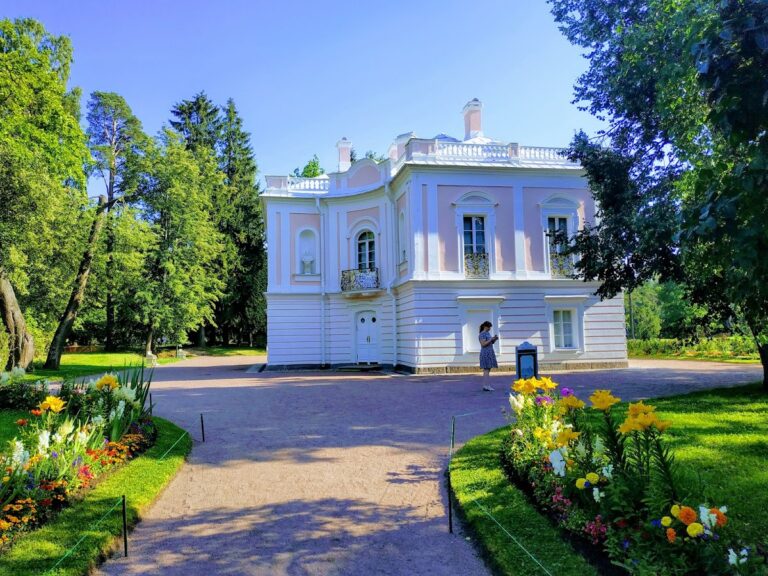
The complex includes the main palace, eastern and western wings, the Assembly Hall with a room for table service, a kitchen with a coffee room, the Catherine Building, the Monplaisir Garden, and the Marine Terrace. The main building has a central pavilion with a steep, Dutch-style broken-pitched roof crowned by a wooden vase. Side pleasure pavilions carry lanterns on their roofs, while ground-level galleries with large windows connect them to the center.
The walls are made from unusually narrow bricks measuring 22 by 10 by 5.5 centimetres. Whitewashed joints emphasize the brickwork and give the exterior its distinctive appearance. The sea-facing promenade is paved with red clinker brick. Each gallery is 22 metres long, and its floor uses black-and-white marble slabs arranged in a Dutch-style checkerboard pattern.
Marine Terrace and Gallery Decoration
The gallery ceilings were painted by craftsmen of the Moscow Armoury Chamber, a Kremlin institution associated with ceremonial objects and skilled decorative work, following designs by the French painter Philip Pilman. The galleries form part of an interior scheme that combines painted surfaces with Dutch tiles, carved oak, textiles, parquet, lacquer panels, and marble.
Parade Hall
Paintings and Wall Decoration
The Parade Hall has oak-panelled walls displaying twenty-two paintings in black lacquer frames. Peter I assembled these works during his foreign travels. Three paintings on the eastern wall are by Adam Silo, an Amsterdam painter of marine subjects whom Peter favored. A tradition holds that Peter used the paintings to test Naval Academy students on their knowledge of ship rigging.
Ceiling and Sculptural Details
The hall also has a marble checkerboard floor and high curved coves. Its painted ceiling, created in 1718 by Philip Pilman and Russian assistants, shows Apollo, figures from the Italian Commedia dell’arte, an improvised theatrical tradition built around recurring characters, and the four traditional Greek wind personifications, Zephyr, Notus, Boreas, and Eurus. Allegorical alabaster herms, sculptures with heads or busts set on rectangular pillars, represent the seasons in the corners of the coves. Their authorship is attributed either to Bartolomeo Carlo Rastrelli the Elder or to Le Blond and Nicolas Pineau.
The Parade Hall appears in Nikolai Ge’s 1872 painting Peter I Interrogating Tsarevich Alexei Petrovich at Peterhof.
Studies and Collections
Marine Study
The Marine Study has oak-panelled decoration and faience tiles, glazed ceramic tiles, depicting thirteen types of sailing ships. Its windows face the Gulf of Finland. The room forms part of the restored sequence of domestic and working spaces that also includes the Kitchen, Pantry, Bedroom, and Study.
Lacquer Study
The Lacquer, or Chinese, Study was designed by Braunstein in the European chinoiserie style, which reinterpreted Chinese and other East Asian artistic forms. Chinese and Japanese porcelain collected by Peter was displayed on elaborate gilded consoles. Of the 546 objects, 150 survived.
The room contains eleven large vertical black-lacquer panels showing scenes of Chinese life and eleven smaller panels with birds, dragons, and cranes. Russian icon painters produced the panels between 1719 and 1722 under the direction of Hendrik van Bronkhorst, a Dutch artist active in Russia. The work was known as “Dutch lacquer work.” Palekh craftsmen created replacement panels from surviving fragments between 1953 and 1963.
The palace presents collections of Western European paintings, Chinese porcelain, Dutch faience, Russian glass, and kitchen utensils from the first quarter of the eighteenth century. These displays also include some of Peter I’s personal belongings and diplomatic gifts received by the emperor.
Nearby sites