Monastery of Rosazzo: A Medieval Benedictine Abbey in Italy


Site at a Glance
- Rating
- 4.6
- Popularity
- Low
- Country
- Italy
- Primary era
- Medieval
- External website
- Open
- Eras represented
- Medieval, Early Modern
- Civilizations
- Holy Roman Empire
- Site type
- Religious
- Remains
- Fortified Monastery
On this page12 sections
History
The monastery of Rosazzo is a Catholic monastic complex in Italy, in the Rosazzo area of Manzano in the eastern hills of Friuli. Its central church, dedicated to Saint Peter the Apostle, was consecrated in 1070 and follows the Romanesque style, while later rebuilding introduced Gothic and Baroque elements. The monastery became an important religious and territorial institution between the Alps, Friuli, and the northern Adriatic.
Early religious settlement and foundation
The origins of Rosazzo are uncertain. Monastic tradition places a hermit named Alemanno on the hill during the ninth century. He is said to have built a small oratory and a cell, attracting other religious followers to the settlement. The community later developed into a monastery of Augustinian canons, clerics who followed a rule associated with Saint Augustine.
The church of Saint Peter the Apostle was consecrated in 1070. Rosazzo was probably founded or formally established under the patronage of Ulrik I of Eppenstein, patriarch of Aquileia from 1068 to 1077. Another tradition places the establishment around 1090. At about that time the monastery was raised to abbey status, and in 1091 Benedictine monks from Millstatt Abbey replaced the Augustinian community. The first Benedictine abbot, Blessed Gerold, came from Millstatt and was appointed by Ulrik I.
Benedictine expansion
Ulrik’s father, the Carinthian duke Markwart IV of Eppenstein, endowed Rosazzo with 140 hides, or farms. Benedictine administration then continued for more than three centuries, bringing stability, prosperity, and territorial expansion. Carinthian dukes, patriarchs of Aquileia, the Eppenstein family, the Spanheim dynasty, and the counts of Gorizia supported the abbey through donations and bequests.
Rosazzo’s lands and privileges extended from the Collio and the hills of Friuli through the lower Vipava Valley and the Karst to Istria and the region around Tarvisio. Its possessions included the area around Pieve di Brazzano, Saint George’s Church at Cormons with its adjoining estates, Saint Andrew’s Church at Koper, and more than thirty villages along the Soča toward its confluence near Tarvisio.
The Spanheims, who held the Carinthian ducal throne from 1122 to 1269, regarded Rosazzo as their second family monastery. Countess Hedwig of Moša and the Carinthian dukes Ulrik I, who died in 1144, and Henry V, who died in 1161, were buried there. Duke Bernard donated Črniče near Šempas in 1220 and further farms at Šmarje near Sežana in 1252. The charter of 1252 listed eighteen former Spanheim villages in the Karst hinterland of Trieste.
Hedwig of Moša brought Friulian and Karst possessions to the Spanheims through her marriage to Count Engelbert I of Spanheim. These holdings included the castles of Moša and Ratenj and lands at Gorizia. After the death of the Carinthian duke Henry of Spanheim in 1123, Gorizia passed to the counts of Gorizia. Henry I of Gorizia was first recorded with the title “comes de Guorze” in 1146.
Abbey power in the thirteenth century
Rosazzo reached its greatest prominence during the thirteenth century. Pope Innocent IV made the abbey autonomous in 1245 and placed it under the direct authority and protection of the Holy See, the central governing authority of the Roman Catholic Church. The abbot gained episcopal and civil powers, including responsibility for administering justice on monastic lands. In the Parliament of Friuli, the abbot held third place in voting order and precedence.
The abbey’s political position was affected by the changing fortunes of the Spanheims. Duke Ulrik III of Spanheim, who ruled from 1256 to 1269, pledged Moša Castle to the counts of Gorizia before 1258. In 1261 he surrendered his remaining possessions in the Karst and Friuli to the patriarch of Aquileia in exchange for supremacy in Carniola.
Commendatory administration and military conflict
A major fire in 1323 destroyed the abbey’s entire documentary archive. In 1391, Pope Boniface IX first granted Rosazzo in commendam, an arrangement in which a commendatory abbot administered the abbey’s revenues and rights without leading its resident monastic community. The transfer was formally confirmed in 1423. Rosazzo was thereafter managed by commendatory abbots and governors whose principal concern was its income.
This change contributed to spiritual decline and to the departure of the Benedictine monks. Cividale assumed responsibility for the abbey’s military defence and fortified the complex. Rosazzo was later adapted into a defensive stronghold during conflicts involving Aquileia, Cividale, Venice, and the Habsburgs. Its position near the boundary between Austrian and Venetian territories made it vulnerable to these struggles.
In 1509, during the wars of the League of Cambrai, a military alliance formed against the Republic of Venice, imperial troops occupied and devastated the abbey. A subsequent fire caused further damage. In 1521, parts of the abbey’s extensive landholdings passed under Venetian rule, while other possessions came under Habsburg Austria. Venetian-held areas included Manzano, Cividale, Cormons-related estates, Premariacco, Monfalcone, and settlements across the Friulian hills. Habsburg possessions included Batuje, Kanal ob Soči, Kobarid, Bovec, Branik, Cormons, and villages in the Brda, Karst, and Vipava regions.
After the Benedictines withdrew in 1522, Dominican friars occupied the monastery and remained for 248 years. Reconstruction began about two decades after the 1509 destruction under Giovanni Matteo Giberti, bishop of Verona and commendatory abbot. The work was directed by the Cividale architect Venceslao Boiani, who rebuilt much of the abbey.
Later transformation and preservation
The patriarchate of Aquileia, a powerful ecclesiastical principality in northeastern Italy and the eastern Alpine region, was suppressed in 1751. The archbishop of Udine then became the abbey’s titular. In 1823, Bishop Emanuele Lodi of Udine ordered further alterations and converted the complex into the summer residence of the bishops of Udine. The bishops also adopted the title “Marquises of Rosazzo,” a title recognized by the Kingdom of Italy in 1927.
The 1976 Friuli earthquake seriously damaged the abbey. Archbishop Alfredo Battisti promoted restoration of the complex and secured its inclusion among the buildings to be repaired, helping to revive the site. The former monastery now operates under the Rosazzo Foundation as a cultural, humanistic, and social centre. It hosts conferences, seminars, exhibitions, and debates and remains under the direct oversight of the archbishop of Udine.
Remains
Church of Saint Peter the Apostle
The abbey church forms the centre of the complex. Built in the eleventh century, it has a three-aisled Romanesque plan, with later Gothic and Baroque additions and alterations. Its façade has a stepped outline and an even surface of exposed stone blocks. An entrance portal occupies the lower level, while a rose window and two single-light windows are arranged above it. The surviving fabric contains evidence of rebuilding and restoration carried out from the sixteenth through the nineteenth centuries.
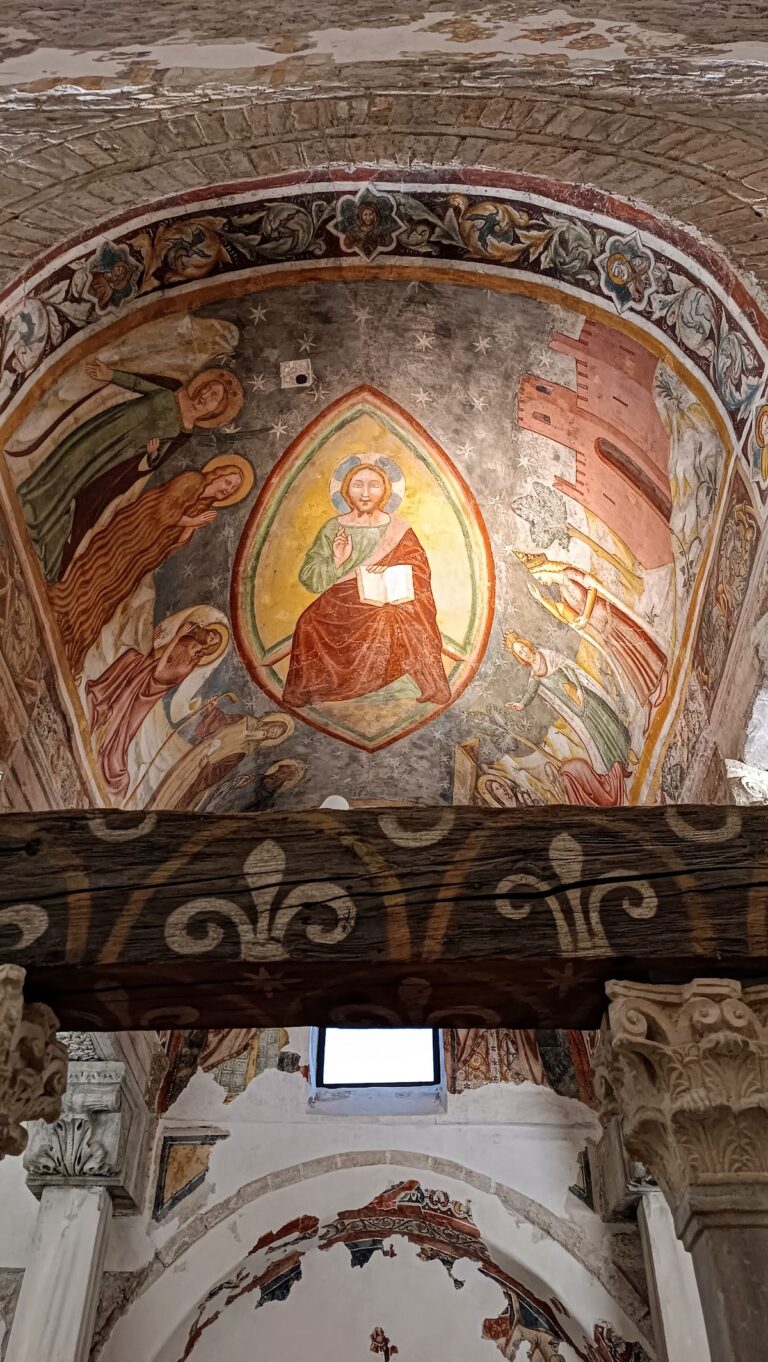
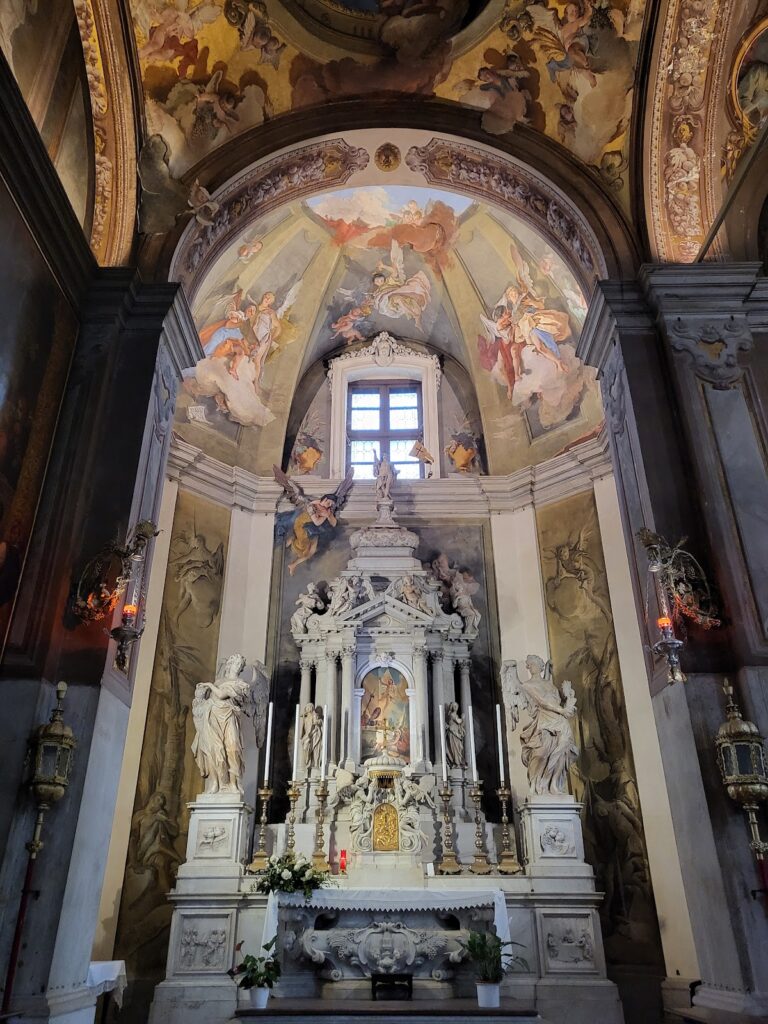
Inside, the church preserves frescoes by Francesco India, known as “Il Moro” or “Torbido.” All of these paintings date from 1535. India was a pupil of Giorgione, the influential Venetian painter of the High Renaissance. The side altars and statues belong mainly to the second half of the eighteenth century and were made by the Udinese sculptors Giovanni and Giuseppe Mattiussi.
Monastic buildings and fortified ensemble
Cloister and chapel
A sixteenth-century cloister stands beside the church. This covered walkway is arranged around an open courtyard and connects the principal monastic spaces. The Chapel of the Crucifixion also forms part of the group beside the church.
Monastic rooms and gardens
Adjoining buildings contain the chapter house, where the community met for official business and readings from its rule, together with the dormitory, refectory, and other service rooms required by monastic life. The complex also retains hanging gardens and a belvedere.
Defensive fabric
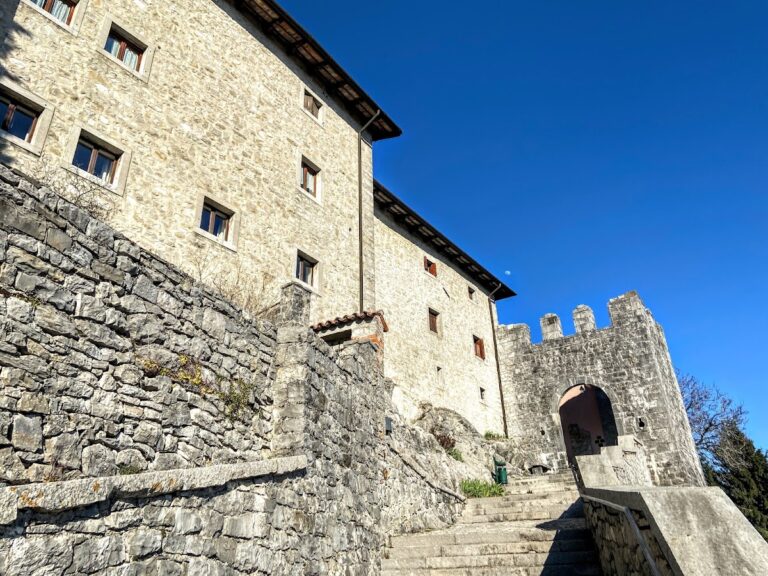
The buildings preserve the architectural character of a fortified ensemble. Its towers were removed during the nineteenth-century alterations, after the complex had served defensive purposes in the conflicts between Aquileia, Cividale, Venice, and the Habsburgs. The church and associated buildings retain the effects of the sixteenth-century reconstruction, the 1823 alterations, and the restoration undertaken after the 1976 earthquake.
Nearby sites