Santuario della Beata Vergine di Castelmonte: A Marian Pilgrimage Sanctuary in Italy


Site at a Glance
- Rating
- 4.7
- Popularity
- Low
- Country
- Italy
- Primary era
- Early Modern
- External website
- Open
- Eras represented
- Medieval, Early Modern, Modern
- Civilizations
- Holy Roman Empire, Venetian
- Site type
- Religious
- Remains
- Sanctuary
On this page11 sections
History
Santuario della Beata Vergine di Castelmonte is a Roman Catholic Marian sanctuary in Italy, standing at Castelmonte in the settlement of Prepotto, near the Julian Alps. Its origins are associated with early Christianity, and the sanctuary developed through medieval pilgrimage, fortification, repeated rebuilding, and continuing devotion to the Virgin Mary.
Early Christian origins
The hill at Castelmonte shows signs of activity before the present sanctuary, including archaeological finds and an ancient brick floor. Tradition holds that a Roman garrison occupied the site to defend Forum Iulii, modern Cividale, against invasions beginning in the fifth century. Castelmonte was also used as a refuge during incursions by the Huns, Goths, Lombards, Avars, and Slavs.
A small shrine cut into the rock may have stood here before the church and was associated with the Virgin Mary and Saint Michael the Archangel, a Christian protector and warrior against evil. A church dedicated to Saint Michael was established after Christianity reached the area, followed at an uncertain date by a church dedicated to Mary. An eighth-century document records Benedictine nuns making an annual pilgrimage to the Marian sanctuary.
Growing devotion to the Virgin Mary among communities connected with Aquileia, an ancient Roman city that became a major Christian center, helped the sanctuary expand into a fortified settlement. Devotion to Saint Michael was especially prominent during the Lombard period. Marian observances later centered particularly on the Annunciation on 25 March, the Assumption on 15 August, and the Nativity of Mary on 8 September.
Medieval sanctuary and pilgrimage
The first surviving written reference to the church dates from 16 June 1175, when property was transferred to the monastery of Santa Maria in Valle at Cividale. Documents from 1244 and 1247 describe Castelmonte as an important and prosperous place within the Patriarchate of Aquileia, a medieval church jurisdiction and ecclesiastical principality in northeastern Italy and neighboring Alpine regions.
In 1253 the sanctuary was united with the collegiate chapter of Santa Maria Assunta in Cividale. Building works took place between 1296 and 1360 and again between 1410 and 1432. During the thirteenth and fourteenth centuries, Castelmonte became a pilgrimage destination for people from Friuli, the Gorizia region, Carniola, Carinthia, Styria, Veneto, and nearby Slovenia. Indulgence privileges associated with Pope Innocent IV and Pope Urban VI, granted in the thirteenth and fourteenth centuries, reinforced its appeal. Such privileges reduced specified temporal penalties associated with sin for particular acts of devotion, often including pilgrimage.
The settlement suffered damage in 1419, attributed to Hungarian attacks, and was fortified against Ottoman armies in 1478. A lightning strike in 1469 set the bell tower on fire, destroying the sanctuary and its wooden statue of the Madonna. The church had been rebuilt by 1479, when a new stone image of the Madonna and Child was placed on the high altar. The surviving sculpture is dated to the early fifteenth century.
Rebuilding and the early modern sanctuary
Earthquakes in 1511 and 1513 partly destroyed Castelmonte. The sanctuary was then rebuilt, enlarged, and embellished, while the surrounding settlement developed during the sixteenth century into a fortified citadel with substantial walls and towers. The present building took shape from the sixteenth century onward and was altered repeatedly. Further remodeling occurred in the seventeenth century and in 1930, especially to the facade and bell tower.
Major rebuilding in 1744 gave the sanctuary its present appearance. Seventeenth-century marble altars and the early-fifteenth-century Marian statue were retained. In 1748 the sanctuary received all the privileges granted to the Basilica of Santa Maria Maggiore in Rome.
From 1492 to 1498, the Castelmonte Manuscript was produced at the sanctuary. This late-fifteenth-century Slovenian manuscript contains translations of the Lord’s Prayer, the Hail Mary, and the Apostles’ Creed, making it an important monument of the Slovenian language.
Changes from the eighteenth century to the present
French troops occupied the area during Napoleon’s Italian campaign, and feudal customs at Castelmonte were abolished in 1797. The church was plundered during the same period. In 1913 the sanctuary was placed in the custody of Capuchin Franciscan friars, a branch of the Franciscan Order associated with communal religious life, preaching, and poverty.
Bombing damaged Castelmonte in 1944, and the crypt was enlarged after the Second World War. Following the 1976 Friuli earthquake, the Capuchins began a diocesan pilgrimage to Castelmonte on 8 September. It has been repeated annually in remembrance of the earthquake.
Castelmonte also forms part of an ancient pilgrimage route linking three Marian sanctuaries, Castelmonte, Monte Santo, and Mariazell, a major Marian shrine in Austria. The three churches are described as forming a triangle dedicated to the Virgin Mary.
Remains
Fortified settlement and mountain setting
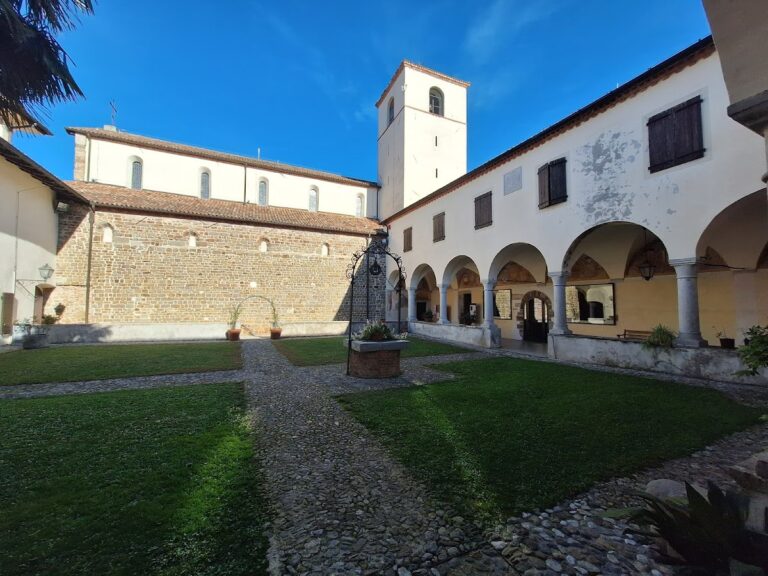
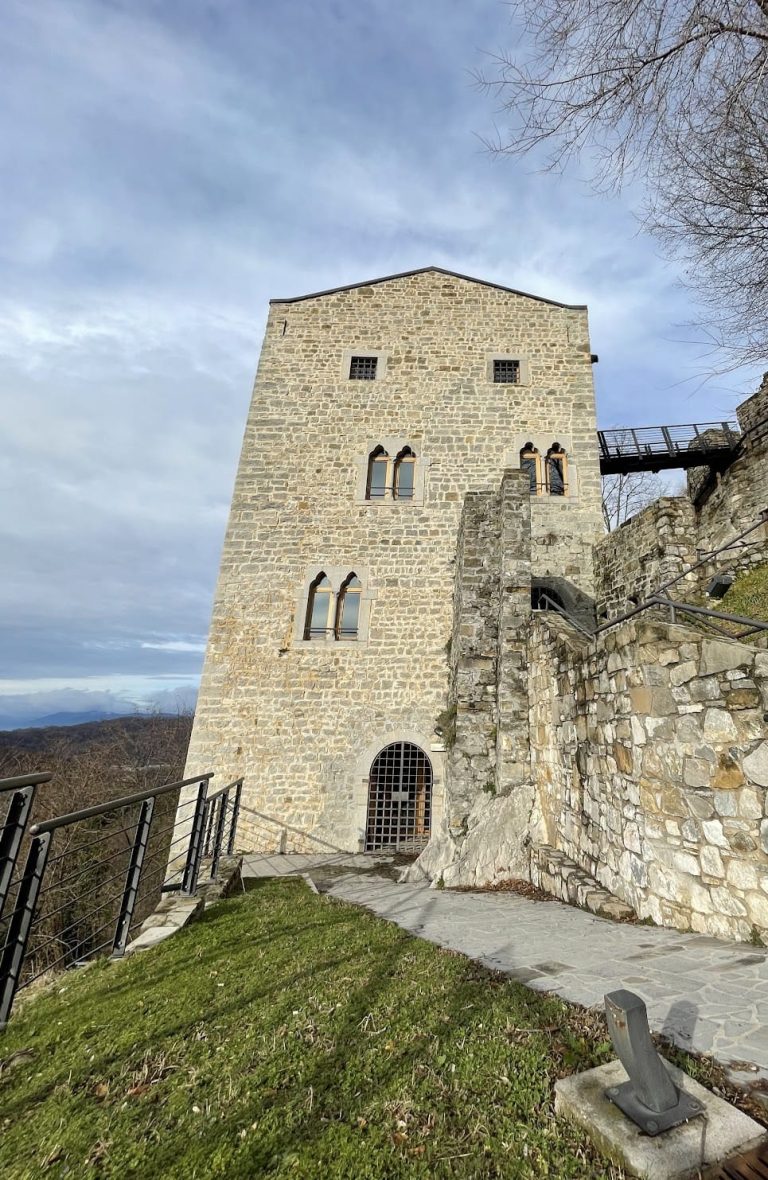
The sanctuary and settlement occupy a mountain position between the Natisone and Judrio valleys, at an elevation of 618 metres and about 7 kilometres from Cividale del Friuli. The fortified village developed around the chapel and included enclosing walls, towers, frontage walls, stairways, and stone buildings. Former craftsmen’s houses within the enclosure served the needs of pilgrims, linking the settlement’s domestic and working spaces with the sanctuary.
Outside the fortifications is the Grotta San Giovanni d’Antro, a grotto carved into the rock. The settlement’s surviving arrangement reflects the growth of a religious center that was also prepared to shelter its community during periods of invasion.
Church and sacred spaces
Crypt of Saint Michael
The crypt beneath the church is the oldest part of the sanctuary. It is associated with Saint Michael, the crypt’s patron, and was enlarged after the Second World War. Its position beneath the church preserves the sanctuary’s connection with the early religious use of the site.
Church interior and Marian image
The church contains a limestone statue of the Black Madonna with the Child. Although it was installed after the 1469 fire, the surviving sculpture dates from the early fifteenth century. Slovenian pilgrims call the image the Beautiful Madonna or the Living Madonna.
Marble altars made by Venetian masters remain inside the sanctuary, including an altar dated to about 1685, together with other Baroque altars. Corridors in the sanctuary building display numerous popular votive offerings, objects left in connection with religious devotion.
Pilgrimage route and manuscript
The road from Cividale to Castelmonte is marked by wayside shrines erected in 1864. They replaced earlier shrines from the seventeenth century and depict the fifteen Mysteries of the Rosary, a Catholic form of prayer centered on meditations about the life of Christ and the Virgin Mary. Pilgrims traditionally made small crosses from wood or branches and left them beside the shrines or at other stations along the route.
Friulian pilgrims traditionally walked from Cividale to Castelmonte and sometimes went barefoot. Pilgrims from the Natisone valleys followed a route from Cemur through Picon and past a chapel dedicated to the Madonna before reaching the eastern gate of the fortified settlement.
The Castelmonte Manuscript is preserved as a late-fifteenth-century Slovenian witness associated with the sanctuary. Its versions of the Lord’s Prayer, the Hail Mary, and the Apostles’ Creed give the manuscript a place in the history of the Slovenian language as well as in Castelmonte’s pilgrimage tradition.