Monastero di San Pietro in Lamosa: A Former Cluniac Priory in Italy


Site at a Glance
- Rating
- 4.5
- Popularity
- Low
- Country
- Italy
- Primary era
- Medieval
- External website
- Open
- Eras represented
- Medieval, Early Modern, Modern
- Civilizations
- Holy Roman Empire, Venetian
- Site type
- Religious
- Remains
- Monastery
On this page20 sections
History
Monastero di San Pietro in Lamosa is a former Roman Catholic monastery and church in Italy, at the northwestern edge of Provaglio d’Iseo in the province of Brescia. Dedicated to Saint Peter, it began with a private church built by the de Ticengo family around the middle of the eleventh century and later became a Romanesque Cluniac priory above the Torbiere del Sebino wetland. The wetland, a former peat-extraction area extending toward Lake Iseo, gave the monastery its name.
Before the Cluniac foundation
The de Ticengo family were feudal dependants of the bishop of Cremona. Their private church expressed the family’s status and asserted its authority in a relatively distant fief. Earlier activity at the site cannot be securely reconstructed from the surviving evidence. A second- or third-century relief built into the loggia of the adjoining Casa Bergomi was once interpreted as proof of a sanctuary dedicated to Mithras, a deity associated with a Roman mystery cult. It is now identified as Attis, an ancient deity linked with vegetation, death, and renewal. The raised ground may nevertheless have had a sacred use before the Christian foundation.
On 6 December 1083, Ambrogio and Oprando de Ticengo donated their church to Benedictines following the Cluniac reform. This medieval movement, centred on the Abbey of Cluny in Burgundy, stressed liturgical observance, monastic discipline, and greater independence from local secular authorities. The donation may have reflected concern for the donors’ souls as well as political or economic interests, since transfers of religious property could involve financial compensation.
The Cluniac priory
In 1095, Pope Urban II confirmed San Pietro in Lamosa as an autonomous Cluniac priory. Its first dependent churches were those of Trigolo and Alfianello, followed by other ecclesiastical properties acquired through agreements that allowed local churches and episcopal rights to remain in place. In 1144, the priory transferred San Gervasio in Clusane to the clergy of Sant’Andrea in Iseo in return for an annual payment to Cluny. In 1154, the chapel of Santa Maria in Pievedizio was transferred to the parish of Azzano for five soldi.
Disputes over the payments for Santa Maria continued until Pope Alexander III freed the chapel from what he judged improper demands in 1161. The decision was ratified in 1177. These disagreements formed part of wider tensions involving Alexander III and Hugh III, abbot of Cluny, during the conflict between Emperor Frederick Barbarossa and the Lombard communes. Hugh supported the antipope Victor IV and the emperor. The struggle was also connected with the Investiture Conflict, the wider medieval dispute over the appointment of bishops and other church officials.
During the thirteenth century, the community usually comprised three monks, servants or lay brothers, and a resident priest responsible for pastoral care. The monks’ principal duties were the Divine Office, hospitality, and almsgiving. Cluniac visitation reports described the priory as unusually well administered, although its finances and internal discipline later deteriorated. The general chapter of 1261 accused Prior Giovanni of appointing monks improperly, contracting debts, and leasing land too freely. A new prior or administrator appointed in 1270 reduced the debts and restored monastic discipline.
War, debt, and recovery
Warfare between Guelph and Ghibelline factions around Brescia weakened the priory. Local priors could not regularly attend Cluniac general chapters, visitations were disrupted, and monks sometimes had to flee to safer places. The first surviving financial report, from 1306, records an unpaid debt of 40 imperial lire owed by Giacomo Della Torre. The prior was also accused of neglecting his duties and permitting the theft of objects required for liturgical celebration. In 1308, a monk threatened him with a weapon.
A visitation in 1331 found the monastery in a disastrous condition, prompting the order’s treasurer to intervene. By 1342, its financial situation had been completely restored. The administration of Prior Richard was praised in 1366, although records ending in 1378 describe the buildings as being in poor condition despite the competence of the sole remaining prior.
Venetian connections and commendatory administration
In the fifteenth century, San Pietro in Lamosa developed political relations with Venice. A ducal letter of 16 September 1454 confirmed privileges previously granted to the community of Provaglio because of its support for Venice during conflicts with the Visconti and later the Sforza. A census of 1460 listed the monastery among the remaining Cluniac possessions in the province of Brescia and noted that it also administered the priory of Santi Gervasio e Protasio in Clusane.
During the second half of the century, Pope Paul II returned priories to dependence on the Apostolic See through commendatory administration. A commendatory administrator held the revenues or formal administration of a religious institution without necessarily residing there. In a letter dated 14 February 1474, Doge Pietro Mocenigo expressed solidarity with the people of Provaglio, who complained that Nicola Franco had usurped the priory. The doge also objected to the appointment of a commendatory administrator because it would remove the monk then serving at the monastery. In 1476, a permanent vicarate was established and entrusted to the priest Battista de Portinalis. A document of 1489 gives a comprehensive account of the priory’s economic assets.
Augustinian administration and parish life
In 1535, with Pope Paul III’s approval, administration passed from Cluny to the Lateran Congregation of Augustinian Canons. These were communities of clerics following the Rule of Saint Augustine while undertaking pastoral and parish duties. The transfer was first assigned to Sebastiano Bonfigli Graziani, who declined it, and then to Cardinal Alessandro Cesarini. The canons successfully requested that the priory be united with their community at San Giovanni Evangelista in Brescia, and the decision was ratified in April 1536.
A papal bull of 17 April 1547 addressed the provision of pastoral care after the resignation of Provaglio’s vicar. The Augustinian canons eventually assumed responsibility for parish ministry in exchange for the priory’s revenues. Following the post-Tridentine reorganization of the Church, San Pietro in Lamosa became Provaglio’s parish church and entered the diocesan administration of Brescia. Bishop Domenico Bollani made the first recorded pastoral visitation on 6 October 1567. On 7 March 1580, Ottaviano Abbiati de Foreriis carried out an important apostolic visitation in place of Carlo Borromeo.
The parish priest gained responsibility for religious instruction and the maintenance of parish registers. The confraternities of the Disciplini and the Blessed Sacrament established their own spaces and altars within the complex. The Disciplini were penitential lay confraternities whose religious practice centred on repentance and the Passion of Christ.
Suppression, private ownership, and renewed cultural use
In the later eighteenth century, the Republic of Venice ordered the suppression and confiscation of monasteries with fewer than twelve religious. San Pietro in Lamosa was sold on 28 September 1786 to Giovanni Battista Agosti for 17,000 ducats and entered private ownership. After Agosti’s death, the property passed to the Bergomi family and then to the Bonini-Bergomi family. A substantial portion is now held by the Valgoglio-Beretta family, while other parts remain largely private property.
The sale encouraged the inhabitants of Provaglio to plan a new parish church in the centre of the settlement. Its construction lasted from 1792 to 1816. San Pietro in Lamosa continued to fulfil important ecclesiastical functions for a further period, but it definitively lost its parish role after 1827 and became a private church. Residential buildings around the former monastery were added or renovated during the first half of the nineteenth century, and other parts of the complex were enlarged or adapted for domestic use.
In 1983, the owners donated the church to the parish of Provaglio. In more recent decades, the former Disciplini hall and several adjoining rooms were transferred to the Fondazione culturale San Pietro in Lamosa for restoration and cultural activities. Established on the initiative of the municipality of Provaglio d’Iseo but operating autonomously, the foundation promotes the medieval monastery within a sustainable cultural-development programme for Franciacorta and the southern Lake Iseo area.
Remains
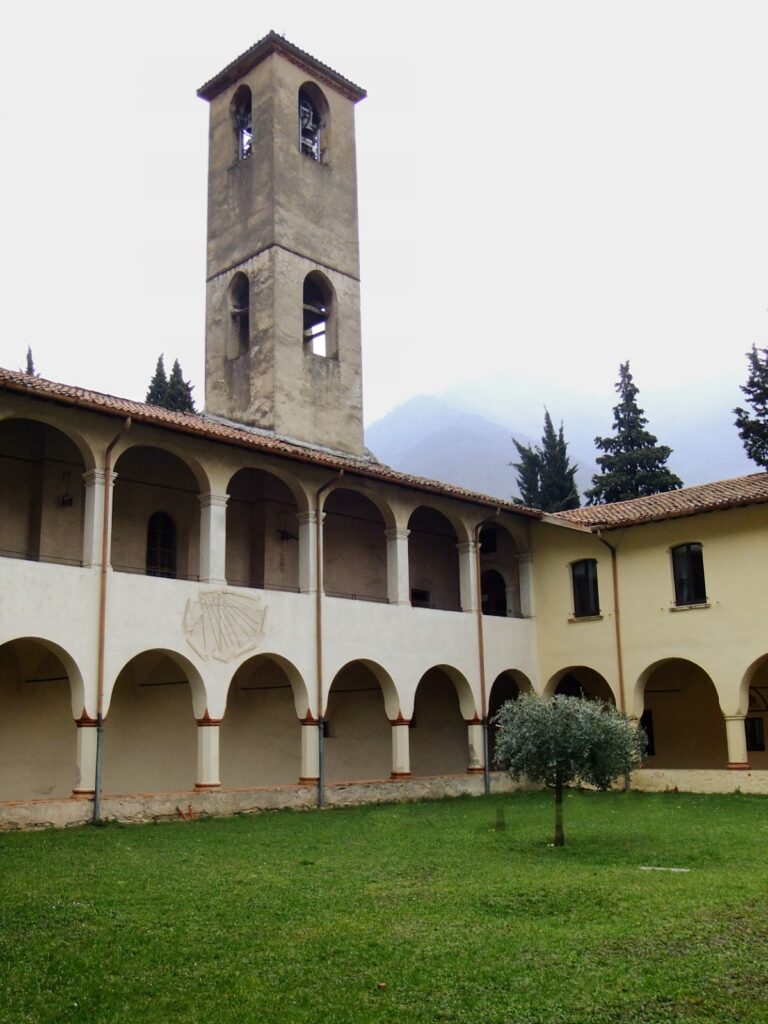
The surviving complex combines an altered medieval church, the former Disciplini hall, residential buildings, and smaller adapted spaces. The church preserves fabric from the earliest Romanesque phase alongside Gothic, Renaissance, Baroque, and later interventions. Its decorative programme is especially extensive, with paintings produced mainly between the thirteenth and sixteenth centuries and later altarpieces and organ elements.
Early church and later structural phases
Romanesque foundations
An archaeological excavation directed by A. Breda in 1988 clarified the plan beneath the fifteenth-century building. It revealed a Romanesque church constructed on undisturbed ground, with three aisles ending in three semicircular apses. The building was approximately 8 metres long, and its central nave was about 5 metres wide. A square structure in front of the façade served, or may have served, as an atrium or narthex, an entrance hall.
The northern side-apse, the north wall, and the base of the bell tower survive from this earliest church. Similar masonry in the side-apse and bell tower places them in the same construction phase and shows that the bell tower was not built around 1130, as Arthur Kingsley Porter had proposed. A large thirteenth-century fresco of Saint Christopher carrying the Christ Child was painted on the exterior façade. Its position made it visible to travellers approaching along the road below the monastery.
Medieval chapels and nave
Between about 1150 and the beginning of the thirteenth century, two chapels were added along the northern side as the original church became too small for the growing population. One contained a basement reached through a Sarnico-stone trapdoor, and the room was intended for the burial of monks. Another interpretation proposes that the chapels originally formed one rectangular room, perhaps an oratory dedicated to the Virgin.
At the turn of the fourteenth and fifteenth centuries, a third chapel was added to the northwest at the commission of the Capitani family. It has a Gothic cross-ribbed vault constructed in brick masonry. The earlier three-aisled arrangement was partly demolished and replaced by a hall divided by pointed arches into four sections supporting a wooden ceiling.
During the first decades of the sixteenth century, the Chapel of the Blessed Sacrament was added to the northwest. The presbytery and central apse were lengthened and raised, while the original apse of the right aisle was incorporated into the new sacristy wall and became externally concealed. These works took place between 1500 and 1509, and the Disciplini hall was completed in 1509. A cemetery chapel was built several centuries later. It first served for burials, and work resumed in 1768 to convert it into a functioning church.
Painted chapels and nave decoration
Saint Mary Chapel
An early chapel dedicated to Saint Mary retains traces of an early twelfth-century monochrome scheme. Reddish-brown floral garlands cover parts of the vault, the northeastern wall, and the lower northern wall. Lion protomes at the springing points of the ribbed vault may represent the struggle between good and evil. Two medallions show Benedict of Nursia and Hugh of Cluny.
The chapel also contains a second-half-of-the-fifteenth-century fresco of the enthroned Madonna and Child with the Blessed Simon of Trent, Saint Benedict, Saint Lucy of Syracuse, and Saint Stephen. The Lissignoli family commissioned it. The intrados, the underside of the arch, includes Saint Anthony Abbot and Saint Sebastian with a bishop, the latter dated 1514. Images of the Blessed Simon reflect a late medieval cult based on the historically false accusation that the child had been ritually murdered by Jews. The paintings present the alleged violence with pronounced realism.
Pellegrini Chapel
The Pellegrini Chapel contains at least three successive painting phases, beginning in 1456 and continuing through the second half of the fifteenth century. Its altarpiece shows Saint Anthony Abbot enthroned between Benedict of Nursia and Peter Martyr, with members of the Pellegrini family kneeling below. A donor inscription names Alessandro Pellegrini of Martinengo. His son Giovanni served as prior from 1454 to 1461.
The lower register includes a Pietà related to the northern Alpine Vesperbild, a devotional image of the dead Christ mourned by the Virgin, and an enthroned Madonna and Child associated with the workshop of Bonifacio Bembo. The intrados depicts Saint Peter the Apostle, Saint Agatha, Peter Martyr, and another Madonna and Child. An Annunciation on the chapel front is dated 1458 and is paired with an Imago Pietatis, an image presenting the suffering or dead Christ for meditation, and God the Father in glory.
Capitani Chapel
A chapel commissioned by Raffaele Capitani di Scalve in the late fifteenth century contains a Crucifixion between Saints Bernardino of Siena and Nicholas of Tolentino. Capitani’s coat of arms appears in the fresco. His will of 1508 requested burial in the chapel beside his mother’s remains. The painting may reflect the influence of engravings by Martin Schongauer and Albrecht Dürer.
Blessed Sacrament Chapel
The Chapel of the Blessed Sacrament was decorated by Paolo da Caylina the Younger before 1555, with work beginning between 1525 and 1536. Its eight-part umbrella-shaped vault alternates the four Latin Fathers of the Church with the four Evangelists. The Latin Fathers were major early Christian theologians whose writings shaped Western Christian doctrine. Prophets and sibyls occupy the surrounding lunettes. The style recalls the Brescian painting of Vincenzo Foppa and Girolamo da Romano, known as Romanino.
Nave and presbytery paintings
The paintings throughout the church form a varied sequence shaped by late Gothic Lombard, Veronese, Paduan, Trentino, Alto Adige, Tuscan, and Brescian influences. Numerous ex voto frescoes express local popular devotion. Franciscan influence is particularly strong, with repeated images of Franciscan-associated saints alongside scenes from the lives of the Virgin Mary and Jesus.
Frescoes on the left side of the nave, probably made by one workshop in the final years of the fifteenth century, show Saint Roch, Saint Lucy, Saint Sebastian, a saintly knight dated 1493, a Madonna and Child, and a second Saint Roch. Another cycle, badly preserved, includes the Blessed Simon of Trent, a Nativity dated 1497 with a fortified city and rocky landscape, Saint Lucy, and a Madonna and Child whose inscription names Gaspare de Bini of Provaglio as donor. A niche intrados contains another Madonna and Child and a further image of the Blessed Simon dated 1518.
The right nave wall contains a difficult-to-identify scene of the Virgin, a pope, a bishop, and nobles working the land. Nearby are the mystical marriage of Saint Catherine of Alexandria with music-making angels, an enthroned Virgin, and remains of the Marriage of the Virgin and Saint Joseph. A seventeenth-century wooden organ case caused the loss of decoration in the second bay. Surviving pier paintings include Peter Martyr, Bernardino of Siena, a Madonna and Child commissioned by Comino Lissignolis, and Saint Sigismund of Burgundy.
The third bay preserves several superimposed phases. The oldest is a thirteenth-century Madonna and Child against a red curtain, beside an incomplete enthroned Madonna and an Annunciation influenced by Veronese art. The lower register contains Bernardino of Siena, an unidentified saint, Vincent Ferrer, and Saint Monica. The final pier bears images of Saint Anthony Abbot and Saint Francis dated 1495, together with a saintly knight probably commissioned from a local painter in 1493.
The presbytery walls contain an unfinished cycle of the Apostles. Some figures are fully painted, while others survive as sinopias, preparatory underdrawings made directly on plaster before the coloured fresco layer. Beneath the roof structure, a frieze of Apostle busts alternating with Franciscan saints runs around the upper walls. A medallion of Saint Peter occupies the triumphal arch above the entrance to the choir.
Later altarpieces and organ
Four altarpieces belong to the period of administration by the Lateran Augustinian canons. The Blessed Sacrament Chapel contains a painting of thanksgiving to the Madonna of the Rosary for the Christian victory over the Turks at Lepanto, attributed to Francesco Giugno. Another canvas, showing God the Father with Saints Andrew, Charles Borromeo, Augustine, Ursula, and Anthony Abbot, is probably by Antonio Gandino.
The presbytery contains a Madonna and Child with Saints Peter and Paul, hypothetically attributed to Domenico Carpinoni. A fourth canvas depicts the Crucified Christ with the Virgin Mary, Mary Magdalene, Saint John the Evangelist, and souls rescued from Purgatory. Dated between the Baroque and Neoclassical periods, it is attributed to Sante Cattaneo and has never been restored.
The church retains a Baroque organ case. Its present instrument was constructed by Daniele Giani in 2015 and incorporates older Antegnati components from a twentieth-century organ made by the Borghi workshop.
Disciplini hall
The Disciplini hall adjoins the eastern side of the church. Built in the late fifteenth or early sixteenth century and decorated by 1509, it was supported by patrons including Giuliano Fenaroli. The confraternity’s devotion to Mary Magdalene shaped a cycle devoted to Christ’s Passion, death, Resurrection, and the need for penitence.
Two horizontal registers of frescoes originally covered the hall’s four walls. Many paintings were damaged or lost while the room served as residential space until 1990. Some scenes remain coloured, while others survive as monochrome sinopias. Certain monochrome passages may have been intended as finished works because coloured pigments, silver, and gold were expensive. The paintings resemble those in San Bernardo in Provaglio and are attributed to a travelling group active around 1510 between Trento, Bergamo, and the Veneto.
The eastern wall preserves recognizable underdrawings of the Nativity, the Massacre of the Innocents, and the Baptism of Christ, with a dove above Christ and an angel holding his garment. The southern wall shows the Last Supper, the Washing of the Feet, Christ’s prayer in Gethsemane, his arrest, and his interrogations before the high priest, Herod, and Pontius Pilate. The Last Supper was badly damaged when a fireplace was inserted.
The western wall contains coloured scenes of the Way to Calvary with Saint Veronica, the Crucifixion, and the Deposition from the Cross. A separate lower-register scene shows white-clad Disciplini with red crosses and Saint Roch pointing to his plague sore. The northern wall preserves underdrawings of the Resurrection, Christ’s descent into the underworld and liberation of Adam and Eve, and the visit of the three women to the empty tomb. Christ appearing to Mary Magdalene is badly damaged, later windows destroyed much of the lower register, and fragments of Pentecost remain visible.
Monastery buildings
The buildings around the former monastery were enlarged and remodelled for residential use after the complex became private property. The church, the former Disciplini hall, and several smaller spaces subsequently acquired different owners and functions, preserving a complex whose medieval religious core is interwoven with later domestic adaptations.
Nearby sites