Joseph-Volokolamsk Monastery: A Russian Orthodox Monastic Center in Teryaevo


Site at a Glance
- Rating
- 4.9
- Popularity
- Medium
- Country
- Russia
- Primary era
- Early Modern
- External website
- Open
- Eras represented
- Early Modern, Modern
- Civilizations
- Russian
- Site type
- Religious
- Remains
- Fortified Monastery
On this page17 sections
History
Joseph-Volokolamsk Monastery is a Russian Orthodox monastery in Teryaevo, Russia, founded in 1479 by Joseph Volotsky as a male communal monastery dedicated to the Dormition of the Mother of God. Construction was financed by Prince Boris Vasilyevich of Volotsk, and the new foundation initially belonged to the jurisdiction of the Archbishop of Novgorod. The monastery later became a major center of religious and political life in sixteenth-century Russia.
Foundation and jurisdictional conflict
After Prince Boris died, his son Fedor Borisovich became prince of Volotsk. Relations between Fedor and Joseph deteriorated, particularly over demands placed on the monastery and feasts financed from its resources. In 1507, Joseph appealed to Grand Prince Vasilii III and Metropolitan Simon for the monastery to be transferred to the direct authority of the Moscow diocese.
The appeal brought Joseph into conflict with Archbishop Serapion I of Novgorod. A church council led by Joseph’s brother, the Bishop of Rostov, deposed Serapion and confined him to the Trinity-Sergius Lavra, where he died in 1516. The dispute established the monastery as an institution with influence beyond its immediate religious community.
The Josephinians and monastic power
In the following decades, the monastery became the center of Joseph’s disciples, known as the Josephinians. Joseph Volotsky was a fifteenth-century Russian Orthodox monk and religious leader whose teaching emphasized strict communal discipline and prayer. The community defended church ownership of land and opposed religious positions it regarded as heretical, giving the monastery an important role in ecclesiastical debates.
During the sixteenth century, tsars visited the monastery for religious devotions, while its buildings also served as a prison for state opponents, dissidents, and heretics. Its inmates included Maximus the Greek, who spent fourteen years there, as well as Vassian Patrikeyev, Feodor Kuritsyn, Archbishop Feodosii of Novgorod, Metropolitan Daniel, Tsar Vasilii IV Shuisky, Matvei Bashkin, and Vasilii Kuritsyn. Gerasim Firsov, later associated with the church schism, spent his final years at the monastery.
The monastery’s estates made it a major landholding institution. In the 1560s, it possessed more than 30,000 desyatinas of arable land. A desyatina was a historical Russian measure of land used in describing agricultural estates. Dependent priories were established on these holdings, which by the beginning of the seventeenth century extended across ten districts and included forty villages worked by 1,364 peasant households. In 1579–1580, the monastery also employed 119 workers and servants.
Abbot Gurii and the sixteenth century
Abbot Gurii led the monastery from 1543 for nine years. During his tenure, the future saint Herman took monastic vows there. After the Russian conquest of Kazan in 1552 and the establishment of a bishopric in the city, Gurii was chosen by lot as its first archbishop.
Joseph-Volokolamsk Monastery also retained an important commemorative and documentary role. Joseph Volotsky, Princes Ivan and Feodor Borisovich of Volotsk, Metropolitan Daniel, Archbishop Feodosii of Novgorod, Malyuta Skuratov, and N. I. Goncharova were buried within the complex. Goncharova was a landowner of Yaropolets and the mother-in-law of the poet Alexander Pushkin. The monastery’s library held books, manuscripts, chronicles, charters, acts, and other documents dating from the fifteenth century, while ancient objects were preserved in its sacristy.
Sieges and the Time of Troubles
The monastery supported the government of Tsar Vasilii IV Shuisky during the Time of Troubles, a period of dynastic crisis, civil war, political instability, and foreign intervention in Russia during the late sixteenth and early seventeenth centuries. Forces led by Ivan Bolotnikov besieged the complex in 1606. Polish forces mounted another siege in 1609–1610, and a detachment commanded by Colonel Roman Rozhinsky occupied the monastery in 1610.
Russian and Swedish forces led by the voivode Valuev and General Gorn expelled the Polish garrison. Rozhinsky was wounded during a clash near the monastery and later died. Captured Polish cannons remained at the complex and were subsequently used for festive salutes or fireworks.
After Vasilii IV was overthrown in July 1610 and forcibly tonsured, he was held under guard for a time in the monastery’s German Tower. In September, he was surrendered to the Polish hetman Stanisław Żółkiewski and taken with his brothers Dmitrii and Ivan toward Smolensk and later Poland. During the Russo-Polish War of the early seventeenth century, the monastery also held Polish prisoners of war. French prisoners were held there during the 1812 campaign.
Later institutional history
A school for priests’ children operated at the monastery from 1777 to 1823. Fairs of the Kaleevskaya volost continued there until 1917. On 31 May 1859, during temperance disturbances linked to opposition to the liquor-farming system and increased taxation on vodka, a crowd of about 3,000 people destroyed drinking establishments at a nearby fair.
After the October Revolution of 1917, the monastery became the Joseph Agricultural Labour Commune. The monks elected the treasurer, Hieromonk Pafnutii, as its chairman. The commune was dissolved in 1922, and the monastery closed. The complex then housed an orphanage, while the former brotherhood building became the Detgorodok secondary school. The Assumption Cathedral was converted into a cinema, with a screen placed before the ancient iconostasis. Soviet authorities removed the bells and transferred most of the icons to Moscow.
Many of the monastery’s manuscripts, books, chronicles, and documents were moved to archives and museums in Moscow and Saint Petersburg, including the Russian State Archive of Ancient Acts, the State Historical Museum, the Russian State Library, and the Saint Petersburg branch of the Institute of Russian History.
War, restoration, and renewed religious use
During the Second World War, Red Army troops and later German forces occupied the monastery. The bell tower was blown up during the Red Army retreat in 1941, and fighting damaged the complex. The 84th Separate Naval Rifle Brigade of the First Shock Army liberated the monastery on 18 December 1941 during the Klin–Solnechnogorsk offensive. The orphanage later returned to the site.
The churches were subsequently restored, and the monastery was returned to the Russian Orthodox Church on 15 May 1989. The Church of the Holy Apostles Peter and Paul reopened for worship that year, followed by the Assumption Cathedral and the Epiphany Church in 1990. The monastery received stauropegial status in 1999, meaning that it was placed directly under the authority of the patriarch rather than a local diocesan bishop. It is a cultural-heritage site of federal significance in the Russian Federation.
Archaeologists opened a burial believed to contain Joseph Volotsky’s remains on 12 June 2003 at a depth of 225 centimeters. The remains were placed in a reliquary in the lower church of the Assumption Cathedral and underwent medical-forensic and anthropological examination. On 12 June 2004, Joseph’s penitential chains were transferred to the monastery from the New Jerusalem Historical, Architectural, and Art Museum and then from the Volokolamsk Kremlin Museum and Exhibition Complex. They were returned to religious veneration in the Assumption Cathedral.
The monastery’s religious traditions also include the Volokolamsk Icon of the Mother of God, venerated for centuries as wonderworking. The date associated with its arrival at the monastery, 3 March, became a church-wide feast. A copy made in 2007 and regarded as wonderworking is kept in the Assumption Cathedral. In the fifteenth and sixteenth centuries, the monastery rivaled the Trinity-Sergius monastery in authority and wealth. It was often called a lavra, an honorific title for a monastery of exceptional importance in Eastern Orthodox tradition, although that status was never officially confirmed.
Remains
The monastery stands in Teryaevo, approximately 16–17 kilometers northeast of Volokolamsk in Moscow Oblast. Its surviving complex combines churches, a fortified stone enclosure, towers, a refectory, and three ponds filled with fresh water. Most of the present buildings date from the sixteenth and seventeenth centuries, while a skete and a commemorative monument belong to the nineteenth and twenty-first centuries.
Early churches and the bell tower
Assumption Cathedral
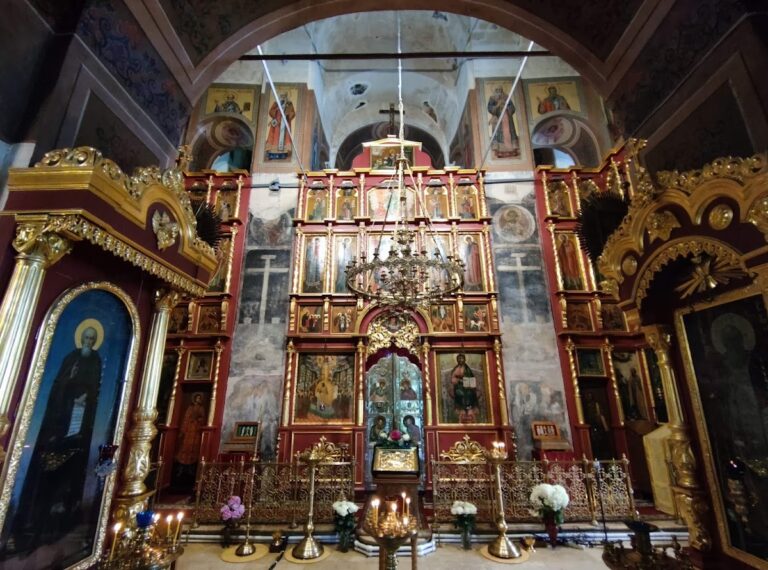
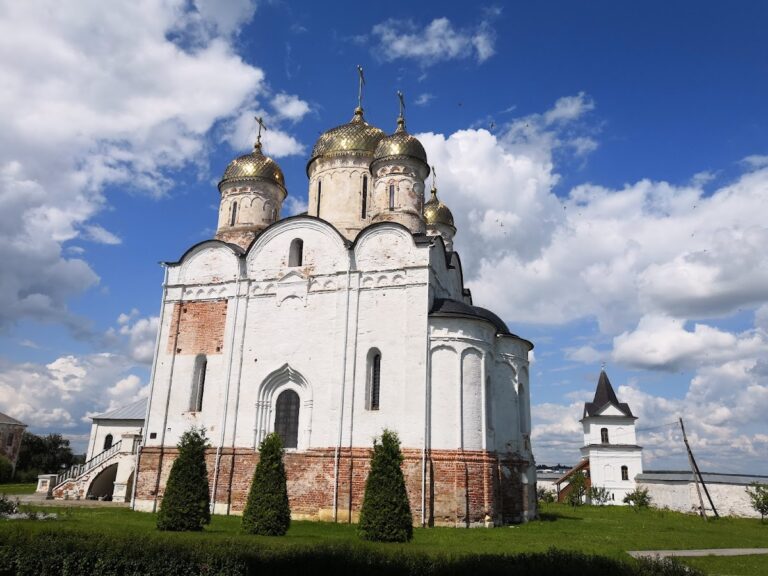
A wooden church was erected when the monastery was founded. In 1486, it was replaced by a stone Assumption Cathedral whose walls were frescoed by the icon painter Dionisius with the participation of his sons Theodosius and Vladimir. Those early frescoes are now lost or concealed beneath later repainting. The present cathedral was built in 1688–1696. Its exterior is decorated with colored tiles, including work associated with Stepan Polubes, and its interior contains a carved iconostasis. The cathedral reopened for worship in 1990.
Octagonal bell tower
An enormous octagonal bell tower rose in nine tiers during the 1490s. It was described as the tallest structure in Russia at the time, and its design anticipated the Ivan the Great Bell Tower in the Moscow Kremlin. The lowest tier contained the Church of the Smolensk Hodegetria, built in 1495. The bell tower was destroyed during the Second World War.
Refectory and gate churches
Refectory and Epiphany Church
The Refectory with the Church of the Epiphany dates from 1504 and is described as the oldest building in the complex. The Epiphany Church was added to the refectory in 1682 in a design similar to that of the gate church. Both the church and the Assumption Cathedral were reopened in 1990.
Church of the Protection of the Mother of God
The Church of the Protection of the Mother of God dates from 1510. It was destroyed in 1941, and its lower walls remain within the monastery complex.
Church of the Holy Apostles Peter and Paul
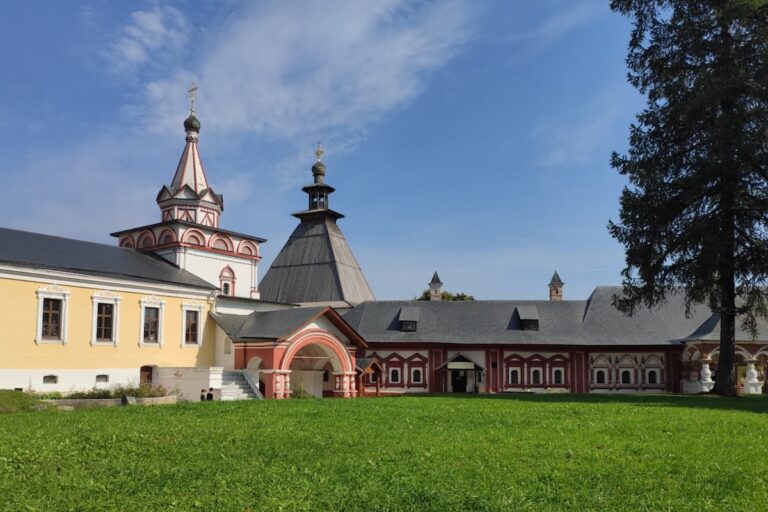
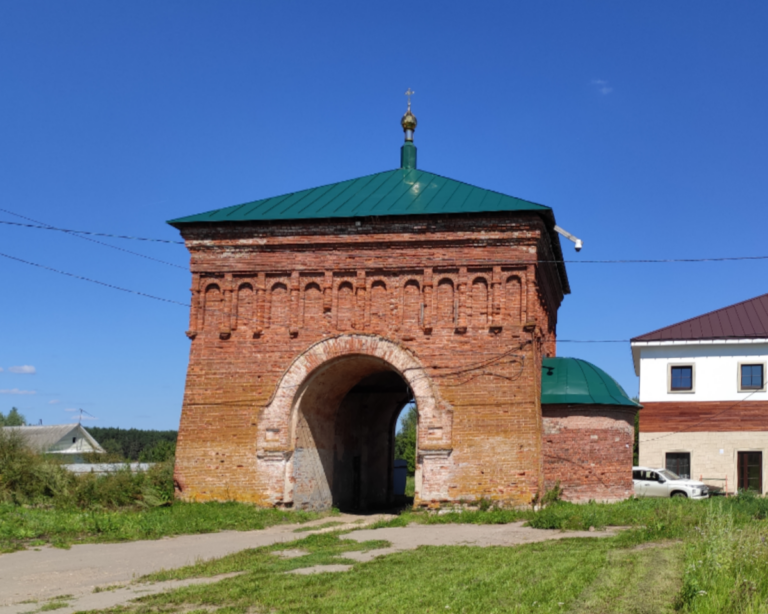
The Church of the Holy Apostles Peter and Paul was built above the main gate in 1679. Its gilded dome forms part of the surviving entrance group, and the church reopened for worship in 1989.
Enclosure and later buildings
The monastery was extensively rebuilt in the late seventeenth century in the Naryshkin Baroque style, a richly decorated Russian style using vivid color, elaborate façades, towers, and ornate church exteriors. A new stone enceinte, or enclosing defensive wall, was completed by 1688 and incorporated multiple towers. These walls and towers organize the principal monastic enclosure around its churches and associated buildings.
A skete with the Church of All Saints was built in 1856–1860. The complex also includes three internal ponds supplied with fresh water. On 14 June 2009, a bronze full-length statue of Joseph Volotsky by Sergei Isakov was installed south of the monastery. The statue is three meters high and stands on a two-meter stone pedestal.
Icons and surviving religious objects
The Volokolamsk Icon of the Mother of God is a copy with important iconographic differences from the twelfth-century Byzantine Vladimir Icon of the Mother of God. A version dated to 1572 is attributed to Moscow production and to a commission by Malyuta Skuratov for a gate church that had not yet been built. That icon is now in the collection and permanent exhibition of the Andrei Rublev Museum of Ancient Russian Culture and Art. A separate copy made in 2007 remains in the Assumption Cathedral, where it is venerated as wonderworking.
Nearby sites