Basilica of Santa Maria degli Angeli: A Fifteenth-Century Franciscan Church in Italy


Site at a Glance
- Rating
- 4.6
- Popularity
- Low
- Country
- Italy
- Primary era
- Medieval
- External website
- Open
- Eras represented
- Medieval, Early Modern
- Civilizations
- Venetian
- Site type
- Religious
- Remains
- Basilica
On this page13 sections
History
The Basilica of Santa Maria degli Angeli is a Roman Catholic church in Gardone Val Trompia, Italy, built in the fifteenth century in connection with a Franciscan convent. Dedicated to the Madonna degli Angeli, it belongs to the Diocese of Brescia and developed from a religious foundation associated with Saint Bernardino of Siena.
Foundation and Franciscan beginnings
Tradition holds that Saint Bernardino promoted the church and convent after reaching Gardone in 1442 during his itinerant preaching. As a Franciscan preacher who encouraged religious reform and renewed devotion, he helped inspire the foundation. The nobles Giacomo and Bernardino Avogadro donated land near the settlement through a notarial deed dated 20 April 1442.
The building campaign took place gradually. A document from 1469 records that Pope Paul II authorized the Friars Minor, the Franciscan order founded by Saint Francis of Assisi, to enter a convent whose construction had only recently begun. A 1496 credit note identifies Bernardino da Martinengo as the builder of the church. The original chapel therefore belongs to the period between the land donation and that later payment, and was dedicated to Bernardino of Siena before the larger monastic complex developed around it.
The convent in the sixteenth century
A visitation by Saint Charles Borromeo in 1580 described a church supported entirely by donations from the faithful. It contained six altars and several funerary monuments, while five religious lived in the convent, including three priests and two lay brothers. The monastery had two cloisters. The older chapel in front of the basilica was then reserved for the feast of its patron saint.
Suppression, military use, and recovery
The fall of the Republic of Venice in 1797 was followed by the suppression of religious orders. Jacobin revolutionaries expelled the friars on 6 August 1798 and sacked the convent. The community returned on 2 August 1799 after appealing to the authorities, but a final expulsion took place in July 1803.
After the abandonment, the state confiscated and sold objects that had remained in the church. The former convent became a barracks until 1810, when a group of devotees obtained its removal from military use and began recovering the church. In 1837 a new organ was installed, and the work destroyed the frescoes on the right side of the apse. The municipality sought the return of the Franciscans and a complete restoration in 1842, although only essential maintenance followed.
The Franciscans left permanently at the end of the nineteenth century. The municipality later sold the convent buildings to private owners while keeping the church. Around the same period, two sides of the smaller cloister were demolished to create a road passage. During the First World War, the former monastic complex served as a military depot.
Restoration and later changes
A complete restoration in 1920, undertaken through private initiative, recovered surviving frescoes, including work by Vittorio Trainini, and the church was reopened for use. Further structural work followed in the second half of the twentieth century. In 1947 Mario Pescatori consolidated the frescoes in the third chapel, a process that also destroyed some decorations.
In 1972 several furnishings and reliquaries were transferred to the parish church of San Marco Evangelista. The barrel vault over the main nave and several secondary rooms added during the barracks period were removed. In 2013 the parish organized celebrations in Gardone Val Trompia for the five-hundredth anniversary of the basilica’s construction.
Remains
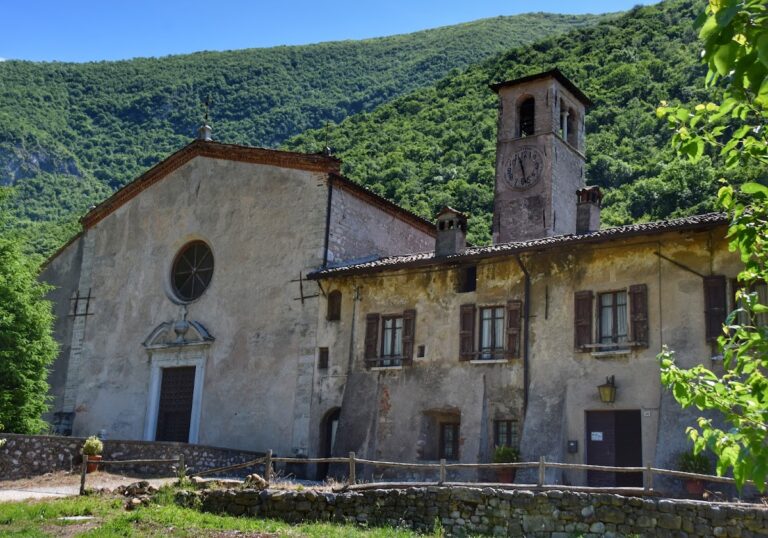
Facade and entrance portico
The basilica retains a fifteenth-century Romanesque design. Its original facade is sheltered by a later spacious portico with a roof of wood and tiles. Beneath the portico, frescoes show Saint Clare, Saint Bonaventure, Saint Louis of Toulouse, and Saint Catherine, arranged as two figures on each side of the central entrance. A lower painted register contains a fragment with five Franciscans, probably removed from the apse of the earlier chapel.
The entrance has a portal made of dark stone. Above it, a lunette bears Bernardino of Siena’s monogram together with an image of Saint Anthony of Padua. Fragments of the original chapel’s apse survive beside the basilica and retain frescoes from that earlier phase.
Interior chapels and painted decoration
Apse and presbytery
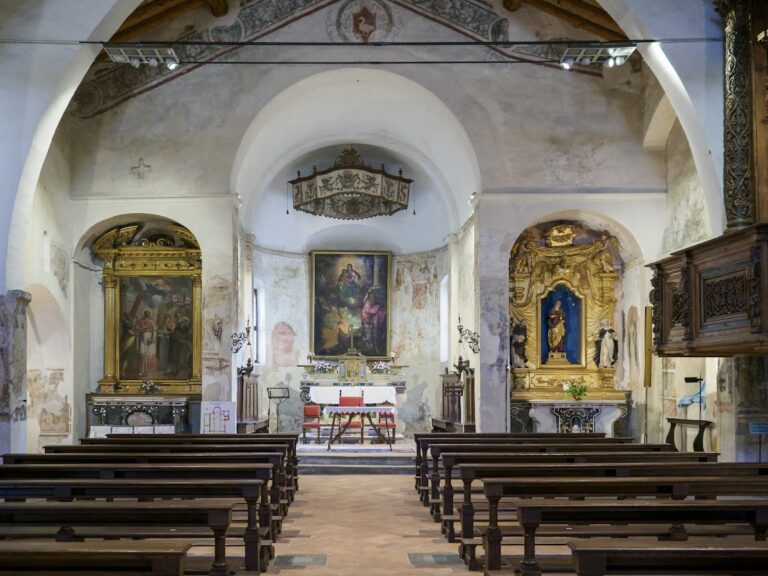
The church has a single nave. In the apse, a central lunette dated 1502 represents the Madonna and Child with three pairs of angels. A painted sail above the Virgin shows God the Father, while images of Bonaventure and Louis of Toulouse appear beside her. An Ecce Homo is attributed to Paolo Caylina the Younger. At the junction of the presbytery and nave, a Sacra conversazione, a devotional image of the Virgin and Child with saints in one setting, dates from 1506 and includes Saints Lawrence and Francis of Assisi.
Side chapels
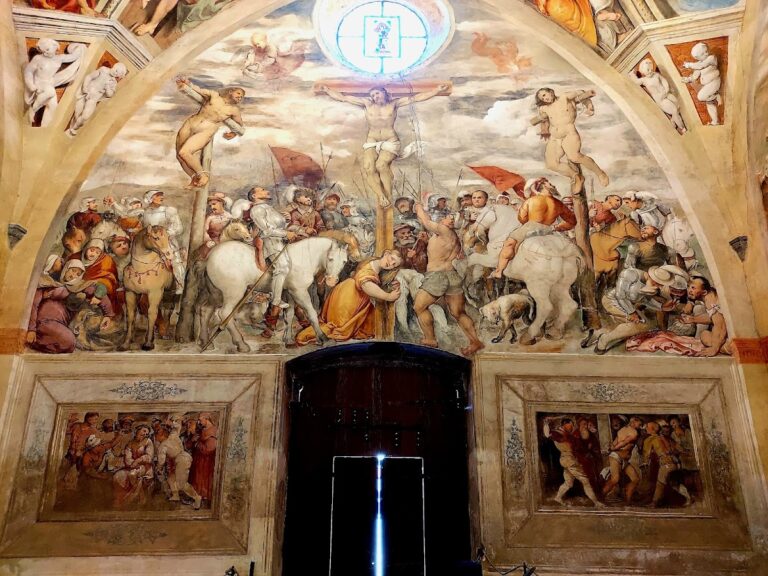
Three polygonal chapels open from the left wall, each covered by an umbrella vault. The first chapel from the entrance contains a Stigmatization of Saint Francis. The second contains a Nativity dated 1514 and a Flagellation. The third holds a triptych depicting Saints Anthony the Abbot and Anthony of Padua. In the chapel dedicated to the crucifix, a large sixteenth-century crucifix was installed after the 1972 restoration.
Altarpieces and dispersed works
Before the Napoleonic spoliation, the basilica held two important works by Moretto, the Assumption Polyptych and a large altarpiece of the Madonna and Child in Glory with Saints, both made around 1530 to 1540. A polyptych is an altarpiece formed from several connected panels. The Assumption Polyptych is now divided among different collections: its two lower panels are in the Louvre, while the central panel showing the Assumption with Saints Jerome, Mark, Catherine of Alexandria, and Clare is in the Pinacoteca di Brera. The original wooden frame remains in the basilica and now holds photographic reproductions.
A second polyptych, showing episodes from the lives of Jesus and Saint Peter and possibly also painted by Paolo Caylina the Younger, is partly held by the Pinacoteca Tosio Martinengo in Brescia. Works still in the church include the counter-facade altarpiece, a Madonna and Child with Saints from the Gandinian school, and a Crucifixion by Bernardo Podavini dated 1774.
Organ
A pipe organ built in 1985 by the Crema firm Inzoli-Bonizzi stands on the apse floor. It has electric action, two keyboards of 61 notes each, and a concave-radial pedalboard with 32 notes. Its facade consists of principal pipes arranged in one central cusp, with their mouths aligned horizontally.
Surviving cloister and convent complex
The larger cloister is the surviving intact cloister of the monastery. Its lower level rests on successive octagonal terracotta pillars set on a continuous base. Above, a loggia has square pillars supporting lowered arches. The adjoining conventual buildings are privately owned, while the basilica remains under municipal ownership.