Monasterio de San Pedro el Real: A Franciscan Convent and Parish Church in Córdoba
Site at a Glance
- Rating
- 4.6
- Popularity
- High
- Country
- Spain
- Primary era
- Early Modern
- Eras represented
- Medieval, Early Modern
- Civilizations
- Crown of Castile, Spanish
- Site type
- Religious
- Remains
- Church
On this page17 sections
History
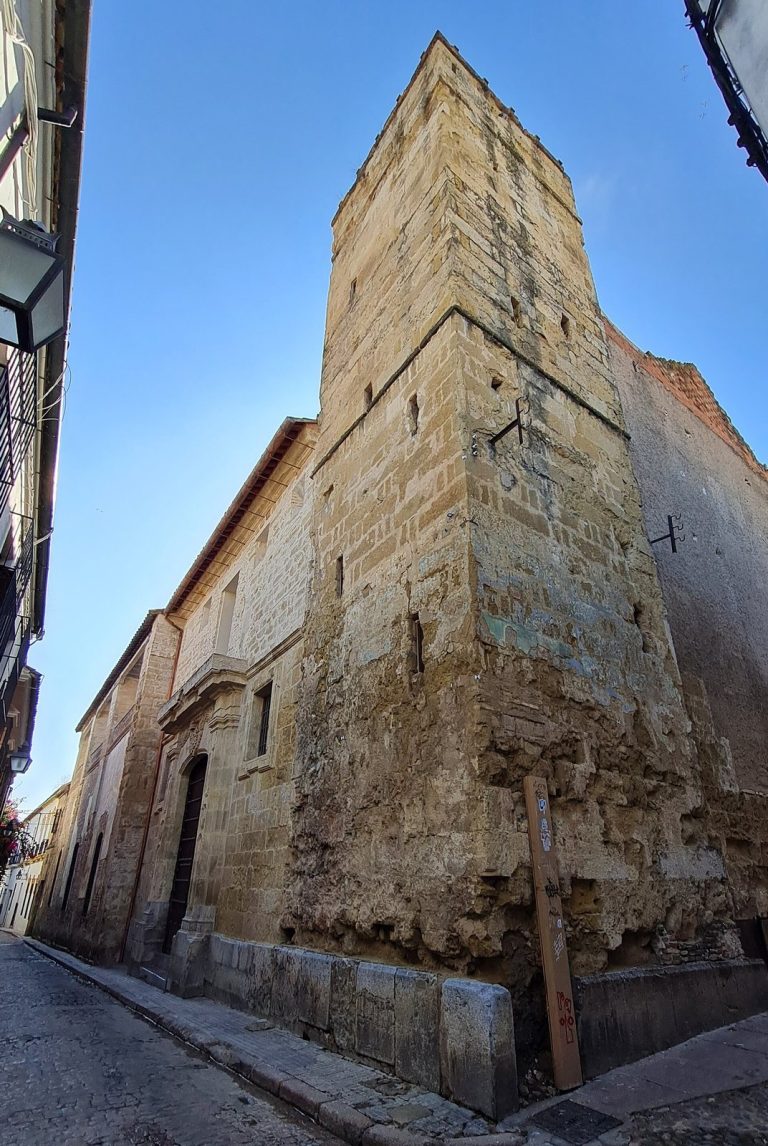
Monasterio de San Pedro el Real is a former Franciscan convent in Córdoba, Spain, founded in the thirteenth century by Ferdinand III of Castile. Its church, substantially altered in the eighteenth century, now serves as the parish church of Saint Francis and Saint Eulogius, a ninth-century Cordoban Christian cleric and martyr. It is one of Córdoba’s Fernandine churches, a group associated with Ferdinand III’s conquest and church foundations in the city, and belongs to the Catholic Diocese of Córdoba.
Foundation and Franciscan convent
The foundation followed the capture of Córdoba by Christian forces on 29 June 1236, the feast of Saints Peter and Paul. Ferdinand established San Pedro as a Franciscan convent, belonging to the Catholic order founded by Saint Francis of Assisi, and San Pablo as a Dominican convent, belonging to the distinct order founded by Saint Dominic of Guzmán. San Pedro’s dedication later gave way to the church’s present dedication to Saint Francis and Saint Eulogius.
Baroque renewal and nineteenth-century changes
An extensive renovation in the eighteenth century transformed the church’s medieval appearance into a Baroque one. The convent acquired an important collection of paintings by artists from Córdoba, and its resident community grew to more than a hundred friars, its largest during the century.
Franciscan management ended during the nineteenth-century disentailment, Spain’s state-led seizure and sale of church and other corporate property. The complex was then used as a cloth and chair factory. Part of the cloister was demolished, and its materials were reused in the Gran Capitán café; marble from its staircase went to a manor house in Écija.
Parish church and modern restoration
In 1877 the church became the parish church of Saint Francis and Saint Eulogius, replacing the parish of the then-vanished church of San Nicolás de la Axerquía and inheriting its property. The Brotherhood of Charity, refounded in 1939, holds its procession on Holy Thursday. The church is also associated with the Brotherhood of the Prayer in the Garden and a branch brotherhood of Our Lady of Cabeza, established here in 1989 after previously being based at the Church of La Compañía.
The surviving cloister was made into a public square by Córdoba’s municipal government in 1982. Restoration of the former convent complex followed two phases: work began under a plan drawn up in April 1990, stopped in 1997, and resumed from November 2003 to December 2007. On 24 March 1982, the church was declared an Asset of Cultural Interest, Spain’s official heritage-protection status for significant historic properties.
Remains
Façade
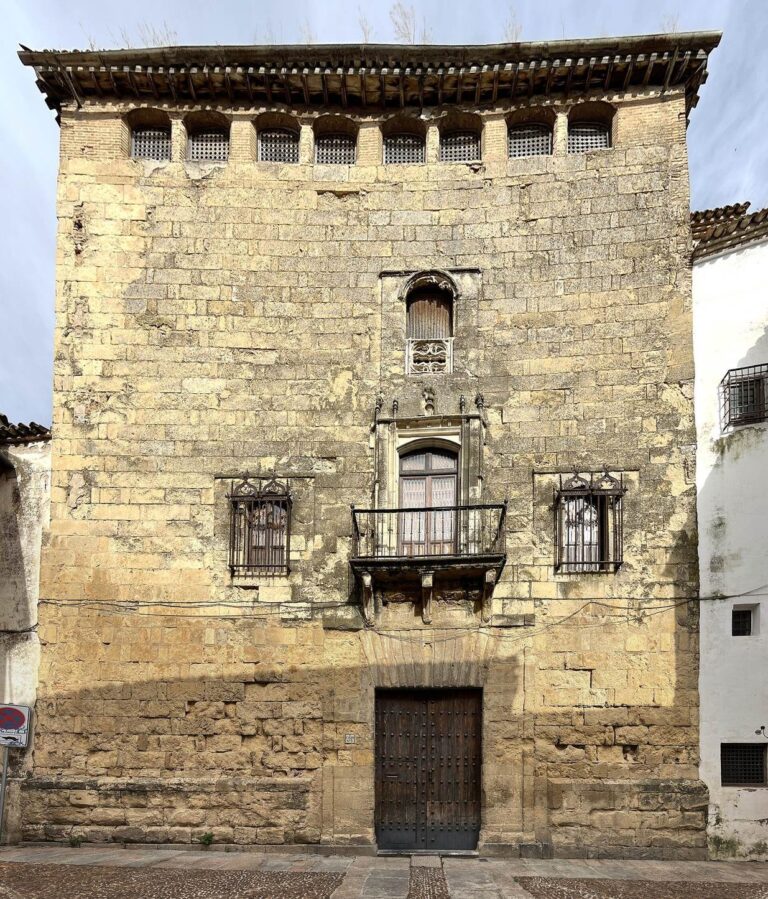
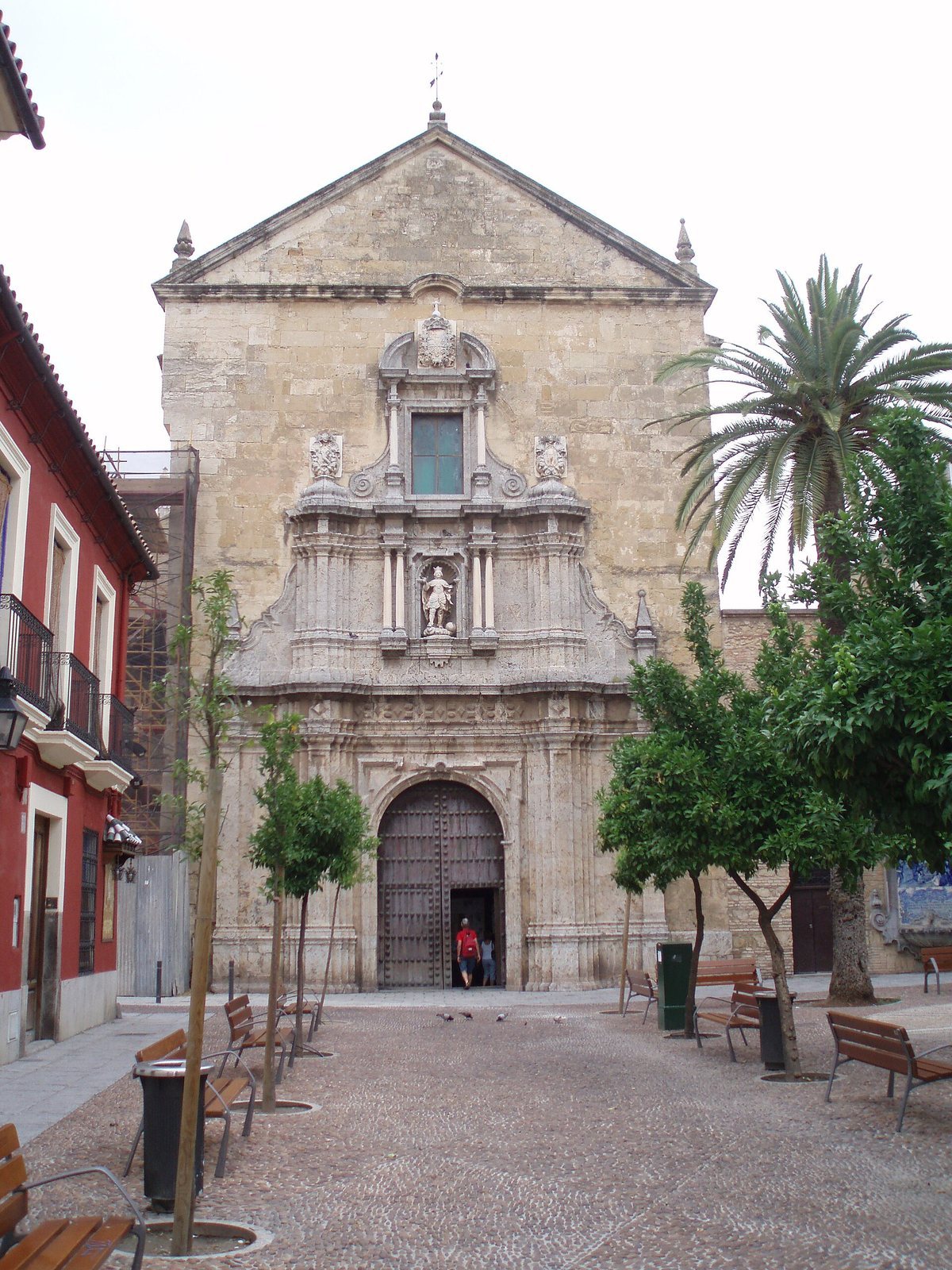
The main façade, made of gray marble in 1731, is arranged in three levels. The entrance occupies the lowest; above it, a niche holds a crowned statue of Ferdinand III with a scepter and a globe. The upper level contains a lintelled window between columns. The statue is Córdoba’s only public sculpture of Ferdinand III.
Nave and vaults
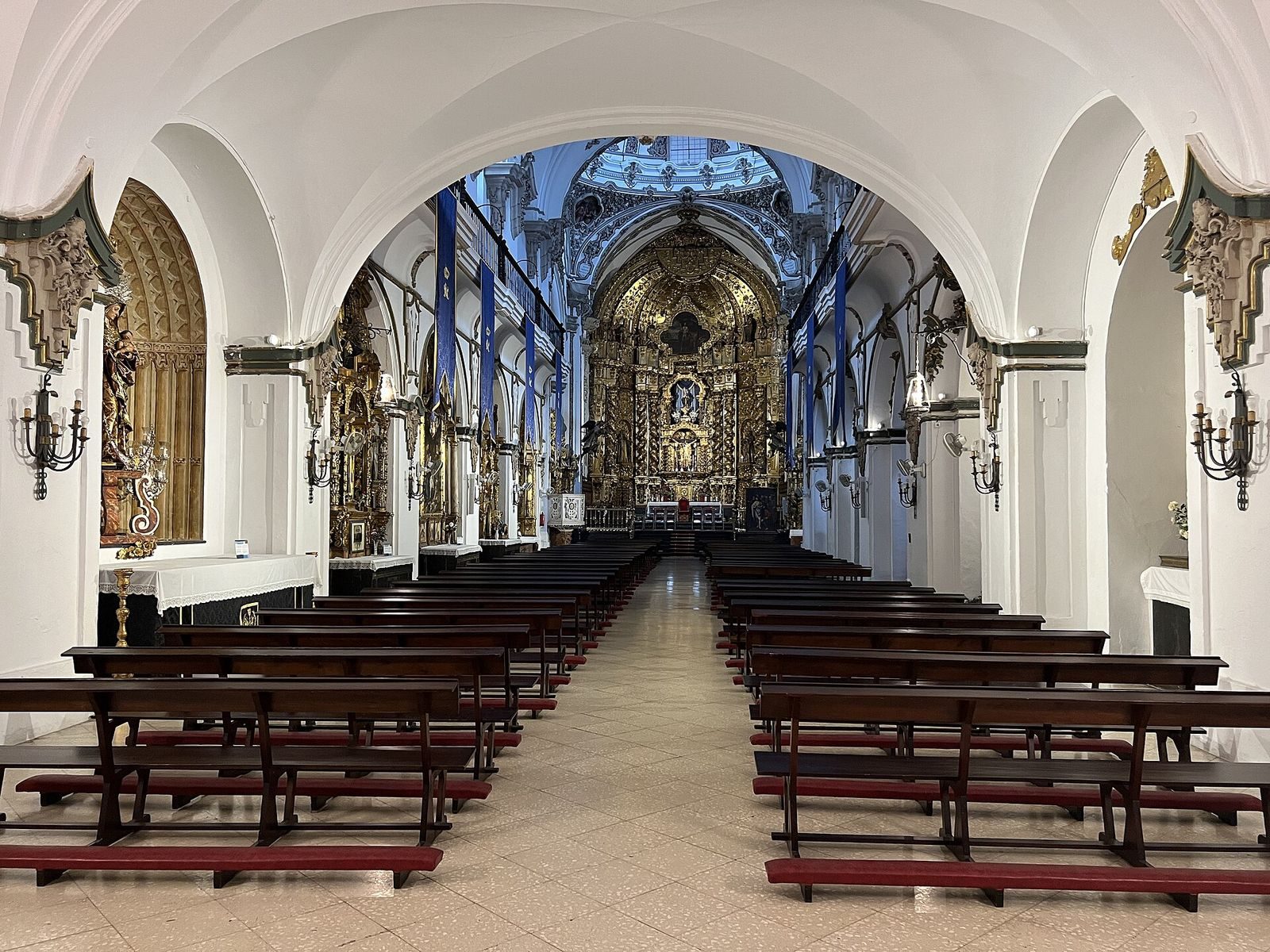
The church has a single nave crossed by a transept, the crosswise arm of the building, and a sanctuary ending in three rounded recesses. An oval vault rests on pendentives, curved triangular supports that carry a vault above a square or polygonal space. The Baroque false dome, a structure shaped like a dome without forming a full load-bearing dome, has a wooden frame and exterior stucco decoration. Woodworm had badly damaged the frame, and restoration work also treated the stucco.
Main altarpiece
The concave main altarpiece, the ornamental structure behind the altar, was made by Teodosio Sánchez de Rueda in 1720. In the central bay of its lower tier is a painting by Alonso Gómez de Sarabia of the Virgin Mary under the title Our Lady of the Aurora, with an anonymous crucifix above. Statues of Saint Francis of Assisi on the right and Saint Dominic of Guzmán on the left flank the central section. The upper tier contains a painting of Ferdinand III, with Saint Peter, represented as the first pope, on the left and Saint Paul on the right, holding a book and the sword associated with his martyrdom.
Chapels
Gospel-side altars
The Gospel side, named for the Gospel readings, has altars dedicated to the Holy Martyrs, the Nativity, Ecce Homo, and Saint Joseph. The Holy Martyrs altar includes a statue of Saint Rita of Cascia, an Italian Augustinian nun. The Nativity altar has a painting by José de Sarabia. The Ecce Homo altar, showing Christ presented before his crucifixion, has a statue attributed to Luisa Roldán, known as La Roldana. The Saint Joseph altar honours the biblical husband of Mary and foster father of Jesus.
Tabernacle chapel
The Tabernacle chapel contains an anonymous eighteenth-century Charity altarpiece with the sixteenth-century image known as the Lord of Charity. That image was the titular figure of the Brotherhood of the Hospital of Charity, which was associated with nearby Plaza del Potro.
Chapels at the foot of the Epistle side
The Epistle side, named for readings from the Epistles, includes the Baptism chapel and the chapel of Saint Raphael. Its altar statue of the archangel was made in 1795 by Manuel Gómez, son of Alonso Gómez de Sarabia. The chapel of the Venerable Third Order is associated with a Franciscan religious community for lay people who follow Franciscan spirituality without becoming friars or nuns. Its altarpiece shows Saint Peter of Alcántara, a Spanish Franciscan reformer, with Saint Nicholas, Saint Benvenuto, Saint Eulogius, and Saint Ferdinand.
Prayer in the Garden chapel
This chapel contains the titular images of the Brotherhood of the Prayer in the Garden. Its statues include Jesus praying in the Garden, brought from San Nicolás de la Axerquía; Christ Bound to the Column, dated 1662; Our Lady of Candelaria, made by Antonio Rubio in 1974; and Our Lady of Protection, dated 2006.
Virgin of Fatima chapel
The chapel named for Our Lady of Fatima, associated with apparitions reported at Fatima, Portugal, in 1917, contains the image of the Virgin Mary known as Our Lady of Cabeza. Its altarpiece also features Saint Anthony of Padua, a Franciscan preacher, with the Christ Child, and Saint John of Nepomuk, a Bohemian priest and martyr.
Our Lady of the Pillar chapel
A separate chapel dedicated to Our Lady of the Pillar stands at the foot of the nave.
Cloister and forecourt
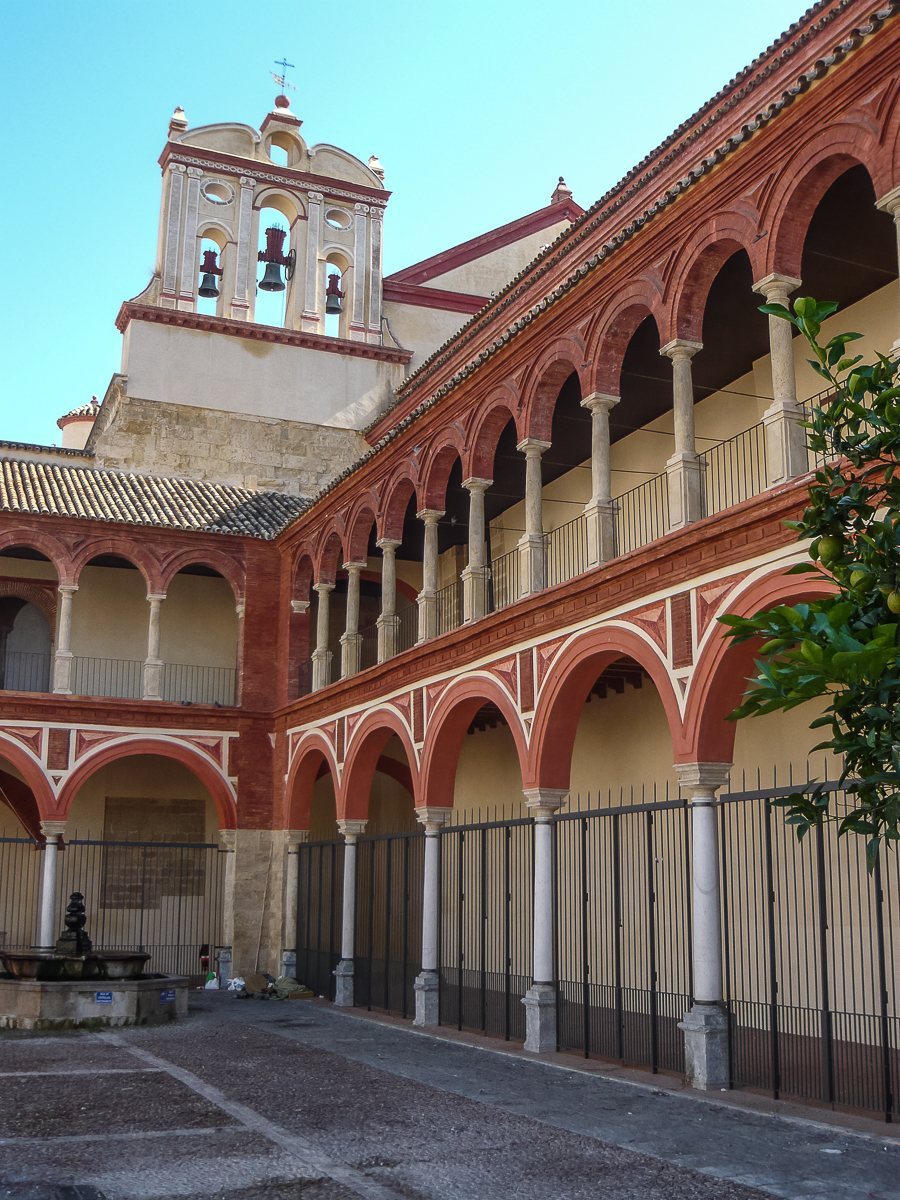
Dating to 1683, the cloister had two storeys of arcades, with two arches above each lower arch. Its semicircular arches rest on columns with Tuscan capitals, the shaped tops of the columns. A forecourt lies before the church. Two cloister galleries survive and have been restored for public use; the surviving portion forms the public square known as Plaza de la Tierra Andaluza.
Archive
The church archive preserves documents from San Nicolás de la Axerquía, the vanished church formerly situated opposite the Guadalquivir River.