Slanci Monastery: A Serbian Orthodox Monastery near Belgrade


Site at a Glance
- Rating
- 4.9
- Popularity
- Low
- Country
- Serbia
- Primary era
- Modern
- Eras represented
- Medieval, Modern
- Civilizations
- Unclassified
- Site type
- Religious
- Remains
- Monastery
On this page7 sections
History
Slanci Monastery is a Serbian Orthodox monastery in Serbia, beside the settlement of Slanci east of Belgrade. Dedicated to Saint Stephen the Archdeacon, a senior deacon in Eastern Orthodox church hierarchies, it belongs to the Archdiocese of Belgrade-Karlovci of the Serbian Orthodox Church. Its origins are associated with the later medieval Serbian state, although traditions place its foundation either with Saint Sava in the early thirteenth century or with King Dragutin at the end of that century. The monastery first appears in Ottoman records in 1560.
The medieval monastery
Slanci flourished especially during the Serbian Despotate, the medieval Serbian state that survived after the decline of the Serbian Empire. Under Despots Stefan Lazarević and Đurađ Branković, its position near Belgrade became more important as the city developed as the new capital. The Branković despot family supported the monastery and changed its former patronal feast, the Presentation of the Virgin, to the feast of Saint Stephen the Archdeacon, the family’s patronal saint. It then became popularly known as the “Great Monastery.”
Destruction and repeated rebuilding
After the fall of the Serbian Despotate in 1459, the monastery was looted and destroyed, and its monks were killed by Ottoman forces. Further destruction followed under Ottoman rule in 1690, 1739, and 1787. Monastic communities repeatedly returned, and the complex was rebuilt several times despite these attacks.
From the nineteenth century to the present
Restoration began during the First Serbian Uprising. After Prince Miloš came to power, however, the monastery was judged too dilapidated and fragile to preserve, and it was demolished in 1833. Its building material was reused in churches at the nearby villages of Mirijevo and Veliko Selo. Local residents then enclosed the former sacred site and sheltered the location of the altar. A chapel was built there in 1900 and became a place of worship for the surrounding population.
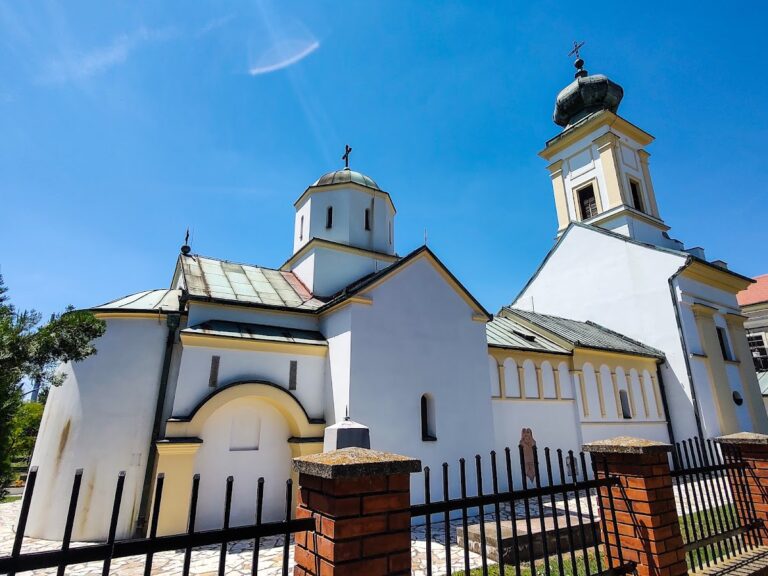
Renewed reconstruction began in 1961 under Serbian Patriarch German Đorić, the twentieth-century head of the Serbian Orthodox Church. Modern rebuilding continued from 1961 to 1971. The chapel was reconstructed in 1969, and construction of the monastery church was completed in 1971, following plans associated with the architect Dragan Tadić. Work on the monastic quarters and estate continued afterward and remains unfinished. Slanci is now a male monastery whose brotherhood prepares monks for Hilandar Monastery, a major Serbian Orthodox foundation on Mount Athos in northern Greece. The site is protected as an archaeological site and as cultural property of the city of Belgrade.
Remains
The rebuilt monastery complex
The present monastery church belongs to the rebuilding campaign begun in 1961 and was completed in 1971. The associated chapel, first erected in 1900, was reconstructed in 1969. Together, these buildings occupy the former monastic site beside Slanci within Belgrade’s Palilula municipality. The monastic quarters and estate were still unfinished after the main rebuilding period.
Archaeological remains and transferred objects
The grounds preserve archaeological remains and other material traces connected with the monastery’s past. After the 1833 demolition, the former sacred area was enclosed by a fence and the altar location was protected by a shelter. Three icons from an unfinished 1812 iconostasis, the screen of icons separating the sanctuary from the main worship space in an Eastern Orthodox church, were transferred to the church at Veliko Selo. Building material from the demolished complex was also reused in churches at Mirijevo and Veliko Selo.