Modlin Fortress: A Strategic Fortress in Poland


Site at a Glance
- Rating
- 4.5
- Popularity
- High
- Country
- Poland
- Primary era
- Modern
- External website
- Open
- Eras represented
- Modern
- Civilizations
- French, Russian
- Site type
- Military
- Remains
- Fort
On this page17 sections
History
Modlin Fortress is a military stronghold in Nowy Dwór Mazowiecki, Poland, built initially by the French under Napoleon Bonaparte in the early nineteenth century. Standing at the confluence of the Vistula, Narew, and Wkra rivers, about 30 kilometers northwest of Warsaw, it controlled important roads, waterways, and river crossings.
Early Fortifications and the Napoleonic Foundation
The surrounding region had been fortified during the early medieval period under the Piast dynasty, the ruling house that established and governed the early Polish state. In the eleventh century, a fortified stronghold was established at nearby Zakroczym. A later Russian plan for a fortress in the area also used the name Zakroczym, although construction did not begin.
Military activity at the present site increased during the seventeenth century. In September 1655, Masovian Polish forces built a fortified camp there to resist the Swedish invasion. During the Battle of Nowy Dwór, Polish troops blocked a Swedish crossing for ten days before withdrawing under artillery fire. Swedish forces then established their own fortified camp, known as Bugskansen. It was demolished in 1660, and no remains survive.
During the Great Northern War, Saxon forces under Field Marshal Adam von Steinau carried out fortification works in the area. In 1794, the Russian general Petr Korniłowicz Suchtelen prepared plans for a fortress called Zakroczym, but the project never reached the construction stage.
Napoleon ordered the fortification of Modlin on 1 December 1806. Work began in early 1807 under French direction and continued during the Duchy of Warsaw, a French-aligned Polish state created by Napoleon in 1807. The fortress initially served as a supply base and granary, then developed into a major stronghold supporting French operations toward Russia.
The first design was prepared by the French engineer General François de Chasseloup-Laubat. The proposed location was moved from the islands to the northern bank of the river, and the first casemates and walls were ready by 1809. After the Battle of Raszyn, the core of the Polish Army was stationed at Modlin.
In 1810, Napoleon decided to make Modlin a principal fortress in his eastern defensive system. Chasseloup-Laubat was replaced by Jean Mallet de Granville, assisted by General François Haxo. More than 19,000 people were working on the fortress by September 1811, and the workforce exceeded 20,000 in 1812. The authorities of the Duchy of Warsaw considered granting the growing settlement a city charter, but the proposal was not implemented.
The fortress was never fully completed. Construction was largely interrupted in 1812 as Napoleon’s campaign against Russia approached, although urgent reinforcement resumed after the French defeat in Russia. Russian forces under Ivan Paskevich began a siege on 5 February 1813. The garrison included Polish, French, Saxon, and Württemberg troops and was first commanded by General Franciszek Ksawery Kossecki, followed by General Herman Willem Daendels. After prolonged resistance, heavy casualties, and the exhaustion of its ammunition, the fortress capitulated on 1 December 1813. It was the last French fortress along the Vistula to surrender.
Russian Expansion and Novogeorgievsk
After 1815, Modlin became part of Congress Poland, a Polish kingdom linked to the Russian Empire while retaining limited autonomy and its own army. Polish and Russian units occupied the fortress, but major construction remained limited until the November Uprising, the Polish insurrection against Russian rule that began in 1830 and ended in 1831.
During the Polish-Russian war of 1831, General Ignacy Ledóchowski prepared Modlin for defense. After Warsaw capitulated, approximately 32,500 Polish soldiers and 91 guns entered the fortress on 8 September. The army soon departed toward Plock, and Russian forces encircled Modlin on 25 September. The fortress capitulated on 9 October 1831, becoming one of the last Polish-held points of the uprising.
After the uprising, Russia tightened its control over Congress Poland and renamed Modlin Novogeorgievsk in 1834. Between 1832 and 1841, the fortress was extensively enlarged to defend Russia’s western frontier and help prevent further Polish uprisings. It formed part of a wider Russian defensive system that also included Warsaw, Ivangorod, and Brest-Litovsk.
Construction largely ceased after 1841, and the fortress gradually became obsolete. In the 1860s, General Eduard Totleben ordered further expansion, including a new fortified barracks circuit and additional ammunition magazines. A large fortified granary, designed by the Polish architect Jan Jakub Gay, was completed in 1844 at the Narew estuary. It combined food storage with a defensible position at the river bridgehead.
Modernization resumed in 1883 as worsening relations between Russia and Germany and the formation of the Triple Alliance increased the perceived threat to Russia’s western frontier. The Triple Alliance was the military partnership of Germany, Austria-Hungary, and Italy formed in 1882. Eight outer forts were built between 1883 and 1888, and Modlin was incorporated into the larger fortified region around Warsaw. The first modernization of these forts took place between 1894 and 1900.
First World War and the German Capture
Russia’s defeat in the Russo-Japanese War of 1904 to 1905 led military planners to reconsider the value of frontier fortresses. In 1909, a proposal to abolish most of the system included Novogeorgievsk, but it was rejected. Instead, the authorities approved a major modernization program, and work on a new outer belt began in 1912.
The pre-1915 modernization was intended to turn Modlin into a center of resistance deep behind enemy lines if Russian forces withdrew from Poland. The work remained incomplete and was affected by hurried construction, inadequate equipment, and improvised materials. Even so, the fortress’s nineteen forts made it one of Europe’s strongest fortifications at the beginning of the First World War.
German forces under General Hans Beseler besieged Novogeorgievsk from 9 to 20 August 1915. The main assault began on 13 August. German troops captured parts of the Carski Dar group, Fort XV, the forts in the Pomiechow sector, and finally the citadel. General Bobyr signed the capitulation on 20 August. The Germans seized approximately 1,600 guns and nearly one million shells.
The rapid defeat resulted from several connected weaknesses. The outer defenses were unfinished, Russian training and equipment were inadequate, and the command lacked resolve. German forces also brought considerable experience in attacking fortified positions, modern siege artillery, and detailed fortress plans. German troops used the buildings for storage, hospitals, and other military purposes until 1918.
Polish Service Between the Wars
After the First World War, Modlin became part of the Second Polish Republic and regained military importance. During the Polish-Soviet War of 1920, a conflict fought during the struggle around Warsaw, the fortress served as the principal defensive base of General Władysław Sikorski’s Fifth Army on the Wkra line. Soviet forces captured several forts before the Polish counteroffensive.
In the interwar period, Modlin was a major garrison, depot, training center, and experimental fortress range. It housed the Armored Forces Officer Cadet School, the Engineers Training Centre, and other army units. Experimental armored observation and machine-gun cupolas, combat shelters, and fortress weapons were tested there, while older defenses were maintained for possible future use.
The complex also included a naval port and river shipyard. On 24 March 1928, Marshal Józef Piłsudski ordered the transfer of the Officers’ Adjudicating Tribunal from Warsaw to Modlin. On 24 January 1930, he established the Modlin Reconstruction Commission under Colonel Bolesław Jatelnicki. Before the Second World War, Poland added six small combat shelters, anti-tank trenches, and field defenses. Some magazines were converted into air-raid shelters, and the planned defensive line followed the inner ring of forts.
Second World War and Later History
During the German invasion of Poland in 1939, Modlin initially housed the 8th Infantry Division and the headquarters of the Modlin Army. General Wiktor Thommée later brought units of the Łódź Army into the fortress and commanded the fortified camp. German forces reached Modlin on 10 September. After two weeks of siege, bombardment, and air attack, the garrison capitulated on 29 September, shortly after Warsaw surrendered.
During the German occupation, the fortress served military and detention purposes. Fort I contained a transit camp, while Fort III contained a concentration camp in which approximately 20,000 people died. Modlin was liberated on 18 January 1945.
After 1945, most of the citadel and forts remained occupied by the Polish Army. Some abandoned forts later deteriorated severely, and original armored components and other surviving equipment were increasingly stolen after 2000. Other works were leased for recreational use. The inner defensive circuit of the citadel and its defensive barracks were entered in the Mazovian regional heritage register under registration number 1062/69.
In 2013, ownership of a 58-hectare area of the fortress changed through a sale to the private company Grupa Konkret. Conservation requirements retained public access to selected parts of the citadel and barracks. In February 2022, after the outbreak of the war in Ukraine, the southwestern part of the barracks was repaired to accommodate refugees from Ukraine. The fortress also became a logistical center for collecting and sorting donated aid.
Remains
Modlin Fortress is organized around a citadel on the right bank of the Narew, the Kazuń and Nowy Dwór bridgeheads, an inner ring of eight forts, and an outer ring planned as eleven forts, of which ten exist. Seven intermediate works survive from a planned twelve. Magazines, warehouses, barracks, and remnants of the Polish field defenses from 1939 complete the fortified landscape. The works combine brick, earth, and concrete and reflect successive French, Russian, and Polish construction programs.
French Citadel and Bridgeheads
Main Defensive Line
The French-period fortress was built mainly from brick and earth according to contemporary French military engineering. Its principal defensive line formed a polygonal fortification with four bastions, projecting angular works designed to provide flanking fire along the walls, and three connecting ravelins. A ravelin is a detached triangular work placed in front of a fortress wall or entrance. The wider French system included the Kazuń bridgehead, a redoubt between the Vistula and Narew, and an artillery position on Swedish Island.
The early outer defenses consisted of a roughly semicircular earthwork strengthened by a wooden stockade and five bastions. Fortified bridgeheads protected the crossings at Kazuń on the left bank of the Vistula and near Nowy Dwór Mazowiecki. Three external crowns remained unfinished, while other works were placed on the Kazuń and Nowy Dwór bridgeheads and on Swedish Island. The ravelins stood approximately 800 to 1,000 meters from the main line, strengthening it against heavy artillery.
Defensive Barracks
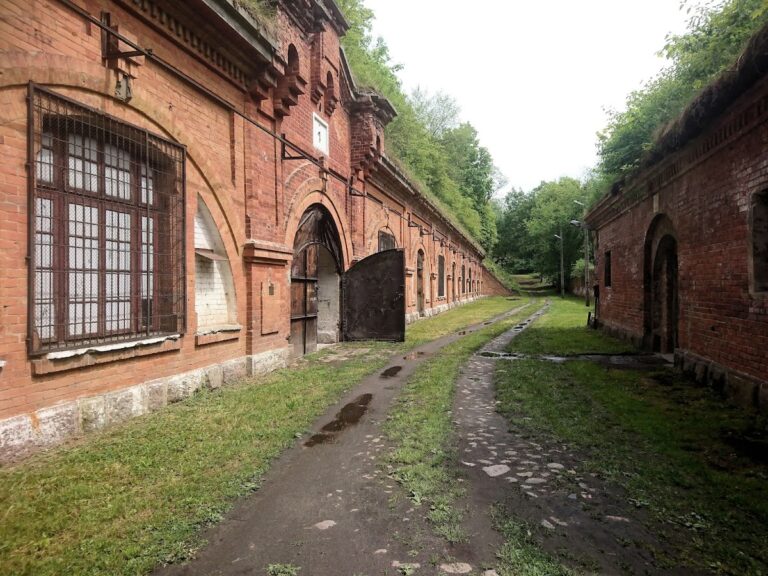
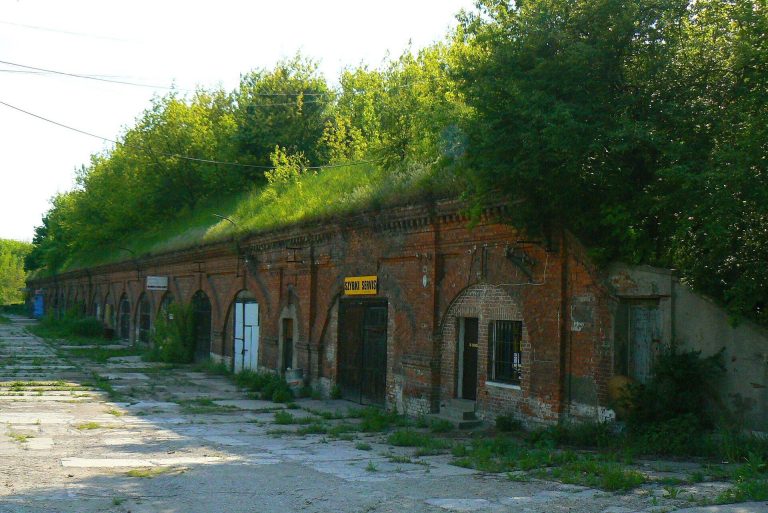
The citadel contains a defensive barracks circuit approximately 2,250 meters long, described as Europe’s longest building. Constructed after 1864 inside the earlier French bastion core, it was designed to house about 20,000 soldiers. The structure served as the fortress’s third defensive circuit and final line of resistance.
Gun embrasures and loopholes allowed artillery and infantry weapons to fire from the barracks. Caponiers, fortified positions projecting into the ditch for direct defense, stood at the angles, and four of them protected the circuit. A surrounding ditch completed the defensive arrangement.
Russian Inner Works and Granary
The nineteenth-century Russian expansion completed the previously abandoned crowns and linked them with a continuous polygonal fortification. The system incorporated ravelins and a Carnot wall, a defended wall intended to support fire from the ditch, as well as several powder magazines inside the citadel. Fort Ostrołęka was created by enlarging a hornwork on the eastern side of the fortress.
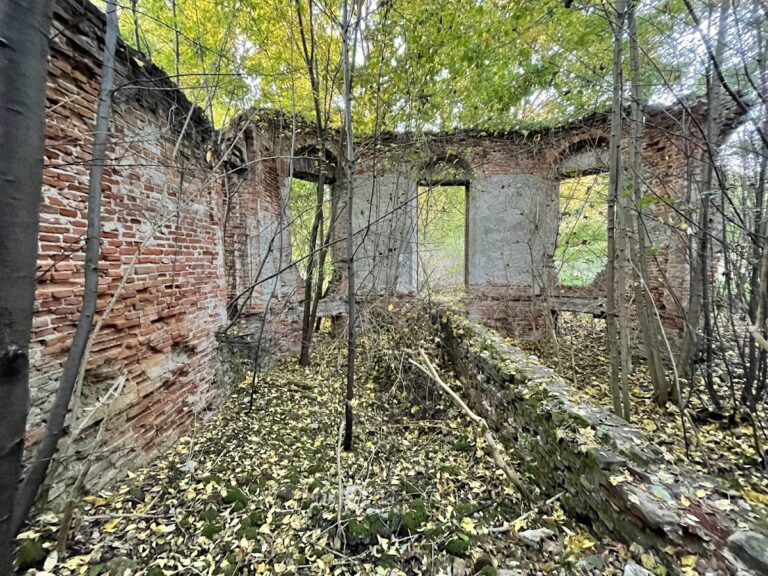
The fortified granary at the Narew estuary was completed in 1844. Designed by Jan Jakub Gay, it combined a storage building with a defensible position at the river bridgehead. The structure is now ruined. Other support facilities included powder-magazine complexes, warehouses, barracks, and service buildings.
Nineteenth-Century Outer Forts
First Outer Ring
Eight outer forts were built between 1883 and 1888 approximately 2 to 4 kilometers from the central fortress, with an additional Fort Nad Wisłą on the Nowy Dwór bridgehead. Their designs followed the Russian F1879 pattern. These were pentagonal forts with two ramparts, one for artillery and another for infantry.
The forts contained brick barracks, caponiers, and counterscarps. A counterscarp is the outer slope or retaining work on the far side of a ditch. Roads, a narrow-gauge railway, and communications lines connected the forts to the citadel. Between 1894 and 1900, the most important brick elements, especially counterscarps and caponiers, were replaced or reinforced with concrete.
Later Outer Belt
The outer ring begun in 1912 was planned to contain eleven forts, twelve intermediate works, numerous powder magazines, and three fort groups named Goławice, Carski Dar, and Janówek. The forts were intended to stand approximately 5.3 to 8.5 kilometers from the citadel. Older forts were retained either as a second defensive line or for accommodation and storage.
The later works followed the F1909, F1910, and GF1908/12 patterns. They were built from earth and concrete, with shallow reinforced concrete in particularly exposed positions, and generally had triangular or trapezoidal plans. Their armament and observation equipment remained incomplete when German forces attacked in 1915.
Siege Remains
Fort XV was captured by German infantry on 16 August 1915. Forts II and III and the citadel were shelled and captured during the final stage of the siege. The Carski Dar group consisted of mutually supporting works, one of which fell on 15 August after prolonged bombardment.
Several defensive structures, including Fort V, Fort XII, and Fort XIV, are abandoned and badly deteriorated. Metal armor and other original equipment have been removed from some works. Other parts of the complex have been adapted for public, cultural, hospitality, or museum use.
Interwar and Modern Military Features
Polish works from the interwar period include experimental armored cupolas for observation and machine guns, experimental combat shelters, and six small shelters designed for two heavy machine guns each. Anti-tank trenches, field earthworks, and air-raid shelters adapted from some powder magazines also survive as elements of the later defensive system.
The former military airfield within the fortress area is now known as Warsaw-Modlin Airport. It reopened for civilian passenger traffic in July 2012. The airfield forms part of the modern landscape associated with the former military complex.
Surviving Public and Cultural Buildings
Publicly accessible facilities include part of the defensive barracks, the western tower known as the Tatar or Red Tower, the barracks courtyard, and the Water Tower. Powder Magazine 197 houses the Modlin Fortress Museum. The former laundry contains the Royal Hotel and Stara Pralnia restaurant, while the former officers’ barracks contain the Museum of the September Campaign and Modlin Fortress.
The Prince of Warsaw Front includes accessible counter-mine passages and defensive structures. The Officers’ Casino and selected areas of Fort III at Pomiechówek are also used for organized cultural and interpretive activities.