Château de Beauregard, Loire Valley: A Renaissance Château and Portrait Gallery


Site at a Glance
- Rating
- 4.1
- Popularity
- Medium
- Country
- France
- Primary era
- Early Modern
- External website
- Open
- Eras represented
- Early Modern, Modern
- Civilizations
- French
- Site type
- Domestic
- Remains
- Castle
On this page15 sections
History
Château de Beauregard is a Renaissance château in France, at Cellettes in the Loire Valley, whose original manor was built by the Doulcet family at the end of the fifteenth century. It became a seigneurial domain, a royal possession, and later a centre of Renaissance architecture, garden design, and political portraiture about 10 kilometres south of Blois, on the edge of the Russy Forest.
From Doulcet manor to royal estate
A chapel older than the fifteenth century once stood in the park. Ruins of the chapel retain a stone scallop shell associated with pilgrims travelling to Santiago de Compostela, together with the Crusaders’ motto “God wills it.” The original manor was established by the Doulcet family. Jean Doulcet served as master of the financial chamber of Charles, Duke of Orléans, and in 1495 Louis of Orléans, the future Louis XII, made Beauregard a seigneurial domain. The same edict authorized the construction of a dovecote.
Jean Doulcet’s son François held a financial office under Louis XII but was dismissed for defrauding the Crown during the Italian campaigns. Beauregard was then confiscated and incorporated into the royal domain. In 1521, Francis I gave the estate to his uncle René of Savoy. The king had used Beauregard as a hunting rendezvous. René died at the Battle of Pavia in 1525, after which the estate passed to his widow.
Jean Duthier and the Renaissance château
Jean Duthier acquired Beauregard in 1545 for 2,000 gold crowns. He was Secretary of State for Finance under Henry II, a humanist, and a patron of the poets Joachim du Bellay and Pierre de Ronsard. Duthier became the principal builder of the Renaissance château, incorporating the old manor into a new complex and commissioning its central gallery. The architect is unknown.
From 1553, Duthier employed foreign artists working for Henry II to decorate the interiors. He also created a formally ordered Renaissance garden and gathered rare plants. In 1551, Henry II gave him 1,500 trees from the royal forests, including oaks, elms, beeches, holly trees, and hazels. The château and park were later described and illustrated by Androuet du Cerceau in the second volume of Des plus excellents bâtiments de France, published in 1579.
Royal administrators and the seventeenth-century expansion
Florimond Robertet took possession of Beauregard in 1566. After Duthier’s death in 1559, Catherine de’ Medici had appointed Robertet Secretary of State for Finance. Robertet made no recorded alterations to Beauregard while concentrating on his own château at Bury.
The Robertet heirs sold the estate to Paul Ardier in 1617. Ardier had served Henry III, Henry IV, and Louis XIII for 55 years before retiring. His offices included Controller-General of War and Grand Treasurer of the Royal Treasury. At the age of 72, he undertook a major enlargement of Beauregard. He demolished the old residential wing, replaced it with two modern symmetrical wings around the central gallery, and gave the outbuildings their present form.
Ardier’s principal achievement was the Gallery of Portraits, also called the Gallery of the Illustrious. His son Paul II Ardier and his granddaughter’s husband, Gaspard de Fieubet, continued the project over three generations and about 60 years. Louis XIV made Beauregard a viscounty in Gaspard de Fieubet’s favour in 1654. The estate later passed to Paul de Fieubet, a magistrate and member of the Council in 1715.
Later owners and conservation
Beauregard left the Fieubet family in 1816, when it was sold to the Viscount of Préval. The Countess of Sainte-Aldegonde, born Adélaide-Joséphine de Bourlon de Chavagne and widow of the Duke of Castiglione, later became its owner. On 8 October 1839, her daughter Marie-Valentine Joséphine, born in 1820, married Alexandre-Edmond de Talleyrand-Périgord, Duke of Dino, at the château.
Jules, Count of Cholet, acquired Beauregard in 1850 and entrusted its restoration to Jules de la Morandière. The château remained in the Cholet family for 62 years. In 1912, Louis Thillier began a major programme of modernization and restoration. Since 1925, the estate has belonged to the Gosselin family and its descendants, the Du Cheyron du Pavillon family, who have continued work on the château and the portrait gallery.
Beauregard was classified as a historic monument in 1840. The park entered the supplementary inventory of historic monuments in 1992, and the château was listed in 1993. The portrait paintings underwent comprehensive restoration between the 1980s and 2020. In 2020, work began to reconstruct the biographies of the 327 figures represented in the gallery from a seventeenth-century compilation, alongside a digitization project.
The Gallery of the Illustrious as political history
The Gallery of the Illustrious presents French and European political history through 327 portraits commissioned by Paul Ardier between 1620 and 1638. Its sequence begins with the accession of Philip VI of Valois in 1328 and ends with the death of Louis XIII in 1643. It covers fourteen successive French kings and figures from 26 countries.
Monarchs, queens, emperors, popes, generals, ministers, and other political figures appear in the collection. Twenty-one women are represented, including queens and regents such as Isabella of Bavaria, Catherine de’ Medici, Marie de’ Medici, Anne of Austria, and Mary Stuart. The portraits were intended as historical documents. Most were copied from French and European collections, while earlier figures were reconstructed from medals, drawings, funerary effigies, and stained-glass windows when no painted likeness was available. None bears a signature or mark identifying its painter or workshop.
The gallery’s reputation also carried its contents beyond Beauregard. In 1834, Louis-Philippe I ordered 89 portrait copies from the château for the historical museum he established at Versailles. The main collection remained together through the care of successive owners and the continuing fame of the gallery.
Remains
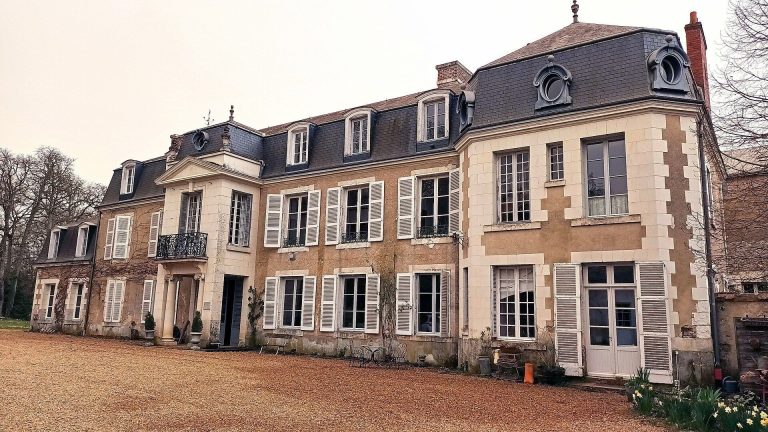
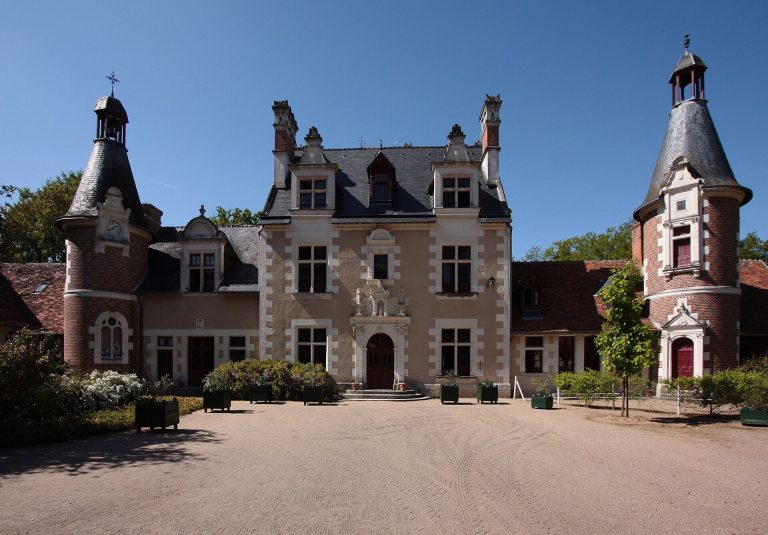
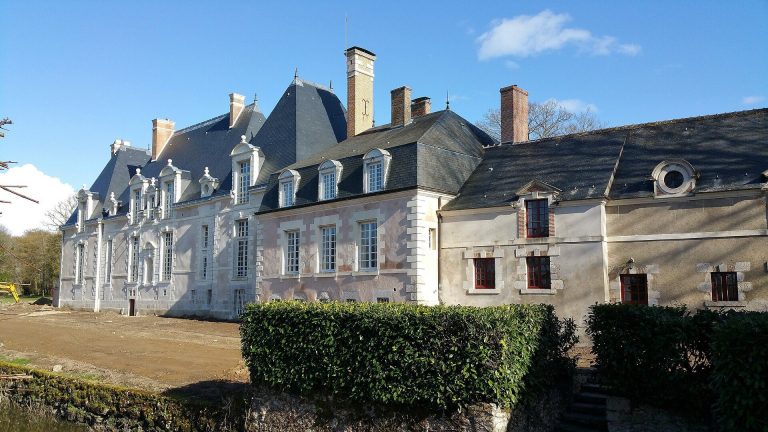
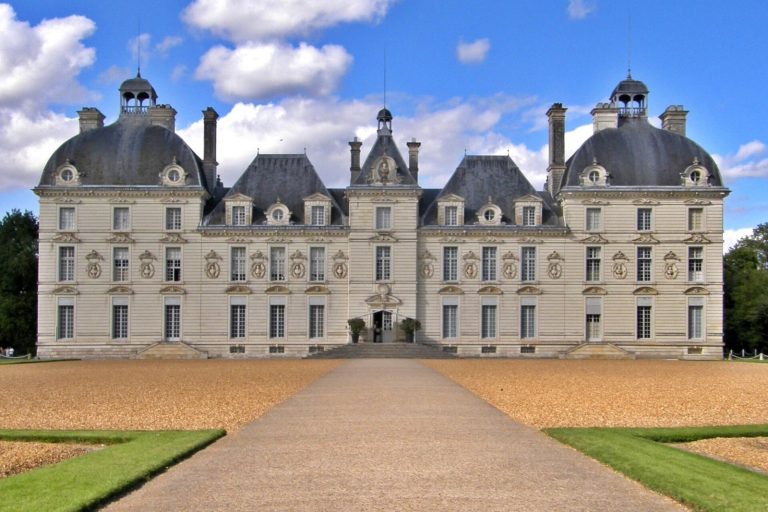
Château de Beauregard is organized around a central building with galleries that once connected the residential buildings. The complex combines sixteenth-century Renaissance work with seventeenth-century enlargement and later changes to the rear façade. Its enclosed park covers 70 hectares, including 40 hectares of ornamental garden and woodland, with the gardens and surviving service structures forming a wider setting for the château.
Central château
Galleries and residential wings
The central building has two levels of galleries. The ground floor contains a covered portico with seven arches, while a second covered gallery occupies the first floor. A two-storey wing projects at a right angle on the south side. Its roof carries tall, narrow Italian-style chimneys decorated with slate inlays.
The fifteenth-century residential wing was incorporated into Duthier’s château and appears on Androuet du Cerceau’s plans. It was demolished in the seventeenth century for a more modern building, which later disappeared in the nineteenth century. The rear façade overlooking the park was also altered in the nineteenth century. A former jeu de paume court, an early form of tennis played in a dedicated court, was removed so that the central building could be doubled in depth. This produced a more massive rear façade and eliminated the earlier projecting arrangement of the residential wings.
Gallery of the Illustrious
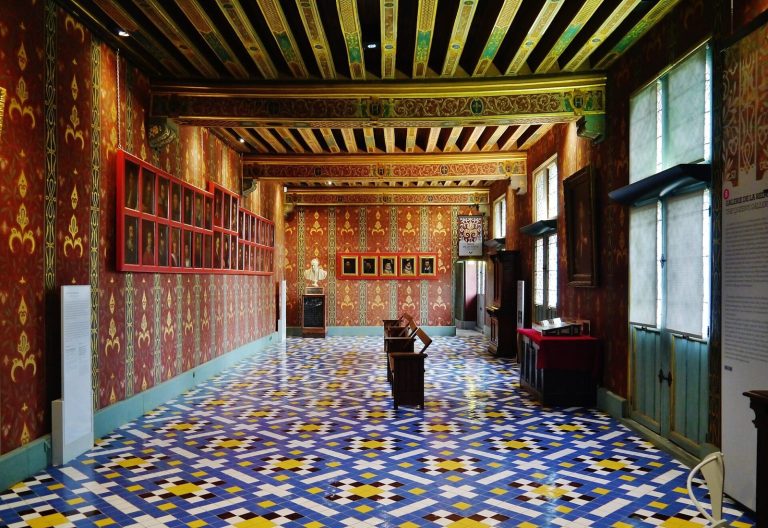
The Gallery of the Illustrious occupies the principal floor and measures about 26 metres long by 6 metres wide. Its 327 canvases cover the four walls in three levels and twelve panels. Most figures appear as busts, with the equestrian portrait of Henry IV and the formal portrait of Louis XIII providing notable exceptions. The portraits average approximately 55 by 45 centimetres.
The large equestrian image of Henry IV hangs above a sixteenth-century fireplace. Fourteen portraits around it are smaller than the remainder of the collection, while the portrait of Louis XIII extends across all three levels. The number of portraits assigned to each reign varies. Philip IV has six, Charles VII has 21, and Louis XIII has 40.
Painted woodwork beneath the portraits carries the dates of the reigns, royal emblems, and royal mottos. The name and function of each represented person appear in the upper part of the corresponding portrait. The setting was supervised by members of the Ardier family. Paul II Ardier installed about 5,500 Delft tiles across roughly 150 square metres of floor. Delft tiles are glazed earthenware tiles associated with the Dutch city of Delft. Their pavement depicts an army arranged in 17 regimental corps wearing clothing of the Louis XIII period.
Marie Ardier and Gaspard de Fieubet commissioned the painted decoration from the Mosnier family, and Pierre Mosnier painted the French kings’ mottos and emblems on the woodwork. The French-style coffered ceiling is predominantly blue, with the colour made from powdered lapis lazuli, a deep-blue stone used as a costly pigment. An adjoining room decorated for Louis XIV has lost its collection, but its ceiling entablature still bears the king’s name and dates.
Cabinet des Grelots
The Cabinet des Grelots is a small private study lined entirely with oak panelling and created in the tradition of the Italian studiolo, a Renaissance study combining scholarly, artistic, symbolic, and personal decoration. Jean Duthier commissioned the panelling from the Italian woodcarver Francisque Scibec de Carpi in 1554. The work took six months. A small doorway once linked the study to the gallery, but it was sacrificed when the portrait collection was installed in the seventeenth century.
The room has a pegged coffered ceiling formed by one large octagon surrounded by eight carved hexagons. Jean Duthier’s arms, three gold bells on an azure ground, occupy the centre. Bells also appear in carved friezes on the walls. The upper panelling contains paintings by local artists based on designs by Nicolò dell’Abbate, while the room’s decoration reflects Duthier’s interests in painting, sculpture, literature, music, silversmithing, warfare, hunting, and jeu de paume.
In the seventeenth century, Paul Ardier enclosed the original fireplace with panelling bearing the Ardier arms. An equestrian portrait of Louis XIII once stood above it. After that painting disappeared in 1925, the Gosselin family commissioned a copy of François Clouet’s Diane chasseresse from the Louvre. Sixteenth-century interiors also included frescoes by Nicolò dell’Abbate, among them decoration associated with the former north wing, which was destroyed in the nineteenth century.
Park and gardens
Historic garden and landscape park
Jean Duthier’s Renaissance garden was geometrically ordered. It contained rare plants, wooden galleries ending in small temples, a central fountain, and boxwood edging around the flowerbeds. Fruit trees included cherry, plum, almond, and walnut. Vineyards ran along the south façade, while the kitchen garden occupied the rear of the park, on the site now used by the Portrait Garden.
After acquiring Beauregard, Paul Ardier enclosed the park with walls in 1619, purchased additional land, and created a new central avenue aligned with the gallery. Duthier’s earlier enclosed garden was retained and adapted as French formal-garden design developed. An orangery, a building for sheltering citrus and other frost-sensitive plants, is recorded from 1661. A larger complex was built in 1718, and half of it survives. An inventory from the early eighteenth century listed 74 orange and lemon trees.
During the eighteenth century or the Napoleonic period, the formal French garden was replaced by an English-style landscape park. The designer is unknown. The park now contains collections of oaks, cedars, bamboo, and plants with decorative bark, together with introduced species including cedar of Lebanon, Virginia tulip tree, and Magnolia grandiflora.
Portrait Garden
The Portrait Garden was created by Gilles Clément in 1992 as part of a programme linking the historic gardens with modern landscape design. It consists of twelve enclosed garden rooms formed by high plant walls, corresponding to the twelve groups of portraits in the château’s gallery. Each room has a dominant colour and contains more than 400 species of perennial plants and shrubs. Some colours refer symbolically to figures or events represented in the gallery, including red in association with the Saint Bartholomew’s Day Massacre.
Icehouse
The park contains a seventeenth-century icehouse renovated during the winter of 2007–2008. The structure illustrates the historical method of storing harvested ice so that it could be preserved and used throughout the year.