Blue Palace: A Historic Classical Palace Complex in Warsaw


Site at a Glance
- Rating
- 3
- Popularity
- Very Low
- Country
- Poland
- Primary era
- Modern
- Eras represented
- Early Modern, Modern
- Civilizations
- Polish–Lithuanian Commonwealth, Russian
- Site type
- Domestic
- Remains
- Palace
On this page13 sections
History
The Blue Palace, also called the Zamoyski Palace, is a historic classical palace complex in Warsaw, Poland, whose origins reach back to the seventeenth century. Its principal nineteenth-century character was established during the classical rebuilding of 1812 to 1815, while its earlier phases included a major baroque expansion commissioned by King August II the Strong.
Potocki and royal ownership
By the end of the seventeenth century, the property belonged to Teodor Potocki, Primate of Poland. The original construction date is unknown, but the palace’s beginnings are tentatively associated with his ownership. Before 1726, the property passed to his brother Stefan. In that year, Stefan Potocki and his wife Teresa gave the palace to August II, a Polish king and elector of Saxony whose court supported major architectural projects in Warsaw.
August II ordered the rebuilding of the residence as a larger baroque complex and intended it for his daughter, Anna Karolina Orzelska. Saxon architects, including Carl Friedrich Pöppelman, Joachim Daniel von Jauch, and Johann Sigmund Deybel, worked on the project. After Orzelska left Warsaw following her marriage, she returned the palace to her father. In 1730, August II transferred it to Maria Zofia Denhoff in return for a lifelong lease of the Wilanów residence.
Czartoryski residence and cultural life
Maria Zofia Denhoff lived at the palace with her second husband, August Aleksander Czartoryski. After her death, the property passed to her son, Adam Kazimierz Czartoryski, and remained with the Czartoryski family for many years. In 1780, Teresa, the eldest daughter of Izabela Czartoryska, died at the palace three days after her dress caught fire from a fireplace during a childhood game.
The palace became the setting for a celebrated Warsaw salon under the patronage of Zofia Zamoyska after the later classical reconstruction. Fryderyk Chopin, whom she supported, performed at private concerts there several times, including in May 1826. He had also played at the palace in 1816, when he was six years old.
The Zamoyski period
In 1811, the palace passed to Zofia Czartoryska and her husband, Count Stanisław Kostka Zamoyski. The Zamoyski family owned the complex until the end of the Second World War, and family members lived there from 1811 to 1944. Stanisław Kostka Zamoyski initiated a major reconstruction in the strict classical style between 1812 and 1815. Friedrich Albert Lessel designed the work, while the sculptural elements were carried out under Paweł Maliński. This rebuilding established the palace’s principal nineteenth-century appearance.
The family also developed the complex as a centre for its collections. A building for the Zamoyski library was constructed in 1816 and 1817. Before the Second World War, the palace housed the family’s extensive art collections and the library of the Zamoyski estate, which was said to contain approximately 250,000 volumes in 1939. In the early twentieth century, the writer Stefan Żeromski worked there as an assistant librarian. A two-storey subsidiary building was added along Senatorska Street between 1833 and 1838.
War damage and reconstruction
The palace and its collections suffered heavy damage during the German attack on Warsaw in September 1939. Sections that remained later burned during the Warsaw Uprising in 1944. Objects and library collections that had survived the 1939 destruction were either removed by the Germans or burned.
Reconstruction took place from 1948 to 1950 under designs by Bruno Zborowski, broadly following Lessel’s plan. The restored complex was intended for the Workers’ Housing Estates Office. From 1958 to 1997, it housed the Society for Polish-Chinese Friendship, and it later accommodated offices of Warsaw’s municipal transport authorities until February 2011.
In 1999, Jan Tomasz Zamoyski sold claims to the palace to the businessman Józef Hubert Gierowski. Gierowski recovered the palace through reprivatization in 2000, contributed it to the company Błękitny Pałac, and later sold his shares in that company. The palace complex, including its garden, library building, and subsidiary building, entered Poland’s register of historic monuments in 1965. The palace is also identified as a protected architectural monument within the registered Blue Palace complex.
Remains
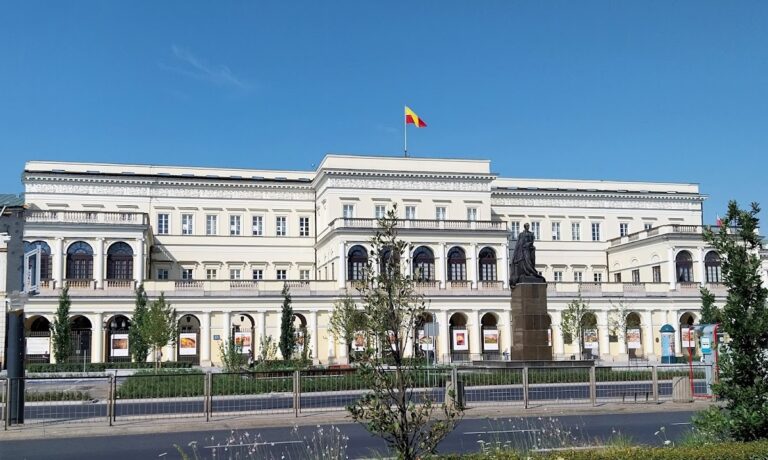
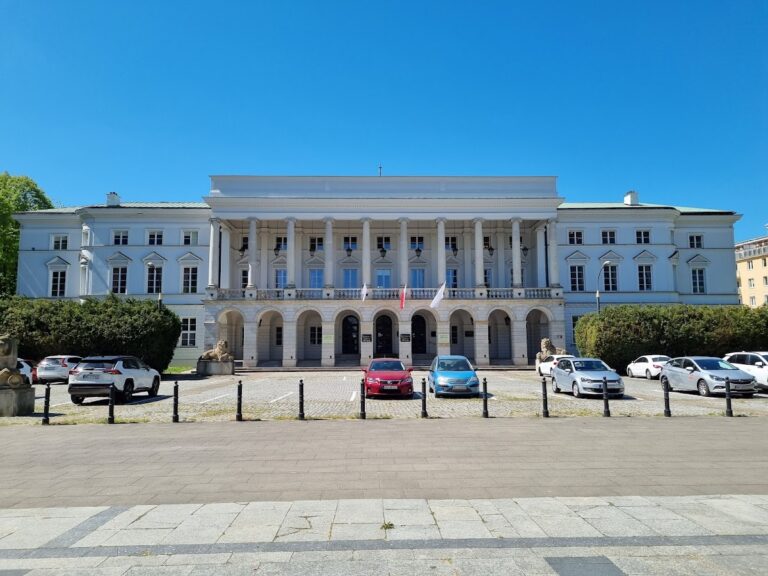
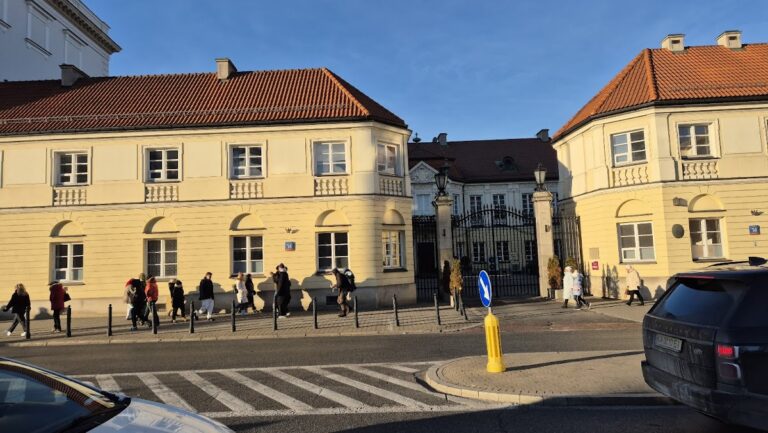
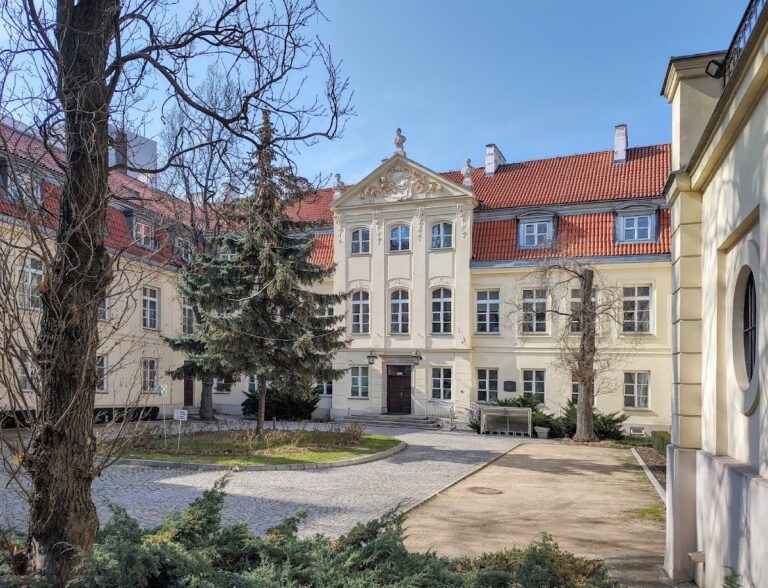
The surviving Blue Palace forms a classical complex at 37 Senatorska Street in Warsaw’s Śródmieście district. Its western side borders Marszałkowska Street, the Antonius Church lies to the east, and the former estate park extends southward into the Saxon Garden. The earlier Potocki residence became the core of the enlarged complex, while side wings created a ceremonial forecourt reaching toward Senatorska Street. Additional buildings were constructed on the western side.
Palace and grounds
Principal palace
The palace’s mansard roof, a roof with two slopes on each side, has a metal covering that developed a rare blue patina. This colouring gave the building its name. The interiors were richly decorated in the Rococo manner, an eighteenth-century style known for delicate ornament, curved forms, asymmetry, paintings, wood panelling, and elaborate stucco work.
The ground-floor rooms were remodeled between 1766 and 1768 to a design by Giacomo Fontana. Between 1770 and 1781, Ephraim Schröger directed another reconstruction that widened the core building. Bernardo Bellotto painted the palace after Schröger’s enlargement, when the building still retained its baroque appearance. The principal palace was later rebuilt in the classical style from 1812 to 1815 according to Friedrich Albert Lessel’s designs. After wartime destruction, Bruno Zborowski and Zasław Malicki reconstructed it between 1948 and 1950, following the nineteenth-century design in broad terms.
Estate garden
A small park behind the palace contained fountains, a waterfall, and an orangery. The former estate garden is now connected southward with the Saxon Garden, preserving the landscape relationship between the palace grounds and the larger garden area.
Library and subsidiary buildings
Zamoyski library building
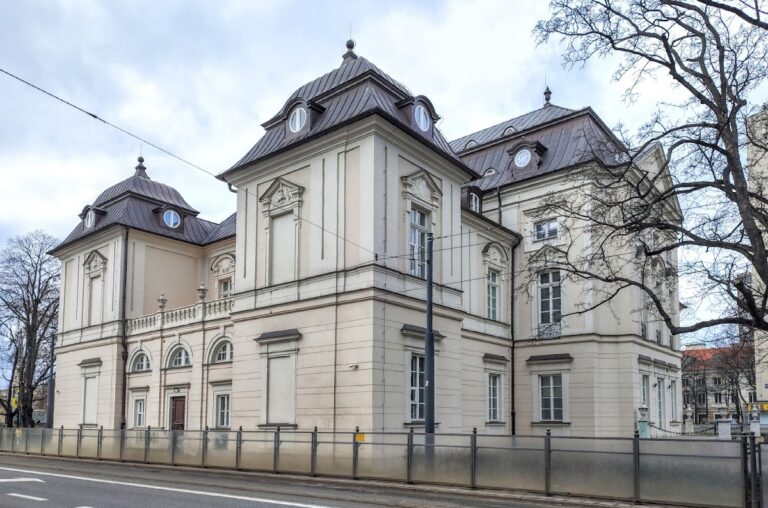
The building created for the Zamoyski library in 1816 and 1817 forms part of the historic complex. It was later adapted between 1866 and 1868 by Julian Ankiewicz in the Neo-Renaissance style. Its history reflects the palace’s role as a repository for the Zamoyski family’s library and art collections.
Senatorska Street subsidiary building
A two-storey subsidiary building was erected along Senatorska Street between 1833 and 1838. It formed part of the nineteenth-century palace complex but was later demolished.
Eastern wing
The rear eastern wing currently contains the St. Antonio restaurant, within the reconstructed palace complex.