Blank Palace: A Historic Municipal and Administrative Building in Warsaw
Site at a Glance
- Rating
- 4.9
- Popularity
- Very Low
- Country
- Poland
- Primary era
- Early Modern
- Eras represented
- Early Modern
- Civilizations
- Polish–Lithuanian Commonwealth
- Site type
- Civic
- Remains
- Palace
On this page9 sections
History
Construction and eighteenth-century remodelling
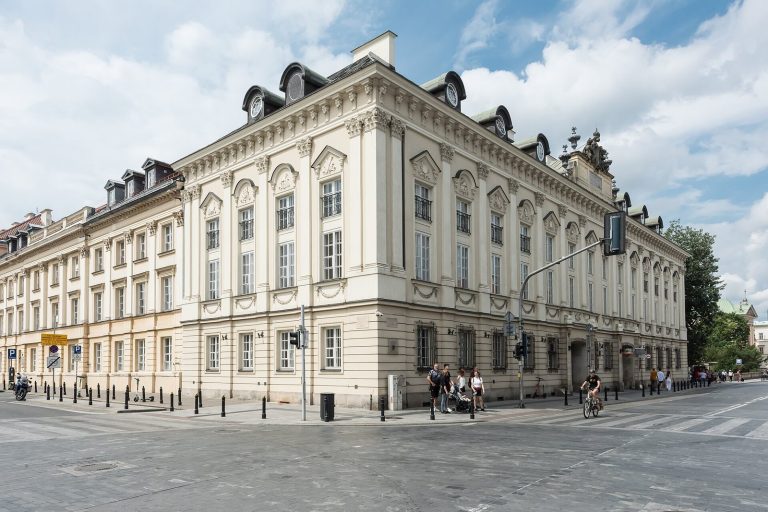
Blank Palace is an early-classicist palace in Warsaw, Poland, built in 1762–1764 for Filip Nereusz Szaniawski, the starost of Kąkolewnica, a historical Polish administrative official. Its architect was Szymon Bogumił Zug, an eighteenth-century Warsaw designer whose work belonged to the transition from late Baroque and Rococo toward Classicism.
Antoni Aleksander Soldenhoff, a general in the Army of the Kingdom of Poland, acquired the palace in 1776 and sold it the following year. In 1777, the Warsaw banker Piotr Blank, who was of French origin, became its owner. He retained the property until his death in 1797.
During Blank’s ownership, Zug remodelled and enlarged the palace, with particular attention to its interiors and exterior elevation. An entrance gate was added at this time. The building hosted Saturday social dinners organised by King Stanisław August Poniatowski, who ruled the Polish-Lithuanian Commonwealth from 1764 to 1795. The palace’s composition drew on eighteenth-century suburban residences in Paris and imitated the palace forms associated with the king and Warsaw’s magnate residences.
Nineteenth-century ownership and municipal use
After Blank’s death, the royal chamberlain Michał Budziszewski acquired the property at auction. At the beginning of the nineteenth century, the former palace was converted into a tenement house containing apartments and shops. Ownership then passed through the family. Budziszewski’s daughter, Józefa Szepietowska, inherited it in 1826, followed by her daughter Adelajda Kiersnowska in 1853.
During the January Uprising, the 1863–1864 Polish-Lithuanian insurrection against the Russian Empire, the palace was confiscated and briefly used by Russian military authorities. It returned to its owners in 1865. Further inheritance followed before the Warsaw magistrate purchased the property in 1896 for municipal offices.
Police, civic administration, and the approach of war
From 1915, Blank Palace housed the command of the Civic Guard. From 1919, it accommodated the Warsaw command of the State Police. During the interwar period, the building also served as a representative seat for the president of Warsaw and was used to receive guests.
At the request of city president Stefan Starzyński, the palace underwent a thorough renovation between 1935 and 1938 and was adapted as his official seat. Starzyński, a politician, economist, and writer, coordinated Warsaw’s defence from the building until the city capitulated in 1939. The restoration of the palace’s original appearance was directed by Stanisław Gadzikiewicz.
Occupation, uprising, and destruction
Beginning on 4 October 1939, during the German occupation, Blank Palace successively housed the offices of Reich Commissioner for Warsaw Helmut Otto, city starost Oskar Dengel, and city starost Ludwig Leist. German administrative offices also occupied the adjoining municipal Technical Department building. When Otto and Dengel left Warsaw, they removed part of the palace’s furnishings.
In March 1943, Kedyw, the special operations and sabotage branch of the Home Army, sent nine bomb-filled packages to the Main Post Office on Napoleon Square. One package was addressed to Ludwig Leist, and its explosion wounded several people.
During the Warsaw Uprising, the palace and neighbouring Jabłonowski Palace formed the Town Hall resistance strongpoint, defended by soldiers of the Kiliński Battalion, a Home Army unit. On 4 August 1944, the poet and Home Army soldier Krzysztof Kamil Baczyński was killed by a German sniper while defending Blank Palace.
The palace was destroyed during the war, with the damage estimated at approximately 90 percent. It was reconstructed in 1947–1949 under the direction of Elżbieta Kienitz-Trembicka and M. Ruszkowski. A plaque honouring Baczyński was installed on the front wall in the 1950s, while a bust and another commemorative plaque were placed in the entrance hall.
Blank Palace was entered in the monument register in 1965. It later housed offices including those of the Masovian Voivodeship Conservator of Monuments. The property is currently owned by the self-government of the Masovian Voivodeship and houses the Ministry of Sport and Tourism.
Remains
Palace ensemble and courtyard
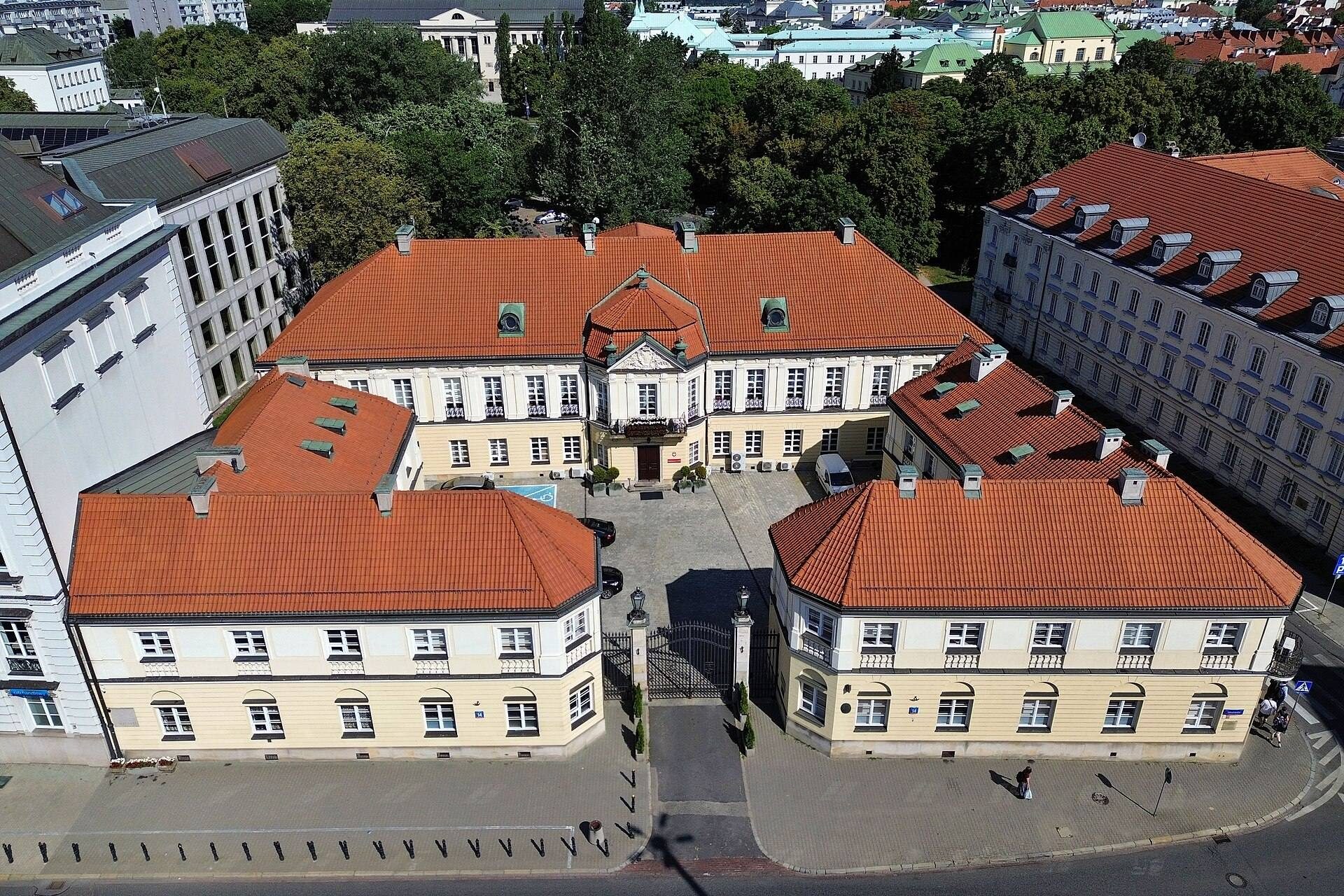
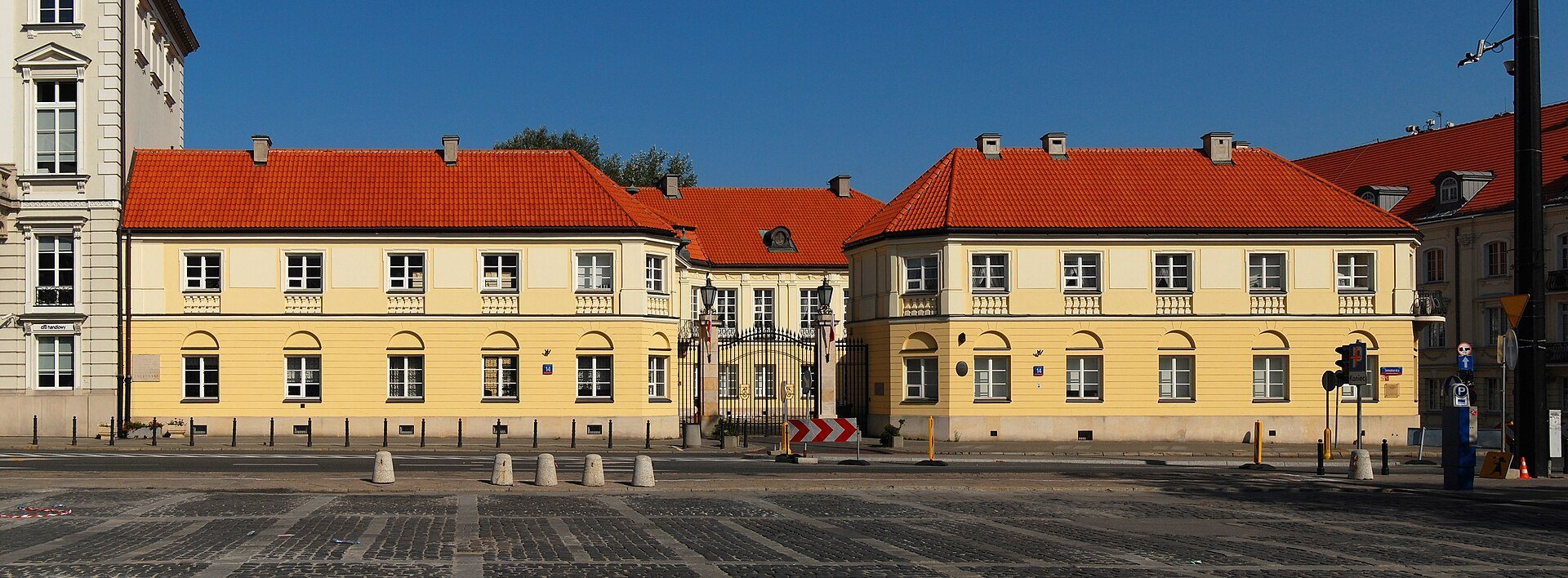
Blank Palace stands at Senatorska 14, on the north side of Theater Square in central Warsaw. The reconstructed two-storey ensemble is organised around a central building, smaller two-storey annexes, a courtyard, and an entrance gate positioned opposite the main building. The central section projects from the main facade and is crowned by a triangular pediment. The gate faces Theater Square and was added during Piotr Blank’s remodelling in 1777.
The arrangement reflects the design of eighteenth-century suburban residences in Paris, while also adopting the palace language associated with the king and Warsaw’s magnate residences. The building had an internal connection with the neighbouring Jabłonowski Palace, which served as Warsaw’s town hall. A municipal Technical Department building, erected in the 1930s at 3 Daniłowiczowska Street, adjoined Blank Palace.
Surviving interiors and commemorative features
The staircase and Shell Hall on the principal residential floor survive from Zug’s eighteenth-century alterations. These elements belong to the remodelling carried out after Blank acquired the property and retain the connection between the palace’s architectural form and its period as a private residence.
The palace’s commemorative features relate to the fighting of 1944. A plaque honouring Krzysztof Kamil Baczyński is fixed to the front wall, and the entrance hall contains a bust of him together with a second memorial plaque. These features accompany a building reconstructed after its wartime destruction rather than preserved intact.
Position within the surrounding urban fabric
Small Nowy-Przejazd Street runs along the palace’s east side, with the rear of Dembiński Palace across the street. The reconstructed Jabłonowski Palace adjoins Blank Palace to the west, while the east front of the Great Theatre is approximately 100 metres away. Together, these relationships place the palace within the surviving and reconstructed civic architecture around Theater Square.