Mjäldrunga Church: A Medieval Romanesque Church in Sweden
Site at a Glance
- Country
- Sweden
- Primary era
- Medieval
- Eras represented
- Medieval, Modern
- Civilizations
- Swedish
- Site type
- Religious
- Remains
- Church
On this page10 sections
History
Mjäldrunga Church is a Romanesque church in Mjäldrunga, Sweden, probably built in the 12th century and consecrated in the 13th. Romanesque architecture is a medieval European style known for thick walls and rounded forms.
Before the church acquired its organ, a harmonium was used. Parish members raised money for the purchase, supplemented by a substantial donation from a Swedish-American. Since 2021, the church has belonged to Herrljungabygden Parish, a local church community; previously it belonged to Mjäldrunga Parish. It is in the Diocese of Skara, a larger ecclesiastical district.
Remains
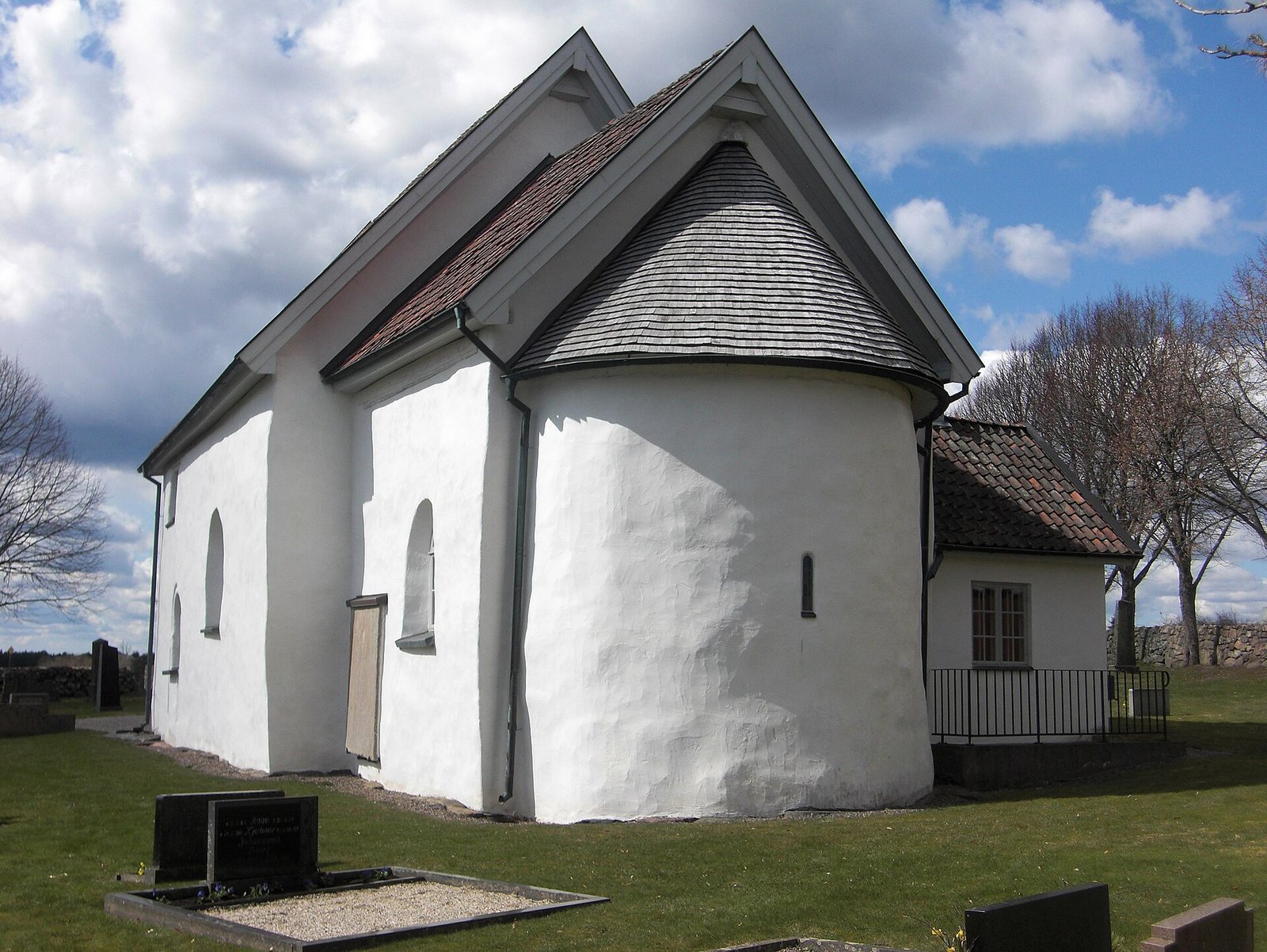
The church stands at a crossroads on a slight rise in the northeastern part of Herrljunga Municipality. It is a towerless stone building with very thick granite walls, a rounded apse, a projection enclosing the chancel, and a triumphal arch separating the chancel from the nave. Its Romanesque form provides the framework for later additions and furnishings.
Exterior
Church building
White roughcast plaster covers the exterior, beneath a shingle-covered gabled roof. A wooden porch stands at the west end, while a sacristy added on the north side in 1922 extends the building. The Romanesque windows have two openings, six panes, and gray frames; the apse also has small Romanesque windows. A window is associated with the old south portal.
Bell tower and bell
A separate wooden bell tower has red-painted boards, narrow strips covering their joints, and a shingle roof. Its large bell probably dates to around 1530. The Swedish inscription, rendered in modern English, reads: “God and St. Hippolytus helped all who helped with the casting.” St. Hippolytus was an early Christian theologian and martyr.
Interior and furnishings
Chancel and gallery
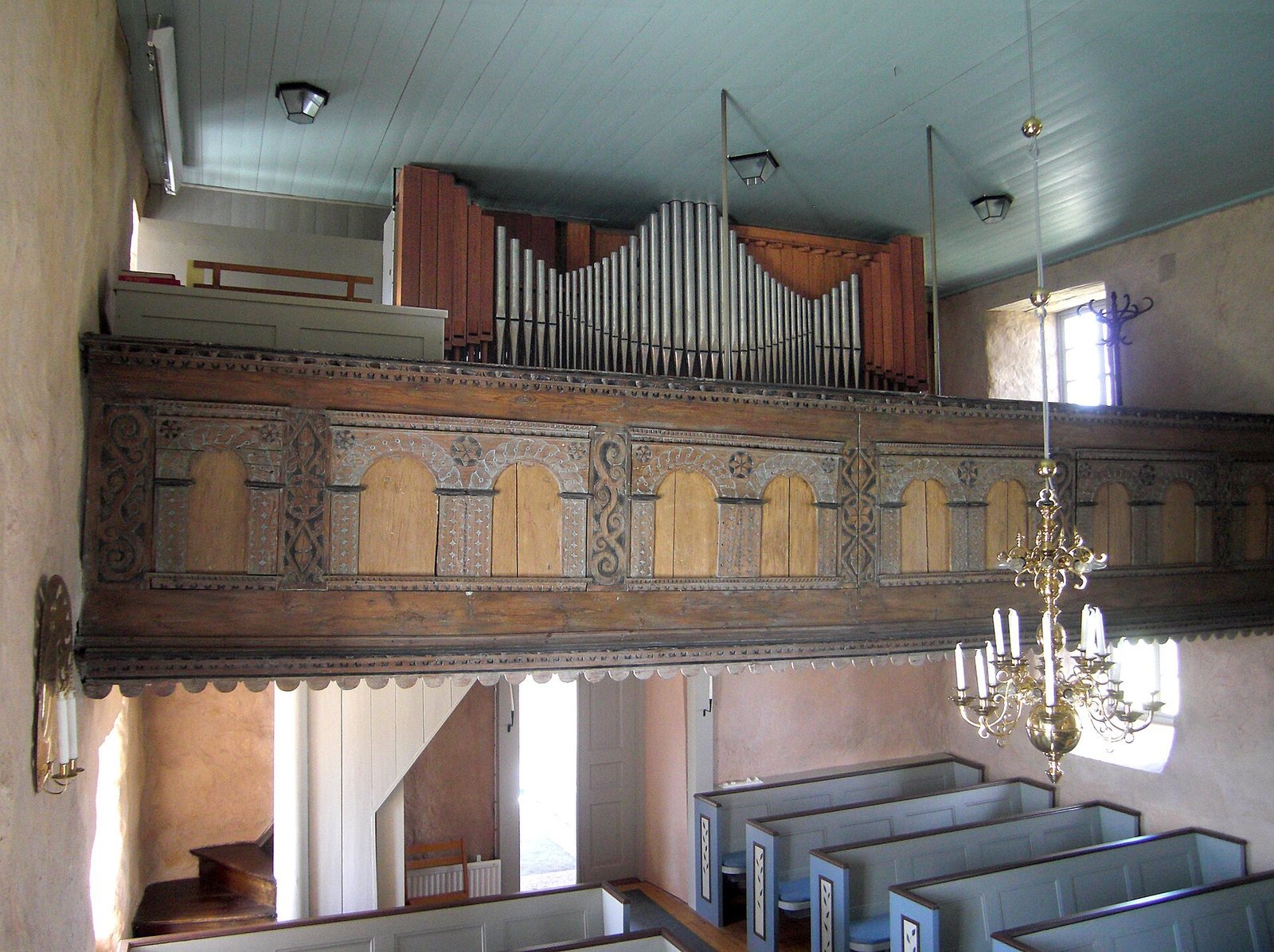
Fragmentary paintings on the chancel roof show angels bearing the greeting, “Glory to God in the highest, and peace on earth.” The gallery front is richly carved. It was restored in 1940, when its original color was reinstated.
Baptismal font
The sandstone baptismal font was made around 1200 in two parts and stands 87 centimeters high. Its rounded bowl has a recessed band at the rim, a rounded molding, and three alternating raised and recessed bands; the underside slopes. The cylindrical foot has a sloping upper section, and a central hole drains the font. It has sometimes been used upside down.
Pulpit and offering chest
The 17th-century pulpit has compartments framed by panels. An iron-bound offering chest dating to the 13th century stands in the sacristy.
Organ
The organ, made in 1956 by Tostared Church Organ Factory, is on the west gallery. It has eight stops distributed across two manuals and a pedal. Its pneumatic mechanism uses air pressure to control the pipes.