Mizuma-dera Temple: A Tendai Buddhist Temple in Osaka


Site at a Glance
- Rating
- 4.2
- Popularity
- Medium
- Country
- Japan
- Primary era
- Early Modern
- External website
- Open
- Eras represented
- Early Modern, Modern
- Civilizations
- Japanese, Tokugawa, Toyotomi regime
- Site type
- Religious
- Remains
- Monastery
On this page12 sections
History
Mizuma-dera Temple is a Japanese Tendai Buddhist temple in Kaizuka, Osaka, Japan, traditionally founded in 744 during the Nara period by the monk Gyōki at the command of Emperor Shōmu. Tendai is a major Japanese Buddhist school based on the teachings of the Lotus Sutra. The temple is also called Mizuma Kannon, and its principal object of worship is a concealed image of Shō Kannon, the Japanese Buddhist form of the bodhisattva of compassion.
Foundation tradition
The temple’s origin is preserved in a foundation legend. Gyōki sought a Kannon who had appeared in Emperor Shōmu’s dream. A white bird led him through several places in present-day Kaizuka, where he met sixteen children understood as manifestations of Kannon. They guided him to Mizuma, where a dragon deity presented him with a six-centimetre image of Shō Kannon made from jambūnada gold.
Gyōki took the image to Emperor Shōmu, whose illness then improved. The emperor ordered that the image be enshrined at Mizuma. The tradition also connects the encounter with a waterfall on the Kibitani River behind the main hall, giving the temple a sacred origin tied to its riverside setting.
Medieval destruction and reconstruction
The temple’s seven-hall complex was completed in 1190. From the medieval period onward, military families strongly protected Mizuma-dera. In 1585, however, the temple supported Negoro-ji during Toyotomi Hideyoshi’s conquest of Kishu, a late-sixteenth-century campaign by the military ruler who unified much of Japan. Forces commanded by Hori Hidemasa attacked and burned Mizuma-dera. The surviving structures were later demolished, and the temple bell was sold to Kaizuka Hongan-ji, now Gansen-ji.
Koide Hidemasa, lord of Kishiwada Castle, rebuilt the main hall in 1596. The three-story pagoda followed in 1661. During the Genroku era, conventionally dated here to 1688–1704, the Okabe family, lords of the Kishiwada domain, supported the reconstruction of the temple buildings.
Later development
A fire in 1784 destroyed the main hall and other buildings. Reconstruction under Kishiwada lord Okabe Nagachika proceeded over the following decades. The main hall was rebuilt in 1827, the three-story pagoda in 1834, and other halls were reconstructed or added progressively.
Mizuma-dera became widely known after appearing in the opening story of Ihara Saikaku’s The Eternal Storehouse of Japan, published in 1688. The work referred to the money-making blessings of Mizuma-dera in Senshu. The temple is also linked with a legendary love story about Seijūrō, a samurai, and Onatsu, a woman of lower social status.
The Mizuma Railway Mizuma Line opened in 1925 to carry pilgrims to the temple. In 1977, Mizuma-dera became a special head temple of the Tendai school. It is the fourth station of the New Saigoku Thirty-Three Kannon Pilgrimage and is also included in the Izumi Saigoku Thirty-Three Pilgrimage, the Nankai Railway Seven Lucky Gods pilgrimage, and the Shinto-Buddhist pilgrimage route. “Mizuma Kannon and its surroundings” was selected among Osaka’s “100 Green Selections.”
The main hall, three-story pagoda, Gyōki Hall, and other features are Kaizuka municipal tangible cultural properties. The Mizuma Senbon-zuki rice-cake-pounding practice is designated as a Kaizuka municipal intangible folk cultural property. In recent years, sixteen pairs of ceramic figures representing the children in the foundation legend have been placed at sixteen locations along the Misfortune-Averting Pilgrimage Road between Sechigo Station, Mizuma Kannon Station, and the temple precincts. The figures were made by Tsuchi no Ko Tōbō, a facility supporting people with disabilities.
Remains
Mizuma-dera stands at the meeting of the Kibitani and Kogi rivers. The Kibitani River borders the precincts on the southwest and joins the Kogi River farther downstream. The largely open grounds have few walls or gates, with enclosed areas around the abbot’s and monks’ quarters. A bridge over the Kogi River provides an approach to the temple and is called Yakuyoku-bashi, or “Misfortune-Averting Bridge.” A separate, gently curved drum bridge connects the monks’ quarters with the temple on the west. A later arched bridge, added in 2010, is also part of the complex.
Central temple buildings
Three-story pagoda
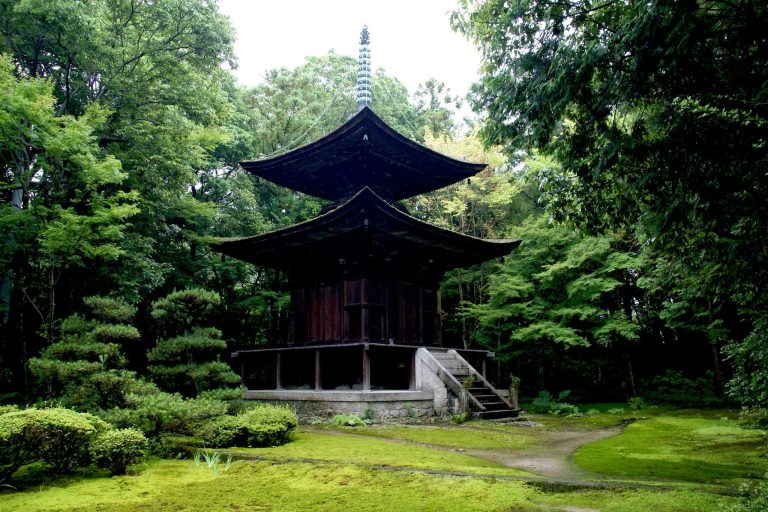
A three-story pagoda stands near the centre of the precincts, with the main hall behind it. This multilevel Buddhist religious structure was rebuilt in 1661 and rebuilt again in 1834 after the fire of 1784. Its position forms part of the central arrangement of the surviving temple buildings.
Main hall and waterfall site
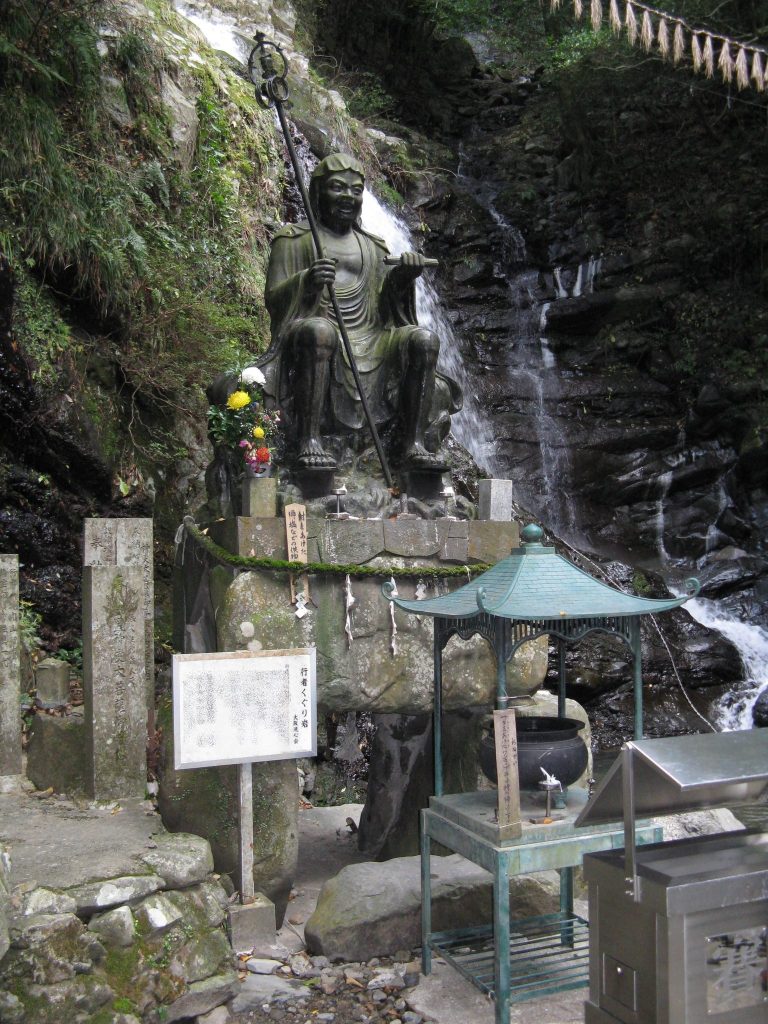
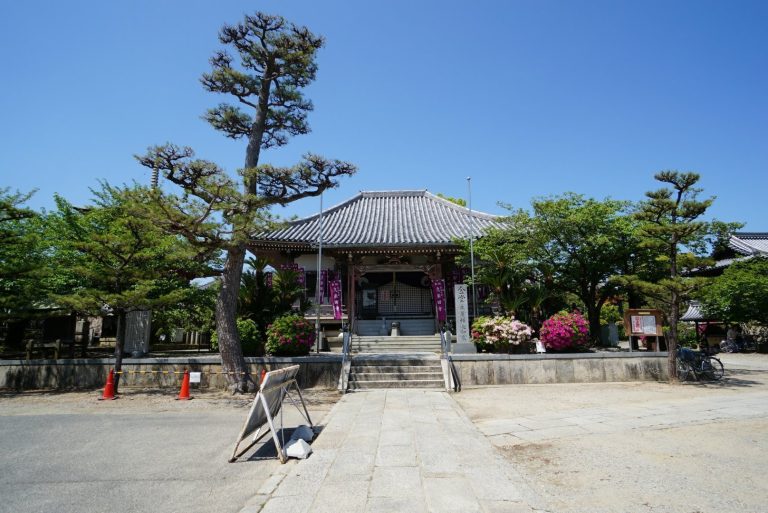
The main hall stands in front of the traditional waterfall site on the Kibitani River. It was rebuilt in 1596 and again in 1827 after the fire of 1784. Behind the hall, the place associated with the dragon deity’s presentation of the Kannon image is identified as the “Waterfall of the Appearance of Shō Kannon.” A board bearing that designation stands beside a fence on the riverbank.
Riverside and supporting structures
Bell tower and sutra repository
A bell tower and a sutra repository stand to the right of the main hall above the Kibitani River. The repository stores Buddhist scriptures. The bell formerly associated with Mizuma-dera was sold in 1585 and is not identified as part of the present temple buildings.
Jōjakkō Hall and the residential quarters
Jōjakkō Hall stands at the right-hand edge of the precincts. The abbot’s and monks’ quarters contain Aizen Hall, dedicated to Aizen Myōō, a Buddhist deity associated with desire, passion, and their transformation into spiritual power.
Kannon worship
The principal Shō Kannon image is kept concealed and has never been publicly unveiled. Mizuma-dera is also known for Yaku-yoke Kannon, a Kannon image believed to repel bad fortune. Together, these images preserve the temple’s continuing association with protection from misfortune and devotion to Kannon.