Kishiwada Castle: A Coastal Castle in Japan
Site at a Glance
- Country
- Japan
- Primary era
- Early Modern
- Eras represented
- Medieval, Early Modern, Modern
- Civilizations
- Japanese, Tokugawa, Toyotomi regime
- Site type
- Military
- Remains
- Castle
On this page16 sections
History
Kishiwada Castle is a Japanese castle at Kishiwada, on the coast of Osaka Bay in Japan. A predecessor stood at Kishiwada Old Castle, about 500 metres southeast of the present site, in the late fifteenth century; when the castle moved to its current location is unknown. Its later history linked regional warrior families, the military campaigns of Toyotomi Hideyoshi, and the Tokugawa-era domain system.
Early origins and regional rule
Kishiwada’s early history is associated with a warrior who served Kusunoki Masashige at the Battle of Minatogawa in 1336, during the Nanboku-chō period, a conflict between rival Northern and Southern imperial courts. The warrior’s family probably developed the area by about 1400, when it came under the control of Ashikaga Yoshimitsu, the third shogun of the Ashikaga shogunate. It is not clear that a castle existed there at that time. A later tradition credited a nephew of Kusunoki with founding one, but the proposed construction date of 1394–1428 and the builder’s identity remain uncertain.
In 1408, Hosokawa Yorinaga and Hosokawa Motoyuki became joint provincial military governors, or shugo, of the upper and lower parts of Izumi Province, and both appear to have had a connection with the castle. In 1500, governors Hosokawa Motari and Hosokawa Masahisa were killed there during an attack by Hatakeyama Hisanobu. Akazawa Tomotsune then retook the stronghold. Archaeological evidence places a castle at the old site in the late fifteenth century. It was abandoned around the beginning of the sixteenth century, although the date of its transfer to the present site is unknown.
During conflict within the Hosokawa family, Hosokawa Mototsune fled to Awa Province. The government of Hosokawa Takakuni appointed members of the family as governors, while the Matsura family helped administer the territory as deputy governors, or shugodai. In 1527, Hosokawa Harumoto defeated Takakuni at the Battle of Katsuragawa and established the Sakai Kubo government. Mototsune and his son Hosokawa Harusada regained the governorship, while Matsura Mamoru remained a deputy.
Miyoshi and Oda control
Mamoru changed allegiance from Harusada to Miyoshi Nagayoshi in 1548. After Mamoru’s death, the Miyoshi family intervened in the territory’s affairs while his young heir, Matsura Manmitsu, was vulnerable. In 1558, Nagayoshi’s younger brother Miyoshi Yoshikata, also known as Jikkyu, entered Kishiwada Castle with Sogo Kazumoto and Atagi Fuyuyasu. Yoshikata undertook a substantial renovation in 1560, and a garrison of 2,800 men was placed under Sogo and Atagi. The castle served a strategic position on routes connecting Awa, Sanuki, and Awaji with Settsu and Kyoto.
Yoshikata was killed in 1562 at the Battle of Kumeda while fighting Hatakeyama Takamasa. Atagi withdrew, and Hosokawa Harusada took control of the castle. After Hatakeyama’s defeat at the Battle of Kyokoji later that year, Miyoshi forces regained it. Matsura Tora became lord amid a family dispute, and Matsura Mitsu later held the castle.
During the Genki era, a Japanese reign period, Mitsu and Hatakeyama Akitaka allied with Oda Nobunaga against the Miyoshi Triumvirate, Shinohara Nagafusa, and Araki Murashige. Mitsu was killed in 1575 by his retainers, the brothers Terada Mataemon and Terada Yasudaifu. The latter, also known as Matsura Munekiyo, succeeded him and served under Sakuma Nobumori. In 1577, as Nobunaga’s forces campaigned in Kii Province, Oda Nobuharu moved to Kishiwada after first being assigned to Sano Fort. Hachiya Yoritaka, who had become a ruler of Izumi in 1580, was made castle lord in 1581.
Toyotomi Hideyoshi and the siege of 1584
In 1583, Toyotomi Hideyoshi placed the castle under Nakamura Kazuuji and ordered him to suppress an uprising involving the Negoro, Saiga, and Kokawa forces. The following year, an army of about 30,000 attacked. Kazuuji and Munekiyo defended the castle with about 8,000 men and held out during a two-month siege. A local tradition says that octopuses helped save the defenders. Munekiyo received a reward and was transferred to Ise Province.
Hideyoshi entered Kishiwada in 1585 and used it as a base for his campaign in Kii. His forces captured castles around Kaizuka, followed by Sekizenji and Sawa. He appointed his uncle Koide Hidemasa to secure the countryside, protect Sakai port, and guard the approach to Osaka. Hidemasa’s holdings, assessed by rice yield in koku, a measure used to express a domain’s wealth, rose from 4,000 to 10,000 in 1594 and 30,000 in 1595. Work on a five-tier, five-storey keep began in 1595 and was completed in 1597.
Tokugawa-era domain seat
After the Battle of Sekigahara, Koide Yoshihide inherited Kishiwada Domain. He had supported the Eastern Army, while his father and elder brother were aligned with the defeated Western Army. In the early seventeenth century, the castle’s lords included Matsudaira Nobuyoshi, Hojo Ujishige, and Yoshihide. Matsudaira Yasushige took over in 1619. In 1623, a tower from dismantled Fushimi Castle was transferred to Kishiwada’s second enclosure. After Yasushige moved to Yamazaki, Okabe Nobukatsu came from Takatsuki in 1631 as lord of a 60,000-koku domain. Kishiwada remained the Okabe family seat for thirteen generations, through Okabe Nagamoto.
The Matsudaira and Okabe lords developed both the castle and its town. Under Yasushige, the outer defences and town were organized; Nobukatsu added a temple district and extended the surrounding defensive arrangement. Kishiwada stood between Osaka Castle and Wakayama Castle. Tradition holds that Nobukatsu, described as a nephew of Tokugawa Ieyasu, was placed there partly to monitor the Kii domain ruled by Ieyasu’s son Tokugawa Yorinobu. An anecdote recounts a conversation between Yorinobu and Nobukatsu about that purpose, though the interpretation is complicated by the castle’s stronger defences facing Osaka than Wakayama.
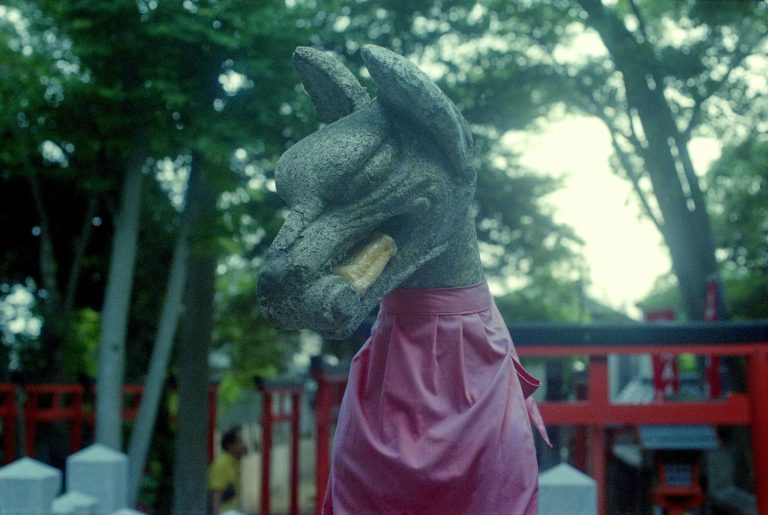
A tradition also links the Kishiwada Danjiri Festival to Okabe Nagayasu, the third-generation Okabe lord. It says he established a Fushimi Inari shrine in the third enclosure and allowed residents to attend its harvest-prayer festival.
Destruction and modern preservation
Lightning destroyed the keep on 20 November 1827. A petition proposed replacing it with a three-storey main keep and a two-storey smaller one, but neither was built. The castle was abolished in 1871 and soon dismantled. After the Meiji Restoration, which ended Tokugawa rule and began a new imperial government, the remaining buildings were destroyed.
In 1953, landscape designer Mirei Shigemori created a dry garden in the main enclosure after demolition of the remaining castle fabric had been proposed. A reconstructed three-storey keep followed in 1954, funded by public donations and requested by descendants of the Okabe lords; it first served as a library. Reconstructed gates and towers were added in 1969, and the keep underwent major renovation in 1991–1992. The castle ruins are designated a historic site by Osaka Prefecture, and the garden is a National Place of Scenic Beauty. Kishiwada was included in the Continued 100 Fine Castles of Japan in 2017.
Remains
The castle occupied Ibuseyama, a low rise on the coastal terrace of Osaka Bay, with rivers to its north and south. Its concentric layout covered an area about 370 metres east to west and 650 metres north to south. The main enclosure, or Honmaru, and second enclosure, or Ninomaru, form an H-shaped plan, linked by a narrow passage and protected by stone walls and water-filled moats. The second enclosure extended toward the bay, where its walls faced the sea. Together, the two enclosures cover 4.9 hectares; the main enclosure measured about 4,702 square metres and the second about 8,000.
Main enclosure
Keep and stone platform
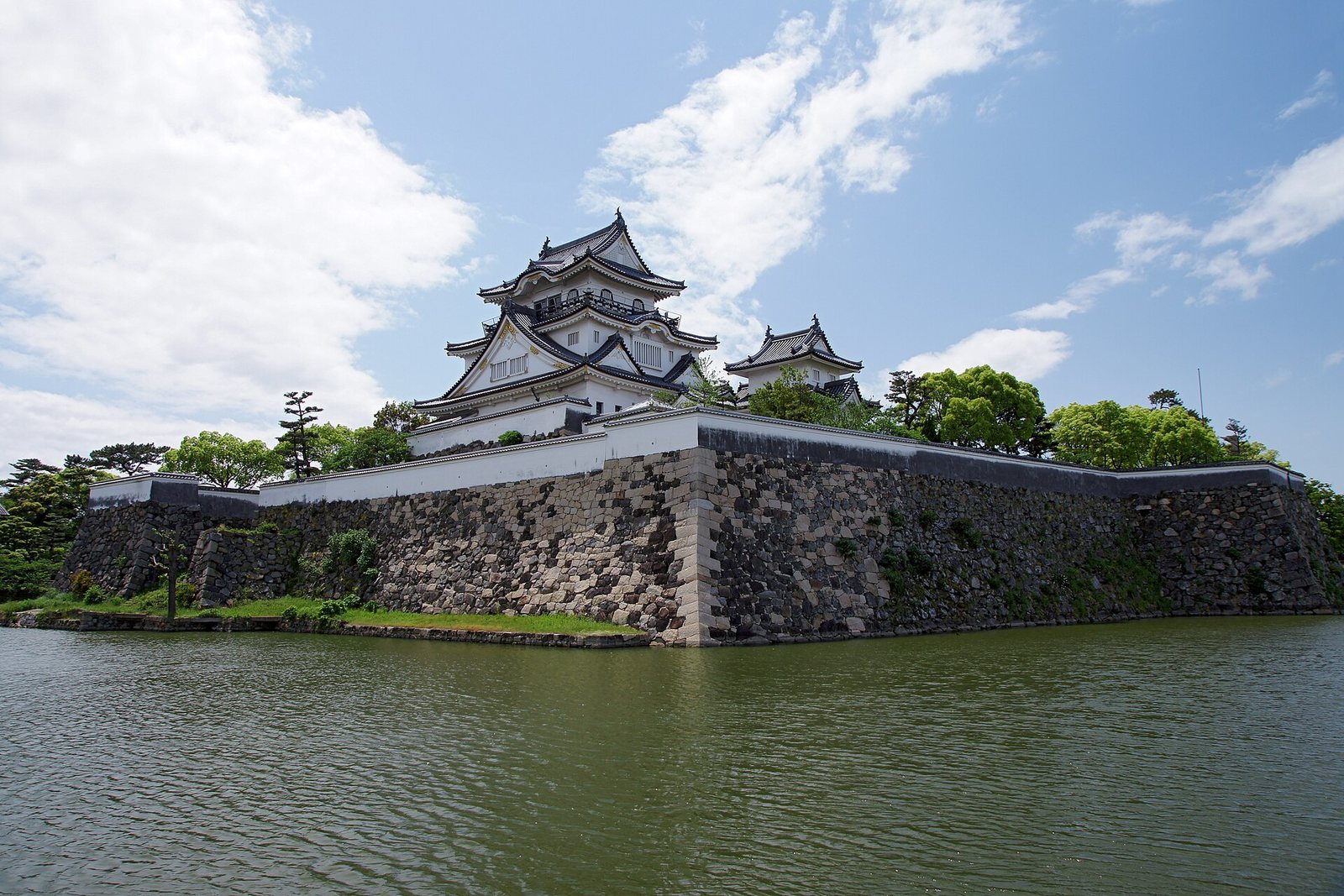
The original keep had five tiers and five storeys. An early Edo-period map depicts it with a triangular roof gable on its first level; a later alteration may have added a curved gable. The tower stood on a stone platform about 18 metres square, with a recorded area of 336 square metres. Its stated height was 18 ken, about 10 metres more than the present reconstructed keep. A smaller platform beside the main foundation may have supported a three-storey tower transferred from Fushimi Castle. The current keep is a reconstructed, connected three-tier, three-storey structure in a lookout-tower style, about 22 metres high.
Walls and Eight Arrays Garden
Stone walls and moats survive around the main enclosure. Narrow ledges at the southeast and southwest feet of the walls may have helped stabilize the friable Senshu sandstone, though their original defensive purpose is uncertain. The masonry projects outward above the ledges, and some corners use squared stones arranged in straight lines. Heavy rain in 1999 caused part of the stonework to collapse. Repairs used stronger granite, whose colour differs visibly from the older stone. More than a hundred grave markers, mostly from the early or middle sixteenth century, were found during the work; the discoveries helped establish that the enclosure’s stone walls date from after 1560.
Shigemori’s dry landscape garden, known as the Eight Arrays Garden, represents battle formations traditionally associated with the Chinese strategist Zhuge Liang. A central commander’s stone arrangement is surrounded by eight groups representing heaven, earth, wind, cloud, bird, snake, dragon, and tiger.
Second enclosure
Palace, turret, and enclosure plan
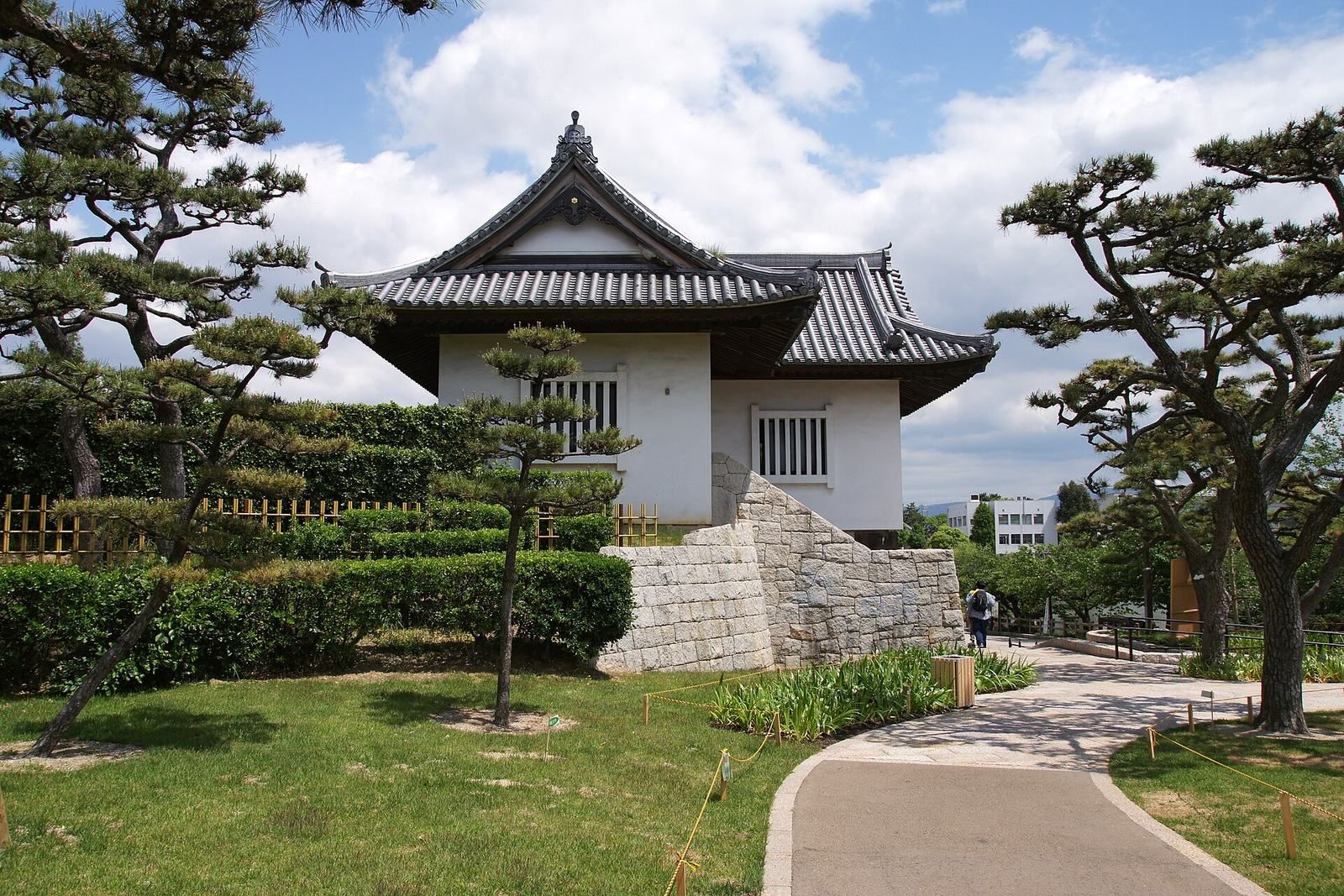
The second enclosure contained a palace and the Fushimi Turret, traditionally associated with the tower transferred from Fushimi Castle. It probably served as the castle’s principal enclosure during the Sengoku period, an era of conflict among regional powers. The outer second enclosure had a moat shaped like a horse stirrup, which may preserve the outline of an approach enclosure from the time when the second enclosure served as the principal one. The outlines of the main and second enclosures have also been compared to a chiki, a device for winding a loom’s warp; this resemblance gave rise to the alternative name Chikiri Castle.
Smithing remains
An excavation in the second enclosure uncovered a smithing pit dating to the late sixteenth century. Finds included more than ten bellows nozzles and over a hundred pieces of iron slag mixed with charcoal.
Outer defences and later landscape
Hamano stone wall
The Hamano stone wall ran along the northwest edge of the town and outer enclosures. Built under Matsudaira Yasushige along the shoreline of the time, it extended about 800 metres and served as both coastal defence and seawall. Two tide gates provided openings through it. A remnant near Nakamachi Children’s Park measures about 9 metres wide and more than 2 metres high, marking the former shoreline and the outer limit of the castle.
Five Winds Villa and shrine
The site of the former New Tea House became the Five Winds Villa, constructed over ten years from 1929. Its grounds include a strolling garden, a principal house, and three teahouses. A shrine within the castle grounds is associated with matchmaking through a wordplay connecting the castle’s Chikiri name with the Japanese expression for a marriage bond.