Mizuki: A Seventh-Century Fortified Embankment in Japan


Site at a Glance
- Rating
- 3.9
- Popularity
- Low
- Country
- Japan
- Primary era
- Classical
- External website
- Open
- Eras represented
- Classical
- Civilizations
- Yamato
- Site type
- Military
- Remains
- Wall
On this page8 sections
History
Mizuki is an ancient fortified embankment in Japan, constructed by the Yamato court in 664 during the reign of Emperor Tenchi. Built as a rammed-earth defense, it protected Dazaifu, the major governmental and military center of northern Kyushu, by blocking the route from Hakata Bay and the Fukuoka Plain into Tsukushi.
Construction after Hakusukinoe
The decision to build Mizuki followed the defeat of Yamato and Baekje restoration forces by the Tang-Silla alliance at the Battle of Hakusukinoe in 663. Baekje was a Korean kingdom allied with Yamato Japan, while Tang was the ruling dynasty in China and Silla was its Korean ally. The defeat created a perceived danger of invasion through Hakata Bay, prompting Emperor Tenchi’s government to reorganize defenses across the region.
Mizuki formed part of a wider system that included frontier guards and beacon installations in Tsushima, Iki, and Tsukushi. Frontier guards defended exposed coastal and island areas, while beacons provided long-distance warnings through signals. Ōno Castle and Kii Castle followed in 665, with further fortifications added in 667. Together, these works linked northern Kyushu with Tsushima, the Seto Inland Sea, and the Kinai region, the central area of early Japan where the Yamato court was based.
Gates and the Dazaifu connection
The eastern and western gates had different diplomatic and administrative roles. The eastern gate received high-ranking officials from the Imperial Court, while the western gate was used by foreign envoys, merchants, and Japanese envoys leaving the country. The road through the western gate connected Dazaifu with the Chikushi Guest House, later called Korokan, a state-controlled reception and diplomatic facility for foreign envoys and overseas trade. It remained a principal ceremonial and diplomatic route until the latter half of the eighth century, and the western gate itself passed through three phases of change.
The arrangement of Ōno Castle, Kii Castle, Mizuki, and the smaller embankments was once associated with the planned outer perimeter of the Baekje capital at Sabi. That interpretation has increasingly been questioned because Dazaifu may not yet have been functioning when the defensive arrangement was created.
Later defense and archaeological investigation
The defensive installations were repaired and maintained during the Mongol invasions of Japan in 1274, when the fortification line continued to serve a defensive purpose. Archaeological investigation began in 1913, when Katsumi Kuroita and Heijiro Nakayama examined a cross-section of the earthwork. Kenkai Naganuma and Takeshi Kagayama investigated its wooden conduit in 1930.
Full-scale excavation began in 1970 through work by the Fukuoka Prefectural Board of Education, the Kyushu Historical Museum, Dazaifu, and Ōnojō. Excavation in 1975 established the outer moat on the Hakata side. In 1978, excavators recovered late-eighth-century Haji ware pottery bearing an ink inscription that reads “Mizuki.” A new survey of the embankment cross-section took place in 2013 and 2014, about a century after the first investigation.
The remains became a Historic Site in 1921, covering approximately 150,805 square meters, and were elevated to a Special Historic Site in 1953. The protected area expanded in 2013, and the site known as Father-and-Child Island at Shimoozato in Ōnojō was added to the Special Historic Site designation in 2019. Mizuki was also selected for the Continued Top 100 Japanese Castles in 2017.
Remains
The main earthwork and foundation
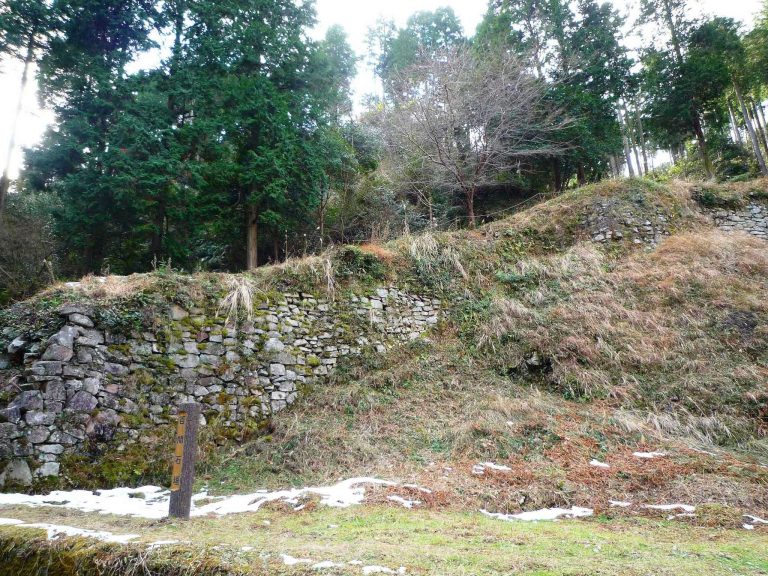
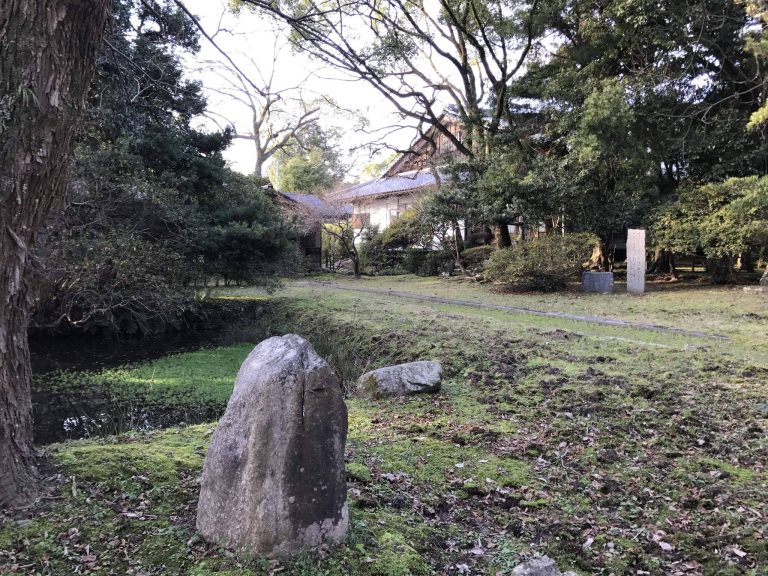
Mizuki is a straight, two-tiered earthwork about 1.2 kilometers long. It rises approximately 9 to 10 meters, measures about 80 meters across its base, and narrows to roughly 25 meters at the top. The embankment closes the narrowest passage between the mountain containing Ōno Castle, also called Shioji Mountain, and the Ushikubi plateau to the west. Its position blocked the plain between the Fukuoka area and Tsukushi, while two routes passed through the fortification toward the Fukuoka area.
The embankment crosses soft alluvial ground through which the Mikasa River flows northward. Its foundation contains large quantities of branches and leaves laid down using the shikisoda method, a technique for strengthening an earthwork’s base. Above this foundation, different soils were placed in successive courses about 10 centimeters thick and compacted into a dense defensive mass.
Gates, moat, and wooden conduit
Openings at the eastern and western ends served the two gates. The western route was the principal connection between Dazaifu and the diplomatic center in the Hakata area. A wooden conduit embedded across the base of the earthwork measures 79.5 meters long, 1.2 meters wide internally, and 0.8 meters high internally.
On the Hakata side, an outer moat lies approximately 5 meters below the present rice-field surface. It is about 60 meters wide and 4 meters deep. One interpretation holds that the Mikasa River supplied water to the moat. Another proposes that it was normally dry and that stored river water could be released during an attack. The latter explanation is considered less likely because storing the water would have been difficult and wooden water conduits existed.
Smaller Mizuki fortifications
Several shorter earthworks west of the main embankment close gaps between the hills and are collectively called the small Mizuki fortifications. The Kamidai small Mizuki has an embankment about 80 meters long, the Odoi small Mizuki measures about 100 meters, and the Tenjinyama small Mizuki extends for about 80 meters. The Sekiya and Toregi earthwork remains in present-day Kiyama are also regarded as small Mizuki fortifications associated with the defensive system leading toward Kii Castle.
The Mizuki station on the JR Kyushu Kagoshima Main Line takes its name from the fortification. Near the station, the railway passes through a cut made through the Mizuki earthwork.