Miyao Castle: A Sengoku-Period Fortification on Itsukushima


Site at a Glance
- Rating
- 3.7
- Popularity
- Very Low
- Country
- Japan
- Primary era
- Early Modern
- Eras represented
- Early Modern
- Civilizations
- Mōri
- Site type
- Military
- Remains
- Castle
On this page7 sections
History
Conflict in the Sengoku Period
Miyao Castle is a Japanese fortification on Itsukushima, also known as Miyajima, built by the regional warlord Mōri Motonari in 1555 during the Sengoku Period, an era of prolonged political fragmentation and warfare. Its construction formed part of Motonari’s plan to lure Sue Harukata into an exposed position and defeat him.
In 1551, Sue Harukata rebelled against his lord, Ōuchi Yoshitaka, who was then forced to commit seppuku, a form of ritual suicide associated with the samurai class and linked to honor after defeat or disgrace. Sue subsequently took effective control of the Ōuchi family and its armies, which ruled Aki Province. Motonari, a powerful regional lord and vassal of the Ōuchi clan, took up arms against him in 1554. Although greatly outnumbered, Motonari’s forces defeated Sue at the Battle of Oshikibata before Motonari returned to the island to oversee construction of the castle.
Construction and the Battle of Miyajima
About 1,000 laborers completed Miyao Castle in approximately one month. The hurried work prepared the fortification for the confrontation Motonari expected. Once construction ended, he went back to the mainland and left only a small garrison at the site.
In late September 1555, Sue Harukata attacked with overwhelming forces and captured the castle. Within days, Motonari and his allies began the Battle of Miyajima. One force approached by sea, while two others landed on the opposite side of the island, crossed the terrain, and struck the castle from behind. Using their knowledge of the landscape and the fortification’s weaknesses, Motonari’s forces surprised the defenders, killing, capturing, or dispersing them before retaking Miyao Castle. The battle became an important milestone in the history of western Japan.
Abandonment and Purification
No record establishes what became of Miyao Castle after the battle. Its temporary, hurried construction and its purpose as bait point toward abandonment by the Mōri clan. The castle also stood on sacred ground, where birth and death were traditionally not supposed to occur. After the battle, local Shinto priests performed elaborate purification ceremonies to remove the ritual pollution associated with death. The site was probably later stripped of timber and stone for use as construction material elsewhere.
Remains
Hilltop Fortification
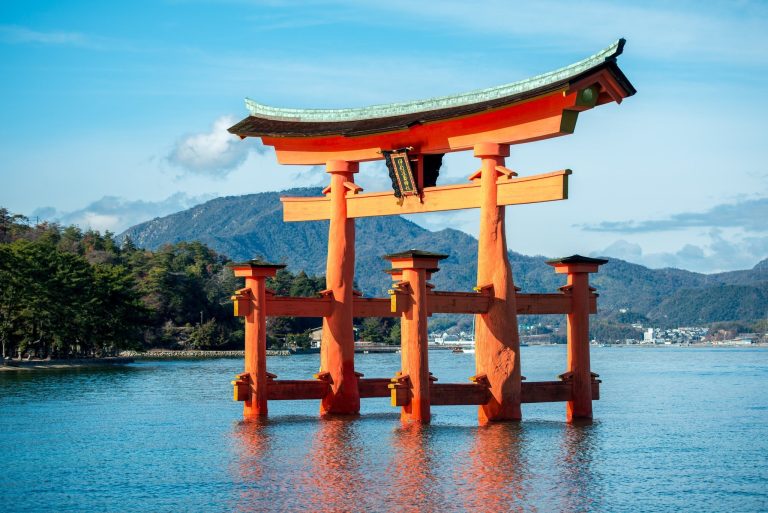
The former castle occupies Yōgai-san, a hill about 30 meters high in the northwestern corner of Itsukushima near Itsukushima Shrine. From this position, the fortification overlooked the channel between the island and the mainland. The site formed a hirayamajiro, or hill-on-plains castle, built on relatively low ground at the foot of steep-sided mountains, including Mount Misen, which rises to approximately 535 meters. The castle area could be approached from the sea on three sides, making its position highly visible while also leaving it relatively vulnerable.
Earth, wood, and stone formed the fortification. Its weakly tamped earthen foundation needed stone walls for support because it could otherwise have collapsed easily. Miyao Castle had no tenshu, the principal tower or donjon of a Japanese castle, and probably never possessed a permanent one. Its form and lack of residential character place it closer to a hill fort than to a fully developed castle intended for a landholding noble.
Surviving Site
The castle site is now a small park on the summit of Yōgai-san. An explanatory signboard and a small shrine occupy the former site, while the main courtyard area survives as the principal recognizable part of the fortification.