Kokuzen-ji Temple: A Buddhist Temple and Atomic-Bomb Survivor in Hiroshima


Site at a Glance
- Rating
- 4
- Popularity
- Low
- Country
- Japan
- Primary era
- Early Modern
- External website
- Open
- Eras represented
- Early Modern
- Civilizations
- Tokugawa
- Site type
- Religious
- Remains
- Monastery
On this page11 sections
History
Foundation and Asano patronage
Kokuzen-ji Temple is a Buddhist temple in Hiroshima, Japan, at the foot of Onaga-yama, also known as Futaba-yama. It originated in 1340 as Gyōnin-ji, founded by the monk Gyōnin, who maintained a hermitage there after becoming a disciple of the Buddhist priest Nichizō.
In 1656, Mitsuhime, the daughter of Maeda Toshitsune and wife of Asano Mitsuakira, the second lord of the Hiroshima domain, promoted the temple’s transformation into the Asano family’s mortuary temple, a place responsible for memorial and funerary observances for the family. It was renamed Kokuzen-ji. Mitsuhime rebuilt the main hall, while Asano Mitsuakira rebuilt the other temple buildings.
Religious change and institutional history
The temple’s affiliation changed from Shingon Buddhism to the Nichiren school, a Japanese Buddhist tradition centered on devotion to the Lotus Sutra. In 1692, during the suppression of the Fuju-fuse movement, a current within Nichiren Buddhism that rejected offerings exchanged with people outside the faith, Kokuzen-ji’s temple lands were confiscated.
The Asano family subsequently converted to the Tendai school, a separate Japanese Buddhist tradition, and transferred its mortuary temple to Nittsu-ji in Ushita. Kokuzen-ji remains a head temple of the Nichiren school and is classified as a temple with established historical standing. Its current head priest is the thirty-ninth in succession.
The 1945 atomic bombing and recovery
On August 6, 1945, the atomic bombing of Hiroshima affected Kokuzen-ji, approximately 2.60 kilometers from the hypocenter. The blast tilted the temple buildings toward the northeast, but they did not collapse.
Many survivors evacuated to the temple from the East Drill Ground south of the site. On August 7, an Imperial Japanese Navy aid station was established in the precincts, receiving especially seriously injured people. Medical teams from the Kure Naval District and civilian doctors from nearby areas worked there. On August 9, a unit of Army shipping troops from the Akatsuki Unit, subordinate to the Ujina Shipping Command, established a base at the temple for relief operations in the bombed area.
Partial repairs followed the war, although deterioration continued. The monastic kitchen and living quarters were repaired over three years beginning in 1988, and the main hall was repaired over five years beginning in 2001. The main hall and the monastic kitchen and living quarters became Important Cultural Properties of Japan on December 9, 1993. That year, Kokuzen-ji was also placed on Hiroshima’s list of surviving atomic-bombed buildings. In 1995, the gate and the precincts forming the approach were designated Hiroshima municipal Important Tangible Cultural Properties.
Remains
Principal buildings
Main hall
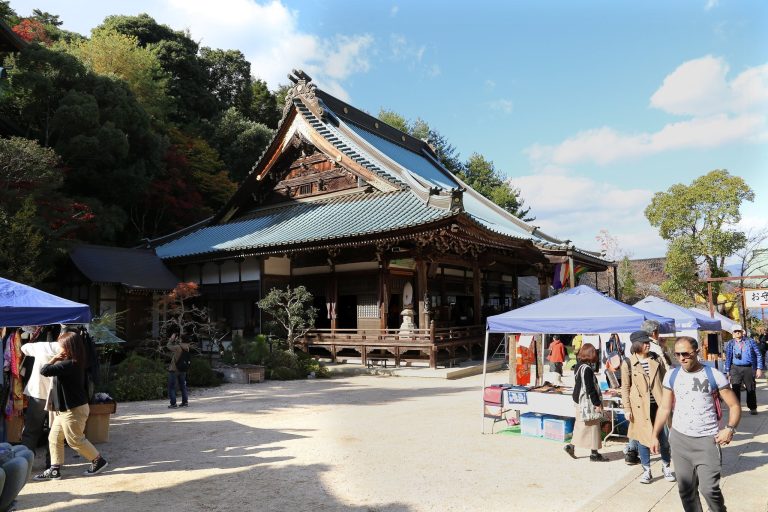
The main hall is a double-roofed building with a hipped roof and a karahafu, a curved gable, over its entrance porch. A worship room with a shikoro roof projects from the rear. This roof form has a lower section that overlaps or extends beneath the main roof, creating an armor-like profile. The hall was built in 1671, and four stone lanterns standing before it date from the same year.
The main hall was constructed by castle carpenters of the Hiroshima domain. Its design uses castle-building methods rather than the forms associated with ordinary temple or shrine architecture. The building was repaired over five years beginning in 2001 and is an Important Cultural Property of Japan.
Monastic kitchen and living quarters
The monastic kitchen and living quarters has a gabled structure with a shikoro roof. Its exact construction date is unknown because its ridge tag, a small record attached to the roof structure, does not survive. Its materials and building methods resemble those of the main hall, indicating that it was built either at the same time or slightly earlier.
Like the main hall, this building was constructed by Hiroshima domain castle carpenters using castle-building techniques. It underwent repairs over three years beginning in 1988 and is an Important Cultural Property of Japan.
Sanmon gate
The Sanmon gate was built in 1840. It is flanked by Nio, a pair of fierce guardian figures traditionally placed at Buddhist temple entrances. The gate and the precincts forming the approach received designation as Hiroshima municipal Important Tangible Cultural Properties in 1995.
Bell tower
The temple’s bell tower was rebuilt in 1906, adding a later element to the surviving complex.
Preserved religious and legendary objects
Kokuzen-ji preserves a wooden image of Kumarajiva, a major Buddhist translator of the fourth and fifth centuries whose Chinese translations of Buddhist scriptures became highly influential in East Asia. The image is described as the only one of its kind in Japan.
The temple also preserves a wooden mallet said to have been given by the demon king Yamamoto Gorozaemon to Heitaro, a figure associated with the supernatural tale Inō Mononoke Roku.