Yanai Chausuyama Kofun: A Keyhole-Shaped Burial Mound in Japan


Site at a Glance
- Rating
- 4.2
- Popularity
- Low
- Country
- Japan
- Primary era
- Classical
- External website
- Open
- Eras represented
- Classical
- Civilizations
- Unclassified
- Site type
- Burial
- Remains
- Burial Mound
On this page11 sections
History
Yanai Chausuyama Kofun is a keyhole-shaped burial mound in Yanai, Japan, built around the end of the fourth century during the late early Kofun period. The Kofun period, conventionally dated from the third to the sixth centuries, was an era of large elite tombs and expanding political relationships. Chausuyama Kofun occupies the eastern entrance to the former Yanai Strait, an inland sea route linking the Kinai region with Kyushu.
Formation and Regional Power
The mound is regarded as the first keyhole-shaped tomb in the Kumage area of southeastern Yamaguchi Prefecture. Other chiefly tombs and the ancient Ishijiyama Castle, a mountain fortress, are known in the wider area. Chausuyama Kofun’s large, formalized plan and pit-type stone burial chamber indicate that its occupant held strong political and military importance within the region.
An exceptionally large bronze mirror associated with the burial is considered to have been a gift from the Kinai Yamato polity, the early central ruling power based in the Kinai region. Its presence points to a close relationship between the local leadership and Yamato during a period when political connections were expressed through monumental tombs and prestige goods.
Discovery and Investigation
The site came to attention in 1892, when two local boys found the opening of a stone chamber. A local fire brigade excavated the chamber and recovered a large mirror, four smaller mirrors, swords, halberds, arrowheads, and several jars. Four bronze mirrors and one bronze arrowhead from this excavation are known to survive.
A monument commemorating the discovery was erected at the mound in 1893. The archaeologist Sueji Umehara examined the site in 1919, and his findings were published in 1921. Later excavations carried out from 1991 to 1995 combined preservation work with the development of the historic site. During the 1992 cleaning and reexamination of the first burial chamber, archaeologists found swords, a large iron sword overlooked during the earlier excavation, magatama beads, tubular jasper beads, fragments of bronze mirrors, and fragments of haniwa.
Protection and Interpretation
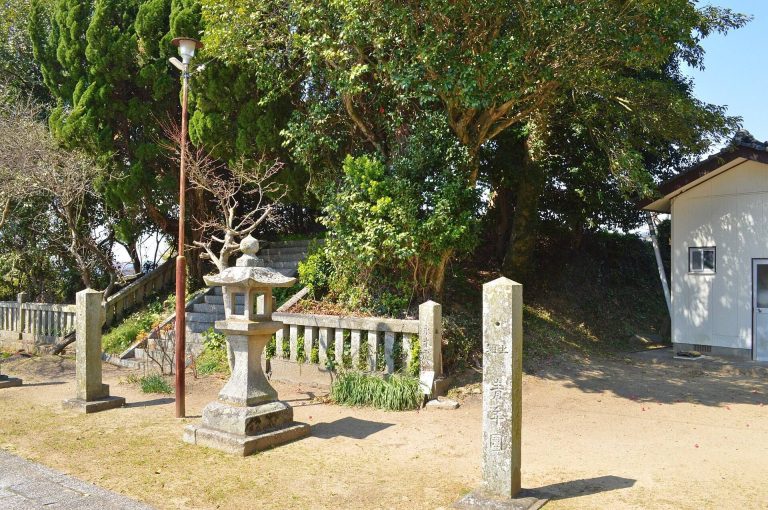
Chausuyama Kofun was designated a National Historic Site in 1948 under the name “Chausuyama Kofun.” Objects recovered from the mound received designation as Yamaguchi Prefecture tangible cultural properties in 1995 and 2007. The preserved mound forms the Chausuyama Kofun Historical Plaza, with an adjacent museum where associated mirrors, weapons, beads, and haniwa are displayed.
Remains
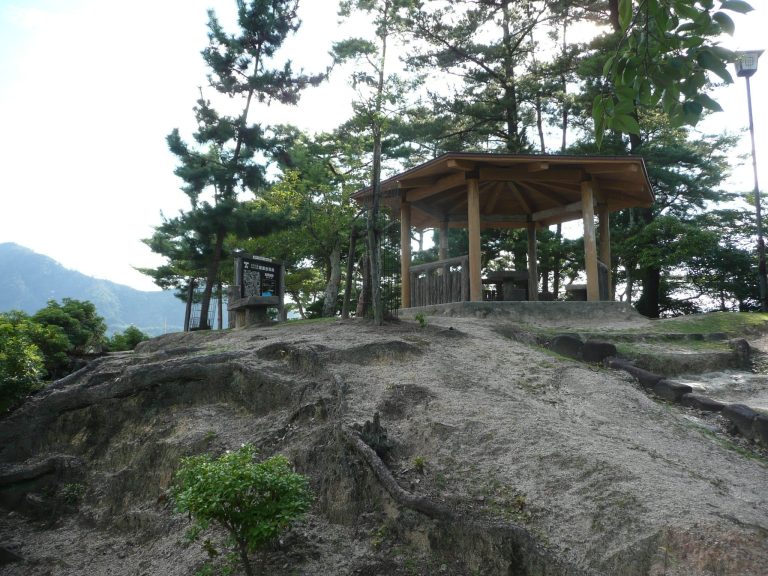
Yanai Chausuyama Kofun stands on the terminal ridge of a hill extending from Mount Kotoshiyama, at an elevation of about 68 metres, overlooking the Seto Inland Sea. Its keyhole-shaped plan combines a circular rear section with a projecting square front section. The front points south-southwest toward Yanai Bay. The mound measures approximately 90 metres in overall length, while the circular rear section is about 57 metres across and 8 metres high. The front section is estimated at about 40 metres wide and 4.5 metres high, and the connecting neck is about 34 metres wide.
Mound Construction and Layout
The rear section was built in three tiers and the front section in two. Much of the mound was cut directly from the natural ground, with added earth used in some areas. A terrace about 1.5 metres wide runs around the foot of the mound, while a second terrace continues between the rear and front sections. The third terrace of the rear section rises about 2.3 metres above the summit surface of the front section, and a slope links the two levels.
The steep ridge shaped the mound’s form. Its slopes descend toward the lower ground on the front side, the central axis bends in a roughly chevron-shaped line, and the front end is curved. The plans of the rear section’s tiers are not concentric. A trapezoidal projecting platform extends from the eastern side of the neck on the rear-section side. It stands slightly higher than, but is nearly continuous with, the second terrace.
On the northeast side, a cutting ditch follows the rear section through the ridge in a horseshoe-shaped curve. It measures approximately 6 metres wide and 20 metres long. The mound slopes were faced with fukiishi, stones laid over the surfaces of a burial mound, using river stones and mountain stones.
Haniwa Arrangements
Rows of cylindrical haniwa, ceramic objects placed on or around kofun, stood on the terraces and along the edges of the summit. They included morning-glory-shaped and pedestal-shaped examples, with the total number estimated at about 140. Jar-shaped, lid-shaped, and house-shaped haniwa were also placed on the summit. Together, these surviving forms reveal the range of ceramic objects used to mark and structure the mound.
Burial Facilities and Objects
First Burial Chamber
Two burial facilities lie on an east-west alignment beneath the summit of the rear section. The first is a pit-type stone chamber, a burial facility sunk into the mound and lined with stone. It was excavated in the Meiji period and cleaned again in 1992. Five bronze mirrors were associated with it, although one is missing. The group includes a picture-design belt deity-and-beast mirror and an inner-facing eight-petaled floral-pattern mirror.
One single-headed, double-bodied monster mirror, also described as a dragon mirror or transformed deity-and-beast mirror, is regarded as one of the largest bronze mirrors known from the Kofun period. Other objects from the burial include jade magatama, tubular jasper beads, bronze arrowheads, iron swords and blades, and fragments of bronze mirrors.
Second Burial Facility
The second burial facility remains unexcavated and is presumed to be a clay-coffin burial. This type of burial uses a coffin-like chamber formed from clay. Its position alongside the first facility indicates that the summit contained more than one burial arrangement, while the surviving excavated materials provide evidence of weapons, ornaments, and ceremonial objects associated with the mound.
Surviving Collections
Excavated materials are held by the Tokyo National Museum, the Yamaguchi Prefectural Museum, and the Chausuyama Kofun Museum, while many other artifacts are in private collections. Two bronze mirrors are preserved at the Tokyo National Museum, one at the Yamaguchi Prefectural Museum, and another at the Chausuyama Kofun Museum. The historical plaza museum also displays arrowheads, blades, beads, and cylindrical, morning-glory-shaped, pedestal-shaped, house-shaped, lid-shaped, and jar-shaped haniwa.