Daishō-in Temple: A Historic Shingon Buddhist Temple Complex on Miyajima


Site at a Glance
- Rating
- 4.6
- Popularity
- Medium
- Country
- Japan
- Primary era
- Modern
- External website
- Open
- Eras represented
- Medieval, Modern
- Civilizations
- Japanese
- Site type
- Religious
- Remains
- Monastery
On this page19 sections
History
Daishō-in Temple is a Japanese Buddhist temple complex in Japan, located on Miyajima in Hatsukaichi, Hiroshima. Traditionally founded in 806 by Kūkai, the ninth-century founder of Shingon Buddhism, it developed as an important religious center associated with Mount Misen, Itsukushima Shrine, and the Omuro branch of Shingon Buddhism. The temple formally bears the mountain name Taki-san and was historically known as Suishō-ji.
Origins and early records
Tradition holds that Kūkai established the temple after crossing to Miyajima and undertaking religious practice on Mount Misen. This connection has not been confirmed, and the institution’s precise beginnings remain uncertain. The earliest written references to Suishō-ji appear in records from 1177.
Earlier interpretations placed medieval Suishō-ji on the mainland opposite Miyajima. Finds of Nara- and Heian-period green-glazed pottery and Buddhist vessels near the main hall on Mount Misen have encouraged another interpretation, namely that the institution was already present on the island in antiquity.
Imperial patronage and shrine administration
An imperial order attributed to Emperor Toba, a twelfth-century ruler of Japan, designated the temple as an institution that prayed for the peace and security of the state. A main hall was also traditionally said to have been built under his command.
By 1180, Daishō-in served as the bettō-ji, or Buddhist administrative temple responsible for a shrine’s religious affairs, of Itsukushima Shrine. It supervised Buddhist-associated rites and shrine monks, giving it a central position in Miyajima’s religious organization during the long period when Buddhist and Shinto institutions were combined.
Ninnaji affiliation and sixteenth-century prominence
From the twelfth century, Daishō-in became a subsidiary temple of Ninnaji in Kyoto and part of its Omuro branch, a major Shingon lineage historically centered on that temple. Imperial and aristocratic support helped Daishō-in reach a peak in the sixteenth century. It was reportedly among the most influential temples in the Ninnaji system and once administered twelve subsidiary temples.
An imperial prince and monzeki, a high-ranking cleric often drawn from the imperial family or aristocracy, became a long-term resident of Daishō-in during the sixteenth century. His attachment to Miyajima led him to remain there, and he died on Itsukushima in 1586. He was later revered as “Itsukushima Omuro,” a title reflected in one of the temple’s historical names.
Daishō-in also hosted important literary gatherings. Toyotomi Hideyoshi, the military ruler who unified Japan, held a poetry meeting in the temple garden in 1592. Earlier linked-verse gatherings had involved the warrior, statesman, and poet Hosokawa Yusai in 1587 and the poet Satomura Shobaku in 1590.
Meiji transformation and rebuilding
Until the Meiji period, Daishō-in retained authority over Itsukushima Shrine and controlled extensive temple lands. The government’s 1868 policy of separating Buddhism and Shinto ended this religious system, removed the temple’s shrine-administrative authority and privileges, and confiscated much of its land.
Emperor Meiji, who ruled Japan during the Meiji period, used Daishō-in as temporary lodging during his visit to Itsukushima Shrine on 31 July 1885. A fire in 1887 destroyed most of the temple buildings. The halls, gates, and monastic buildings visible today were progressively rebuilt or developed after the disaster through the efforts of successive monks and local residents. Repair of the Mount Misen trail was completed in the early twentieth century with a donation from Itō Hirobumi, a major Meiji-era statesman and Japan’s first prime minister.
Recent disasters and continuing religious roles
A typhoon on 27 September 1991 caused extensive damage on Mount Misen and in the temple’s main precinct. A major memorial service marking restoration of the damaged areas took place on 10 October 1998.
In 2006, a ceremony consecrating a statue of Maitreya marked the 1,200th anniversary of the traditional foundation. The fourteenth Dalai Lama participated in the anniversary observances from 3 to 8 November. Daishō-in remains one of three major Japanese temples associated with protection from misfortune and the granting of good fortune. It is also the fourteenth temple of the Chūgoku Thirty-Three Kannon pilgrimage, the first temple of the Sanyō Flower Temples pilgrimage, and the eighty-seventh temple of the Hiroshima New Shikoku Eighty-Eight-Temple pilgrimage.
Including Mount Misen, the temple lies within the World Heritage area associated with Itsukushima Shrine. Its religious and cultural standing is also reflected in its position as a major Omuro-branch temple and in its holdings designated as national Important Cultural Properties.
The Reikadō, or Sacred Fire Hall, burned completely in 2005 and was rebuilt in 2006. On the morning of 20 May 2026, it burned again and the building was destroyed. The sacred fire had been removed and divided among separate custodians beforehand, allowing the fire itself to survive. An initial investigation found no evidence of arson.
Remains
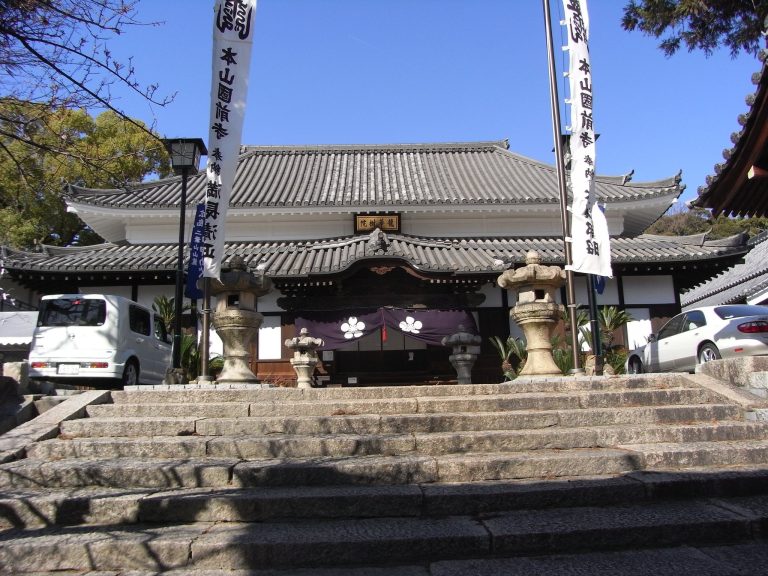
Daishō-in forms a hillside complex distributed along Mount Misen and around the main precinct near Itsukushima Shrine. The lower precinct contains numerous halls and facilities, while further buildings stand near the mountain summit. The approach begins at the Niōmon Gate and rises by stone steps to the Onari Gate, also called the Imperial Messenger Gate. The central passage of the latter was historically reserved for imperial messengers, while ordinary worshippers generally used a side passage. Maple trees, many small Buddhist images, and the elevated mountain setting form part of the surviving physical character of the grounds.
Main precinct halls
Main Hall and Imperial Prayer Hall
The main hall is traditionally attributed to the command of Emperor Toba. Nearby, the Imperial Prayer Hall, also known as the Toba Imperial Prayer Hall, enshrines Nami-kiri Fudō Myōō, a form of Acala associated with calming waves and protecting voyages. The image held particular importance for warrior elites and was reportedly placed aboard Toyotomi Hideyoshi’s flagship during the expedition to Korea, where prayers were offered for safe passage and military success.
Kannon Hall and Star-Offering Mandala Hall
The Kannon Hall houses an Eleven-Headed Kannon, a form of the bodhisattva of compassion whose multiple heads represent expanded compassionate response. During the period when Buddhist and Shinto practices were combined at Itsukushima Shrine, the image was regarded as the Buddhist counterpart of the shrine’s deity. It was transferred to Daishō-in after the 1868 separation policy. The Star-Offering Mandala Hall stands beside the Kannon Hall, with a pond garden in front of this group of buildings.
Maniden and prayer wheels
The Maniden is a two-story prayer hall at the top of the main staircase. It enshrines the Three Oni Gongen, a local protective religious figure or group honored at Mount Misen. Although Daishō-in is a Shingon Buddhist temple, worship at the hall retains Shinto-style practice, including two ritual claps. Images of tengu outside the building serve as protective symbols, and the second floor provides a broad view over Miyajima.
Numerous rotating prayer wheels, called mani wheels, line the stairs leading toward the Maniden. Worshippers turn them while climbing, an action understood to produce the religious merit of reciting the Great Perfection of Wisdom Sutra.
Mount Misen buildings and sacred fire
Summit halls
Daishō-in’s summit buildings on Mount Misen include the Mount Misen Main Hall, the Dainichi Hall, the Reikadō, and the Sanki Hall. The Mount Misen Main Hall enshrines Akasagarbha and serves as the eighty-eighth station of the Hiroshima New Shikoku Eighty-Eight-Temple pilgrimage.
Reikadō and the Undying Fire
The Reikadō stood near the summit, about a one-and-a-half-hour walk from the main precinct. It housed the “Undying Fire,” traditionally said to have been lit by Kūkai during his practice on Mount Misen in 806 and to have continued burning for more than 1,200 years. The hall was destroyed by fire on 20 May 2026, but the flame survived because it had been removed and distributed before the building burned.
The fire was traditionally maintained with firewood. In May 2022, a copper lamp using wax fuel was installed in the Reikadō to help stabilize the flame. Part of the original flame was also used for the Peace Flame at Hiroshima Peace Memorial Park.
Devotional buildings and objects
Daishi Hall and Henjōkutsu
The Daishi Hall is among the oldest surviving buildings in the precinct. Beneath it lies Henjōkutsu, an artificial cave containing a pilgrimage path covered with sand from the eighty-eight pilgrimage temples of Shikoku.
Treasure Hall and Fudō Myōō
The Treasure Hall houses a wooden seated image of Fudō Myōō measuring 98.7 centimeters in height. Carved from a single block of wood, the figure is generally dated to the latter half of the tenth century. It was transferred from Shinjoin at Ninnaji in 1920 and is designated a national Important Cultural Property. The image was formerly enshrined in the Dainichi Hall on Mount Misen and is traditionally attributed to Kūkai.
Bell Tower and great bell
The Bell Tower contains a great bell weighing two hundred kan. It was recast in a style modeled on the Yellow Bell mode of Myoshinji Temple in Kyoto. The bell itself is an early object associated with the Heian period. An inscription naming Taira no Munemori as its donor in 1177 is regarded as a later engraving, while the bell’s form retains features of old bells, including high striking bosses and a dragon-shaped suspension fitting set at right angles to the line connecting them.
Other halls and devotional images
The grounds include the Eight-Sided Manpuku Hall, Amida Hall, Aizen Hall, Yakushi Hall, Mizukake Fudō Hall, the Gokuraku Kannon Hall, and a kitchen-knife memorial mound. The Eight-Sided Manpuku Hall enshrines the Seven Lucky Gods, while the Yakushi Hall houses the Medicine Buddha and the Twelve Heavenly Generals.
Other devotional images include figures of the Child Kōbō-Daishi, the One-Vow Daishi, the Seven Lucky Gods, and other Buddhist figures. The One-Vow Daishi is believed to grant a single wish. The Shaka Parinirvana Hall contains a gilded reclining image of Shakyamuni Buddha and figures of the Sixteen Arhats. A Buddha-foot stone beneath the hall is provided for worship.