Minowa Castle: A Regional Stronghold in Kōzuke, Japan
Site at a Glance
- Country
- Japan
- Primary era
- Medieval
- Eras represented
- Medieval
- Civilizations
- Takeda
- Site type
- Military
- Remains
- Castle
On this page8 sections
History
Minowa Castle is a hilltop stronghold in Japan, built in 1512 by a leader of the Nagano clan as the family’s residence and seat of power in western Kōzuke Province. Its construction fell within the Muromachi period, an era of shogunal rule. As warfare among regional powers intensified during the later Sengoku period, the castle became a focus of conflict and a regional headquarters for successive warrior houses.
Nagano rule and regional conflict
An alternative tradition places the castle’s construction in 1526 and credits the leader’s son. The Nagano claimed descent from Ariwara no Narihira, a nobleman and poet of the Heian period. In 1546, Hōjō Ujiyasu defeated Uesugi Norimasa at the Battle of Kawagoe. Norimasa, a senior deputy associated with authority in the Kantō region, suffered another defeat at the hands of Takeda Shingen’s forces the following year. Nagano Narimasa then shifted his allegiance to the Hōjō. Norimasa fled to Echigo in 1558, while Hōjō, Takeda, and Uesugi forces continued to contest the region.
When Uesugi Kenshin campaigned to regain Kōzuke in 1560, the Nagano returned to the Uesugi side. Narimasa died around 1561, though 1560 is also possible. His son Narimori succeeded him as a teenager, with estimates placing his age at either 14 or 17. The family concealed Narimasa’s death for a time. Tradition holds that he instructed them to forgo a funeral, bury him at the clan’s mortuary temple, and resist surrender even at the cost of their lives. When Shingen learned of the death, he renewed his invasion.
The Takeda capture and rule
By about 1565, Minowa was increasingly isolated. The following year, a Takeda force of about 20,000 besieged the castle. A counterattack defeated a sortie led by Kamiizumi Nobutsuna, and the stronghold fell. Narimori died by suicide in its innermost enclosure. Nobutsuna reportedly continued to resist in a small part of the castle. Shingen allowed him to leave unharmed and invited him to join the Takeda, but Nobutsuna refused.
The Takeda made Minowa their regional headquarters in Kōzuke. Its appointed castle commanders, or castellans, included Sanada Yukitaka and Naitō Masatoyo. Masatoyo took command around 1570 and was killed at the Battle of Nagashino in 1575; his son succeeded him at the castle.
Changing rulers and abandonment
After the Takeda fell in 1582, Oda Nobunaga assigned Kōzuke to his retainer Takigawa Kazumasu. Kazumasu took control of Minowa before moving to another castle. Following Nobunaga’s death in the Honnō-ji Incident on June 2, Hōjō Ujimasa and his son Ujinao invaded Kōzuke. They defeated Kazumasu at the Battle of Kannagawa on June 18 and 19. Naitō Masatsuki and nearby lords submitted, and Hōjō Ujikuni entered Minowa.
During Toyotomi Hideyoshi’s 1590 campaign against the Hōjō, forces led by Maeda Toshiie and Uesugi Kagekatsu attacked Minowa, and its garrison surrendered. After Tokugawa Ieyasu received the Kantō region, he granted the castle to Ii Naomasa with a holding assessed at 120,000 koku, a measure of land value based on rice yield. Naomasa expanded and modernized the stronghold, then moved his seat to the newly built Takasaki Castle in 1598. Minowa was abandoned. Place-names from its western district were also used in Takasaki’s castle town, carrying local names into the new settlement. The site became a National Historic Site on December 17, 1987.
Remains
Ridge and enclosure layout
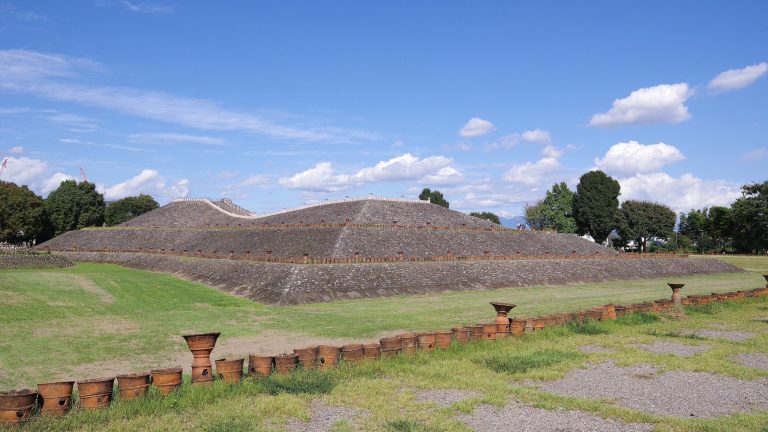
The castle occupied a ridge extending southwest from Mount Haruna, on a hill about 30 metres high. The Shirakawa River ran through a deep valley to the west, while Haruna Marsh lay to the south; both formed natural defenses. The position also commanded routes west toward Shinano Province and north toward Echigo Province. The site covered about 47 hectares and measured roughly 1,200 metres from north to south and 400 metres from east to west. Its enclosures followed a tiered arrangement, also described as roughly three concentric layers, with two small ridges at the southern end.
Entrances and outer defenses
The original main entrance stood at the southwestern edge of the ridge. A large gate with an enclosed, angled approach was later built beside the river. Under the Takeda, an outer defensive work in front of a gate, known as the Maru Umadashi, protected the exposed northeastern edge. A crescent-shaped dry moat lay in front of its gate.
Walls, moats, and surviving features
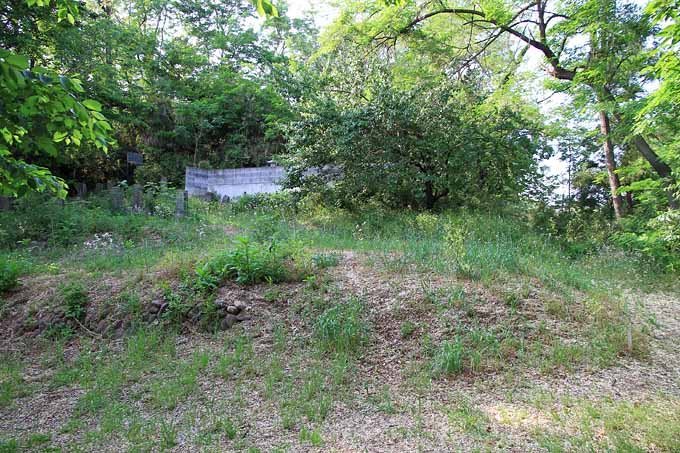
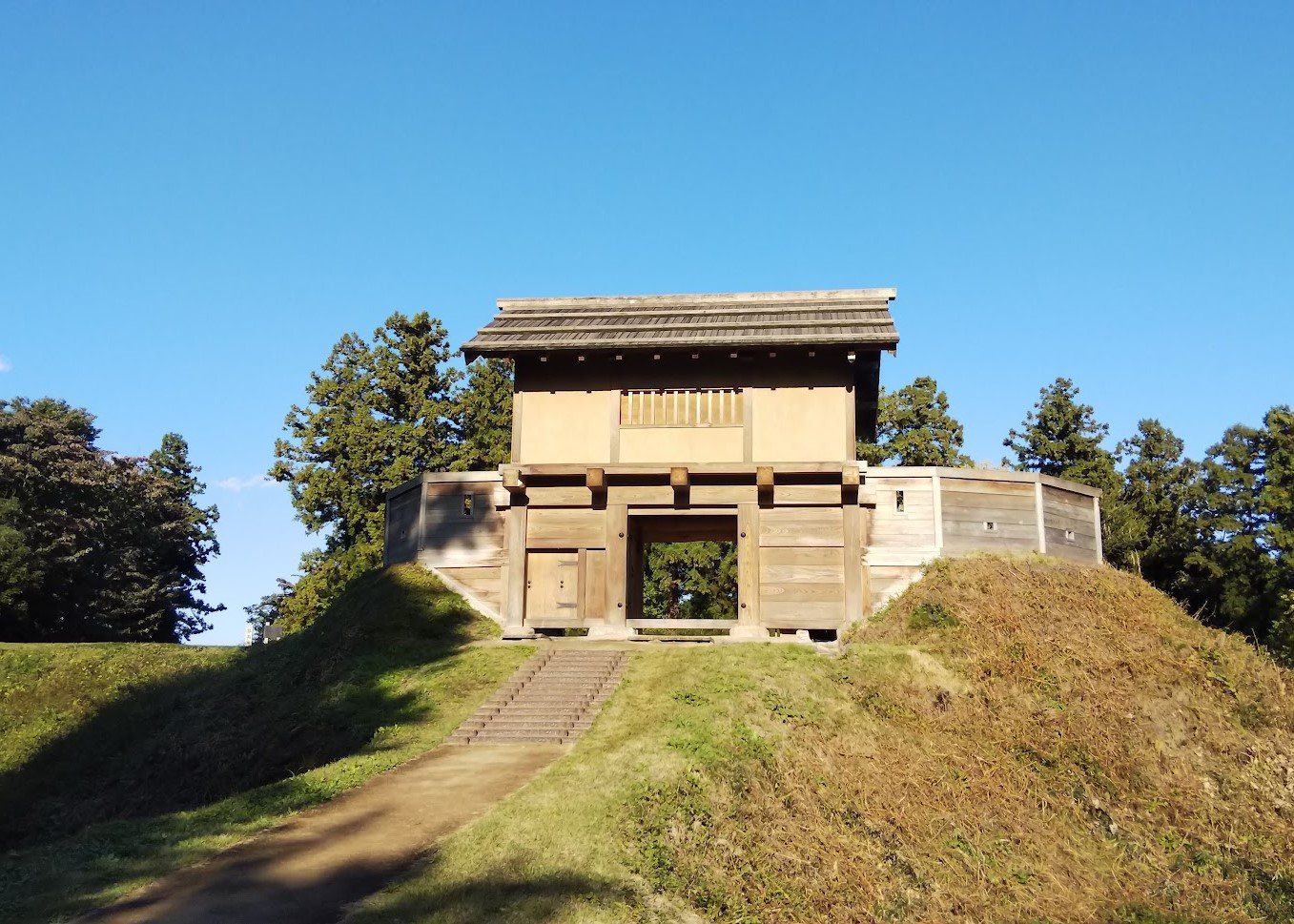
Under Ii Naomasa, deep, wide dry moats were dug, and stone walls replaced earthen ramparts along the principal route into the castle. The ruins retain stone walls, earthworks, dry moats, outer defensive works, and wells. A timber reconstruction of the western entrance gate to the main enclosure’s outer defensive work was completed in 2016.