Hōtōzan Kofun: A Late Kofun-Period Burial Mound in Japan


Site at a Glance
- Rating
- 4.1
- Popularity
- Very Low
- Country
- Japan
- Primary era
- Medieval
- Eras represented
- Medieval
- Civilizations
- Yamato
- Site type
- Burial
- Remains
- Burial Mound
On this page9 sections
History
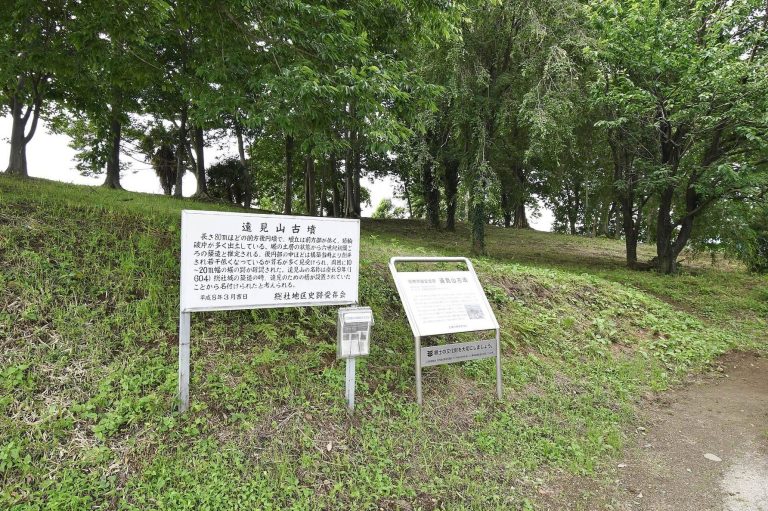
Hōtōzan Kofun is a Japanese burial mound in Maebashi, Japan, built around the middle of the seventh century during the final phase of the Kofun period. It stands within the Sōja Kofun Cluster on the Maebashi upland, west of the Tone River and at the southeastern foot of Mount Haruna. Also known as Sōja Town No. 9 Mound, it is the largest of the cluster’s three major square mounds and ranks among the largest monuments of this type in eastern Japan from the final Kofun period.
A monument in late Kofun-period Sōja
Hōtōzan followed Atagoyama Kofun and preceded Jaketsuzan Kofun. These three large square mounds represent successive monuments in the political development of the region from the late sixth to the seventh century. Their form belongs to a period when square burial mounds, known in Japanese as hōfun, were being built after the end of the keyhole-tomb tradition that had characterized many earlier elite burials.
The mound’s scale and contents differ markedly from those of other regional monuments of the same broad period. Its stone-processing techniques, shared with Jaketsuzan Kofun and the Sannō Abandoned Temple Site, connect the burial mound with wider changes in the Sōja area. Along with its relationship to the Yamato polity, the powerful authority centered in the Kinai region that later formed the basis of the Japanese imperial state, this evidence helps explain the emergence of Sōja as a political and cultural center of ancient Kōzuke Province, the historical province corresponding broadly to present-day Gunma Prefecture. The area later became the setting for the provincial capital, a provincial Buddhist temple, and a provincial nunnery.
Later history and investigation
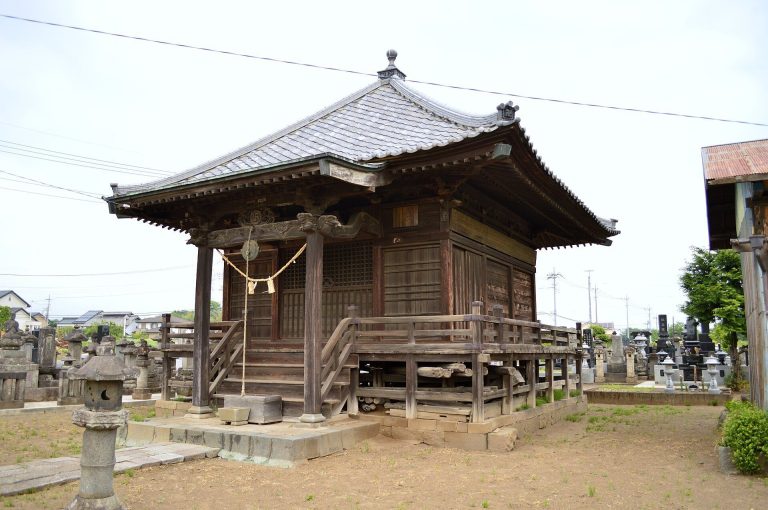
The burial chamber had been open since antiquity, making its original grave goods impossible to establish. During the Edo period, the Akimoto clan cemetery was created on the mound’s summit. The Akimoto clan ruled Sōja Domain from 1601 to 1633, and the cemetery contains the graves of successive clan leaders. It has a separate designation as a Maebashi City historic site.
Hōtōzan Kofun was described in the 1786 diary Yamabuki Nikki. A measured plan of the stone chamber was prepared in 1920, and the chamber interior was measured again in 1956. Archaeological investigation began with work on the entrance passage in 1968. The area before the stone chamber and its forecourt were restored in 1969, while the National Museum of Japanese History surveyed and measured the mound, chamber, and sarcophagus in 1990.
Further investigations accompanied construction of the Sōja Community Center in fiscal years 2007 and 2009, followed by excavation during road improvements in fiscal year 2011. Additional excavation took place in fiscal year 2021. Three-dimensional recording of the stone chamber was then carried out in fiscal year 2022 and again in fiscal years 2023 and 2024. Hōtōzan Kofun became a National Historic Site on November 13, 1944. The protected area was enlarged on October 11, 2021, and on February 21, 2024, two more mounds were added to the designation, which was renamed the Sōja Kofun Cluster.
Remains
Mound and surrounding layout
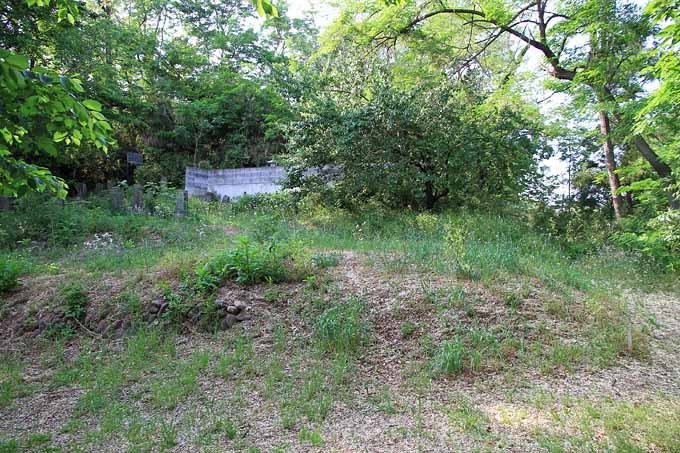
Hōtōzan Kofun is a square mound measuring approximately 66 meters on each side and 12 meters high. Its main axis runs 32 degrees east of north. Built in three tiers, it was partly faced with fukiishi, stones laid over the surface of a burial mound. A moat about 18 meters wide surrounds it, giving the monument and moat an overall extent of roughly 102 meters per side. Jaketsuzan Kofun lies about 120 meters to the east, while the designated areas of the two mounds are separated by approximately 20 meters. Jaketsuzan has a more strongly northward orientation, with its axis 13 degrees east of north, and its layout includes an outer bank and a further ditch beyond the moat.
Stone burial facility
Chamber and entrance
The burial facility is a finely constructed, double-sleeved horizontal stone chamber, meaning that side projections or recessed sections frame the entrance area. It opens toward the southwest and measures 12.04 meters in total. The complex contains a main chamber, an antechamber, an entrance passage, and a forecourt. It was built on a platform about 3 meters above ground level, with the forecourt probably cut into that platform.
The main chamber is 3.32 meters long, 2.90 meters wide at the rear wall, and 2.09 meters high. The antechamber measures 3.90 meters long and 1.95 meters wide, while the entrance passage is 3.56 meters long and 1.77 meters wide. A single enormous stone forms the rear wall, and another forms the main chamber ceiling. Precisely cut blocks make up the side walls of the main chamber and entrance passage. Pillar-like details frame the entrance and intermediate doorways. Thick plaster survives on the inner surfaces, together with red construction lines made during the chamber’s construction.
House-shaped sarcophagus
At the center of the main chamber stands a hollowed-out, house-shaped stone sarcophagus carved from pyroxene andesite. Such a sarcophagus resembles a dwelling and consists of a separate lid and coffin body. Its long axis lies across the axis of the chamber. The sarcophagus is 2.30 meters long, 1.30 meters wide, and 1.33 meters high. Its lid measures 2.28 meters long, 1.30 meters wide, and 0.43 meters high, with two pairs of square rope-holding projections on the long sides and one pair on the short sides. The coffin body measures 2.08 meters long, 1.12 meters wide, and 0.90 meters high.
Each side of the sarcophagus base carries a carved lattice-like panel. These recessed or cut-out designs are unusual and have been interpreted as evidence of Buddhist cultural influence. The form of the chamber has also been compared with that of Obitoke-Koganezuka Kofun in Nara.
Associated objects and interpretation
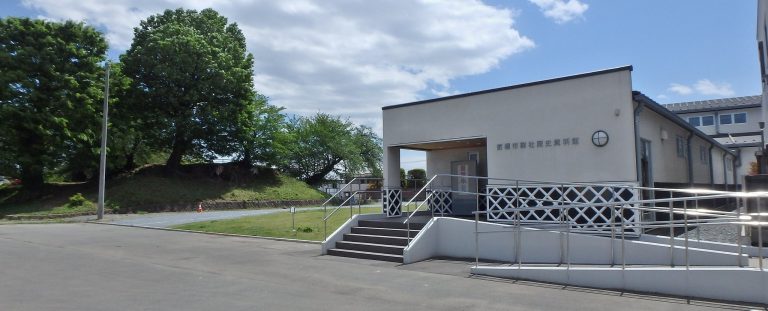
A single-edged sword traditionally said to have come from Hōtōzan Kofun has a blade 57 centimeters long and a total length of 71 centimeters. A model of the stone chamber and a replica of the house-shaped sarcophagus are displayed at the Maebashi City Sōja Historical Museum.