Hodota Kofun Cluster: Keyhole-Shaped Burial Mounds in Japan


Site at a Glance
- Rating
- 4.2
- Popularity
- Low
- Country
- Japan
- Primary era
- Classical
- External website
- Open
- Eras represented
- Classical, Medieval
- Civilizations
- Yamato
- Site type
- Burial
- Remains
- Necropolis
On this page8 sections
History
The Hodota Kofun Cluster is a group of three large burial mounds in Japan, located at the southern foot of Mount Haruna in Takasaki, Gunma. Built during the Kofun period, approximately from the third to the sixth century, the mounds date from the late fifth century into the first half of the sixth century and use the characteristic keyhole-shaped form that combines a circular rear mound with a square front section. They are considered likely burial places of an influential aristocratic lineage.
Formation of the cluster
The three mounds were probably constructed in sequence. Futagoyama Kofun, the largest and oldest, generally dates to the late fifth century. Hachimanzuka Kofun was probably built during the fourth quarter of the fifth century, followed by Yakushizuka Kofun as the youngest member of the group.
Hachimanzuka preserves evidence of an elaborate arrangement of figurative haniwa, clay funerary objects placed around or on burial mounds. Its animal figures included a cormorant carrying a fish, a form regarded as possible evidence that cormorant fishing already had a ritual or ceremonial role during the Kofun period. An investigation in 1929 confirmed an area where these figures had been arranged, and the results were published in 1932.
Yakushizuka preserves clues to a volcanic event during its construction. Volcanic-ash deposits occur in its outer moat but not its inner moat, suggesting that the outer moat was dug first and that an eruption of Mount Haruna took place before the inner moat was completed. The mound’s smaller quantity of haniwa has been interpreted as possibly reflecting the human and economic damage caused by that eruption.
Investigations and preservation
Futagoyama was investigated in 1930 by the Tokyo Imperial Museum and Gunma Prefecture under the central direction of Goto Shuichi. Further investigations followed in 1971–1972 and 1984. Related archaeological work at the cluster continued from at least 1929, including an investigation of Yakushizuka in 1988 that clarified its probable original dimensions and moat arrangement.
A tradition associated with Saiko-ji, a Buddhist temple, holds that Yakushizuka was excavated in 1683 after a dream revelation. The stone coffin was reportedly found filled with vermilion, together with burial objects and a statue of Yakushi, the Buddha associated with healing and medicine. Objects from the cluster and information about it are displayed at the neighboring Kamitsuke-no-Sato Museum of Archaeology.
The cluster became a National Historic Site in 1985, and the designated area was enlarged in 2003. It forms part of the Kamitsukenu Haniwa-no-sato History Park, of which approximately 63,000 square meters lies within the nationally designated cultural-property zone. A group of objects excavated at Hodota was designated an Important Cultural Property in 1939. Burial objects from Yakushizuka, including a floral-design mirror, cast-bronze horse fittings, and beads, are preserved at Saiko-ji and also hold that designation.
Remains
Layout of the cluster
The three kofun, monumental Japanese burial mounds, occupy distinct positions within the site. Futagoyama lies to the southwest, Hachimanzuka to its northeast, and Yakushizuka to its northwest. The centers of the mounds are approximately 320 meters and 290 meters apart. Each mound has a keyhole-shaped plan, with a circular rear section joined to a square front section, and the earthworks were reinforced with stone revetments, or coverings of laid stone.
Futagoyama
Formally designated the Ide Futagoyama Kofun and also called Atagozuka, Futagoyama is approximately 108 meters long. Its circular rear section is about 74 meters across and 10 meters high, while its square front section is about 71 meters wide and 7 meters high. The mound was built in three tiers and surrounded by two horseshoe-shaped moats. Four small islands occupied the inner moat around the rear section, including positions near the narrow junction and the rear slope. River-stone revetments covered the mound, islands, and intervening banks, while rows of cylindrical haniwa encircled the earthwork.
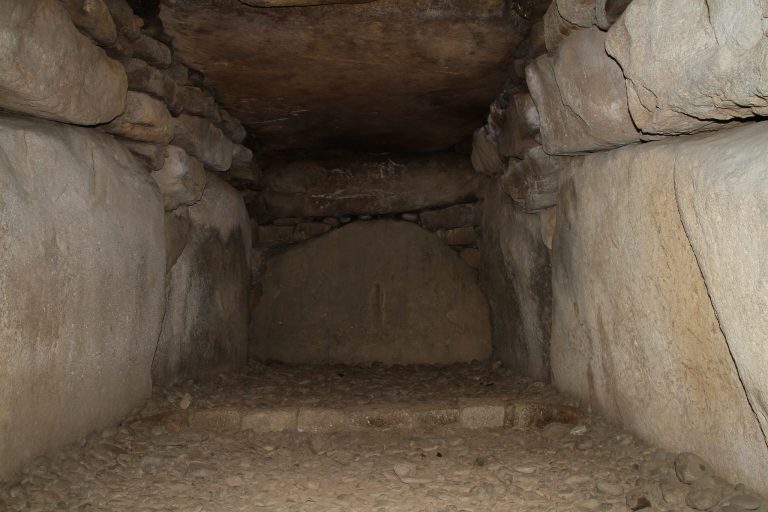
An enclosed area extended from part of the northern intermediate bank to the outside of the outer moat’s northwestern corner. Its figurative haniwa represented people, a harnessed horse, wild boar, dogs, shields, parasols, and houses. Near the summit of the rear section, the principal burial facility consisted of a pit-like stone chamber lined with river stones, or a stone coffin covered in that way. It held a boat-shaped coffin made from tuffaceous andesite or tuff, approximately 2.3 to 2.4 meters long.
The coffin had been disturbed and robbed. Its lid is missing, and the eastern side of the body is broken, but fragments of a helmet, lamellar armor, iron arrowheads, an iron spear, gold ornaments, gilt-bronze shoes, agricultural tools, beads, horse fittings, stone imitations of objects, and a decorated sword were recovered. A bronze mirror probably also accompanied the burial. The stone coffin was later reburied about one meter below the summit to protect it.
Hachimanzuka
Hachimanzuka measures approximately 102 meters in length. Its circular rear section is about 56 meters in diameter and survives to around 6 meters high. The upper part of the square front section was shaved away, leaving its height unknown, although its width is approximately 53 meters. Two horseshoe-shaped moats and an additional narrow outer ditch enclosed the mound. Four small islands were placed within the inner moat near the narrow junction and behind the rear section. Stone revetments covered the mound, and cylindrical haniwa stood along the mound foot, island edges, and intermediate bank.
In front of the square section, cylindrical haniwa formed a rectangular enclosure on the intermediate bank. Figurative examples represented warriors, shrine maidens, falconers, horses, chickens, wild boar, and water birds. One wild-boar figure had detached from a hunter figure. The best-known piece is a cormorant with its head raised and a fish held in its beak. A cord with a bell hangs around the bird’s neck, and the object is held by the Kamitsuke-no-Sato Museum of Archaeology.
The burial pit was cut into two levels in the rear mound and measured approximately 5 by 4 meters. It contained an east–west-oriented boat-shaped tuff coffin packed around with gravel. Including its rope knobs, the coffin is 3.5 meters long and 1.5 meters wide. Its interior was painted red, the body remains complete, and two-thirds of the lid survived. The coffin contained no objects, while jasper tubular beads, glass comma-shaped beads, and miniature iron agricultural tools were found around it, including a sickle, a yanaganna scraper, an axe, and a hoe blade.
South of the coffin, a stone-paved area secured with white clay represents a probable second burial facility, likely a stone-lined pit made later than the coffin. Armor scales and a straight sword were reportedly found there during the Meiji period. Saiko-ji preserves objects said to have come from Hachimanzuka, including a gilt-bronze cheek plate, a lozenge-shaped horse pendant, and a straight sword. A Haji ware pedestal cup from the eastern island imitates an early Sue ware pedestal cup and is thought to date to the beginning of the later Kofun period. Sue ware was a high-fired ceramic tradition, while Haji ware was made from lower-fired earthenware.
Yakushizuka
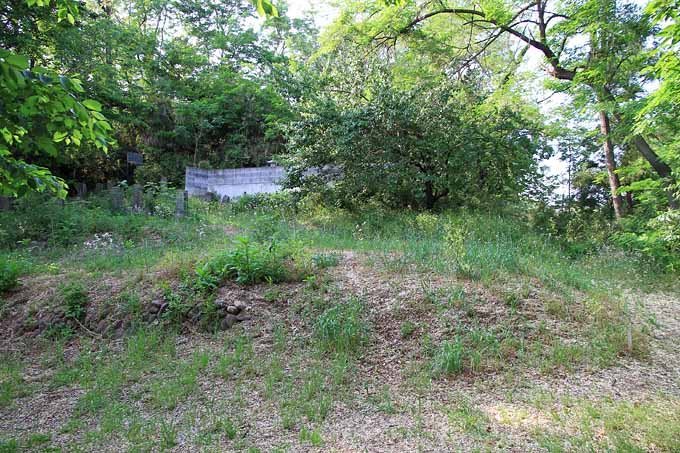
Yakushizuka’s surviving mound is approximately 70 meters long because its southern and eastern sides were substantially cut away by the buildings and cemetery of Saiko-ji. Excavation in 1988 indicated an original length of about 105 meters, a rear-section diameter of approximately 66 meters, and a front-section width of about 70 meters. The mound probably had two surrounding moats, although they did not form a complete circuit. Stone revetments and haniwa formed part of its construction.
A boat-shaped stone coffin made of tuff was excavated during the Edo period. Its body measures up to approximately 3 meters long and 1.4 meters wide, and it is preserved in a protective shelter on the summit. Burial objects associated with Yakushizuka include an inner-rayed floral-design mirror, cast-bronze horse fittings, and beads. Across the cluster, excavated objects also include agate and lapis-lazuli comma-shaped beads, jade tubular and spherical beads, bronze fittings, sword points, floral fittings, and bronze bells.