Mildenstein Castle: An Imperial Castle and Administrative Centre in Germany




Site at a Glance
- Rating
- 4.7
- Popularity
- Medium
- Country
- Germany
- Primary era
- Medieval
- External website
- Open
- Eras represented
- Medieval, Modern
- Civilizations
- Holy Roman Empire, Margraviate of Meissen
- Site type
- Military
- Remains
- Castle
On this page17 sections
History
Mildenstein Castle is a medieval castle in Germany, standing above the Freiberger Mulde at Leisnig, and was probably established as an imperial castle during the tenth century. The rocky spur had already been settled before the castle was founded. Known as Burg Leisnig in the High Middle Ages, it became a governing centre of the Imperial Territory of Pleißenland and later served administrative, judicial, residential, and cultural purposes.
Imperial origins and the Burgraves of Leisnig
The castle first appears in the written record in 1046, when Emperor Heinrich III granted the Burgwards of Colditz, Rochlitz, and Leisnig to his wife, Agnes of Poitou. A Burgward was an early medieval fortified administrative centre and the district governed from it. In 1084, Heinrich IV enfeoffed the castle to Wiprecht of Groitzsch.
Through the marriage of Wiprecht’s granddaughter Mathilde to Rapoto of Abenberg, Mildenstein passed to the Franconian count in 1143. Rapoto sold it in 1148 to Duke Friedrich III of Swabia, the future Emperor Friedrich I Barbarossa. In 1158, Barbarossa restored the castle to imperial property and granted it as a fief to the Burgraves of Leisnig. Imperial property was land held directly by the emperor, while a burgrave was a territorial or military governor associated with a castle.
As an imperial possession, Mildenstein administered part of the Pleißenland. The Burgraves of Leisnig became powerful regional rulers, founded Buch Abbey in 1192, and acquired further lordships, including Mutzschen, Lauterstein, Waldheim, and Rochsburg.
Conflict and the loss of imperial status
In the early thirteenth century, Mildenstein was the seat of the imperial ministeriales family von Mildenstein. Ministeriales were unfree servants of high status who could hold military and administrative authority. After the family lost a dispute over tithes from former church properties, Margrave Henry the Illustrious captured the castle in 1232.
During the fourteenth century, the Burgraves of Leisnig lost influence to the Margraves of Meissen. Their territories around Leisnig and Altenburg passed to Margrave Frederick the Serious after 1329. In 1365, the family lost its direct relationship with the Empire, known as imperial immediacy, and was compelled to sell its burgraviate. It retained possessions around Rochsburg and Penig before dying out in 1538.
Wettin administration and later historical phases
After 1365, Margrave Wilhelm I ordered a major rebuilding of Mildenstein for representative purposes. This work gave the complex much of its later appearance, although the castle did not become a residence. Under the Wettins, the ruling dynasty that governed Saxony, it remained the seat of the local administration known as the Amt Leisnig.
The castle and the town suffered severe damage during the Thirty Years’ War. The forward section was especially affected, and civilian houses increasingly occupied it afterward. The area eventually became part of Leisnig itself.
In 1706 and 1707, Stanisław Leszczyński, a Polish king and claimant involved in the struggle for the Polish crown, stayed temporarily at Mildenstein while Swedish forces occupied the Electorate of Saxony. His stay was connected with negotiations associated with the Peace of Altranstädt.
During the eighteenth and nineteenth centuries, the castle housed regional judicial institutions, first the Justice Office of Leisnig and later the district court. It also contained a prison and apartments for officials. The prison continued in use until 1952.
Park, museum, and cultural use
From 1798, the Mirus family created a Romantic park around the castle. Its features included artificial ruins and a rock tunnel built in 1866. Museum use began in 1890 through the Leisnig Historical and Antiquarian Society.
A local zoological park was established on the grounds in 1964. It temporarily held more than 150 animals representing 30 species and forms before closing in 1990. Mildenstein Castle is now owned by the Free State of Saxony and administered by State Palaces, Castles and Gardens of Saxony. The complex functions as a museum and venue for concerts and other cultural events.
Remains
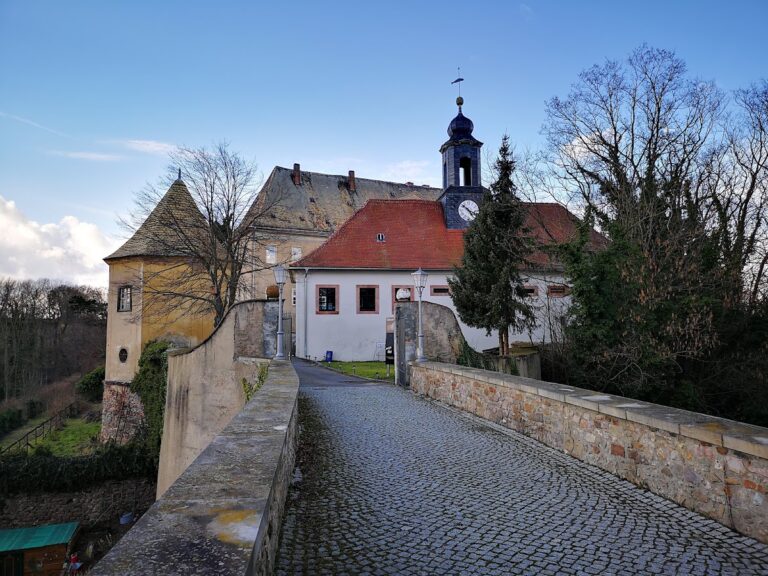
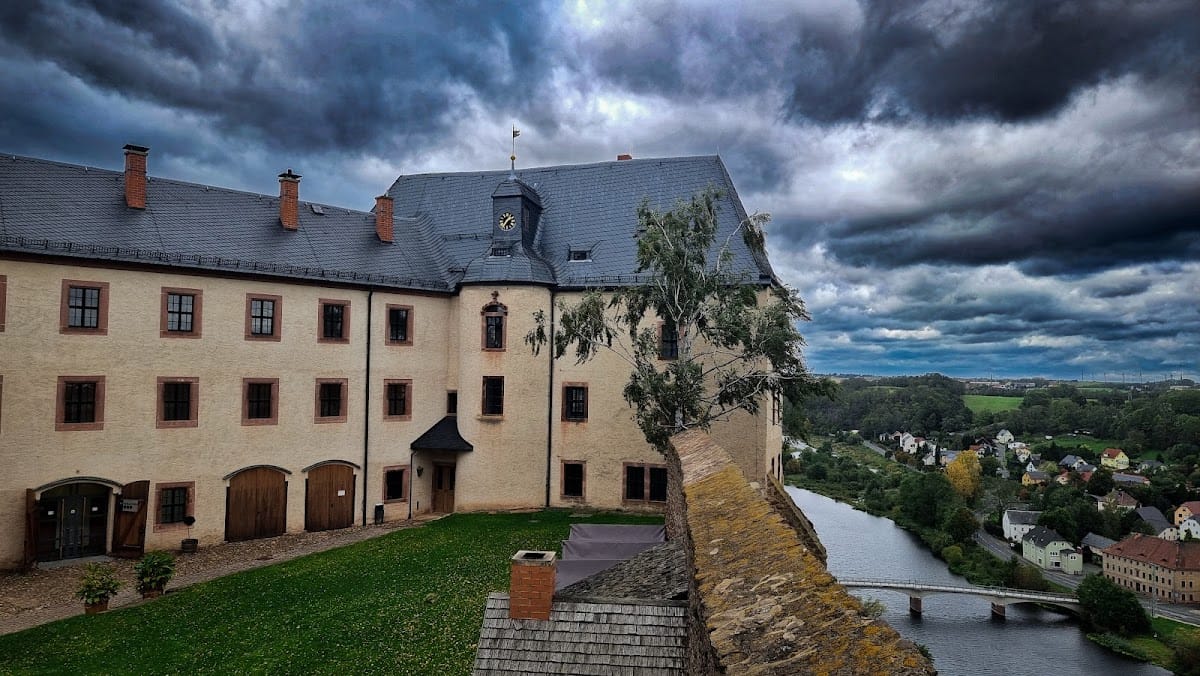
Mildenstein Castle occupies a fortified spur above the Freiberger Mulde, at the northern edge of Leisnig opposite Fischendorf. The spur is a former lava dome formed from pre-Mesozoic rhyolite, including the local stone known as Leisniger Quarzporphyr. The large hilltop complex is arranged as a rear castle, middle castle, forward castle, and a former second outer ward. Two principal fortified towers reflect the scale and defensive importance of the medieval complex.
Early castle buildings and defenses
Chapel
The chapel dates from around 1100, or more broadly from the twelfth century, and is the oldest surviving building in the complex. It was rebuilt around 1400 and enlarged with a Gothic choir between about 1400 and 1420. These alterations preserved the building while changing its form during the later medieval rebuilding of the castle.
Inner bergfried
The bergfried in the inner courtyard was built in the late twelfth century. A bergfried was the principal fortified tower of a medieval German castle, used chiefly for defense and refuge rather than as a permanent residence. The tower is 32 metres high and 14 metres in diameter. Its lower section is constructed from locally found quartzite blocks, while bricks were used above approximately eight metres.
The tower’s former high entrance lies about 13 metres above the courtyard. It could be reached by ladders, rope ladders, or a removable wooden stair. Increasing dilapidation led to the dismantling of part of the tower in 1791. After restoration in 1875, it was used as an observation tower and remains climbable.
Gatehouse and defensive walls
The gatehouse dates from the late twelfth or early thirteenth century. Defensive walls and towers were substantially developed during the same period, forming the principal fortified framework of the inner and middle parts of the castle.
Outer-ward bergfried
A second bergfried in the outer ward was built during the first half of the thirteenth century. Another later and separate outer-ward bergfried survives as a ruin in the urban area in front of the forward castle, within the former Burglehn district. That area, once associated with the residences of the castle men, is not part of the museum-operated castle grounds.
Forward castle
Fourteenth-century rebuilding
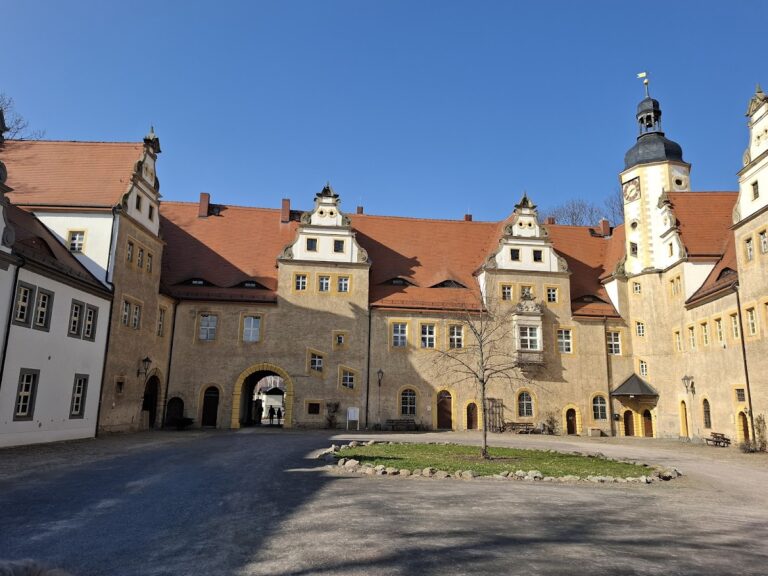
Near the end of the fourteenth century, the forward castle was rebuilt under Margrave Wilhelm I. Its principal buildings include the granary, or Kornhaus, the Herrenhaus, or lord’s residence, and the Pagenhaus, or squires’ quarters. This rebuilding produced much of the complex’s present appearance.
Interior rooms and exhibitions
The forward castle contains a reconstructed Knights’ Hall, an official’s office, vaulted cellars, and granary floors, including one dated 1374. The Herrenhaus contains a Black Kitchen and an exhibition on the court of the young rulers. The permanent museum displays address Christian art, life at the castle when it served as a noble residence, early-modern administration, and the history of the prison system. Special exhibitions vary in subject.
Objects associated with the museum
Giant Boot of Döbeln
A 2.48-metre-high riding boot known as the Giant Boot of Döbeln was displayed in the castle museum from 1957 to 2010. It was made in 1925 for the six-hundredth anniversary of the Döbeln shoemakers’ guild and is now displayed in Döbeln town hall.
Later oversized boot
In 1996, two Leisnig shoemakers produced another boot, measuring 4.90 metres in height. It is exhibited in a building near the castle and is regularly used in parades.