Mirwart Castle: A Medieval Fortress and Country Residence


Site at a Glance
- Rating
- 4.2
- Popularity
- Low
- Country
- Belgium
- Primary era
- Medieval
- External website
- Open
- Eras represented
- Medieval, Early Modern, Modern
- Civilizations
- Duchy of Lorraine, Holy Roman Empire
- Site type
- Domestic
- Remains
- Castle
On this page10 sections
History
Mirwart Castle is a medieval castle complex in Saint-Hubert, Belgium, whose earliest fortifications were built at the beginning of the eleventh century by Lorraine rulers or a Lorraine lord. Raised to protect the territory from the lords of Bouillon and Orchimont, it occupied a strategic position above the Valley of the Lomme. The site later developed through repeated destruction, rebuilding, military strengthening, and conversion into a country residence.
Conflict with Saint-Hubert Abbey
During the eleventh century, the lords of Mirwart came into conflict with the monks of Saint-Hubert Abbey, a powerful religious institution involved in territorial affairs. Henry of Verdun, Prince-Bishop of Liège, supported the abbey’s side. A prince-bishop combined the authority of a bishop with secular rule over a territory, making the Prince-Bishop of Liège an important political power in the region. Henry reinforced the castle sometime between 1077 and 1082, but complaints from the abbey led to the fortress being dismantled in 1083.
Prince-Bishop Otbert opposed the destruction and recovered control of the fief. In 1099, he ordered the fortress rebuilt and granted Mirwart as a feudal holding to Bovon de Waha, a medieval knight and feudal lord. Bovon’s descendants continued the rebuilding and held the castle for almost two centuries.
Medieval transfers of power
In 1293, Jean d’Avesnes acquired the fief. The Prince-Bishop of Liège contested the transaction because it had taken place without his consent. The resulting dispute drew in Prince-Bishop Jean de Sponheim, the counties of Hainaut, Luxembourg, Namur, and Loon, and the Duchy of Brabant, each seeking influence over Mirwart.
Control later passed to Jean of Luxembourg. Unable to pay the agreed transfer sum, he was forced to surrender Mirwart to Prince-Bishop Adolphe II de La Marck. The castle consequently came under the control of the dukes of Burgundy. In 1471, Duke Charles the Bold granted the lordship to Eberhard van der Marck-Arenberg of the House of La Marck.
The Peace of Ryswick in 1697 confirmed Mirwart’s separate status. The castle belonged to the counts van der Marck while remaining under the patronage of the Prince-Bishops of Liège.
Sieges and the end of the fortress
Mirwart endured several sieges during conflicts involving the Netherlands and Spain, and later during wars between the Habsburg monarchy and France. It changed hands repeatedly, suffering damage before being rapidly repaired and strengthened for military use. Its defenses continued to be modernized until 1678. After the late seventeenth century, however, Mirwart no longer served as a fortress under siege.
At the beginning of the eighteenth century, the castle was completely restored and gradually converted from a military stronghold into a prestigious residence. It remained under the ownership of the Diocese of Liège, but the work reduced much of its strongly fortified character.
A country residence and twentieth-century decline
In the nineteenth century, Mirwart was acquired by Aimé-Gabriel d’Artigues, the industrialist who founded the Vonêche glassworks. The property later passed through the families Van der Linden d’Hoogvorst, d’Arrigade, and von der Becke, who further embellished it as a country residence.
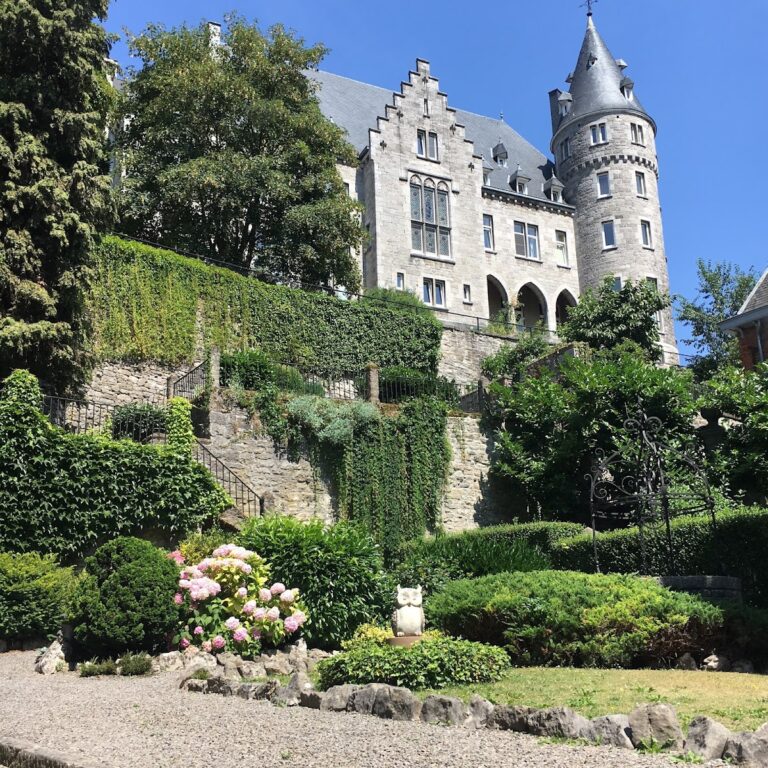
The last major rebuilding took place in the middle of the nineteenth century under a project by Alphonse Balat, a leading Belgian architect who also worked for King Leopold II of Belgium. This campaign established the architectural appearance associated with the modern complex.
Mirwart suffered little damage during the First and Second World Wars because fighting took place away from the castle during the two German occupations. After the Second World War, its owners could no longer maintain or restore it, and the authorities of Luxembourg Province assumed responsibility. A renovation campaign ended in 1951, but the province could not find a suitable use for the building. The castle was gradually abandoned during the 1950s, and valuable furnishings, decorative fittings, and historic paintings were removed from its interiors.
After unsuccessful efforts to attract an investor, Luxembourg Province ended an agreement with a later owner who had not carried out the promised restoration. The castle was sold to ICM SA in 2016, after which extensive repair and restoration work began. Mirwart is a classified heritage site in Wallonia, with its protection recorded in 2012.
Remains
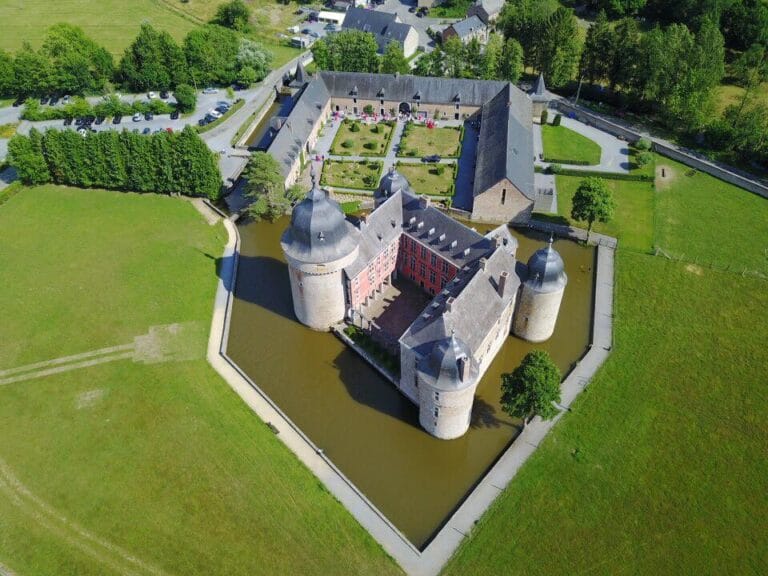
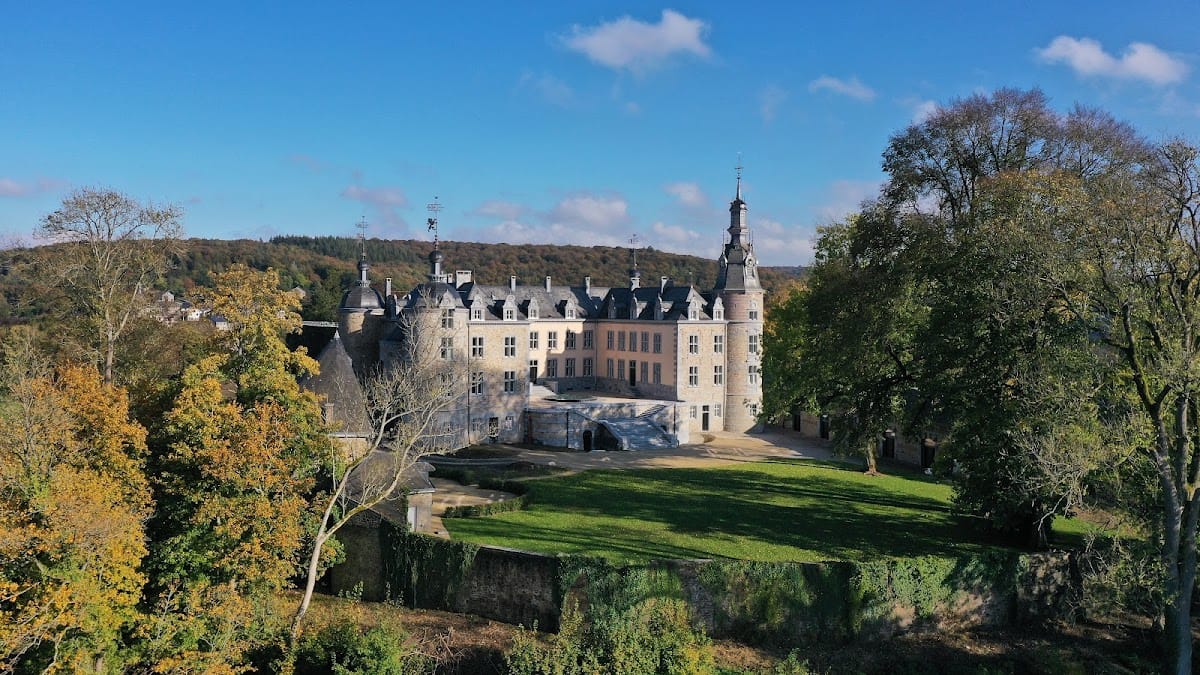
Mirwart is a palace-and-castle complex built on a rocky promontory above the Valley of the Lomme. Its surviving fabric combines the remains and successive rebuilding phases of an early fortified stronghold with the later forms of a residential château. Stone and brick are the principal construction materials. Medieval and early-modern defensive work was repeatedly reinforced before eighteenth- and nineteenth-century alterations reshaped the complex as a refined country residence.
Fortress and residential transformation
Early fortified stronghold
The oldest surviving parts date from the eleventh century and belong to the early fortified complex established on the hilltop. The castle’s defensive character developed through repeated reinforcement during the medieval and early-modern periods. Damage caused by sieges was followed by repairs and further military strengthening, while later restoration and remodeling incorporated the earlier stronghold into the expanded complex.
Residential château
The eighteenth-century restoration began the physical transformation from fortress to prestigious residence. Later nineteenth-century work, particularly the project associated with Alphonse Balat, gave the complex its modern architectural appearance. Stone and brick construction remained part of the building’s fabric, while the residential alterations reduced the emphasis on military defense and added the character of a country estate.
Condition and restoration
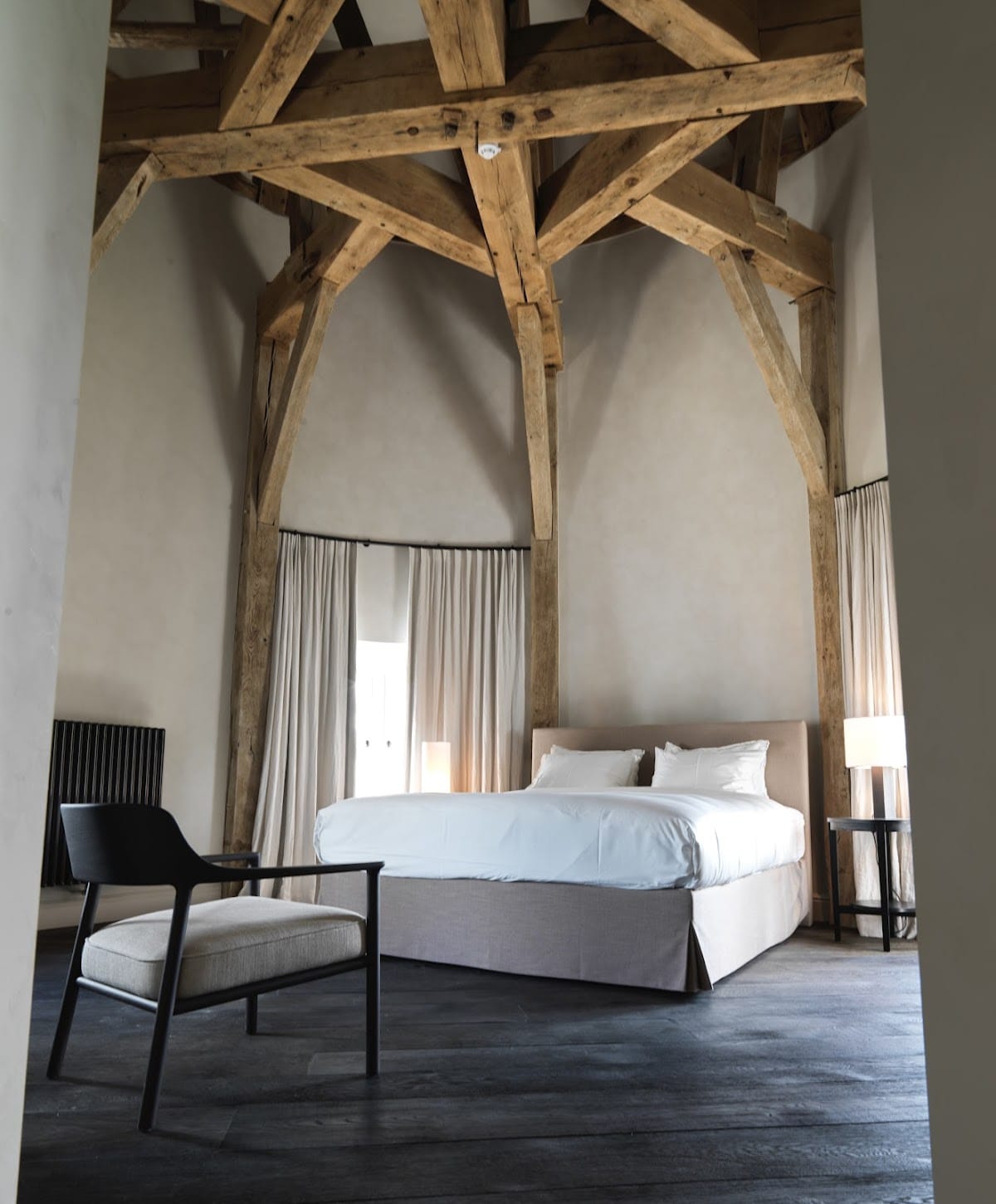
The interiors suffered serious damage during the period of abandonment in the 1950s. Furniture, decorative elements, and old paintings were removed, leaving the building in need of substantial repair. Large-scale restoration work began after the 2016 sale to ICM SA and has sought to repair the castle and conserve the surviving complex.