Mikami Shrine: A Sacred Mountain Shrine in Japan

Site at a Glance
- Rating
- 4.2
- Popularity
- Low
- Country
- Japan
- Primary era
- Medieval
- External website
- Open
- Eras represented
- Medieval
- Civilizations
- Ashikaga shogunate, Kamakura shogunate
- Site type
- Religious
- Remains
- Sanctuary
On this page15 sections
History
Mikami Shrine is a Shinto shrine in Yasu, Shiga Prefecture, Japan, whose buildings at the present site were commissioned in 718 under an imperial order during the early eighth century. Its religious setting is Mount Mikami, a 432-metre mountain also known as Ōmi Fuji, which serves as the shrine’s shintai, the sacred natural feature believed to house a kami, or divine presence. The shrine’s history combines mountain worship, court patronage, warrior support, and long-continuing agricultural and seasonal rites.
Mountain worship and early foundations
Shrine tradition places the beginning of worship on the summit of Mount Mikami. Ame-no-mikage-no-mikoto is said to have descended there on the eighteenth day of the sixth month during the sixth year of Emperor Kōrei’s reign. A descendant of the deity, serving as priest, then enshrined the mountain as a sacred object. Ame-no-mikage-no-mikoto is associated with ritually purified fire and is traditionally described as a child of Amatsu-Hikone and grandchild of Amaterasu.
The exact historical foundation of Mikami Shrine remains uncertain, but ritual activity around the mountain reaches back much further than the shrine buildings at the present precinct. Investigations at Ōyama Rock, near the foot of Mount Mikami, recovered twenty-four bronze bells between the Meiji and Shōwa periods. These objects indicate ritual use of the area by at least the Yayoi period. The bells belong to the type of bronze ritual instrument known as a dōtaku.
The eighth-century shrine and court recognition
In 718, Fujiwara no Fuhito, an influential aristocrat and statesman of the early eighth-century imperial court, ordered the construction of shrine buildings at Kayakihara, the present location of the shrine. Hida craftsmen carried out the work, using kaya wood, and the deity was transferred from the mountain to the new buildings. Kayakihara already contained a place from which worshippers could venerate Mount Mikami at a distance.
The shrine’s recorded estate was described as including a thousand chō each of mountain, river, and agricultural land. It extended across more than fifty villages, from Yokota in Kōka District downstream toward the Yasu and Yoshikawa rivers. The extent of this estate reflects the institutional resources associated with the shrine in the ancient period. The deity’s court rank also rose over time, from Junior Fifth Rank, Lower Grade, in 859 to Junior Fifth Rank, Upper Grade, in 859, Senior Fourth Rank, Lower Grade, in 865, and Junior Third Rank in 875. Shrine tradition later assigns the deity Senior First Rank during the reign of Emperor Yōzei, from 876 to 884.
In 927, Mikami Shrine appeared in the Engishiki, a tenth-century compendium of court regulations and ritual procedures. Its register recognized the shrine as a major shrine of Yasu District in Ōmi Province and listed it among institutions receiving imperial offerings for monthly rites and the Niiname harvest ceremony. In 974, Emperor En’yū designated Mikami an imperial prayer site.
Medieval devotion and later institutional changes
A temple called Tōkōji stood at the foot of Mount Mikami from antiquity through the medieval period. It was traditionally said to have included many halls and other buildings, and its extent was represented in the historical plan known as the “Old Mikami Site Map.” The shrine also attracted the devotion of Minamoto no Yoritomo and successive military leaders. Warrior governments continued to donate estates and arrange repairs to its buildings through the period of the Edo shogunate.
Modern state classifications altered the shrine’s formal status. Mikami Shrine became a county shrine in 1876, was raised to prefectural-shrine rank in 1913, and was elevated in 1924 to Kanpei-taisha, an imperial shrine of the second rank. After the Second World War, it entered the separate shrine category of the Association of Shinto Shrines.
Protection and repair also shaped the surviving complex. The honden, worship hall, and gate received special protection in 1899, followed by government-supported dismantling and repairs. The honden became a National Treasure in 1952, together with its attached shrine cabinet. The worship hall, gate, and Wakamiya Shrine honden are Important Cultural Properties, while the Sannomiya Shrine honden is a tangible cultural property of Shiga Prefecture.
Festivals and continuing rites
The autumn ancient festival on October 14 is commonly called the Zuiki Festival. Said to have begun before the Kamakura period, it was formerly known as the Wakamiya Hall Sumo Ritual. The ceremony gives thanks for the autumn harvest and prays for the continuation of descendants. Five portable shrines made from zuiki, the dried stem of a taro plant, are offered, and children perform sumo during the Shibahara rite. The festival preserves medieval parishioner organization and ritual practices and is designated a National Important Intangible Folk Cultural Property.
The principal festival takes place on May 14. Other continuing observances include rice planting at the Yuki Sacred Rice Paddy, the mountain and divine-manifestation rites on the eighteenth day of the sixth lunar month, the Dragon King Festival, seasonal purification ceremonies, fire and sacred-clothing rites, and the Niiname Festival on November 23. The Yuki Sacred Rice Paddy was designated during Emperor Shōwa’s accession as the field for rice presented at the 1925 Niiname Festival. Rice planting there in traditional clothing has continued as an annual rite.
Remains
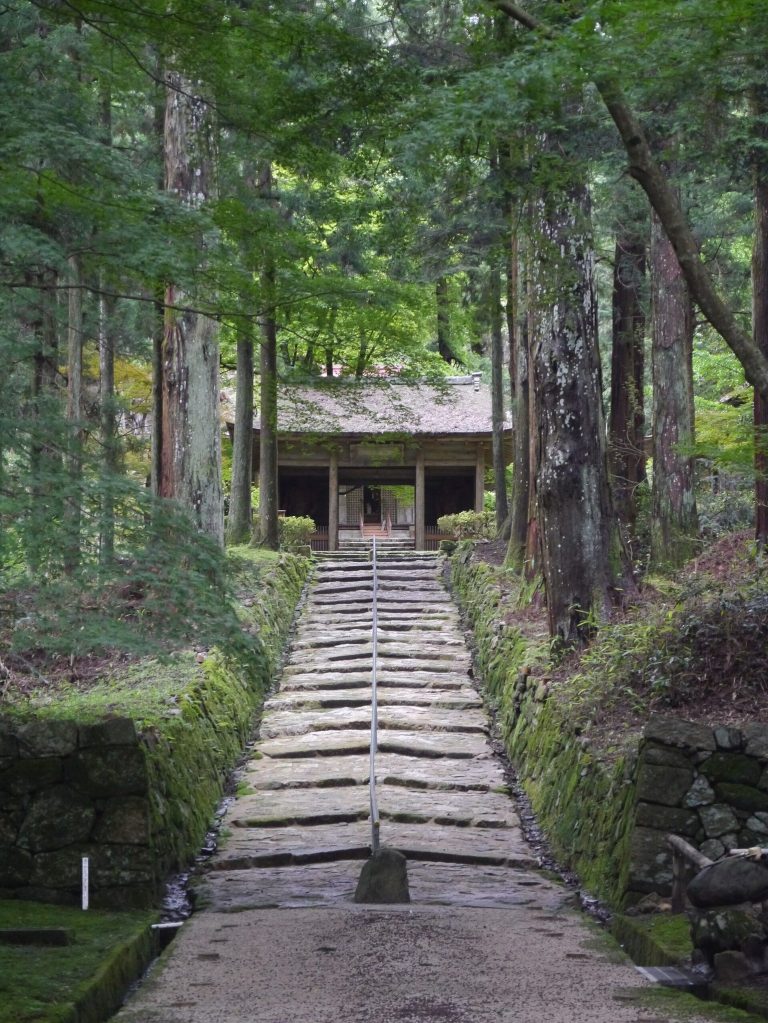
The precinct lies at the foot of Mount Mikami, which rises to the east beyond National Route 8. The honden stands in the northern part of the grounds and faces south, while the mountain’s sacred summit contains the Okumiya and Okutsu Rock Seat. The surviving complex includes the principal shrine buildings, subsidiary shrines, a mikoshi hall, a treasure storehouse, shrine offices, and a temporary festival sanctuary at the mountain’s foot. The buildings combine shrine, Buddhist-temple, and aristocratic residential elements, a distinctive arrangement known as the Mikami style.
Principal shrine buildings
Honden
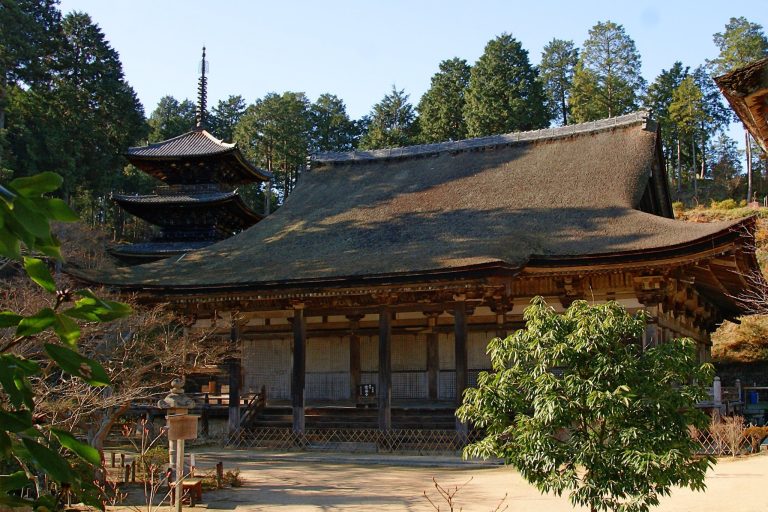
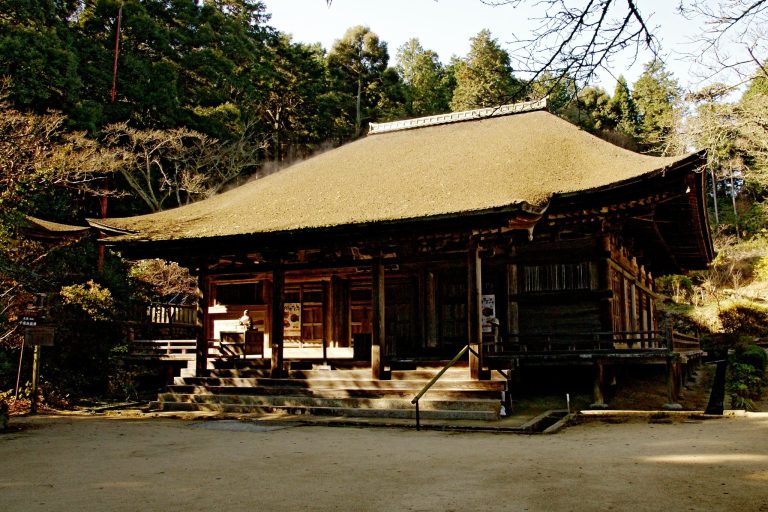
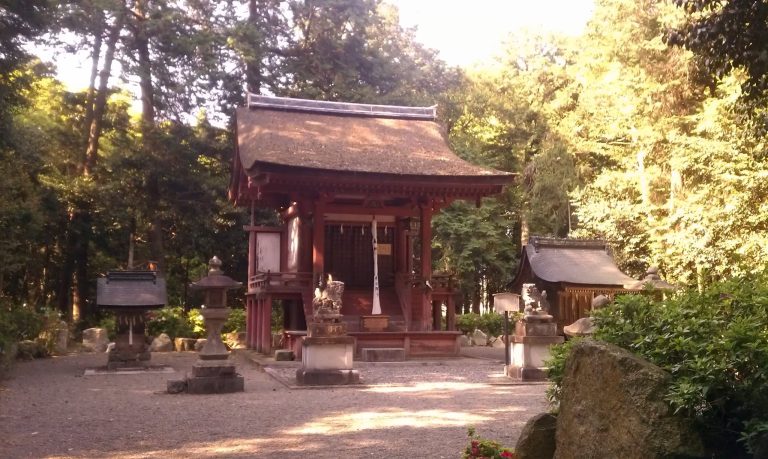
The honden is a square, three-bay, single-story building attributed generally to the late Kamakura period. Its irimoya roof combines a central gable with hipped slopes and is covered with hinoki bark. A one-bay porch projects from the front. Plastered walls and lattice windows contribute to its unusual mixture of architectural traditions. The surrounding veranda and porch are considered alterations dating from around 1337.
The building faces south even though Mount Mikami lies to the east. Its rear door and eave may preserve an earlier function as a place for worshipping the mountain from a distance. Another interpretation views these features as evidence that the building served as a storehouse for sacred treasures or ritual implements. The honden’s attached shrine cabinet forms part of its National Treasure designation.
Worship hall
The worship hall is also a square, three-bay, single-story structure with an irimoya roof, a one-bay porch, and hinoki-bark roofing. Its construction is generally attributed to the late Kamakura period. The arrangement resembles that of the honden, and tradition identifies it as an earlier honden that was relocated and modified.
Gate
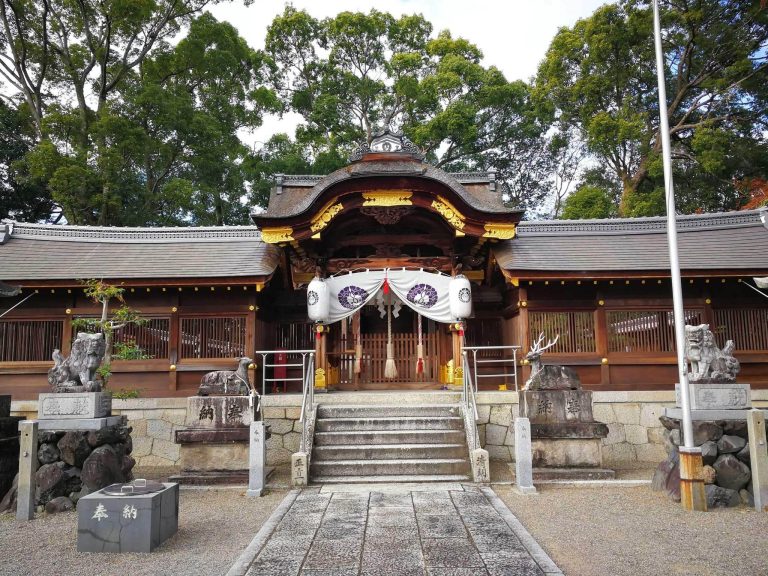
The gate is a three-bay, single-entry building with an irimoya roof covered in hinoki bark. It dates from the Muromachi period and forms one of the protected historic structures at the entrance to the precinct.
Subsidiary shrines
Wakamiya Shrine
Wakamiya Shrine stands to the left of the honden when viewed from the front. Its honden is a late-Kamakura-period, single-bay building in the nagare-zukuri style, which extends the front eave in a long, asymmetrical slope. The roof is covered with hinoki bark. It enshrines Izanagi, Sugawara no Michizane, Ame-no-Iwatowake, Ame-no-Mihoko, and Nozuchi, with three of these deities added at a later time.
Sannomiya Shrine
Sannomiya Shrine stands to the right of the honden. Its honden was built during the Muromachi period as a single-bay nagare-zukuri structure with a hinoki-bark roof. Formerly called Juzenji Shrine, it enshrines Ninigi-no-Mikoto. The building is a tangible cultural property of Shiga Prefecture.
Other sacred buildings
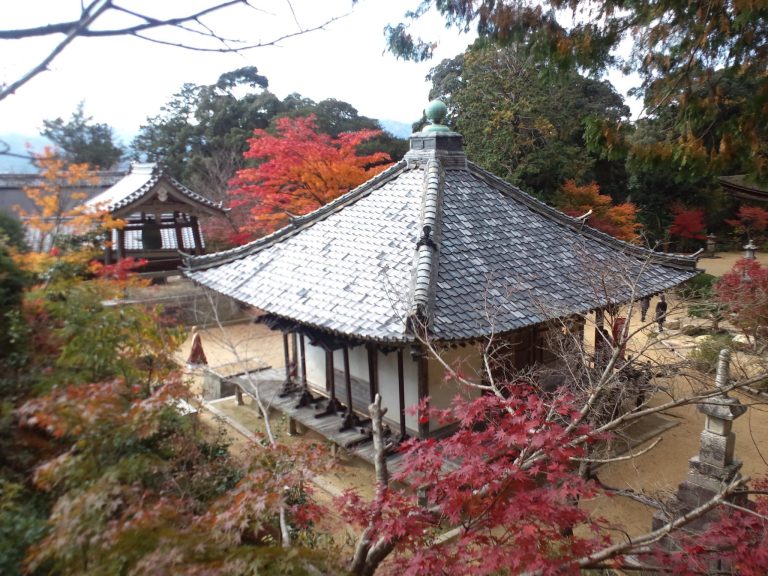
Other subsidiary shrines include Daijingu Shrine, which enshrines forms of Amaterasu, and Mikagitori Shrine, dedicated to Amatsu-Hikone and Sarutahiko. Atago Shrine and Kamado Shrine are both associated with the fire deity. At the summit of Mount Mikami, the Okumiya enshrines Ame-no-mikage-no-mikoto and stands before the Okutsu Rock Seat. Hachidai Ryūō Shrine is dedicated to the Eight Dragon Kings.
Ritual spaces and archaeological remains
The Yuki Sacred Rice Paddy lies in front of the precinct and includes a commemorative monument behind a torii gate. The field remains part of the shrine’s ritual landscape through its annual rice-planting ceremony. At the foot of Mount Mikami, a temporary festival sanctuary serves the observances connected with the mountain and the shrine’s seasonal calendar.
Ōyama Rock, at the mountain’s foot, produced twenty-four bronze bells during investigations carried out from the Meiji through Shōwa periods. Their discovery provides physical evidence for ritual activity around Mount Mikami by at least the Yayoi period. The summit’s sacred rock and the Okutsu Rock Seat remain linked to the shrine’s understanding of the mountain as its sacred body.