Ōminesan-ji Temple: A Shugendō Sanctuary on Mount Ōmine


Site at a Glance
- Rating
- 4.6
- Popularity
- Very Low
- Country
- Japan
- Primary era
- Early Modern
- External website
- Open
- Eras represented
- Medieval, Early Modern
- Civilizations
- Tokugawa
- Site type
- Religious
- Remains
- Temple
On this page13 sections
History
Ōminesan-ji Temple is a Japanese Shugendō sanctuary at the summit area of Sanjōgatake on Mount Ōmine in Tenkawa Village, Nara Prefecture. Shugendō is a tradition of mountain ascetic practice that combines Buddhist and Shinto elements. The temple’s principal deity is Zaō Gongen, a powerful syncretic Buddhist-Shinto protector, and its foundation is traditionally attributed to En no Gyōja during the late seventh century.
Foundation and sacred mountain tradition
En no Gyōja, the semi-legendary founder of Shugendō, is said to have carved an image of Zaō Gongen after experiencing the deity at Kinpusen. He then established a hall for the image near the mountain summit. Another tradition attributes a major renovation to the monk Gyōki during the Tenpyō period and links the establishment of a lower mountain hall at Yoshino with the difficulty of reaching the summit sanctuary.
The summit and lower mountain halls were originally parts of one Shugendō institution called Kinpusen-ji. Their separation into Ōminesan-ji at the summit and Kinpusen-ji below took place in the modern period. The sacred mountain area of Kinpusen extends from Mount Yoshino to Sanjōgatake, while the name Ōmine refers more broadly to the mountains of the Ōmine range. The approximately 80-kilometre Ōmine Okugake Trail runs from Mount Yoshino through the range to Kumano Hongū Taisha and serves as a training route for ascetic practitioners.
Revival and pilgrimage
The institution declined during the early Heian period, then was revived in the late ninth century by the Shingon monk Shōbō, also known as Rigen Daishi. From the tenth century onward, members of the imperial family and aristocracy made pilgrimages to the mountain sanctuary. This pattern connected the remote summit with wider religious and courtly networks.
During the Sengoku period, conflict with the Ikko sect led to the burning of the summit main hall and other buildings. The main hall was rebuilt during the Edo period. One tradition dates a rebuilding to 1616 under Mokujiki Kaigen. In 1614, Tokugawa Ieyasu ordered the Tendai monk Tenkai to assume leadership of Kinpusen-ji and Ōminesan-ji.
Modern religious separation
The Meiji Restoration brought a major institutional change. The policy known as shinbutsu bunri, which formally separated Buddhist and Shinto institutions after centuries of religious combination, abolished the syncretic system associated with the site, and Shugendō was officially suppressed. From 1871, Kinpusen-ji and Ōminesan-ji were treated as Shinto shrines. In 1886, they returned to Buddhism and were formally separated as the lower and summit institutions.
The summit sanctuary has remained subject to a prohibition on women from the early Heian period to the present. Supporters defend the restriction as a tradition of roughly 1,300 years, while it has also attracted criticism as discrimination against women. A separate training place for female practitioners opened in 1959 on nearby Inamuragatake, a peak 1,726 metres high. It is known as “Women’s Ōmine.”
Custodians and heritage status
Five custodial temples, called Goji-in, share responsibility for maintaining and administering Ōminesan-ji on a rotating basis. Sakuramoto-bō and Tōnan-in belong to the Kinpusen Shugendō Honshū, Chikurin-in is independent, Kizō-in belongs to the Honzan Shūgenshū, and Ryūsen-ji belongs to the Daigo branch of Shingon Buddhism. Ryūsen-ji’s principal temple is at Dorogawa in Tenkawa Village, while the other four are based at Mount Yoshino.
Annual ceremonies open and close the summit sanctuary on May 3 and September 23. Ōminesan-ji is also associated with a pilgrimage station for the sacred sites of En no Gyōja. The precincts became a National Historic Site of Japan in 2002, a designation protecting places of archaeological, historical, or cultural importance. In 2004, the temple became part of the UNESCO World Heritage property “Sacred Sites and Pilgrimage Routes in the Kii Mountain Range.”
Excavation near the summit recovered sutras that Fujiwara no Michinaga had offered in a gilt-bronze container and that had been buried in a mound. The find received National Treasure status, Japan’s highest category for important cultural properties, on August 11, 2007. Cultural properties connected with the site are held by the Tokyo National Museum, the Nara National Museum, and the Nara Prefectural Archaeological Institute of Kashihara.
Remains
Ōminesan-ji occupies the summit area of Sanjōgatake, which rises to 1,719.2 metres in the middle of the Ōmine Mountain Range. The physical setting combines a summit sanctuary, mountain lodgings, a maintained approach trail, and cliff-based training areas. The main hall is known as Yamagami no Zaō-dō, meaning “Zaō Hall on the Mountain,” distinguishing it from the lower-mountain Zaō Hall at Kinpusen-ji.
Summit sanctuary
Main hall
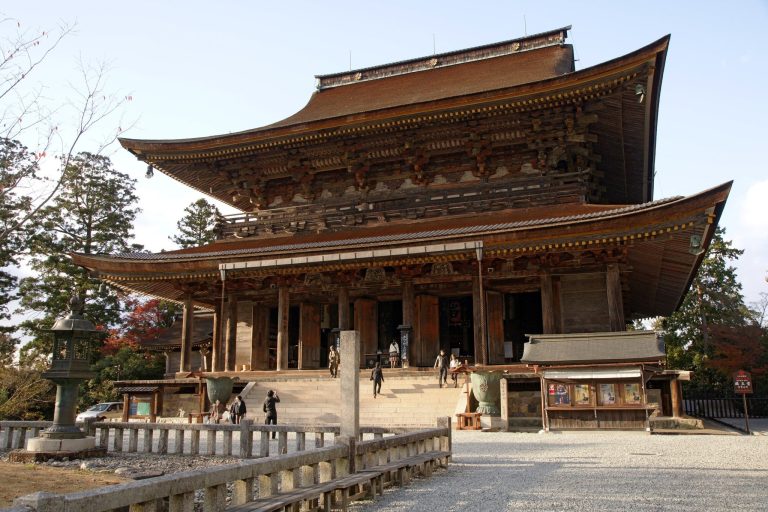
The present main hall was rebuilt in 1691. It is a hipped-roof building approximately 23 metres by 19 metres and about 13 metres high. Copper tiles and copper sheets cover the roof. The inner sanctuary dates from 1691, while the outer sanctuary was enlarged by 1706. Earlier forms of the hall are said to have measured about three bays by four bays until the beginning of the Kamakura period, and repeated fires shaped the building’s earlier history.
Mountain lodgings
Five lodging buildings operated by the custodial temples stand together a short distance before the main hall. Their operating season runs from May 3 to September 21. Each building places its principal image facing the dining area on the first floor. Kizō-in houses Zaō Gongen, while the other four lodgings house an image known as Jinben Daibosatsu.
The lodgings accommodate worshippers and general climbers and contain baths used for ritual purification. They serve simple vegetarian meals. Because the buildings stand within the restricted area, their accommodation is limited to men, and some interior arrangements reflect that use.
Sanctuary boundary
Boundary gates enclose the summit sanctuary along the route toward the peak. The restriction on women begins beyond this boundary, placing the controlled entrance within the sacred mountain landscape of Mount Ōmine.
Mountain approach and practice areas
Trail buildings and water source
The maintained mountain trail from Dorogawa and Ōmine Ōhashi passes the remains of Ichinose Teahouse and Ipponmatsu Teahouse, the water source called En no Gyōja’s “Aid Water,” Dorotsuji Teahouse, and two Daranisuke Teahouses. The teahouses span the trail, allowing the route to pass through their buildings. At Dorotsuji, the approach joins the Ōmine Okugake Trail from Mount Yoshino. The Daranisuke Teahouses were built by a pharmacy at the foot of the mountain associated with producing and selling Daranisukemaru medicine.
Ascetic training sections
Several parts of the approach serve as chain-assisted training areas for mountain ascetic practice. They include Abura Koboshi, Kanekakeiwa, and Nishi no Nozoki. At Nishi no Nozoki, the practice area occupies a cliff edge where practitioners lean outward while secured by a safety rope held by a guide. Bypass routes allow the difficult sections to be passed safely.
Behind the main hall is Ura no Gyōjō, a cliff practice area where practitioners train without safety ropes. Entry requires guidance from a guide. Together with the chain-assisted sections on the approach, this area forms part of the physical setting in which Shugendō practitioners undertake demanding mountain exercises.