Mên-an-Tol: A Prehistoric Holed-Stone Monument in Cornwall
Site at a Glance
- Popularity
- Very High
- Country
- United Kingdom
- Primary era
- Bronze Age
- Eras represented
- Stone Age, Bronze Age, Modern
- Civilizations
- Unclassified
- Site type
- Religious
- Remains
- Sanctuary
On this page6 sections
History
Mên-an-Tol is a prehistoric stone monument near Penzance in Cornwall, United Kingdom, probably dating to the late Neolithic or early Bronze Age, two prehistoric periods whose dates vary by region. Its Cornish name means “stone of the hole” or “holed stone,” and was given millennia after the monument’s construction. It is also known as the Crick Stone and Devil’s Eye.
Historical record and interpretation
In 1749, William Borlase, an antiquary who studied ancient objects and sites, drew the stones in a formation angled at about 135 degrees. The arrangement is now roughly linear. The westernmost stone was shifted into line with the other two sometime after 1815. Borlase also noted that local farmers had taken stones from the surrounding area.
In the mid-nineteenth century, local antiquary and illustrator John Thomas Blight published drawings and suggested the stones might have come from a stone circle. William Copeland Borlase, a descendant of William, described the area in more detail in 1872. He noted that stones from nearby large-stone tombs had been reused elsewhere, and considered the monument’s ritual associations a possible reason its stones had been spared.
Hugh O’Neill Hencken’s 1932 archaeological report argued that the stones were no longer in their prehistoric positions. He proposed that the holed stone might have belonged to a destroyed tomb. An investigation in 1993 suggested that the standing stones came from a circle of 18 to 20 stones, of which 11 had been located, and that the holed stone might instead have been part of a nearby portal tomb, a prehistoric tomb built from large stones.
Other interpretations place the holed stone at the centre of a stone circle, where it may have framed points on the horizon. This remains a conjecture, with the central standing stone at nearby Boscawen-Un cited as a comparison. The holed stone has also been proposed as a capstone for the nearby cairn, a mound made of stones, and a calendar-related feature. William Borlase speculated that the monument was used for initiation rites and sacrifices. The three stones have also been likened, when viewed in three dimensions, to the numerals 101.
Healing beliefs and protection
Local traditions connected the monument with healing and protection. A fairy-like Cornish spirit called a piskie was said to guard it and bring miraculous cures. In another story, a changeling, a child believed to have been substituted by fairies, could be passed through the hole to bring back the child who had been taken. For centuries, people believed that children with rickets, a disorder affecting bone development, could be cured by being passed naked through the opening nine times. Those with back or limb pain were said to crawl through it for relief.
Other customs held that a woman who passed through the opening backwards seven times at a full moon would soon become pregnant. People also used the stones for divination and believed they could ward off curses. The healing traditions are associated particularly with the name Crick Stone. Mên-an-Tol was designated a scheduled monument in 1926, a status providing legal protection for archaeological remains.
Remains
Stone arrangement
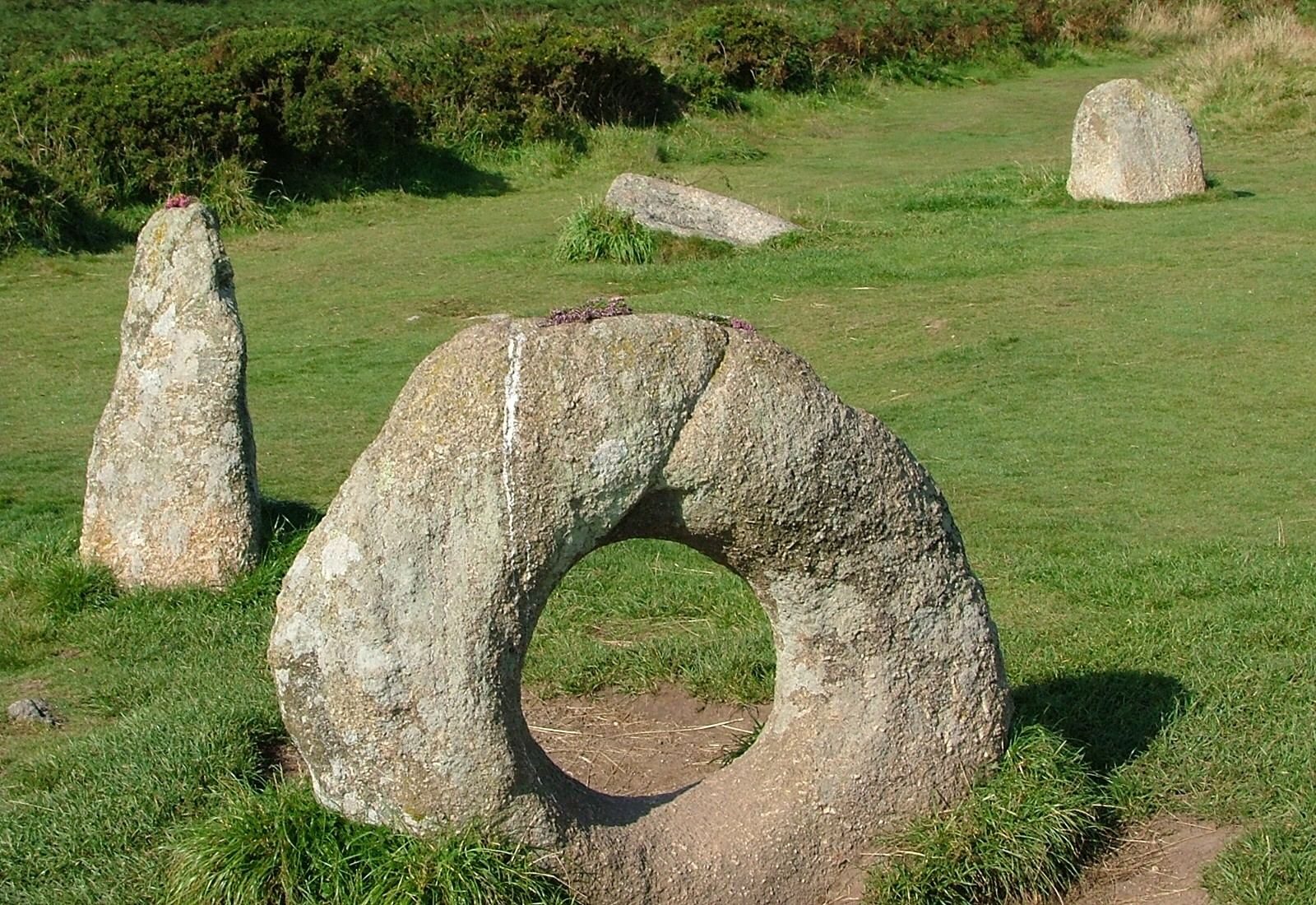
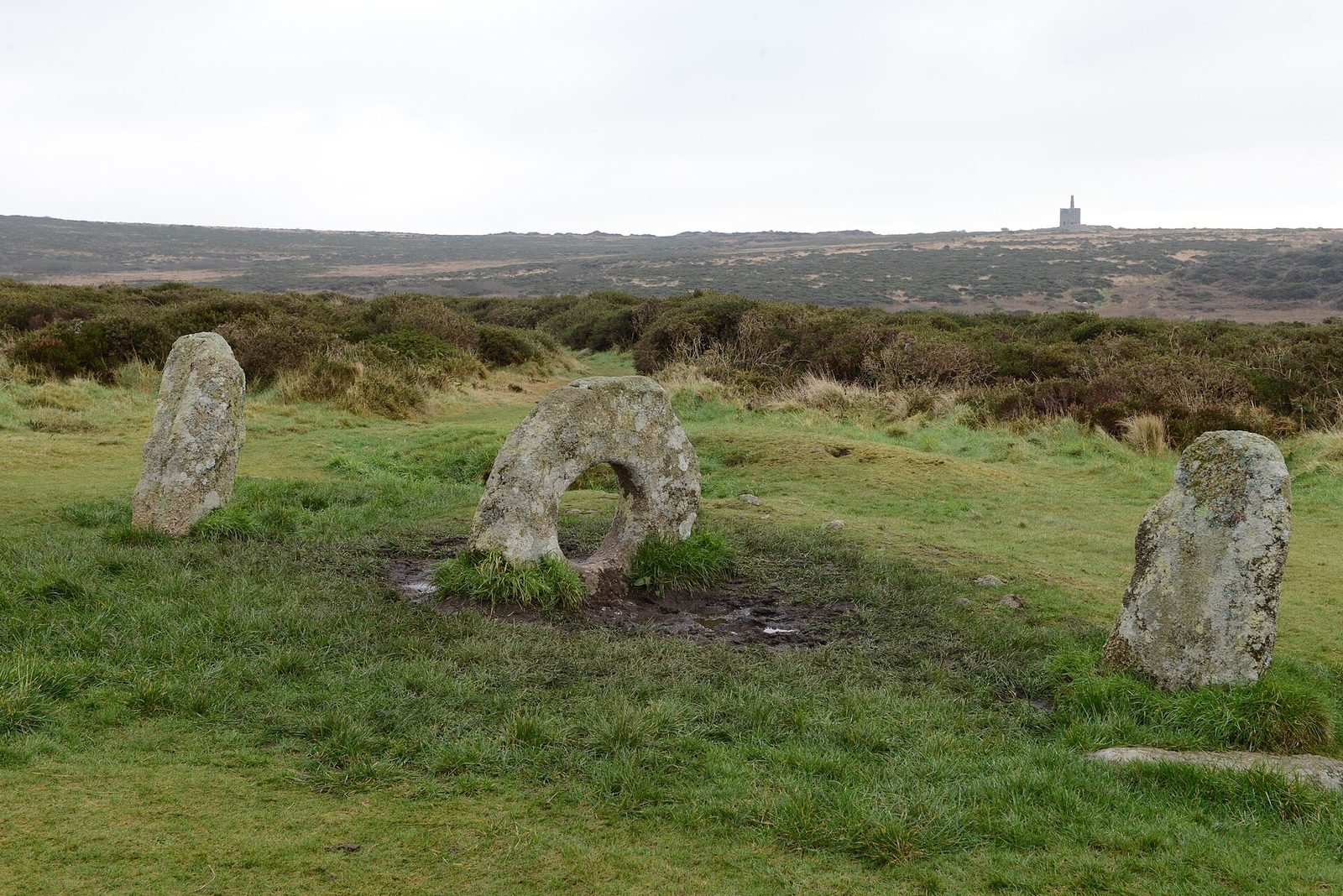
The monument’s principal feature is a granite stone with a roughly octagonal outline and a circular opening. It is about 1.3 metres across and 1.1 metres high; the opening measures roughly 0.5 metres in diameter. Two upright granite stones, each about 1.2 metres high, stand on either side, one in front of and one behind the opening. They are roughly three metres apart, and the present arrangement runs approximately southwest to northeast. The holed stone may have formed naturally rather than being deliberately shaped. The only other Cornish example of this type is the Tolvan stone near Helston.
Surrounding features
One further standing stone and six stones lying on the ground are scattered nearby, with some partly buried. A low, stony mound lies just southeast of the main group. Two other early Bronze Age mounds, described as barrows or cairns, are about 120 to 150 metres to the north, and additional stones have been found below ground. The monument stands near the road between Madron and Morvah, about three miles northwest of Madron. The Mên Scryfa inscribed stone is roughly 300 metres north, and the Boskednan stone circle is less than a kilometre to the northeast. The monument is in good condition.