Melegnano Castle: A Medieval Fortress and Renaissance Residence in Italy

Site at a Glance
- Rating
- 4.2
- Popularity
- Medium
- Country
- Italy
- Primary era
- Medieval
- External website
- Open
- Eras represented
- Medieval, Early Modern
- Civilizations
- Duchy of Milan
- Site type
- Military
- Remains
- Castle
On this page24 sections
History
Melegnano Castle is a medieval fortress and Renaissance aristocratic residence in Italy, in Melegnano. Built through successive Milanese political phases from the thirteenth to the seventeenth century, it developed from a defensive work intended to protect Milan and its countryside into a residence decorated with an extensive sixteenth-century pictorial program. The castle is now recognized as Italian national heritage.
Early fortification and Milanese conflict
An earlier fortification occupied the site, possibly as early as the tenth century, before its destruction in 1239. In 1243, Cattellano Carbone, podestà of Milan, began a fortified structure called a receptum to defend Milan and the surrounding countryside against repeated incursions by Emperor Frederick II.
The first thirteenth-century castle took the form of a motta castrale, a fortified mound protected by a moat and small towers. Its political importance was also visible in 1279, when Milanese Guelfs and Ghibellines signed a peace treaty there. These were rival medieval factions broadly associated with support for the papacy and the Holy Roman Emperor.
Visconti and Sforza phases
The castle was substantially enlarged through the initiatives of Matteo I Visconti and Bernabò Visconti around 1350. The Visconti and Sforza were the two principal ruling dynasties of Renaissance Milan, and their association with Melegnano reflects the site’s place in the political and military organization of the duchy. During this rebuilding, the fortress acquired a quadrangular plan with square corner towers.
After Bernabò Visconti’s death, the castle passed by testamentary bequest to his concubine, Donnina de’ Porri. Gian Galeazzo Visconti, the first Duke of Milan, died at Melegnano Castle on 3 September 1402. Bianca Maria Visconti, duchess and wife of Francesco I Sforza, also died there in 1468.
The original enclosure was damaged during the attack on Melegnano from 25 April to 1 May 1449. Duke Francesco Sforza used siege engines to demolish the towers and walls on the rear side of the castle. The destruction explains why that part of the former quadrangular enclosure no longer survives and why the building later developed its present U-shaped plan.
The Medici di Marignano
In 1512, Melegnano Castle passed to the Brivio marquises. With the approval of Emperor Charles V, they sold the castle and the entire fief of Melegnano in 1532 to Gian Giacomo Medici and his family. The family adopted the name Medici di Marignano, derived from the former name of Melegnano.
Francesco II Sforza named Gian Giacomo Medici the first Marquis of Melegnano in recognition of his military services, and Charles V later confirmed the title. Gian Giacomo was a condottiero, a professional military commander who led troops under contract and could serve different Italian states or rulers. The marquis and his descendants retained ownership of the castle and invested more than 30,000 scudi in masonry works. The family remained its owner until 1981, when the last heirs sold it to the Province of Milan.
The castle’s sixteenth-century decoration celebrates the rise of the Medici di Marignano from modest origins to prominent military, civic, and ecclesiastical positions. Its imagery recalls Gian Giacomo’s campaigns in the war of Siena, around Lake Como, and in the conquest of Musso, the siege of Lecco, the conquest of Morbegno, the naval battle of Bellagio, and the wider War of Musso, fought from April 1531 to January 1532.
The pictorial program also links the family to leading noble houses and to imperial power. Its mythological and heroic subjects create allegorical parallels with the family’s advancement, while the rise of Cardinal Giovanni Angelo Medici to the papacy as Pius IV gave the family an especially important ecclesiastical connection. Giovanni Angelo Medici, later Pius IV, was a member of the Melegnano family and was distinct from the ruling Medici of Florence. His association was also connected with the establishment of the Festa del Perdono privilege for the community of Melegnano in 1563.
Later use and restoration
The castle’s strategic military function ended in the seventeenth century. It later became the seat of the municipal museum. In 1983, after an exchange of property, the provincial administration granted the municipality of Melegnano the use of several rooms, where a public library was established.
A complete exterior restoration began in 1998 and was later extended to the interior rooms, including those containing mid-sixteenth-century frescoes. When the complex reopened in 2001, the Civic Collection of Don Cesare Amelli was inaugurated. Amelli was a local parish priest and historian. The restored paintings preserve evidence of the artistic schools active in sixteenth-century Lombardy and of Lombard Mannerism, a style known for elaborate decoration and sophisticated, often artificial compositions influenced by Central Italian art.
Remains
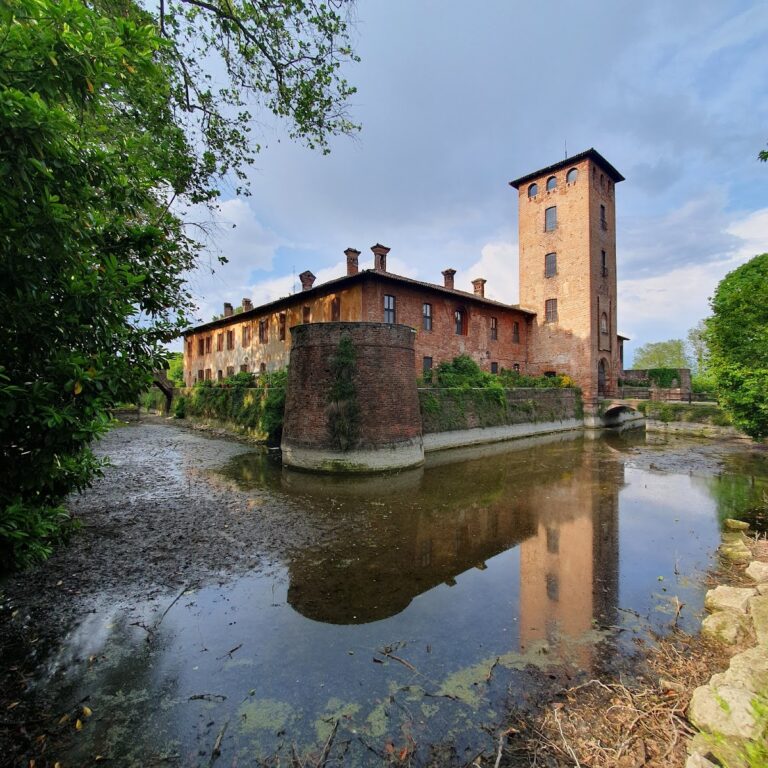
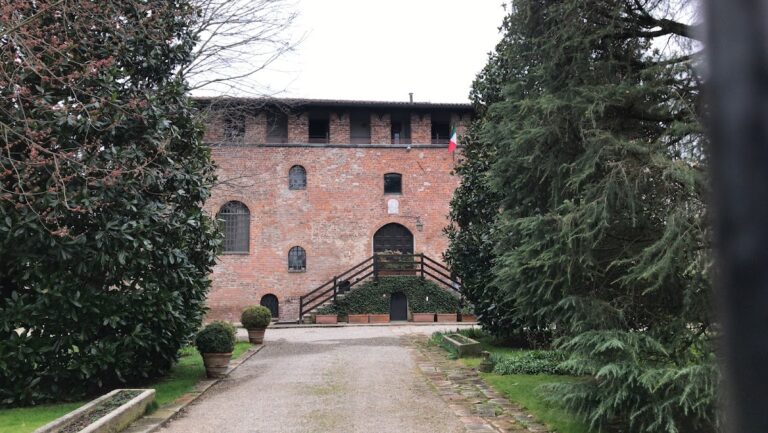
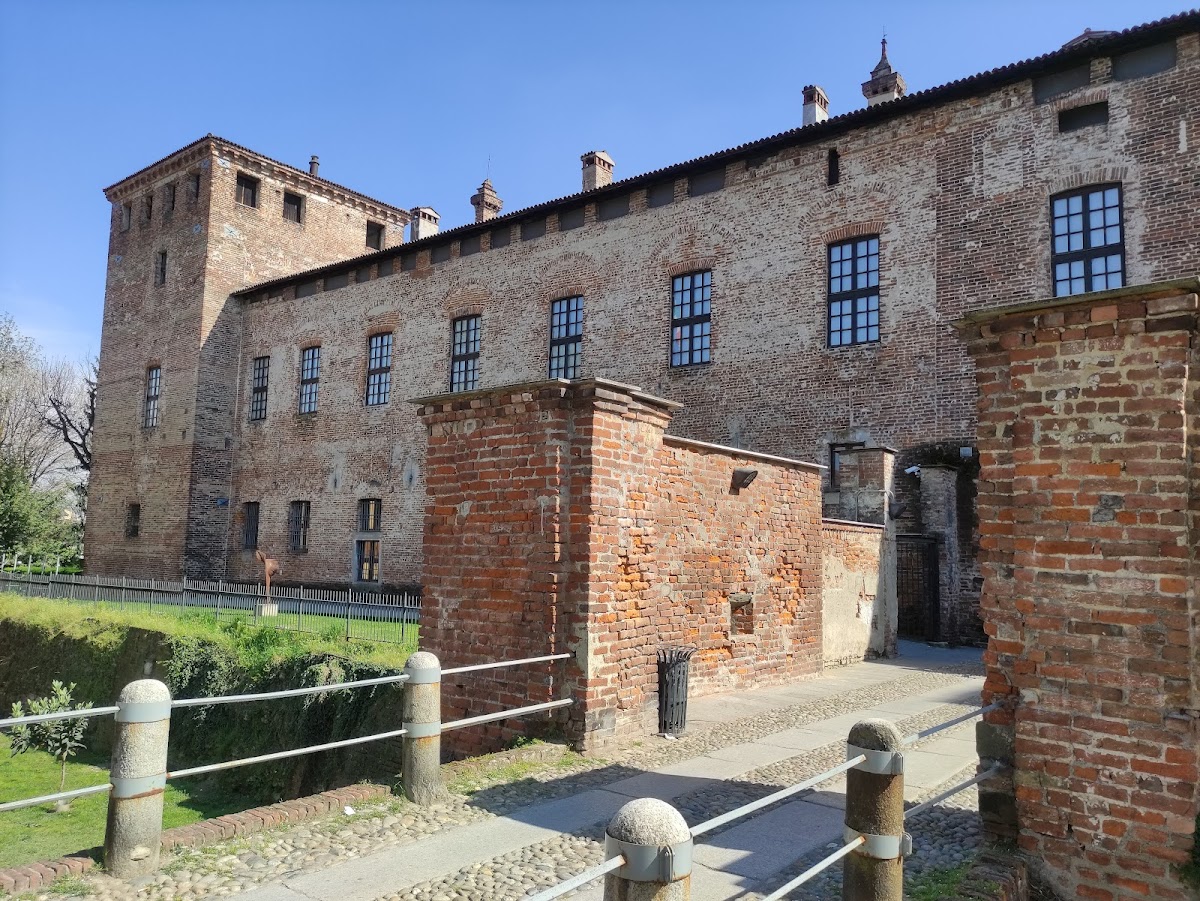
Melegnano Castle survives as a brick complex with an atypical U-shaped plan. The front facing Piazza della Vittoria is the only side substantially preserved in its original form, while the rear portion of the medieval quadrangle was destroyed in 1449. Two of the original four corner towers remain visibly standing. Each tower has sides of approximately 10 metres, and the castle’s sides measure about 75 metres.
Fortifications and entrance
Brick front and towers
The surviving front is built entirely of brick. Its present rectangular windows replaced the earlier pointed-arched openings, whose outlines remain visible in the masonry. This change reflects the sixteenth-century conversion of the fortress into an aristocratic residence. Guelf-style merlons remain beneath the roofline. These rectangular crenellations are traditionally associated with the Guelf faction and differ in appearance from the swallowtail crenellations commonly linked with Ghibelline fortifications.
Moat and ravelin
Part of the original Visconti moat survives around the castle. It was once especially deep and connected with the Lambro River, and later became known as the Fossa Medici. In front of the building are traces of the former ravelin, a detached triangular defensive work protecting a fortification’s approach. The surviving elements consist of two lateral walls pierced by loopholes and openings for cannon.
Bridge and honor staircase
The original drawbridge at the entrance was later replaced by a permanent bridge. Beyond the central terracotta entrance portal, an honor staircase rises to the upper floors. Its brick steps are laid in a herringbone pattern and separated by stone strips, a construction that allowed horses to ascend into the building.
Courtyard and painted interiors
Courtyard and upper-floor decoration
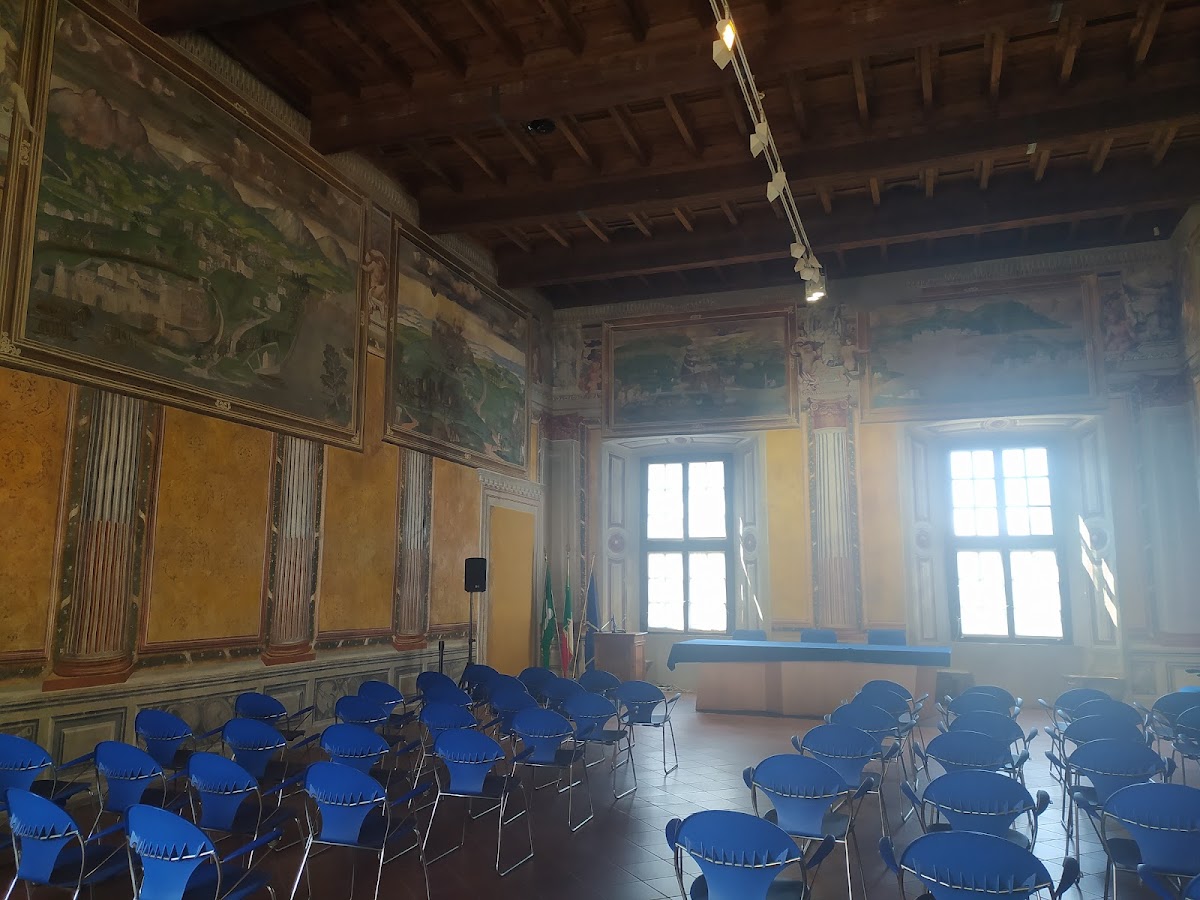
The interior courtyard has arcaded porticoes with round arches and rusticated treatment. The surrounding spaces formerly included residential rooms, stables, and hay stores for animals kept within the complex. On the first floor, rooms are decorated with sixteenth-century wall-painting cycles, mostly by unidentified artists. The paintings were executed in fresco, meaning on fresh plaster, with some retouching applied after the plaster had dried. Humidity damaged portions of the decoration, particularly on exterior-facing walls and in lower parts of the rooms.
Entrance atrium and staircase
The entrance atrium contains floral decoration and painted landscapes set within a fictive balustrade. The staircase vault carries a fresco of Phaethon driving the chariot of the sun, accompanied by Gian Giacomo Medici’s coat of arms. Another fresco shows Mars judging between Peace and War, together with the arms of the Medici of Florence, the Borromeo, and the Medici di Marignano. On the opposite wall, Ganymede is carried away by Jupiter’s eagle beside the arms of Augusto Medici and the Von Ems zu Hohenems family.
A brigantine belonging to Gian Giacomo Medici appears with the motto “Salva nos vigilantes.” Another fresco praises courage with the words “Non frangitur pondere virtus.” Together, these images combine family emblems, classical mythology, military associations, and moral ideas at the principal point of entry.
Rooms of dynastic and military imagery
Sala del Camino di Siena
The Sala del Camino di Siena contains a monumental sixteenth-century stone fireplace. Its decorative frame includes high-relief telamons, sculpted male figures used as architectural supports. The same technique represents episodes from the War of Siena, one of Gian Giacomo Medici’s greatest military victories.
Sala dell’Imperatore
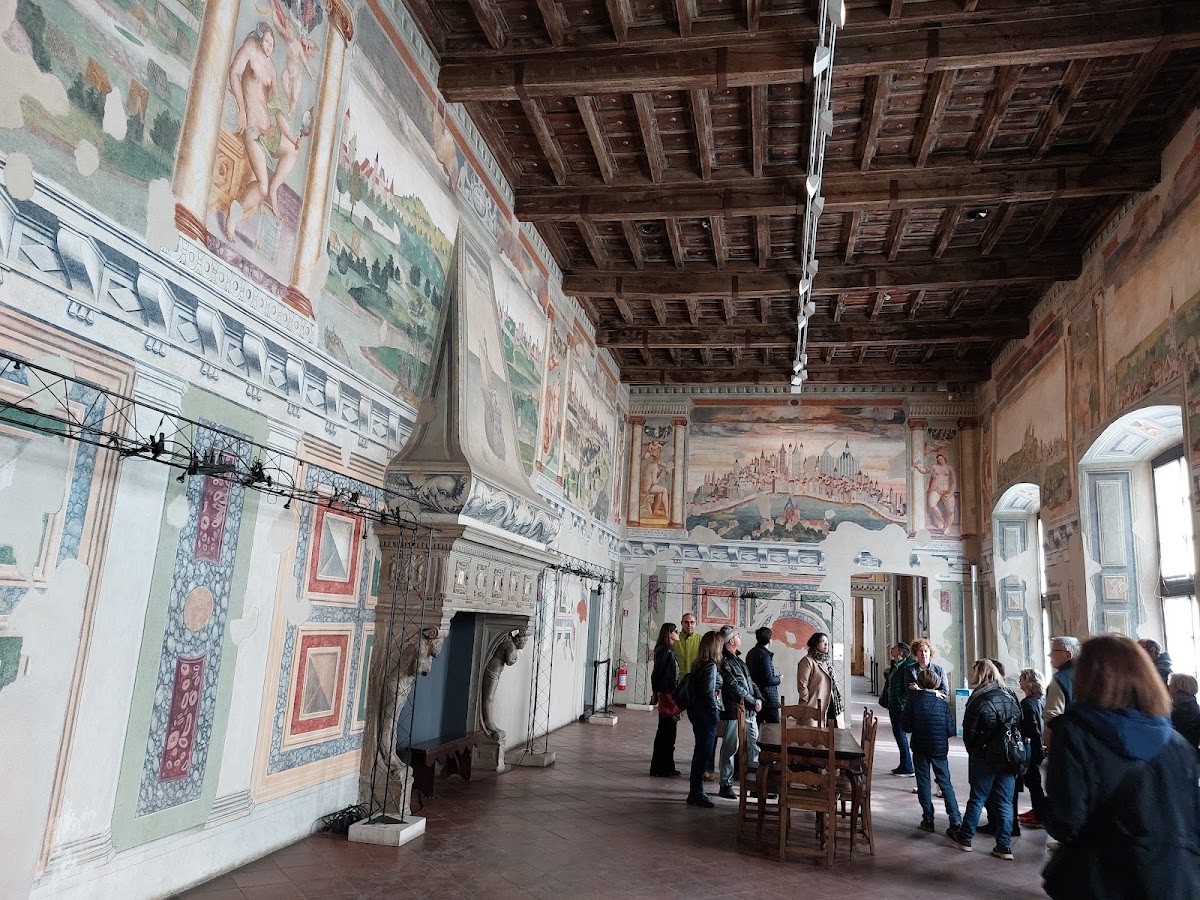
The Sala dell’Imperatore measures 20 by 7.30 metres and is dedicated to the emperors of the Holy Roman Empire, especially Charles V. The Holy Roman Empire was a Central European imperial polity, and Charles V was also Duke of Milan during the period connected with the castle’s Medici ownership. A colossal sandstone fireplace stands at the centre of the long wall, with its hood supported by two caryatids, sculpted female figures serving as architectural supports.
The frescoes are divided into upper and lower registers. The upper register combines views of German cities with female allegories, while the lower register contains architectural motifs. The city views include Basel, Speyer, Worms, Cologne, Erfurt, Fulda, and Frankfurt an der Oder. The allegories represent Medicine, Charity, Music, Prudence, Fortitude, Faith, Justice, Temperance, Peace, Hope, Grammar, and Hunting. One damaged figure remains difficult to interpret.
The view of Frankfurt an der Oder refers to a customs station established by Charles V in a frontier city. The anonymous painter apparently used woodcuts of German cities derived from Sebastian Münster’s Cosmographia Universalis, printed in 1544.
Sala delle Stagioni
The Sala delle Stagioni presents the four seasons through their associated Greek and Roman deities. Winter is represented by Janus, spring by Venus, summer by Ceres, and autumn by Pomona. The winter scene shows the two-faced Janus holding a key, Saturn with a sickle, figures connected with wine and winter festivities, sacrificial and symbolic animals, and the Janiculum hill in Rome. Crows, traditionally sacred to Juno, appear in the background.
The autumn wall depicts a festival of Bacchus. It includes the satyr Silenus, Pomona on a chariot drawn by two goats, rural figures, baskets filled with autumn foliage and fruit, and a broad wooded landscape. The spring wall shows the love of Mars and Venus, Venus’s triumph on a decorated chariot, Eros, Pan, a lute player, Mercury, and the myth of Mercury’s theft of Admetus’s cattle. The allegories of Discretion and Fame accompany the composition.
The summer wall presents Ceres in triumph on a rustic chariot drawn by swans, surrounded by grain, fruit, agricultural figures, mountains, a shore, the sea, buildings, Neptune, and Trittolemus. The faces of Neptune and Trittolemus reproduce those of Gian Giacomo Medici and his brother Giovanni Angelo, the future Pius IV. An adjoining scene depicts Apollo, the Sibyl Deiphobe, and the myth of Asteria.
Sala delle Battaglie
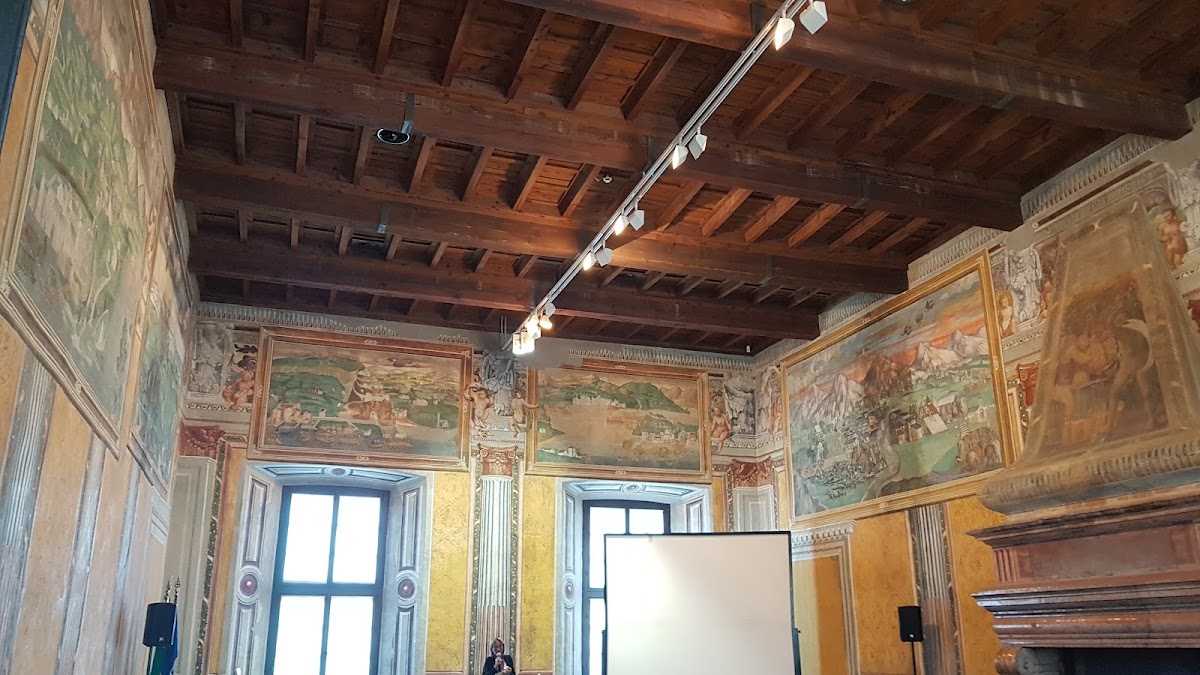
The Sala delle Battaglie measures 16 by 9.70 metres and is lit by four windows opening toward the castle square and courtyard. Its upper painted frieze contains nine battle scenes directed by Gian Giacomo Medici in places where he served as a condottiero, chiefly around Lake Como, before receiving the marquisate.
The scenes are enclosed by fictive architecture filled with weapons, trophies, drums, and banners. Painted fluted columns support an architrave, above which appears a fictive yellow arabesque tapestry decorated with festoons. One scene shows Gian Giacomo’s occupation of Chiavenna through a nocturnal stratagem involving the soldier Mattiolo Riccio and the hostage castellano Valfio Silvestri. Mount Dalò and a walled settlement appear in the composition, while the monumental fireplace has a hood decorated with the forge of Vulcan.
A central fresco depicts the siege of Lecco, carried out by Gian Giacomo for the French between 1526 and 1528 before he changed allegiance. It shows the Visconti defensive tower and the bridge built by Azzone Visconti, identifiable by the serpent emblem at its centre. Other paintings represent the conquest of Morbegno, the naval battle of Bellagio, episodes from the War of Musso, Bellagio and Varenna, the fortifications of Musso, fighting between the Grisons and Gian Giacomo’s troops, failed Swiss assaults on Musso, and a naval operation connected with the conquest of Malgrate.
The Bellagio naval scene shows the Medici fleet fighting the ducal fleet. Seven vessels are represented, each with three sails, forty-eight oars, and cannon firing 39-pound projectiles. Four falcons circle above the battle, adding another detail to the visual account of Gian Giacomo’s military power.
Mythological and family rooms
Sala di Ercole
The Sala di Ercole measures 14.40 by 7.30 metres and served as a large antechamber leading to the other upper-floor rooms. Its upper zone contains eighteen frescoes from the life of Hercules. The episodes include his infancy, the killing of the Nemean lion, the Hydra, Geryon, Orthrus, Antaeus, Nessus, the sea monster threatening Hesione, the rescue of Deianira, the death of Icarus, and the contest for Hippolyta’s belt.
Sala degli Argonauti
The adjoining Sala degli Argonauti measures 8.10 by 7.10 metres. It functioned as the marquis’s private study and as a reception room for his closest friends. The fresco cycle follows Jason and the Argonauts, the heroes who sailed on the Argo in the Greek myth of the Golden Fleece.
The scenes include the Argo’s voyage to Colchis, the rescue of King Phineus from the Harpies, Medea’s magic, Jason’s arrival at the court of King Aeetes, the trials involving bronze bulls and dragon’s teeth, the recovery of the Golden Fleece, Medea’s escape with Jason, and Aeetes’s pursuit. The cycle was probably painted around 1565 and has been attributed, without certainty, to Bernardino Campi. A book containing woodcuts of the paintings was published in that year, and the decoration shows influences associated with Giulio Romano and Palazzo Te in Mantua.
Sala degli Stemmi
The Sala degli Stemmi has sixteen painted coats of arms across the upper portions of its four walls. They represent families related or allied to the Medici of Melegnano, including the Visconti, Morone, Sforza, Calvi, Balsamo, Castaldi, Del Maino, Crivelli, Altemps, Medici, Gonzaga, Serbelloni, Borromeo, Medici of Florence, Orsini of Pitigliano, and Rainoldi. The room was later adapted as a private family chapel.
Sala di Enea
The Sala di Enea contains frescoes framed by fictive architecture and putti. Its central scene shows Aeneas aboard his ship, whose sail bears the motto “Post tot discrimina rerum,” meaning “after so many dangerous adventures.” Other scenes show Venus, Aeolus, Jupiter, Mercury, Artemis, Cupid, the storm after Troy, Aeneas’s meeting with Venus, the building of Carthage, Dido, and Dido’s banquet.
Saletta di Pio IV
The Saletta di Pio IV takes its name from a frescoed portrait of Pius IV. Its other paintings draw on Ovid’s Metamorphoses and represent the separation of the elements from Chaos, Prometheus creating humanity, the Giants’ assault on Olympus, the banquet of Lycaon, the Flood, Deucalion and Pyrrha, the killing of the Python, and Daphne’s transformation into a laurel tree.
The room also contains portraits of Charles V and his successor, Ferdinand I, together with allegories of Rhetoric, Astronomy, Arithmetic, Dialectic, and Grammar. Beneath Grammar appears the word “ACITAMARG,” the name of the art written backwards. Across the castle, these mythological, heroic, allegorical, dynastic, and military scenes connect classical stories with the family’s social advancement, military career, and imperial associations.