Viboldone Abbey: A Medieval Humiliati Monastic Complex in Italy


Site at a Glance
- Rating
- 4.6
- Popularity
- Low
- Country
- Italy
- Primary era
- Medieval
- External website
- Open
- Eras represented
- Medieval
- Civilizations
- Holy Roman Empire
- Site type
- Religious
- Remains
- Church
On this page15 sections
History
Viboldone Abbey, also known as the Abbey of Saints Peter and Paul, is a medieval Catholic complex in Italy, founded by the Humiliati in 1176 and completed in 1348 in the Romanesque and Gothic traditions. Located in Viboldone, a locality of San Giuliano Milanese in Lombardy, it is recognized for its architecture and fourteenth-century frescoes as one of the important medieval complexes of the region.
The Humiliati Foundation
The Humiliati were a medieval Catholic movement whose communities brought together monks, nuns, and laypeople in a life combining prayer with labor. At Viboldone, the community produced wool cloth and cultivated fields using innovative agricultural and processing methods. The abbey became one of the order’s leading centers, ranking after Santa Maria di Brera among its important establishments. A plaque beside the main entrance records the completion date of 1348.
Changes in Religious Ownership
In 1571, Saint Charles Borromeo, the cardinal and archbishop of Milan who played a major role in Catholic reform, suppressed the Humiliati. Viboldone then passed to the Olivetan Benedictines, a reform branch of the Benedictine tradition associated with the Congregation of Monte Oliveto. Under Austrian rule, the Olivetans were suppressed and forced to leave the abbey in 1777.
The Benedictine Community
After several years of abandonment, Cardinal Ildefonso Schuster, the archbishop of Milan, offered Viboldone in 1940 to a Benedictine community led by Margherita Marchi. She had separated from the Congregation of the Benedictines of Priscilla. On 1 May 1941, the Benedictines of Viboldone were established as a sui iuris monastery, meaning a monastery with its own canonical status and governance within the Catholic Church.
The community produces preserves and, since 1945, has undertaken substantial religious and theological publishing alongside its monastic activities. In 1965, Pope Paul VI ordered the transfer of Aureli Maria Escarré, the Catalan Benedictine abbot of Montserrat, to Viboldone to protect him from persecution under Franco’s regime. Luisito Bianchi served the Benedictine community as chaplain for many years. The abbey remains a Roman Catholic institution within the Archdiocese of Milan and is associated with the Benedictine order.
Remains
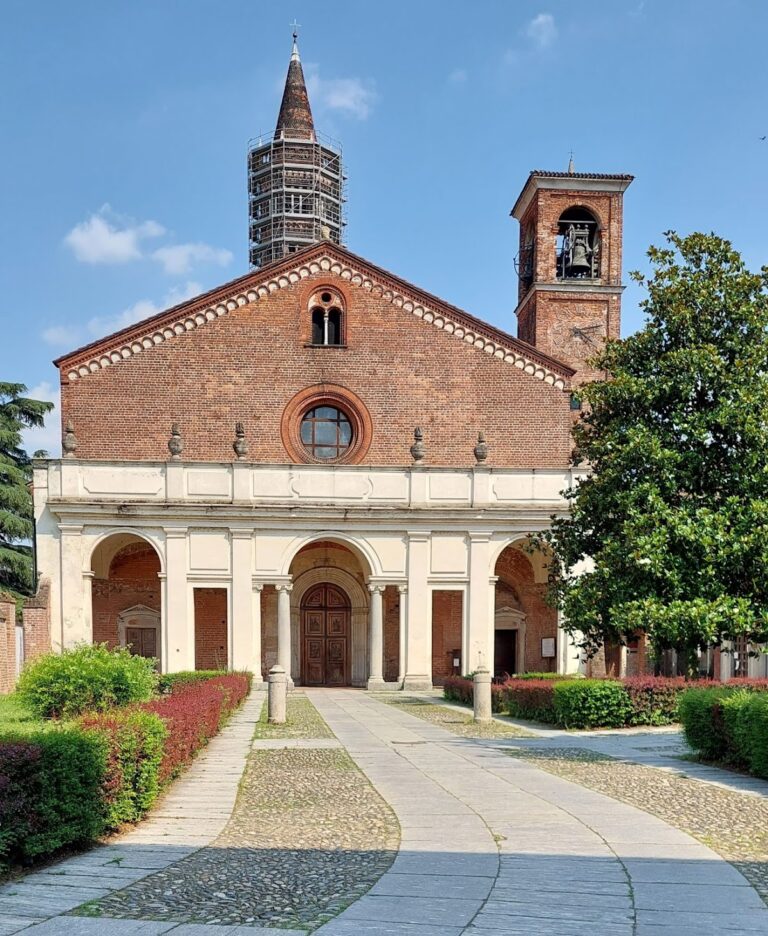
The surviving complex is centered on a brick church with a gabled facade, a three-nave interior, a tower above the central crossing, and extensive painted decoration. Its restrained architectural treatment contrasts with the strong color and narrative richness of the frescoes. The building adjoining the church also contains the Sala della Musica, whose decoration preserves an important visual record of musical instruments used in Milan between the late fifteenth and early sixteenth centuries.
Facade and Bell Tower
Gabled Facade
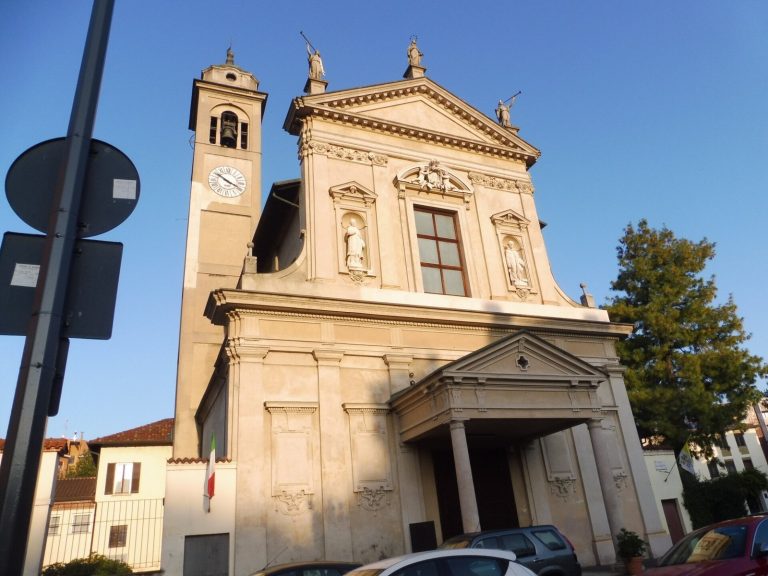
Completed in 1348, the facade is built of exposed brick and divided into three sections by two semi-columns. White-stone decoration and mullioned windows open toward the sky, giving the front a patterned surface. The white-marble portal is surmounted by a lunette showing the Madonna and Child between Saints Ambrose and John of Meda. The sculptures are attributed to the artist generally identified as the Master of the Viboldone Sculptures. Fourteenth-century statues of Saints Peter and Paul occupy the two Gothic niches beside the portal.
Entrance Door
The main church door belongs to the period of the facade’s construction. Made of dark wood, it is reinforced with large wooden ribs and heavy nails, while a smaller door set within it provides entry into the church.
Bell Tower
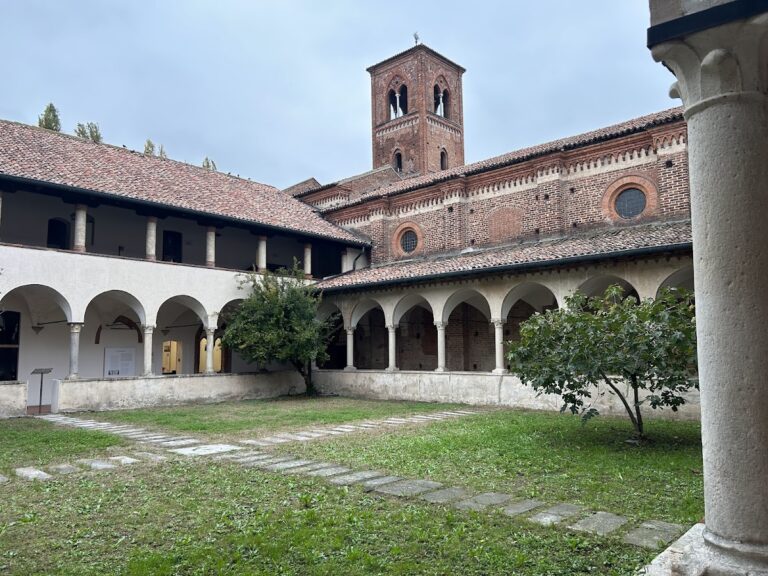
The bell tower rises above the church’s tiburio, the tower-like structure over the central part of a church. Its basket-shaped conical form is associated with Cistercian architectural tradition. Terracotta cornices, small arches, paired and triple mullioned windows, and oculi repeat the facade’s combination of brick-colored and pale decorative elements.
Church Interior
Naves and Vaults
The church follows a rectangular hall plan with three naves divided into five bays by transverse pointed arches. The first bay is Romanesque, while the later bays were built in the thirteenth century in the Gothic style. Brick or terracotta columns support high cross vaults, each formed by the intersection of two barrel vaults. The columns have capitals made from the same material and shaped as chamfered cubes. Around the keystone at the center of every vault are circular segments in rainbow colors, interpreted as a sign of God’s friendship with humanity.
Frescoes and Painted Decoration
Frescoes associated with the Giottesque school, the late medieval Italian tradition linked to Giotto and his followers, provide much of the church’s visual richness. On the front wall of the tiburio is a Madonna in Majesty with Saints, dated directly to 1349.
The opposite wall carries a large Last Judgment attributed to Giusto de’ Menabuoi, a fourteenth-century Italian painter known for religious frescoes. Its date may fall shortly before 1370, although a date near 1350 has also been proposed. Christ appears at the center within an iridescent mandorla, an almond-shaped aureole. The blessed stand to his right and the damned to his left, with Satan shown devouring his prey above them. In the upper part of the wall, two angels roll up the course of historical time and reveal the Heavenly Jerusalem behind them.
Music and Monastic Culture
Abbey Organ
The abbey organ was built in 2004 by Giovanni Pradella. It has fully mechanical action, two manuals of 58 notes each, and a pedalboard of 27 notes. Some registers can be assigned to either manual, allowing a wide range of combinations and tonal variations despite the instrument’s small size. Its uses include liturgy, teaching, and concerts.
Sala della Musica
The Sala della Musica occupies the first floor of the building adjoining the church and overlooks the piazza through two windows. Its frescoes represent a portico divided by fluted pilasters into twelve window-like compartments, each containing a life-size musical instrument. The instruments are painted in monochrome red earth, with black shading and ochre shadows on a white ground. Arranged in crossed pairs as trophies, they emphasize centrality and symmetry and create the weightless effect associated with grotesque decoration.