Mariä Himmelfahrt: The Former Cistercian Abbey Church in Aldersbach, Germany


Site at a Glance
- Rating
- 4.6
- Popularity
- Very Low
- Country
- Germany
- Primary era
- Early Modern
- External website
- Open
- Eras represented
- Medieval, Early Modern
- Civilizations
- Holy Roman Empire
- Site type
- Religious
- Remains
- Church
On this page11 sections
History
Mariä Himmelfahrt is a Roman Catholic monastery church in Aldersbach, Germany, whose present Baroque form was created for the former Cistercian abbey between 1705 and 1734. Its oldest elements are medieval, and the church remains part of a building ensemble with the monastery. Today it belongs to the parish of Mariä Himmelfahrt Aldersbach in the Vilshofen deanery of the Diocese of Passau.
Medieval foundation and early rebuilding
The church developed within the Cistercian monastic community. The Cistercians were a Catholic order rooted in the Benedictine tradition, with a strict emphasis on communal prayer, observance, and manual work. Relics helped shape the religious importance of Aldersbach. Two noblewomen brought the relics of Saint Ursula to the monastery in 1351. The remains of the Roman martyr Felicianus later came from Rome at the initiative of Abbot Malachias Niederhofer. Relics traditionally identified as those of the nine-year-old Roman martyr Valerius arrived from Rome in 1746 as a gift for the monastery’s six-hundredth anniversary, while Abbot Paulus Genzger arranged the transfer of the unidentified Roman martyr Clara.
Abbot Michael Kirchberger ordered the medieval choir to be demolished and rebuilt in 1617. The late-medieval west tower survived this campaign and was incorporated into the later church. In 1649, after the Thirty Years’ War, an outbreak of plague killed 110 people in Aldersbach. The St Roch altar preserves the memory of this event, since Saint Roch was traditionally invoked as a protector against plague.
The Baroque rebuilding
Under Abbot Theobald I Grad, the nave was rebuilt and the choir adapted between 1705 and 1734. Dominikus Magzin, the city architect of Landau, acted as construction manager. Decoration began in 1718, and the church was probably largely complete by 1720. Cosmas Damian Asam, a leading Bavarian late-Baroque painter and frescoist, is associated with the frescoes. The stucco is attributed to his brother Egid Quirin Asam through stylistic analysis. Egid was a sculptor, architect, and stucco artist, and the interior reflects the brothers’ characteristic integration of architecture, painting, sculpture, and ornament. Joseph Matthias Götz and Joseph Deutschmann were among the other principal artists.
The church’s visual programme centres on redemption and gives particular prominence to Mary as its patron. Its principal scenes include the Annunciation, Nativity, Resurrection, Ascension, and Pentecost. The pilgrimage tradition of the Scourged Saviour also became associated with the church. A pilgrimage to this image existed near the monastery from 1752 and was described as the only pilgrimage to the Scourged Saviour in the Diocese of Passau.
Later alterations and liturgical furnishings
In 1755, an unidentified builder remodelled the tower facade in the Rococo style and rebuilt its bell storey. Rococo, an eighteenth-century style known for graceful curves, light colours, and playful ornament, complemented the church’s earlier Baroque decoration. Abbot Theobald II commissioned the choir stalls, identified by an inscription dated 1762. A sequence of memorials also recalls the monastery’s mitred prelates since 1444, including Abbot Simon, who died in 1501, and Abbot Johannes Riemer, who died in 1514.
Secularization in 1803 brought major changes to the church’s musical furnishings. The choir organ was moved to Egglham and the Schmid main organ to the town parish church in Vilshofen. A new one-manual organ was installed in 1836, rebuilt in 1881, and replaced by a larger instrument in 1929. After restoration in 1954, the 1929 organ was transferred to the north gallery in 1985. A new three-manual organ with 42 registers, made by Ludwig Eisenbarth, was completed in 1992. Its second and third manuals can also play the transferred Weise organ.
The church lost its historic bells. Six cast-steel bells were installed in 1946 after the Second World War, but their poor sound and heavy structural load led to their replacement. Six bronze bells were cast in Passau in 2013, installed during tower repairs in 2015, and consecrated on 10 May 2015. The former steel bells are displayed outside the church. The original pink-and-white exterior colouring was restored between 1978 and 1980. During that work, original ornamental and figural sandstone elements were moved to the cloister and replaced on the facade by cast-stone copies.
Remains
Exterior and spatial structure
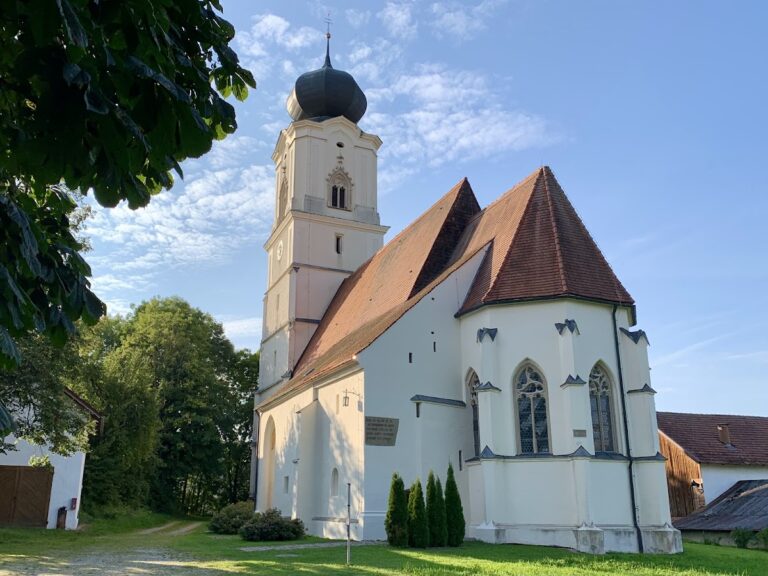
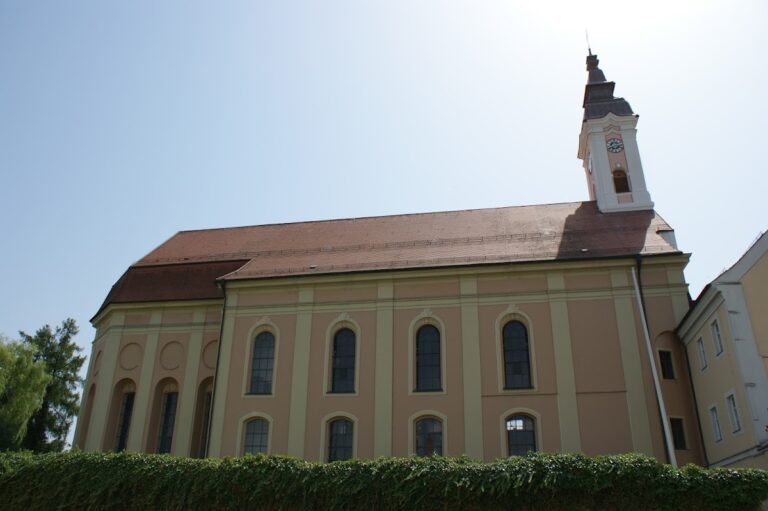
Mariä Himmelfahrt has a pink-rendered exterior with white architectural detailing. Its powerful tower rises from a square lower section and has ornamented volute buttresses above the corner posts of blind balustrades. A multi-tiered, profiled domed roof crowns the structure. Two-storey windows extend through the tower and adjoining facade sections up to the roof cornice. Curved gable sections with vase finials conceal the roof slopes, while the portal carries elaborate Rococo ornament. The original sandstone ornaments and figures removed during the twentieth-century restoration are displayed in the cloister.
Relief-decorated stage walls beside the tower show scenes from the lives of saints. They include Saint Benedict exposing the deception of the Gothic king Totila, a saint with the serpent cup, Saint Bernard of Clairvaux persuading Duke William of Aquitaine of papal authority, and a saint holding the instruments of the Passion. Saint Bernard was a twelfth-century Cistercian abbot, preacher, theologian, and major force in the order’s expansion. The portal figure is the Immaculata, an image of Mary associated with the doctrine of her Immaculate Conception.
Nave, choir, and painted programme
The interior is a spacious, brightly lit wall-pillar church measuring 64 metres in total length. In this church type, substantial piers project from the side walls and organize the bays while preserving broad connected volumes. The nave is 21 metres wide, the choir 10 metres wide, and the interior reaches a height of 20 metres at the vertex. Furnishings become increasingly elaborate from west to east, culminating in the high altar.
The five-bay nave is formed by wall pillars with rounded corners and covered by a semicircular barrel vault without raised springing. Its proportions create a broad, hall-like space. The recessed choir incorporates the enclosing walls of the early seventeenth-century building. It consists of two broad bays with blind arcades and arched niches containing galleries. Two further bays correspond in width to the polygonal sides of the choir termination and, like them, contain tall round-arched windows.
The west gallery is moderately deep and supports a large organ platform conceived as part of Egid Quirin Asam’s architectural design. Rich stucco and a strongly curved parapet shape the platform. Two angel atlantes, sculpted human figures used as architectural supports, carry the central balcony. The oblique side balconies continue into the capitals of the western wall pillars, with corresponding supporting arcades beneath them.
The choir arch contains a cartouche flanked by two angels. Its original chronogram, an inscription whose Roman-numeral letters produce a date, reads “Christo Deo ex Maria Virgine Incarnato” and gives the year 1720. An incorrect restoration changed “Christo” to “Credo.” Read in the usual way, the altered inscription produces 1719, or 2219 if the letter D in “Credo” is counted.
The nave decoration combines a principal fresco extending across three bays with transverse oval paintings in the terminal bays. In the choir, a curved field and a circular field reinforce the architectural order, with the circular painting creating the illusion of a domed rotunda. The stucco represents a transition in Egid Quirin Asam’s work from forceful Italian Baroque forms toward the more elegant French-derived Régence style, a transitional phase between formal Baroque and mature Rococo ornament.
Four large cartouches joined to the frame of the principal fresco contain full-length Evangelists among clouds. The choir depicts the Latin Church Fathers, while smaller Passion scenes between the wall pillars are framed by putti holding instruments of the Passion and related objects. The frescoes are generally well preserved. Cosmas Damian Asam painted some of them, while the two nave ovals and the smaller paintings in the wall-pillar bays are probably workshop or assistant works. Warm fresco colours continue into the marble finishes of the furnishings, while extensive gilding and pink stucco with restrained gold-brocade panels unify the interior.
The western nave oval represents the Annunciation. The principal fresco shows the Nativity as a vision experienced by Saint Bernard of Clairvaux. The stable at Bethlehem appears beneath an opening sky containing God the Father, while angels carry a cross and a serpent globe and draw back a curtain symbolizing the mystery of Christ’s Incarnation. The stable stands beneath a blue daytime sky with pink-ochre clouds. Light radiates chiefly from the Christ Child, with additional illumination from God the Father and the angels. Shepherds hurry up steps toward the scene, guided by a brightly lit angel. A youthful Saint Bernard appears on a balcony-like projection as the figure through whom the viewer enters the vision.
The painted space of the Nativity is independent of the church’s actual architecture. A balustrade rests on the curved fresco frame only in its lower western section and separates from it above. The eastern oval shows the risen Christ appearing to Mary on Easter Sunday. The choir paintings represent the Ascension and the outpouring of the Holy Spirit.
High altar and choir furnishings
The high altar was installed in 1723 and is a major work by the Passau sculptor Joseph Matthias Götz and his workshop. Its monumental structure uses pairs of twisted columns and an upper section dominated by an angelic glory surrounding the Trinity. The figures have naturalistically modelled flesh tones, while most other surfaces are gilded. Light enters through narrow openings between the figures from the choir-end window, whose upper part is yellow-glazed.
The high-altarpiece painting is signed by Mathias Kagen and dated 1619. Transferred from an older altar, it depicts Saint Bernard kneeling before the Virgin, who nourishes him with the “milk of wisdom.” Götz made the tabernacle, the furnished receptacle for consecrated Eucharistic elements, in 1725. Above it stands a carved Crescent Madonna from around 1620 by Hans Degler of Weilheim, also transferred from the earlier altar. Silver-finished carved busts of Saints Ursula and Eugenie flank the figure.
The Marian altar and Cross altar at the choir arch date from about 1728 and were probably designed by Götz. Each has four twisted columns, a richly treated upper section with angels and putti, and an altarpiece showing either the Visitation or the Deposition from the Cross. The paintings bear the dates 1728 and 1729 and the name Bergmüller. Carved busts of Mary and Joseph stand on the revolving tabernacles.
The choir stalls were completed in 1762 from walnut veneer with marquetry. Their rear panels carry fine tin Rocaille arabesques, and freely carved Rocaille cresting frames two paintings identified as works by Bartolomeo Altomonte from 1761. The seats curve toward the choir arch. Gilded reliefs on the screen walls show Saint Alberic receiving the monastic habit from Mary and Saint Bernard witnessing angels recording the monks’ prayers in the Book of Life. Saint Alberic was an early Cistercian abbot associated with the order’s formative period.
Side altars and devotional images
The narrower side altars mainly use two-column structures. The second pair is especially associated with Cosmas Damian Asam, whose paintings date from around 1720. Other side altars, made between 1720 and 1730, were produced by Andreas Math of Vilshofen and Nikolaus Stuber of Munich.
The second altar on the right is dedicated to Saint John the Baptist. Asam’s signed painting shows John preaching to the Jews, while the upper image represents the Cistercian saint Peter of Castelnau. Saints George and Florian stand at the sides. A glass reliquary, a container for relics, holds the remains of Felicianus. Beside the altar is Abbot Malachias Niederhofer’s memorial stone, bearing a coat of arms with a crane holding a stone.
The Three Kings altar is the third on the right. Its principal painting represents the Adoration of the Magi, and the upper image shows Saint Anthony of Padua. The altar contains the relics traditionally identified as those of Valerius. A marble inscribed stone from the Roman catacombs was transferred here and placed behind the altar.
The fourth altar on the right is the Saint Bernard, or Öttingen, altar. It contains a copy of the Altötting Madonna. Its large painting shows Saint Bernard receiving a vision of the Virgin and the redemption of souls from purgatory during Mass. The upper image represents Saint Sebastian, patron of the sick. The fifth altar on the right is dedicated to Saint Walburga. Nikolaus Stuber’s painting shows the abbess of Heidenheim with her brothers Willibald and Wunibald, while the upper image, based on Lucas Cranach, represents Mary Help.
The second altar on the left depicts the martyrdom of Saint Ursula and her companions at the hands of the Huns in a 1720 painting by Cosmas Damian Asam. Its upper image shows the martyrdom of Saint Bernard of Alzira, and Saints Catherine and Barbara flank the altar. A reliquary contains the bones of the unidentified Roman martyr Clara.
The Benedict altar is the third on the left. Its principal image depicts the death of Saint Benedict, and its upper image shows the Archangel Michael. A glass shrine contains a wax figure of Saint John Nepomuk, who was canonized during the church’s construction and increasingly venerated at that time. The fourth altar on the left is the Guardian Angel altar, with Nikolaus Stuber’s image of a guardian angel and an upper image of Saint Roch. Between reliquaries stands a copy of the Scourged Saviour from the Wieskirche.
The fifth altar on the left is the Magdalene altar. Its principal painting shows Saint Mary Magdalene, and the upper image represents Mary’s Protection from Sammarei. A wall monument commemorates Sigmund Münch von Münchhausen, a benefactor of the monastery who died in 1620.
Pulpit, memorials, and chapels
The pulpit bears an inscription identifying it as a work by Joseph Deutschmann of Passau dating to 1748. Its staircase and body have gilded reliefs connected with preaching, including the twelve-year-old Jesus in the Temple. Fully sculpted symbols of the Evangelists complete the decoration. John the Baptist stands on the lambrequin-hung sounding board, accompanied by four child angels representing the continents. These animated Rococo sculptures are probably autograph works by Deutschmann.
Confessionals in the eastern wall-pillar bays date from around 1760 and carry figures by Deutschmann that apparently represent the Four Last Things, death, judgment, hell, and heaven, accompanied by putti. Funerary monuments extend through the church, the chapel circuit, and the monastery cloister. The memorial series for the monastery’s prelates includes the tombstones of Abbot Simon and Abbot Johannes Riemer, both made by the Passau sculptor Jörg Gartner. The cloister contains the large incised full-length figure of Albrecht von Closen, who died in 1341, while the chapel circuit contains the figural relief slab of Wolf von Leublfing, who died in 1530.
The Sacraments Chapel stands at the apex of the chapel circuit. Its circular ceiling painting depicts the Supper at Emmaus within ornament imitating stucco and is probably by Johann Jakob Zeiller. The longitudinal rectangular sacristy has a flat cove vault and five window bays. Its ceiling paintings, signed by Zeiller and dated 1746, show Zacharias’s sacrifice in the Temple and the confirmation of the Cistercian Order by Pope Calixtus II. The second scene has also been interpreted as a Mass with Pope Eugene III.
The sacristy’s walnut-veneered cabinet work was made around 1730 by the monastery joiner Brother Kaspar Grießemann. Rich inlay and twisted columns divide the furnishings. Full-length, multi-bay credenzas line the south and west walls, with broken entablatures decorated by gilded gable pieces and flower vases. A painted Immaculata by Wenzeslaus Jorhan, dated 1746, stands in a niche in the south wall.
Organ and bells
The present main organ, completed by Ludwig Eisenbarth in 1992, has three manuals and 42 registers. Its couplers include II/I, III/I, III/II, I/P, II/P, and III/P, together with a 16-fold electronic setter combination. The transferred 1929 Weise organ can be played through the second and third manuals. Above the choir, a small elevation bell in the roof turret sounds the note B. The six bronze tower bells installed in 2015 replaced the cast-steel bells of 1946, which remain displayed outdoors in front of the church.