Andechs Abbey: A Benedictine Pilgrimage Monastery in Germany


Site at a Glance
- Rating
- 4.5
- Popularity
- High
- Country
- Germany
- Primary era
- Early Modern
- External website
- Open
- Eras represented
- Medieval, Early Modern
- Civilizations
- Duchy of Bavaria, Holy Roman Empire
- Site type
- Religious
- Remains
- Monastery
On this page13 sections
History
Andechs Abbey is a Catholic Benedictine monastery in Germany, centred on a pilgrimage church built between 1423 and 1427 in the Late Gothic style. It stands in the municipality of Andechs on the Holy Mountain east of Lake Ammersee, within the Diocese of Augsburg, and is now a priory of Saint Boniface Abbey in Munich. The monastery occupies the site of Andechs Castle, the ancestral seat of the Counts and Dukes of Andechs, and remains a major pilgrimage centre in Bavaria.
The castle site and early pilgrimage
The hill was formerly occupied by Andechs Castle, whose dynasty became extinct in the male line in 1248. Its possessions then passed to the Wittelsbachs, a major German ruling dynasty that governed Bavaria for centuries. The castle was destroyed, leaving its chapel as the principal surviving religious structure on the site.
Traditions concerning the sacred treasury reach back to Count Rasso of Diessen, who was believed to have brought relics from Rome and the Holy Land to his monastery at Wörth, later called Grafrath. The relics were reportedly moved to the castle hill for protection from Hungarian raids. The name Andechs first appears in the eleventh century, while pilgrimage activity is documented from the twelfth century.
Andechs was also associated with Saint Hedwig of Silesia, a medieval duchess and Catholic saint linked to Silesia and the Andechs family. Tradition places her birth at Andechs in the 1170s, and she married Henry I the Bearded there in 1186. The Andechs-Merania dynasty later lost its position during conflict with the Wittelsbachs. Accusations relating to the murder of King Philip of Swabia in 1208 were subsequently withdrawn, and the dynasty was rehabilitated.
The rediscovery of the relics
On 26 May 1388, a substantial collection of relics was rediscovered beneath the altar of the former castle chapel. The collection had reportedly been hidden after the castle’s destruction. It was first taken to the ducal court chapel in Munich, but the Three Holy Hosts returned to Andechs in 1394. Other relics followed by 1425, and their return renewed the pilgrimage.
The Andechser Apothekenliste, a medieval medical list, was compiled around the beginning of this revival. It describes medicines, illnesses, methods for gathering herbs, and medicinal recipes, offering a detailed glimpse of late-medieval medical practice. In 1416, the former castle chapel and its pilgrimage activities came under the authority of the collegiate foundation at Dießen.
Expansion and Benedictine foundation
The growing number of pilgrims led the canons of Dießen to build a larger church between 1423 and 1427. In 1438, Duke Ernst established a collegiate foundation for secular priests to care for the relics and pilgrims. The first documented inn on the Holy Mountain was also recorded at this time.
On 17 March 1455, a papal mandate converted the collegiate foundation into a Benedictine monastery in the presence of Duke Albrecht III of Bavaria-Munich. Benedictines follow the Rule of Saint Benedict, which emphasizes communal prayer, work, discipline, and stability. Monastic buildings were erected north of the church, monks arrived from Tegernsee, and Eberhard Stöcklin became the first abbot in 1458, when Andechs became independent.
Brewing was already practiced at Andechs during the Middle Ages, and Albrecht III established an official monastic brewery in 1455. Alongside agriculture, hospitality, and a conference and cultural centre, brewing continues to support the monastery’s religious, cultural, scholarly, and social work. The Benedictine community operates the brewery independently of a commercial conglomerate.
Fire and Baroque rebuilding
Lightning caused a devastating fire on 3 May 1669, destroying almost the entire monastery and church complex. Reconstruction began immediately and was completed by the mid-1670s. The rebuilding restored Andechs as a major pilgrimage centre, and the complex was later reshaped in the Baroque and Rococo periods.
For the church’s three-hundredth anniversary, Abbot Bernhard Schütz commissioned Johann Baptist Zimmermann to remodel and decorate the interior between 1751 and 1755. Zimmermann designed and supervised the Rococo work, which included stucco and frescoes in the nave, side aisles, and sacristy. The Rococo style is known for light, elaborate ornament and richly decorated interiors. Other contributors included Johann Baptist Straub, Franz Xaver Schmädl, Hans Degler, Johann Andreas Wolff, Elias Greiter the Younger, and the goldsmith Johann Michael Roth.
Secularization and restoration of the priory
Bavarian secularization in 1803, the state dissolution of monasteries and transfer of their property to secular ownership or administration, ended the monastic foundation at Andechs. Its valuables were taken to Munich, and the pilgrimage church became the property of the Free State of Bavaria. The former monastery buildings and estate passed through several private owners between 1803 and 1846.
King Ludwig I of Bavaria acquired the former monastery in 1846. In 1850 he transferred its buildings and properties to the Benedictine Abbey of Saint Boniface, which he had founded in Munich. Andechs has remained institutionally connected with Saint Boniface as a Benedictine priory since that refoundation.
Twentieth-century associations
In 1929, Cardinal Adolf Bertram of Breslau transferred relics identified as those of Saint Hedwig to Andechs. Pilgrimages dedicated to Hedwig have been held there since 1943. During the Second World War, valuable cultural property, including much of the library of Saint Boniface Abbey, was stored at Andechs.
A fire in 1964 severely damaged the building that had served as the monastery shop since 1890. It destroyed the roof structure and decorative plasterwork and ceiling stucco associated with the Wessobrunn school, a Bavarian tradition especially known for ornamental stucco. The long restoration of the pilgrimage church was completed in 2005, the 550th anniversary of the Benedictine foundation, when a new Jann organ was dedicated.
The Wittelsbachs have used Andechs as a burial place since the Middle Ages. In 1977, Duke Albrecht established a family cemetery near the pilgrimage church, and several coffins were transferred there from other burial places. Carl Orff, the twentieth-century German composer best known internationally for Carmina Burana, was buried in the church’s Painful Chapel in 1982. Since the late twentieth century, the monastery has supported cultural programming associated with Orff. The Carl Orff Festival was held annually during the summer near his grave before disagreements between the monastery and the Carl Orff Foundation led to its discontinuation in 2015.
Andechs is regarded as Bavaria’s second-largest pilgrimage destination after Altötting. Its continuing importance is also reflected in its Benedictine affiliation, Wittelsbach burial tradition, relic treasury, architecture, cultural associations, and brewery. The monastery’s exclusive rights to the marks “Der Andechser” and “Kloster Andechs” were confirmed by Germany’s Federal Court of Justice in 2008. Andechs is protected as a Bavarian architectural monument.
Remains
The surviving complex developed around the former castle site on the Holy Mountain. The pilgrimage church occupies the centre, while the principal monastic buildings are arranged around a central court and cloister. The church retains its fifteenth-century Late Gothic structure, whereas the monastery buildings largely preserve the Baroque rebuilding carried out after the fire of 1669.
The pilgrimage church
The pilgrimage church was built between 1423 and 1427 as a three-aisled hall church for the growing pilgrimage and the relic treasury recovered in 1388. Dedicated to Saint Nicholas, Saint Elizabeth, and Saint Mary, it now has an interior dominated by Rococo decoration produced between 1751 and 1755. Johann Baptist Zimmermann executed ceiling, wall, and column stucco as well as frescoes in the main nave, side aisles, and sacristy. The Rococo interiors have largely survived, together with work by the sculptors Johann Baptist Straub, Franz Xaver Schmädl, and Hans Degler, the painters Johann Andreas Wolff and Elias Greiter the Younger, and the goldsmith Johann Michael Roth.
The church tower was rebuilt after the 1669 fire. Its bells had previously hung in an octagonal structure at roof level. During the reconstruction, the tower was raised and given the bulbous, spherical Baroque cupola that remains its characteristic feature.
The relic treasury and medical manuscript
The former castle chapel of Saint Nicholas is the place where the relic treasury was found beneath the altar in 1388. The collection includes the Three Holy Hosts and other relics associated with the Andechs pilgrimage. The treasury also contains relics identified as the skull bones of Saint Hedwig.
The monastery preserves the Andechser Apothekenliste, which contains a list of medieval medicines, descriptions of illnesses, advice on gathering herbs, and medicinal recipes. As a surviving document, it provides material for understanding the medical knowledge and practices associated with the late-medieval pilgrimage period.
The Baroque monastic complex
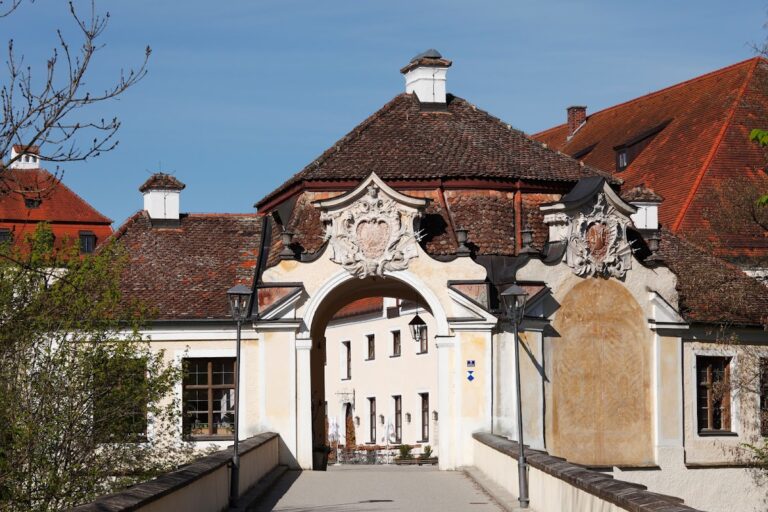
The post-fire monastery was built mainly between 1669 and 1674. Plans supplied in 1670 by the Munich court architect Marx Schinnagl were executed under the court master mason Kaspar Zuccalli. The rebuilt complex has three storeys arranged around a cloister and central court. Monks’ cells occupy the upper floors of the west and north wings, the library is in the south wing, and the east wing contains the refectory below a sequence of rooms for the abbot and princely guests.
The builders reused the foundations of the fifteenth-century cloister and the ground floor of its south wing. A long building from 1613 in the south-eastern part of the complex survived the 1669 fire comparatively intact. By contrast, the brewery and bakery east of the church and the cloister buildings north of it were among the areas most severely damaged. The Baroque rebuilding remains largely preserved.
Chapels and burial places
The Painful Chapel, a side chapel of the pilgrimage church, contains Carl Orff’s grave and serves as one of the Wittelsbach family’s burial places. Prince Heinrich of Bavaria, who died in 1958, was the last of the listed Wittelsbach burials inside the church.
The Wittelsbach family cemetery lies south of the monastery garden near the pilgrimage church. High whitewashed walls enclose it, and coffins transferred from other burial places were placed there in 1977. The cemetery is not open to the general public.
The brewery and damaged shop building
The monastery brewery remains an operating part of the complex. Beer is brewed and bottled on site, and part of the production is served in the monastery’s inn, terrace, and beer garden. Its continued operation forms part of the economic activity that supports the Benedictine community.
The subsidiary building used as the monastery shop from 1890 was heavily damaged by the 1964 fire. The blaze destroyed its roof structure and the Wessobrunn-school ceiling stucco and plasterwork, leaving the building as a material reminder of the losses suffered by the complex in the twentieth century.