Schloss Söldenau: A Renaissance Castle and Former Brewery in Germany


Site at a Glance
- Rating
- 4.6
- Popularity
- Very Low
- Country
- Germany
- Primary era
- Early Modern
- External website
- Open
- Eras represented
- Medieval, Early Modern
- Civilizations
- Holy Roman Empire
- Site type
- Domestic
- Remains
- Castle
On this page9 sections
History
Schloss Söldenau is a castle in Germany, at Ortenburg in Bavaria, developed by the Tuschl knights from a moated castle around 1320. Its present form is a Renaissance four-wing complex with a medieval core. For centuries it served as the residence of the Hofmark Söldenau, a manorial jurisdiction whose holder exercised certain administrative and lower judicial rights over the associated settlement. The site is also known by the forms Säldenau, Saeldenaw, and Seilnauw.
Foundation and Tuschl ownership
The four-wing complex was first mentioned in 1323 under Schweiker I Tuschl, Knight of Söldenau. The original name, Säldenau, derived from Sälde, meaning fortune or “fortunate meadow.” The Tuschl knights also built Saldenburg, which was named after Söldenau and constructed in 1368.
Söldenau had passed out of Tuschl possession before the family line ended in 1397. In his will of 1376, Heinrich Tuschl assigned the castle complex and other properties at Bergheim and Pöring to Protzk von Wolfenberg and Wilhelm and Stefan Mautner of Katzenberg. On 21 December 1378, these holders sold the possessions to the Bavarian dukes Otto, Stephan, Friedrich, and Johann. Söldenau was thereby held as a fief from the Counts of Ortenburg.
Changes of lordship
On 12 October 1389, Ulrich der Ekker acquired the fortresses of Söldenau and Rainding for 15,100 guilders. His heirs later sold Söldenau, on 20 January 1413, to Georg Aichberger of Moos.
From 1426, the castle became involved in a dispute over inheritance. Count Heinrich V of Ortenburg had married Ursula von Ecker of Saldenburg and claimed part of her father’s inheritance, including properties around Saldenburg and Rainding as well as Söldenau. Duke Johann III of Lower Bavaria-Straubing proposed giving Heinrich one quarter of the inheritance, but the settlement failed. A further attempt by Duke Heinrich XVI in 1442 also produced no resolution. In 1445, the territories around Saldenburg were sold to the Bavarian duke, ending the dispute.
The Aichbergers retained Söldenau until their family line became extinct in 1511. The castle was probably burned during the Landshut War of the Succession in 1504, a conflict over the division of the Duchy of Bavaria, as was nearby Ortenburg. Through his marriage to Veronika von Aichberg, Count Ulrich II of Ortenburg inherited the Hofmark in 1511.
Disputes over the Aichberg inheritance continued until 1517. The inheritance included the County of Hals, the lordships and castles of Moos, Söldenau, and Saldenburg, and substantial debts. Duke Ludwig X of Bavaria acquired the County of Hals to settle the debts. The remaining possessions were divided among the heirs, and Ulrich II received Saldenburg and Söldenau with their associated Hofmarks.
Brewing and later history
A brewery had operated in the castle since 1577 and was probably established under Count Ulrich III of Ortenburg. Its foundation was probably connected with the financial difficulties of the Ortenburg family after the Reformation, the sixteenth-century religious movement that divided Western Christianity and led to the establishment of Protestant churches in parts of Europe.
By 1799, the complex had become dilapidated and underwent major rebuilding. The castle buildings were then converted entirely into a brewery. On 14 August 1805, Count Joseph Carl exchanged the Ortenburg imperial county and the counts’ Bavarian possessions, including Söldenau, for the former monastic office of Tambach. An imperial county was a territory within the Holy Roman Empire whose count held imperial immediacy, meaning that the territory was not subordinate to another territorial lord. The Tambach office had been created from secularized ecclesiastical property, transferred from church control to secular authorities.
After the exchange, the brewery passed to the Kingdom of Bavaria and was sold together with the castle. The castle remained inhabited until the mid-1990s. In 1992, the brewery and the rights to the Söldenau brand were sold to Arcobräu Gräfliches Brauhaus GmbH & Co. KG in Moos, after which brewing at Söldenau ceased. SBS Getränkehandel GmbH & Co. KG later occupied parts of the former brewery behind the castle. Beer continued to be sold under the Söldenau name, although it was produced elsewhere.
Parts of the complex have since been renovated, while large sections still require work. Schloss Söldenau is privately owned and not open to the public. It is protected as a listed architectural monument, and subsurface medieval and early-modern remains and finds in the area of the former castle and later moated castle are protected as an archaeological monument.
Remains
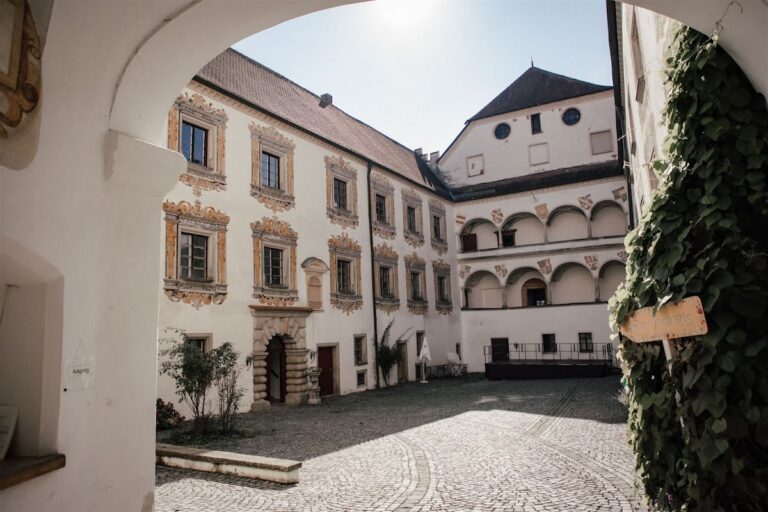
The surviving site is organized around a Renaissance four-wing castle with a medieval core. The building encloses a central courtyard and contains 45 rooms. It occupies an approximate footprint of 2,000 square metres within a property of about 8,000 square metres. The complex survives as a whole, although substantial parts of the buildings remain in need of renovation.
Castle complex and water defences
Four-wing castle
The present castle consists of four connected wings arranged around an enclosed courtyard. Its Renaissance form incorporates the earlier medieval fabric that developed from the original moated castle. The building’s long use as a residence and later brewery is reflected in its continued survival as a large, unified complex. Renovated areas stand alongside sections that still require substantial work.
Moats and former ponds
The original castle was protected on every side by two moats. The nearby Wolfach was diverted to supply or support this water system. The former castle ponds, known as the Schlossweiher, have since been levelled. Their area now includes the parking area of the Söldenau volunteer fire brigade and a passage leading to the brewery associated with the castle.
Former brewery buildings
Parts of the former brewery survive behind the castle. These buildings have been adapted for use by a drinks-trading company, preserving a physical connection with the industrial phase that followed the castle’s conversion in 1799.