Church of the Visitation, Rauenzell: A Roman Catholic Parish Church
Site at a Glance
- Popularity
- Very Low
- Country
- Germany
- Primary era
- Medieval
- Eras represented
- Medieval, Early Modern, Modern
- Civilizations
- German, Holy Roman Empire, Kingdom of Bavaria
- Site type
- Religious
- Remains
- Church
On this page11 sections
History
The Church of the Visitation is the Roman Catholic parish church of Rauenzell, now part of Herrieden in Bavaria, Germany. It belongs to the Diocese of Eichstätt. A church stood here by 1452, when Rauenzell became an independent parish.
Medieval parish and pilgrimage
Rauenzell and Oberbach were initially dependent on the parish of Großenried. Masses were being held in Rauenzell by 1322. In 1362, the Chapel of Our Lady, then dependent on Burgoberbach, received an indulgence letter from 13 bishops. In Catholic practice, an indulgence concerns the remission of temporal punishment associated with sin.
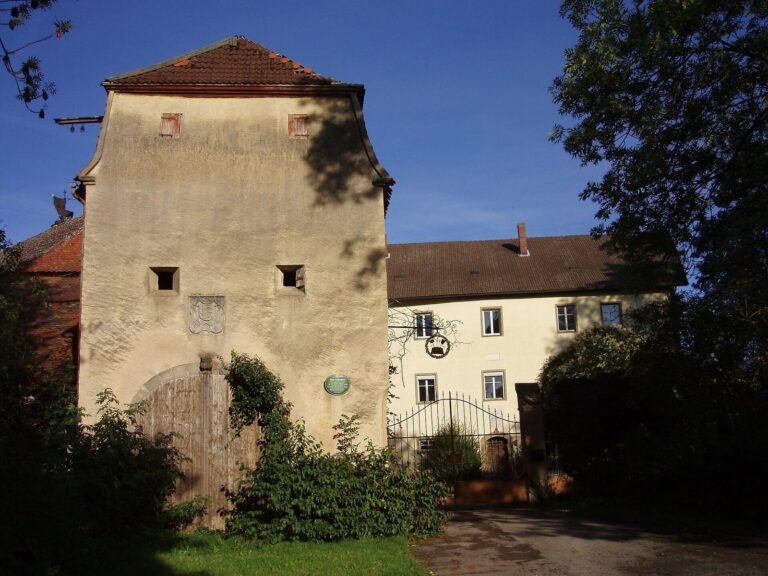
In 1452, Bishop Johann III von Eych of Eichstätt made Rauenzell an independent parish, separate from Burgoberbach. A church was certainly present by then and may have been fortified. The cemetery enclosure’s former gate tower, which had loopholes, is consistent with that possibility.
A local tradition links a pilgrimage to a consecrated host left in the Steinbach forest by a noblewoman in the 14th century. A wooden chapel dedicated to St. Salvator was consecrated at the site in 1493 or earlier, and pilgrims continued to visit into the 19th century.
Renovations and expansion
The parish church was renovated in 1699 and may have suffered damage during the Thirty Years’ War, the European conflict fought from 1618 to 1648. A 1748 estimate associates the church tower’s present form with plans by an Eichstätt court sculptor. Three Baroque altars were consecrated in 1752, and the nave received a plank ceiling in 1795.
As Rauenzell’s population grew, the church was extended eastward in 1821. Three new altars were installed between 1839 and 1844. The schoolhouse within the cemetery enclosure was demolished in 1877, and a sacristy was added to the church in 1889.
The St. Salvator pilgrimage chapel was enlarged between 1764 and 1784 under the Prince-Bishop of Eichstätt’s court building director. State authorities ordered its demolition in early 1808 during secularization, when church institutions and property were transferred or suppressed under state authority. Artworks from the chapel were moved to the Rauenzell parish church.
St. Johann Chapel in the cemetery was probably built in the 15th century and renovated in 1627. Its roof was altered in 1779. After its altar was removed in 1891–92, a grotto recalling the Marian shrine at Lourdes was installed. A western addition in 1950 restored the building’s use as a cemetery chapel.
Recent changes
The earlier organ had a case front made by Andreas Weiß in 1777; it was later moved to an organ museum. A replacement instrument, built by the Jürgen Lutz workshop in Feuchtwangen, was consecrated in July 2003 by Bishop Walter Mixa. In 2007, the church’s wooden floor was replaced with stone flooring and modern heating was installed.
Remains
The parish church
Plan and exterior
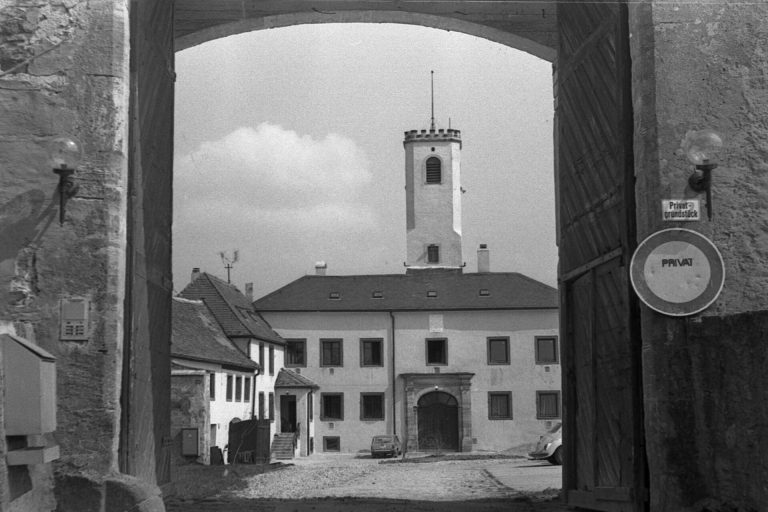
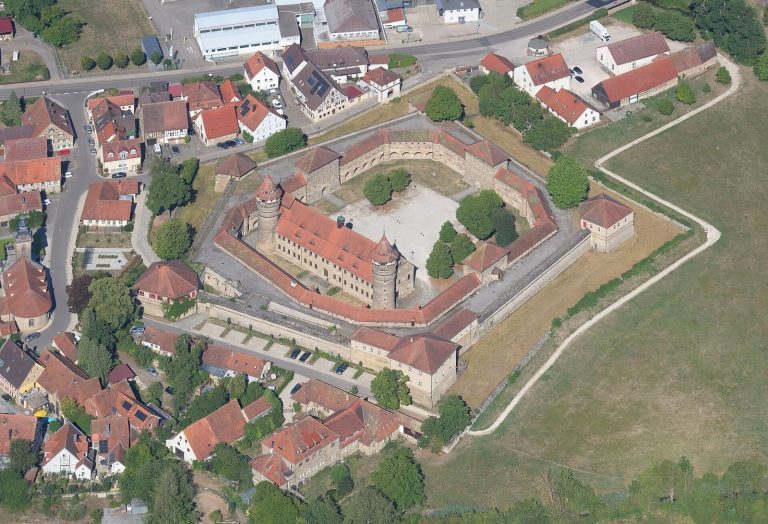
The church stands on a slight rise in southern Rauenzell, inside a walled cemetery shared with St. Johann Chapel. Its west–east plan places the tower at the western end and the choir, the area around the main altar, at the eastern end. The five-bay nave, the main space for the congregation divided into five sections, has a flat ceiling and shallow-arched windows. Shallow niches with basket-shaped arches widen its eastern bay, giving that part a transept-like form. The roof is gabled with partly hipped ends.
The choir ends in five angled faces corresponding to part of an octagon. Its plastered flat ceiling has a molded band and curved cove, and each of its sides has a shallow-arched window. A recessed arch, marked by narrow vertical wall strips, separates the choir from the nave. The sacristy, a room for preparing services and keeping liturgical objects, adjoins the choir to the east.
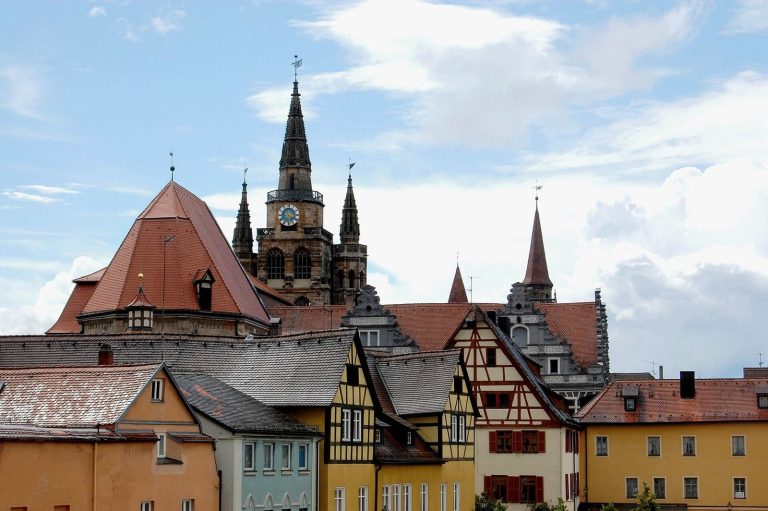
The square, two-storey tower has round-arched openings for the bells in its upper level and a four-sided pyramidal roof. At the entrance, a porch with a net-rib vault, whose ribs form a network pattern, shares a lean-to roof with a 15th-century Mount of Olives niche. The organ loft is at the west end of the church.
Altars and pulpit
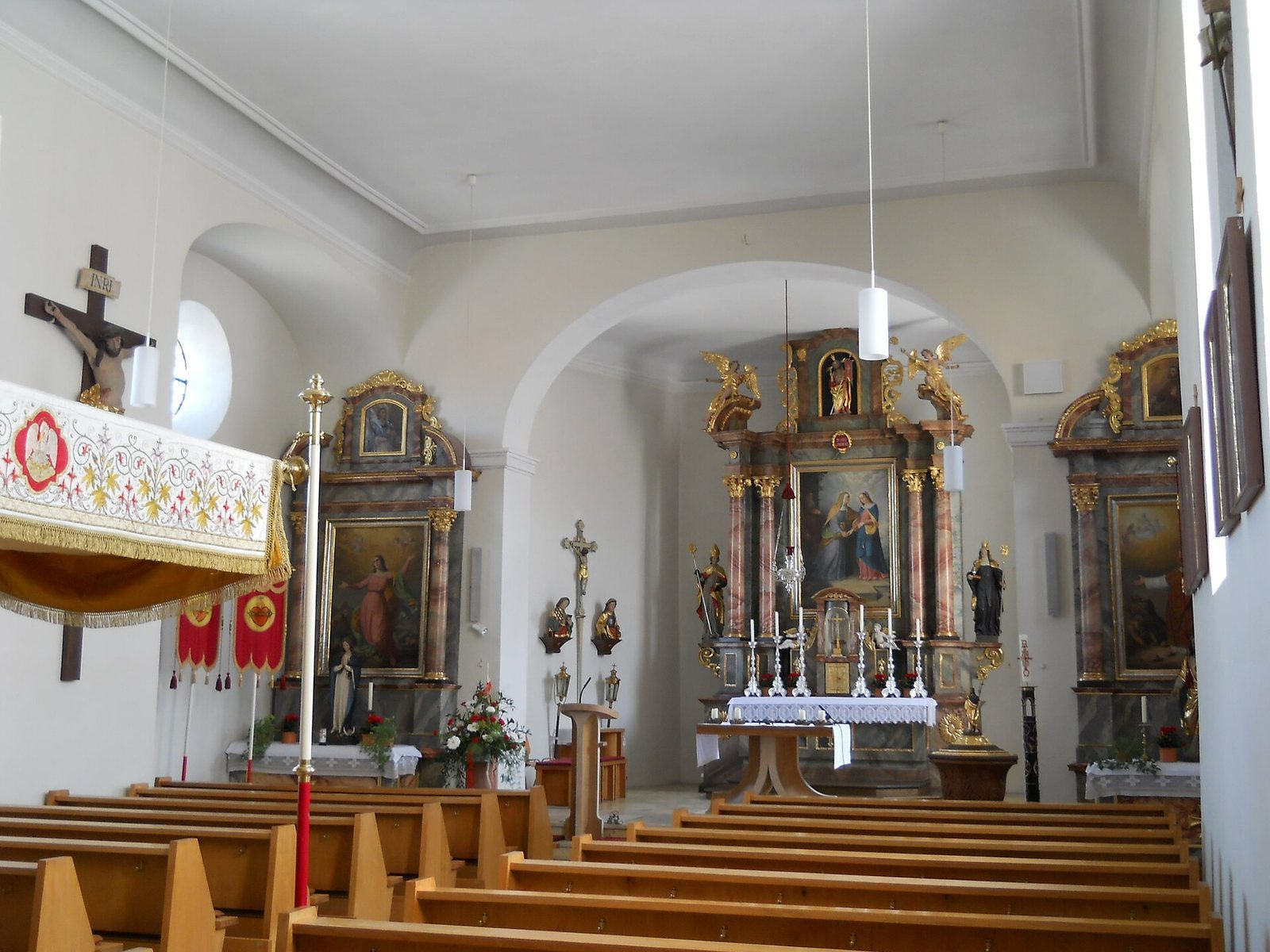
The high altar has four columns and angels in its upper section. Repainted wooden figures of Willibald and Walburga, early medieval missionary saints associated with Eichstätt, stand on either side. A repainted wooden figure of the Risen Christ, dating to around 1500, is set above them. The rectangular 19th-century altarpiece, painted by Johann Andreas Engelhart of Nuremberg, shows the Visitation, the episode in which Mary visits Elizabeth.
The two-column north side altar has Engelhart’s painting of Saint Catherine, with an upper painting of Saint Dominic by Lang dated 1891. The south side altar has Engelhart’s painting of the stoning of Saint Stephen, dated 1847; its upper painting depicts Saint Francis and is probably by Lang. The suspended pulpit probably belongs to the same period as the altars. Its back panel carries a round-arched image of the Redeemer, and its canopy is topped by the Lamb from the Book of Revelation.
Sculpture and memorials
A panel from the 18th century depicts the foundation story of the St. Salvator pilgrimage. Another transferred work from that chapel is a sandstone figure of Christ lying in the tomb, with an angel supporting his head. Dating to the second half of the 15th century, it stands in a niche in the south wall of the nave.
The church also contains a repainted wooden crucifix from around 1500; a repainted group of Saint Anne, Mary, and the infant Jesus; and a repainted Pietà, both from the second half of the 15th century. The heads of the Saint Anne group have probably been reworked. Repainted busts of Saints Lawrence and Florian date to around 1500. Other figures include the archangels Michael and Raphael, Saint Sebastian from the first half of the 16th century, and a repainted statuette of the Risen Christ from the first half of the 18th century. A processional cross dates to around 1800, while a figure of Brother Konrad of Parzham, a Bavarian Capuchin friar and saint, stands in the porch and dates to 1938.
The 15th-century Mount of Olives group consists of repainted stone figures showing Christ praying before his arrest and is regarded as an important work of art. An 18th-century limestone memorial to Johannes Georgius Vollnhals is set into the church’s exterior wall.
Organ and bells
The present organ has a five-part case front decorated in red and green marbling, with partial gilding and carved panels. Its 16 stops control sets of pipes; two hand keyboards and a foot keyboard operate the instrument. The key and stop actions are mechanical, and sliding valves direct air to selected pipes.
The church’s four-bell set has two historic and two contemporary bells. Artist Harry MacLean designed the decoration on the bells dating to 1965.
St. Johann Chapel
St. Johann Chapel stands in the cemetery’s southeast corner. Its upper portion is octagonal and capped by an eight-sided pyramidal roof. A nave-like addition extends westward, and the interior includes the Lourdes grotto.