Herrieden Castle: A Medieval Fortress and Prince-Bishop’s Brewery
Site at a Glance
- Popularity
- Low
- Country
- Germany
- Primary era
- Early Modern
- External website
- Open
- Eras represented
- Medieval, Early Modern
- Civilizations
- Holy Roman Empire
- Site type
- Military
- Remains
- Castle
On this page8 sections
History
Founding and medieval lordship
Herrieden Castle is a medieval fortress in Herrieden, Germany, dated to about 1122, the year it first appears in records. It served as the seat of reeves, officials who administered property and affairs, for the collegiate foundation, a church institution served by a community of clergy, attached to the Diocese of Eichstätt. The counts of Oettingen appointed these officials. The Lords of Herrieden, recorded from 1169, held their lands as dependants of the counts and lived in the castle.
The counts of Oettingen were among the castle’s owners, followed from the fourteenth century by the Prince-Bishopric of Eichstätt, an ecclesiastical territory whose bishop also exercised secular rule. The castle’s position and administration connected it to both the local lords and the changing authorities of the region.
War, destruction, and reconstruction
In 1314, rival elections made Ludwig IV, a Wittelsbach ruler known as Louis the Bavarian, and the Habsburg Frederick the Fair competing German kings. Herrieden backed Frederick and resisted Ludwig. During the ensuing conflict, Ludwig besieged the town with help from Nuremberg experts in projectile weapons. The defenders, commanded by Kraft von Hohenlohe, broke out of the burning town in a counterattack. After a prolonged siege, Ludwig’s forces captured Herrieden and destroyed its walls and towers.
Ludwig camped outside Herrieden on 23 and 24 March 1316. After the town was plundered, he ordered the remains of Saint Deocar exhumed. He gave part to the Nuremberg forces and took another portion to his residence in Munich; that portion was later destroyed in bombing during the Second World War. Relics retained in Nuremberg were kept at the Church of Saint Lawrence from 1316, and Deocar became a third patron saint of the city alongside Saints Sebald and Lawrence. His growing fifteenth-century veneration there was linked to the belief that he had been Charlemagne’s confessor.
An earthquake in 1356 brought down an unfinished rebuilding of the castle. In 1358, Charles IV, a medieval Holy Roman emperor, granted Herrieden a charter of protection and gave the town a reliquary of Saint Vitus. By 1383 the castle had been provisionally repaired, allowing the reeve of Eichstätt to resume an official residence there. Bishop Frederick IV of Eichstätt, who was also Count of Oettingen, then carried out a complete rebuilding between 1396 and 1412.
A fire after 1490 destroyed the castle and its bridge. Bishop Gabriel von Eyb rebuilt the castle between 1508 and 1510. Swedish forces burned it again in 1633.
Later uses and modern changes
In 1685 the castle became the prince-bishop’s brewery, with further building work in 1686 and 1717. The brewery passed into private ownership in 1806. The castle was renovated between 1811 and 1814, but the main building burned in 1877–78 and was rebuilt. The keep collapsed in 1907, and the main building underwent another renovation in 1952. The city of Herrieden has owned the castle since 2009.
Remains
Fortifications and buildings
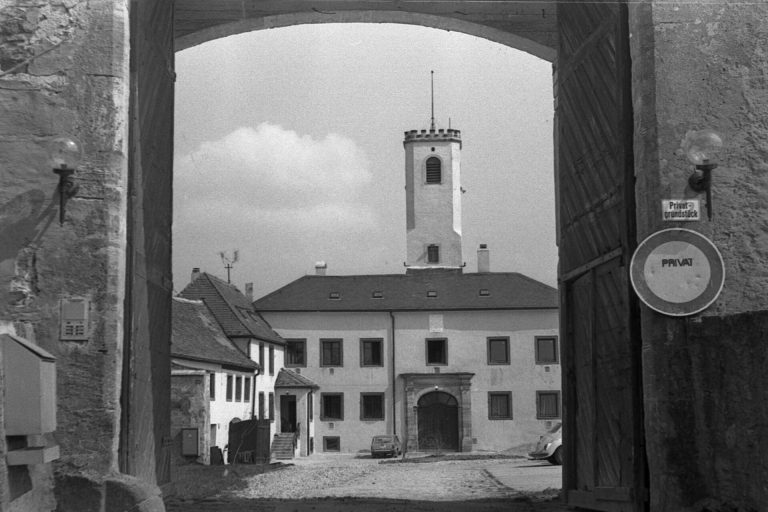
The ruin stands at the northeastern edge of Herrieden’s old town, within the historic town center. Its fortifications form part of the town wall and defensive circuit, while a separate semicircular ditch protects the castle. Extensive retaining walls survive. A partly buried arched bridge leads to the gatehouse.
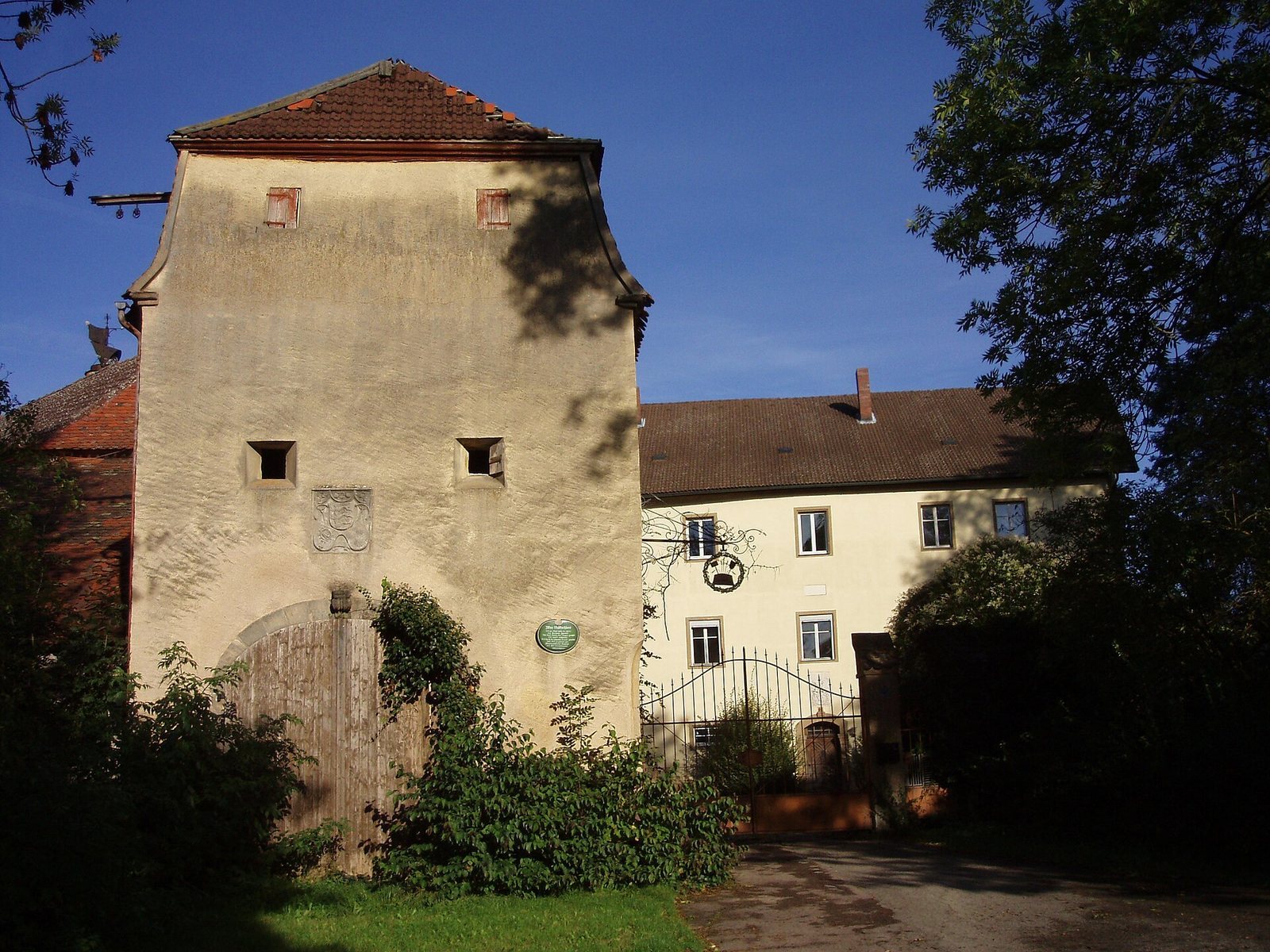
Gate tower and entrance
The surviving gate tower has a mansard roof, with steep lower slopes and shallower upper slopes, and a passage beneath a basket-handle arch, a flattened, rounded arch. Small rectangular windows have shaped surrounds. Above the entrance on the town side, a relief displays the arms of the Eichstätt cathedral chapter, the diocese, and Bishop Gabriel von Eyb; its inscription gives the date 1510.
Inside the tower, a sandstone relief is set into the former outer face of the castle wall. It shows a holy abbot, possibly Deocar, a kneeling bishop, and the arms of the Diocese of Eichstätt, its cathedral chapter, and Bishop Frederick IV, Count of Oettingen. The inscription is dated 1412 and credits Frederick with the building work.
Main building and brewery wing
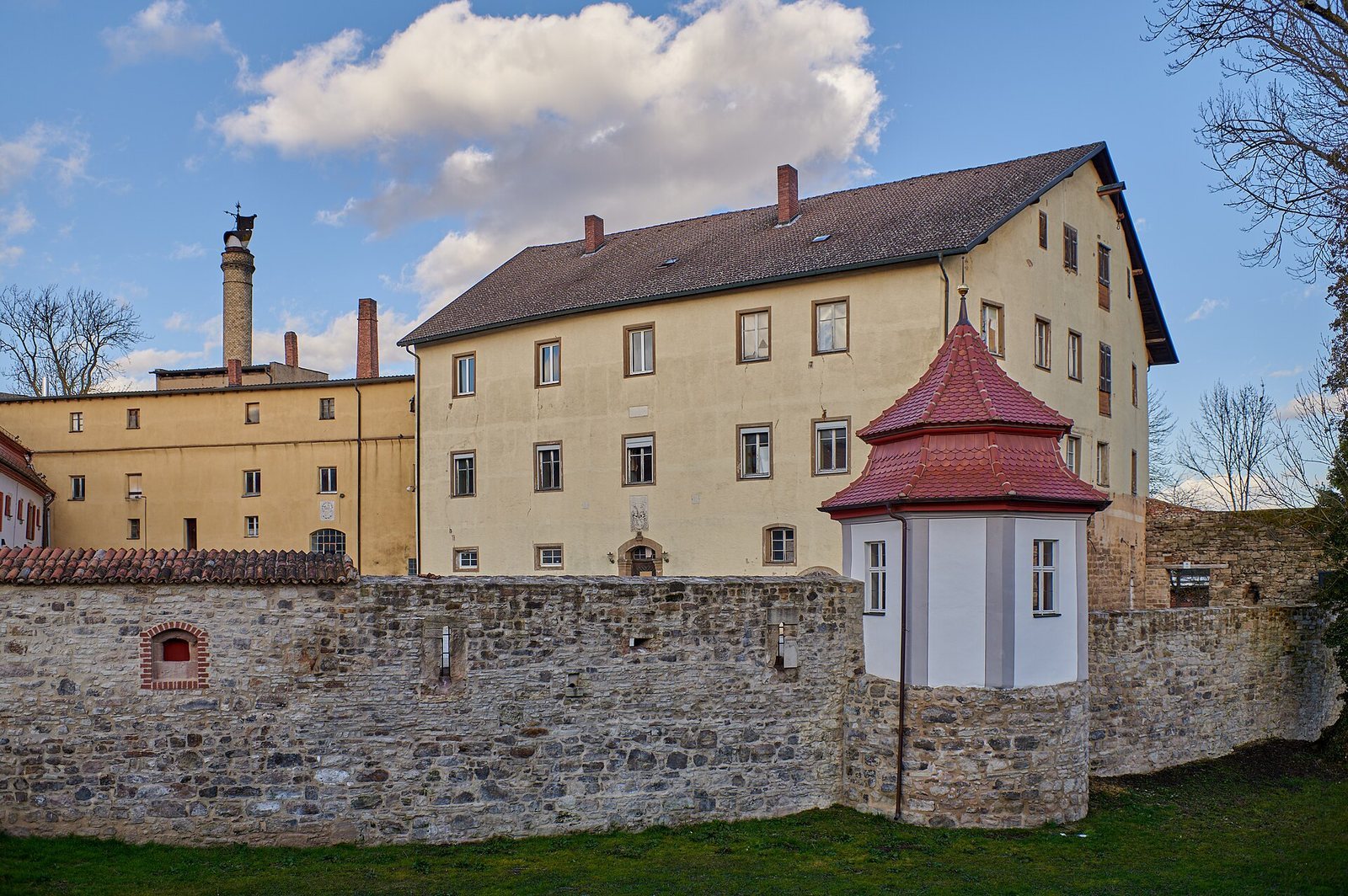
The main building stands against the outer wall and has been altered repeatedly, particularly after the fire of 1877. Its ground floor contains a hall with two aisles and three bays, covered by a groin vault formed where two barrel-shaped ceilings intersect. Pillars support the vault. The hall also contains a tall rectangular vat made of hewn stone, formerly used to steep barley for brewing.
The building’s exterior has shallow vertical pilaster strips at the corners and a continuous base that steps outward beneath a coping stone. An armorial relief carries an inscription naming Johann Anton Knebel von Katzenellenbogen as bishop and prince of the Holy Roman Empire and giving the date 1717. Reliefs on the front of the main building and the adjoining brewery wing identify Bishop Gabriel von Eyb and the year 1508, and Bishop Johannes Eucharius Schenk von Castell and the year 1686.