Kleinaspergle: An Early La Tène Elite Burial Mound
Site at a Glance
- Popularity
- Medium
- Country
- Germany
- Primary era
- Iron Age
- Eras represented
- Iron Age
- Civilizations
- Celtic
- Site type
- Burial
- Remains
- Burial Mound
On this page14 sections
History
Burial and chronology
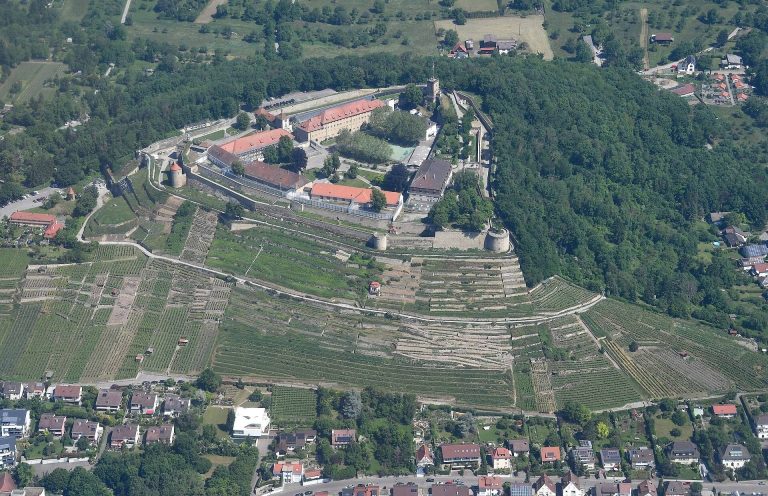
Kleinaspergle is an early La Tène burial mound near Asperg and Möglingen in Germany, created for elite burials associated with Celtic communities. It lies about one kilometre from the former Celtic hillfort of Hohenasperg. The richest burial mound associated with the hillfort, it is also the youngest known elite grave in its vicinity.
The burial belongs to La Tène A, near the transition from the late Hallstatt to the early La Tène period. Hallstatt and La Tène are successive Iron Age periods in central Europe. The grave is conventionally dated to 450–380 BC, while Wolfgang Kimmig proposed a narrower date around 430–420 BC. Individual grave goods are generally assigned to the late fifth century BC. The Greek drinking cups were made before about 450 BC, so they show that the burial took place after their manufacture.
Excavation and interpretation
The central chamber had been plundered in the thirteenth century. The side chamber remained undisturbed until Oscar Fraas excavated the mound in early summer 1879. Complex land ownership restricted his work to a narrow strip. He entered the mound through a standing-height tunnel with passages extending radially and in concentric lines. Diaries, sketches, and drawings by Carl von Häberlin and Eberhard Fraas survive, but they do not establish how fully the side chamber was investigated or where individual objects were found. Fraas left the central chamber unexplored because the looters’ shaft had made it unstable.
The sex of the person in the side chamber remains uncertain. Fraas considered the burial female, while Paul Jacobsthal argued that alcoholic residue in the wine vessel made an elite woman less likely. Konrad Spindler interpreted the drinking horns as evidence for a male burial. Kimmig questioned those arguments, noting comparable drinking sets in graves at Reinheim and Worms-Herrnsheim that were regarded as female. The finds also show that Mediterranean objects and designs reached central Europe and were adapted by Celtic elites and early La Tène craftspeople. The different imported objects have distinct distributions north of the Alps, a pattern Dennis Harding interpreted as evidence of unusually extensive connections across the Alps. The drinking equipment has been taken as evidence for lavish feasting on at least ceremonial occasions. Some objects were gilded at a workshop beside the mound before burial.
Remains
Mound and chambers
Mound and ditch
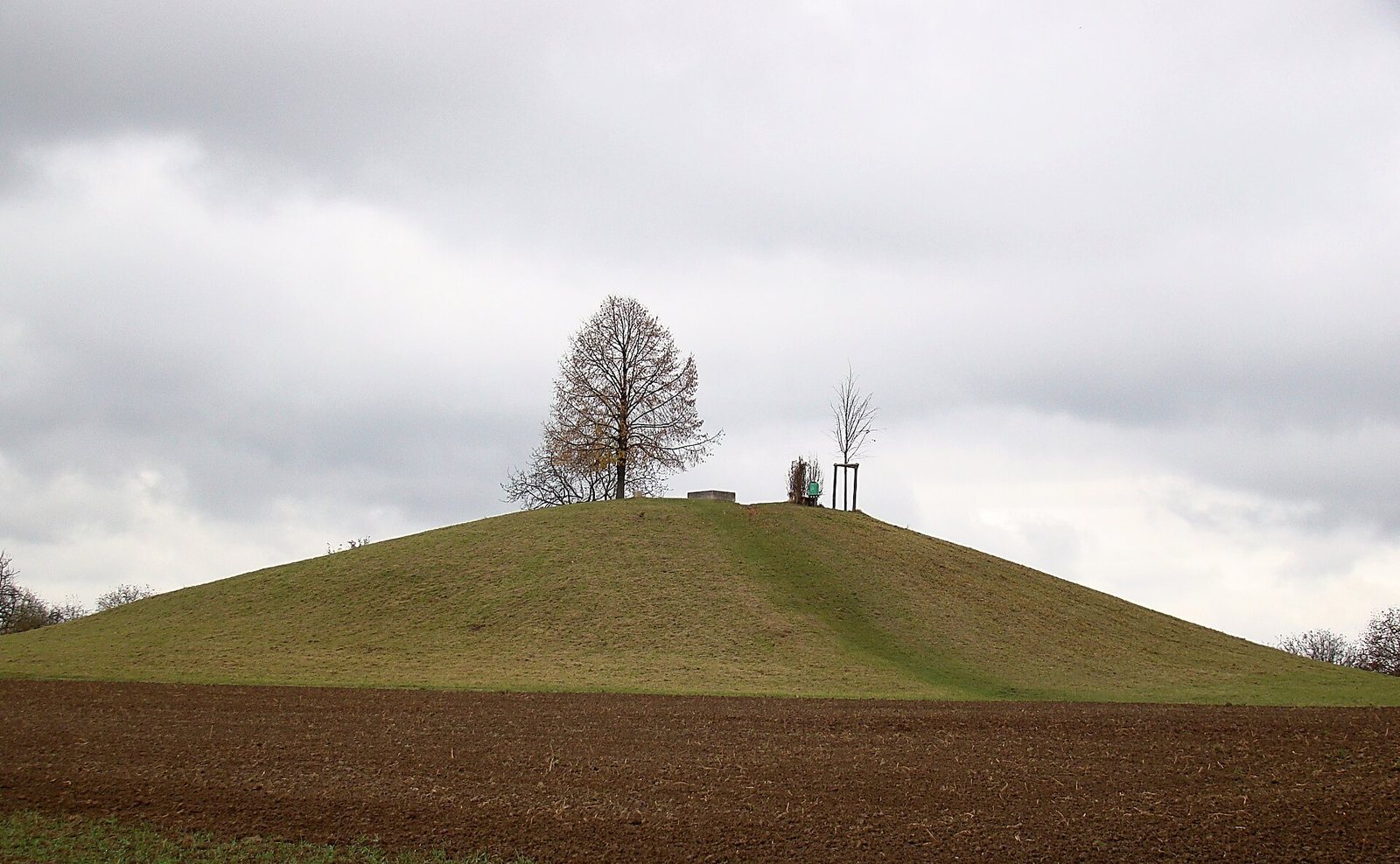
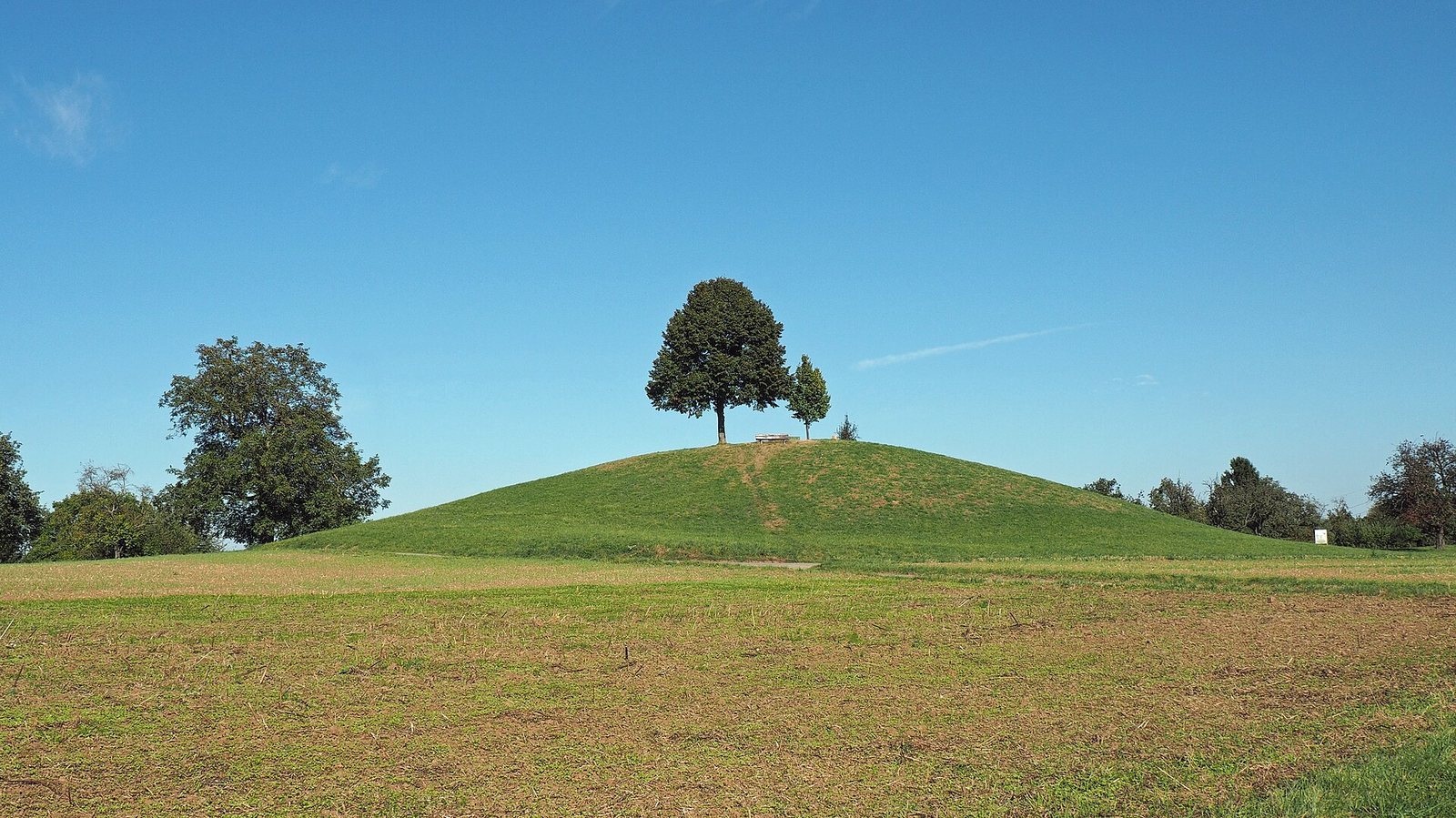
The mound is about 60 metres across and 7.6 metres high, surrounded by a circular ditch roughly 2.5 metres wide and 1.2 metres deep. It may have been raised in two stages: an initial mound about 40 metres across for the central grave, later enlarged for the side burial. The mound’s fill contains traces of settlement debris and appears to have been gathered from a broad area nearby, since digging the surrounding ditch would not have supplied enough material.
Burial chambers
Both chambers were timber-lined and built in a similar way. The central chamber measured about 3 by 4 metres and extended 2.8 metres below the natural ground. The western side chamber measured about 2 by 3 metres and stood at ground level.
Grave goods
Ornaments and fittings
The finds include an arm ring made from sapropelite, a dark, compact form of lignite, as well as a separate lignite ring, iron belt fittings including a belt hook, and pieces of gold foil. A particularly elaborate object is a gold-covered ornamental disk on an iron base. Rows of pearls and lyre, leaf, and flower designs decorate its surface; it once also had coral inlays. Its pattern was laid out with a compass. The disk may have been attached to leather or clothing and perhaps served as a badge for a particular group. Comparable disks are known from male graves and weapon burials.
Bronze drinking vessels
The drinking service included a bronze bowl, a bronze cauldron with a wooden ladle, and a bucket decorated with raised bands. Made in Ticino around 430 BC, the bucket was imported, although similar vessels were also produced in the region. The equipment was intended for two people and served to mix, prepare, or pour alcoholic drinks. A bronze wine-mixing vessel made in the area of Vulci in central Italy had a handle ornamented with carefully chased satyr heads, male nature spirits with animal features. Residue from an alcoholic drink remained inside it, and its decoration resembles that of the bronze flagon.
Sieve and container
A bronze sieve, based on an Etruscan model, was used to separate spices from alcoholic drinks. Only its handle and spoon-shaped bowl survive; both bear patterns of palmettes, leaves, and spirals drawn with a compass. A bronze container from northern Italy was also among the finds.
Decorated flagon
Fragments of a bronze flagon have been reconstructed as belonging to a tall, slender vessel that narrowed toward the bottom and had a beaked spout. Four faces decorate the rim and the base of its handle: a demonic face at the handle’s top, two dog-like faces on the rim, and a bearded face with pointed ears at the handle’s base. Their bulbous noses, prominent eyes, and puffed cheeks give them a strongly modeled appearance. The lowest face resembles an Italic satyr and echoes the satyr heads on the wine-mixing vessel. Two S-shaped scrolls above it may represent an early Celtic leaf crown. Although the flagon’s shape recalls Etruscan vessels with beaked spouts, its distinctive faces identify it as Celtic work. Vincent Megaw regarded it as a striking early example of Celtic craftspeople adapting an imported form.
Greek drinking cups
Two shallow, two-handled Greek drinking cups were found. One is red-figure pottery, a technique in which figures retain the clay’s reddish color against a dark background. Attributed to the conventionally named Amphitrite Painter, it shows a woman with a torch before a burning altar and an offering table; an ivy wreath runs around the inner rim. The other cup, attributed to the Sotades Painter, has a black glaze and a faded image described as a yellow-green myrtle branch with fruit. Both cups had been broken in antiquity and repaired with bronze clasps covered in patterned gold foil. The repair work uses La Tène designs rather than copying the cups’ original decoration. The red-figure cup first drew Paul Jacobsthal’s attention to La Tène art.
Drinking horns
Two drinking horns had gold mounts measuring 14.5 and 17.5 centimetres. Each mount consists of five pieces joined by ring-shaped collars decorated with beaded wire, with a rope-like interlaced pattern running along its length. The larger also carries a wave pattern. Riveted animal heads at the bases have been described as sheep, perhaps a ram and an ewe, with almond-shaped eyes and curved brows. One mount combines Greek-style patterns with the other’s Celtic wave scrolls. A remnant of aurochs horn, from an extinct species of wild cattle, was found inside one mount. These locally made fittings have been linked to Greco-Etruscan or Near Eastern influence and also interpreted as reflecting steppe-nomadic imagery. Megaw attributed the goldwork to a workshop represented by finds from Schwarzenbach I and Eigenbilzen. The excavated objects are now in the collection of the Landesmuseum Württemberg.