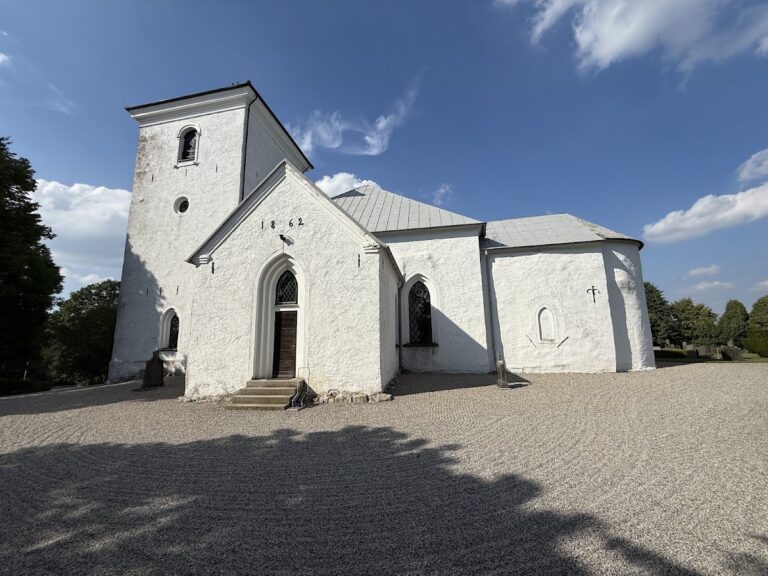
Lyngsjö Church: A Medieval Romanesque Church in Sweden


Site at a Glance
- Rating
- 4.6
- Popularity
- Very Low
- Country
- Sweden
- Primary era
- Medieval
- External website
- Open
- Eras represented
- Medieval, Early Modern
- Civilizations
- Danish
- Site type
- Religious
- Remains
- Church
On this page10 sections
History
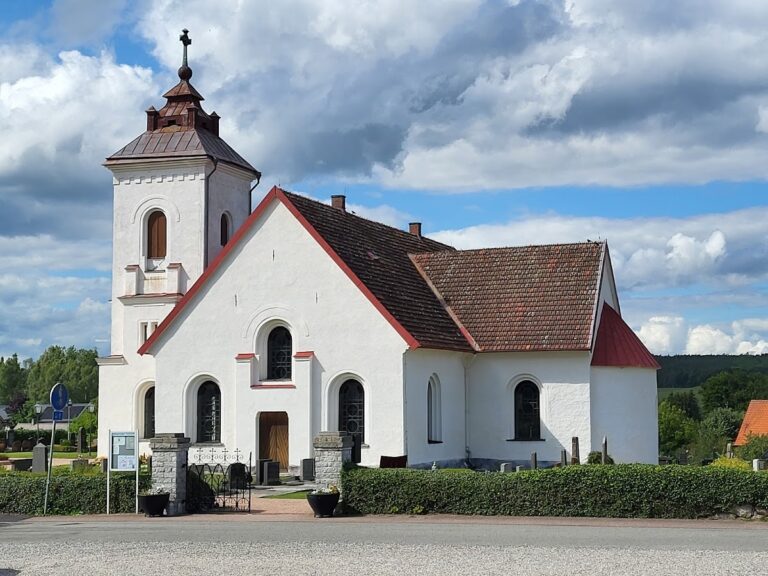
Lyngsjö Church is a medieval church in Sweden, probably built in the 1140s in the Romanesque period. Affiliated with the Church of Sweden, it developed as a religious centre in Lyngsjö, in the province of Skåne, and preserves evidence of medieval worship, later architectural change, and the social history of the surrounding district.
Medieval foundation and development
The church was originally built of fieldstone and consisted of a broad western tower, a nave, a choir, and an apse. Its first architectural form belonged to the Romanesque style, a medieval tradition known for heavy masonry, rounded arches, and substantial structural forms. The original barrel vault was later replaced by Gothic vaults in the fifteenth century. Gothic vaults are later medieval stone vaults associated with the Gothic style.
The church’s baptismal font dates from the end of the twelfth century and carries imagery connected with the killing of Thomas Becket, the archbishop of Canterbury whose death in 1170 made him a major Christian martyr. The choice of this subject may have had a political meaning. At approximately the same time, a relic of Becket was brought to Gumlösa Church elsewhere in Skåne.
Justice at the hundred centre
From 1649 to 1750, Lyngsjö was the centre of Gärds hundred, a historical administrative district. Its courthouse and gallows served the surrounding community. Criminals condemned to death received their last rites in Lyngsjö Church before execution and were required to enter through the smaller doorway as a sign of humility. The last execution at Lyngsjö took place in 1836.
Alterations and renewed study
The apse was demolished in 1796, and the entrances were altered. These changes modified the medieval building while leaving much of its earlier structure and interior decoration in place. During renovation work in 1953, medieval wall paintings were discovered. They were restored in 1954, bringing religious scenes from the church’s earlier history back into view.
The richly decorated altar front, or antependium, was displayed at the Baltic Exhibition in Malmö in 1914. An antependium is a decorated hanging or panel placed at the front of an altar. Its origin remains uncertain. It may have been imported or made locally by an Italian or German goldsmith working on Lund Cathedral, and it has been dated to approximately 1150 to 1170.
Remains
Building and medieval paintings
Lyngsjö Church survives as a fieldstone medieval building whose main historic elements include the western tower, nave, choir, and the later Gothic vaults. A small entrance in the northern wall has been walled up. It measures approximately 144 by 61 centimetres and preserves the memory of the church’s former system of entrances, including the smaller doorway associated with condemned prisoners.
Fragments from two different sets of medieval wall paintings remain inside the church. The older paintings may belong to the period of construction or to the 1190s. They show religious scenes, including episodes from the life of Christ. A later painting on the wall dividing the choir and nave represents Saint Christopher and dates from the fourteenth century. Saint Christopher is a Christian saint traditionally associated with carrying Christ across a river. The paintings were restored after their discovery during the twentieth-century renovation.
Altar and baptismal font
Romanesque antependium
The Romanesque antependium is made of gilt copper and contains thirteen figures. Mary, the mother of Jesus in Christian tradition, occupies the central panel, seated on a throne with the infant Christ. Solomon and David, kings of ancient Israel, appear above and below her in semicircles. Aaron and Moses, major figures of the Hebrew Bible, are placed to her left and right in circles. Eight further figures represent Christian prophets.
The work is considered unusually refined and without an equal of its type in the Nordic countries. Its design has been compared with an antependium from Comburg Monastery in southern Germany. Claes Wahlöö, an art historian and former deputy head of the Kulturen cultural-history museum in Lund, described it as more suitable for a cathedral high altar than for a rural church.
Thomas Becket font
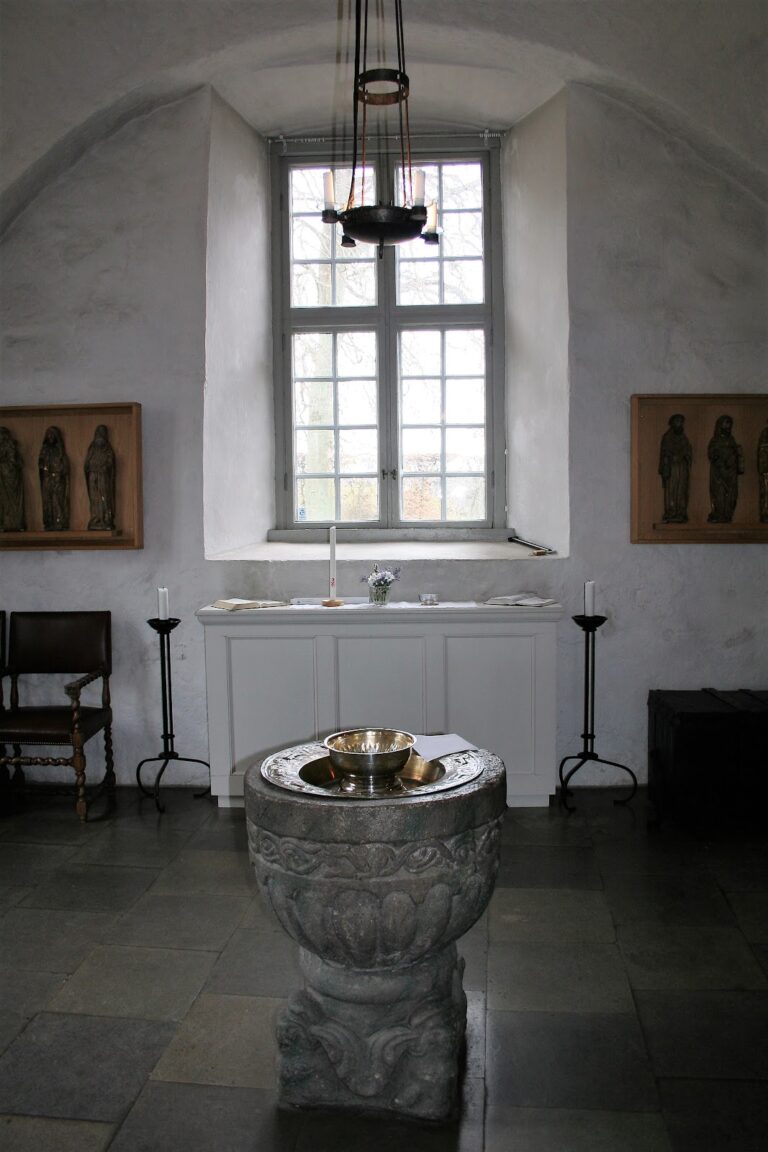
The Romanesque baptismal font is carved from local sandstone and dates from the end of the twelfth century. A baptismal font is the vessel used for Christian baptism. Its sculptor is presumed to have been Tove, a Romanesque artist identified through a signature on another font.
The font’s principal sculptural scene depicts the martyrdom of Thomas Becket. A surrounding frieze shows Henry II of England, the king whose conflict with Becket preceded the killing, ordering the murder from his throne. Beside him is the inscription “REX.HRICVS,” interpreted as “King Henry” in Latin. Soldiers with drawn swords approach Becket, who falls after being struck. Behind him are an altar and a clerical figure holding a cross, interpreted either as Edward Grim, a cleric traditionally associated with an eyewitness account of the attack, or as Becket represented as a saint. A following scene shows Becket ascending to heaven.
Other carvings on the font include the Coronation of the Virgin, a Christian theme showing Mary being crowned in heaven, together with grotesque Romanesque beasts and imaginary animals. The seventeenth-century altarpiece stands behind the altar and antependium, while the pulpit dates from approximately 1600.
Bells and sacred spring
The church has two bells. The larger is from the thirteenth century. The smaller was made in New York and given by Pehr S. Peterson, a former villager who emigrated to the United States. It bears the inscription “Åt Lyngby kyrka af Pehr S. Peterson, Chicago, A. D. 1889,” meaning “To Lyngby Church from Pehr S. Peterson, Chicago, A. D. 1889.”
Approximately 800 metres north of the church is a spring regarded as holy, probably since pre-Christian times. During the Middle Ages it became associated with Saint Helena, a fourth-century Roman empress traditionally linked with the discovery of relics connected with Christianity. The water was still considered miraculous in the eighteenth century.