Church of the Assumption in Przasnysz: A Gothic Parish Church in Poland


Site at a Glance
- Rating
- 3.8
- Popularity
- Very Low
- Country
- Poland
- Primary era
- Medieval
- Eras represented
- Medieval, Early Modern, Modern
- Civilizations
- Kingdom of Poland, Russian
- Site type
- Religious
- Remains
- Church
On this page16 sections
History
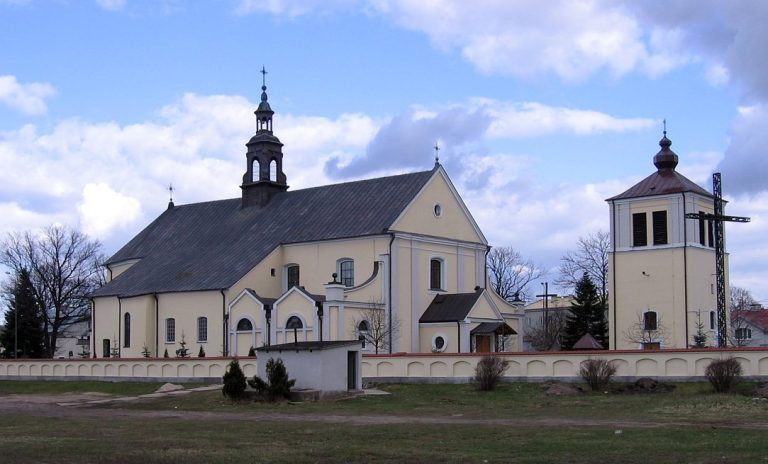
The Church of the Assumption in Przasnysz, Poland, is the city’s oldest historic monument and a Roman Catholic parish church dedicated to the Assumption of the Blessed Virgin Mary, the Christian belief that Mary was taken bodily into heaven. The present Gothic brick church was built between 1474 and 1485, and its origins are connected with a much earlier place of worship.
Medieval origins and construction
Tradition places a first wooden church on the site as early as the thirteenth century. A later masonry church was consecrated in 1408 by Marian, an auxiliary bishop of Płock. That building was destroyed by fire around 1470. The present church followed through the foundation of Michał Bończa-Boniecki, parish priest of Przasnysz. Bishop Piotr of Chodków consecrated it around 1489.
Two side chapels were created at approximately the same time as the church. The northern Chapel of the Five Wounds of Christ was founded by the tailors’ guild. Jan Kostka of Rostkowo founded the southern chapel, dedicated to the Blessed Virgin Mary and Saints Bartholomew, Cecilia, and Barbara. Jan Kostka was the grandfather of Saint Stanislaus Kostka, a sixteenth-century Polish Jesuit novice who became a Catholic saint and is especially associated with Przasnysz and the nearby village of Rostkowo. A large western vestibule was added later, probably during the first half of the sixteenth century.
The Kostka connection
Saint Stanislaus Kostka was baptized in the church in autumn 1550. His family’s connection with the building continued through the burial of his parents and brothers in the northern chapel. This association later made the church an important setting for commemorations connected with the saint and with the pilgrimage tradition linking Przasnysz and Rostkowo.
In the seventeenth century, the church suffered repeated fire damage together with the town. After reconstruction following the fire of 1645, it was consecrated again in 1670 by Maciej Kurski, an auxiliary bishop of Poznań. The renewed dedication reflected the rebuilding of a functioning parish church after the destruction.
Fire, rebuilding, and restoration
A fire on 19 February 1792 left the church in ruins for more than half a century. Reconstruction began in 1848 and continued until 1856 through the efforts of parish priest Grzegorz Budny, but the work did not provide a lasting solution. A more thorough restoration was directed by parish priest Stanisław Czapliński in 1877 and 1878, followed by another restoration in 1890.
Czapliński’s intervention changed both the interior and exterior appearance of the building. Eight pillars that divided the nave and obstructed the altars were removed. The gables of the west facade and vestibule were reshaped, while the sacristy and treasury were rebuilt. A vestibule was added to the southern chapel, and the interior received a false barrel vault. The decorative roof turret, music gallery, altars, pulpit, and baptismal font also date from this period.
Twentieth-century religious and civic history
In summer 1915, the parish church was temporarily converted into a military hospital. Its connection with Saint Stanislaus Kostka became especially prominent during celebrations held on 28 and 29 August 1926, marking the bicentenary of his canonization. Relics of the saint were ceremonially transferred to the church at Rostkowo. Bishop Antoni Julian Nowowiejski celebrated Vespers, an evening prayer service, at Przasnysz on 28 August. The celebrations concluded at Rostkowo the following day and drew approximately 100,000 worshippers.
National celebrations for the four-hundredth anniversary of Saint Stanislaus Kostka’s death took place in August 1967. Cardinal Stefan Wyszyński visited the church on 19 August, where Bishop Bogdan Sikorski welcomed him from the pulpit. After Mass celebrated by Auxiliary Bishop Franciszek Jedwabski of Poznań, Wyszyński blessed the restored Kostka Chapel. Sikorski then inaugurated a perpetual novena, a continuing series of devotional prayers, dedicated to Saint Stanislaus Kostka. Wyszyński celebrated Mass in the church on 20 August. Cardinal Karol Wojtyła and other Polish bishops also gathered at the parish rectory while travelling to the celebrations at Rostkowo.
Since 1983, annual diocesan pilgrimages of children and young people to Rostkowo have departed from the church. They attract more than ten thousand pilgrims. The building was entered in the historic-monument register under number A-383 on 8 December 1958.
Remains
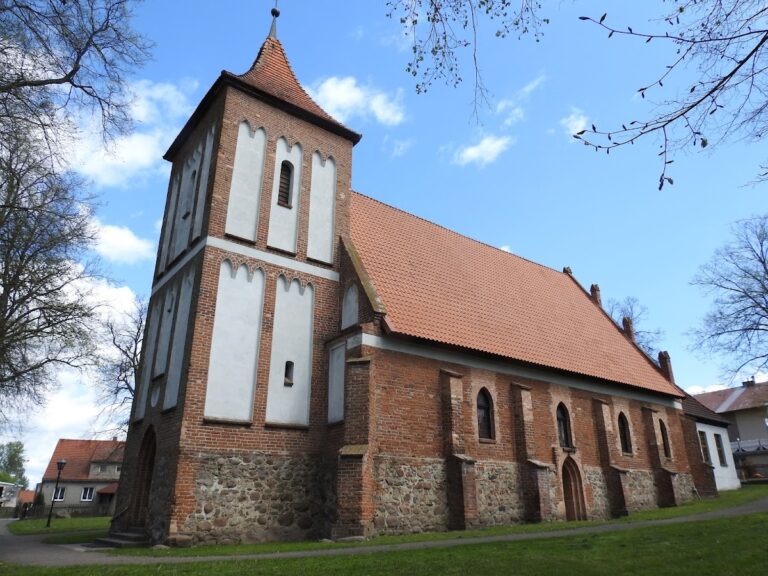
Gothic church layout
The church is an oriented Gothic brick building with a single nave, a straight-ended presbytery, and two side chapels placed beside the nave. The presbytery is the part reserved for the altar and clergy, and a chancel arch separates it from the nave. Each chapel has two bays and is preceded on its eastern side by a low vestibule. A rectangular extension along the northern side of the presbytery contains the sacristy, the room for vestments and liturgical equipment, and the treasury, a secure storage room for church valuables.
Nave and presbytery
The nave, presbytery, and western vestibule are covered by gabled roofs, while the chapels and sacristy have single-pitched roofs. The nave has a ceiling. The presbytery formerly had a crystal vault, a late Gothic vault with richly divided faceted surfaces. Beside the northern side of the chancel arch stands a circular stair turret with a tent-like roof.
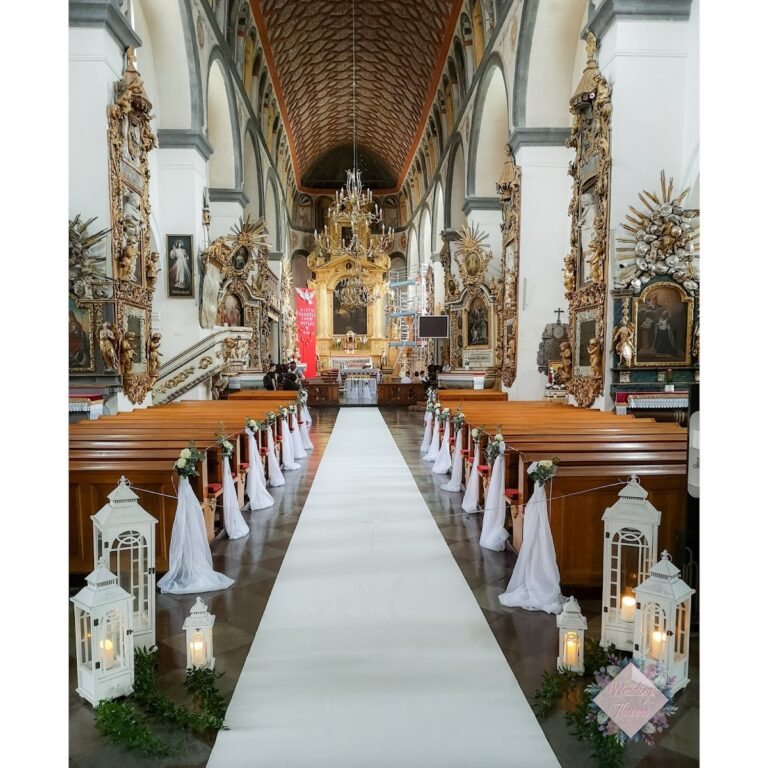
The interior furnishings include Neo-Rococo altars, a pulpit, and a baptismal font. The richly gilded high altar contains figures of Saints Peter and Paul, angels, and bishops. Its imagery includes the Assumption of the Blessed Virgin Mary, Saint Adalbert on the movable shutter, and the Transfiguration.
Side altars
The left side altar is dedicated to Our Lady of the Rosary. It contains a nineteenth-century image of the Virgin Mary dressed in a silver-metal covering, with Saint Isidore represented in the upper part. The right side altar is dedicated to Saint Casimir and contains images of Saints Casimir and Roch. Numerous epitaphs survive within the church.
Chapels and Kostka memorials
Chapel of the Five Wounds
The northern Chapel of the Five Wounds of Christ has a ribbed cross vault, formed by intersecting ribs that support the vaulted bays. Its altar contains an image of the Crucified Christ. The chapel also preserves the burials of members of Saint Stanislaus Kostka’s family.
Kostka family burials
Jan Kostka, castellan of Zakroczym, was buried there after his death in 1576. A castellan was a high-ranking official historically responsible for a castle and its surrounding administrative district. The chapel also contains the burial of Małgorzata of the Kryski family, who died in 1593, and of their sons Wojciech and Paweł. Wojciech died in childhood in 1579. Paweł, standard-bearer of Ciechanów and founder of the Bernardine church in Przasnysz, died in 1607. Bernardines belong to the Observant branch of the Franciscan order.
During the tenure of parish priest Józef Piekut, a commemorative white-marble plaque in a black-marble frame was installed in the chapel wall in 1911. It gives the death dates of Saint Stanislaus Kostka’s parents and brothers.
Vestibule, sculpture, and bell tower
Western vestibule and memorial plaques
The large western vestibule contains memorial plaques to soldiers of the National Armed Forces, National Military Union, and Home Army who were murdered by the NKVD and the Security Office between 1945 and 1951. The NKVD was the Soviet internal-security and secret-police apparatus. The three Polish organizations named on the plaques were underground movements active during or after the Second World War.
Other plaques commemorate parish priests of Przasnysz, including Jan Biliński, who is identified in the clergy list as a teacher and guardian of Saint Stanislaus Kostka. A plaque at the church entrance is dedicated to Cardinal Aleksander Kakowski, who was baptized in the church.
Our Lady of Sorrows
A statue of Our Lady of Sorrows stands in front of the church. It originally came from the parish cemetery and was saved from destruction during the Second World War. The statue was installed in its present position in 1965.
Gothic bell tower
Beside the church stands a free-standing Gothic brick bell tower, probably dating from the end of the fifteenth century. Its third story was added in the sixteenth century. The tower forms a separate surviving element of the historic parish complex.