Lutheran Church in Dźwierzuty: A Late Gothic Place of Worship
Site at a Glance
- Popularity
- Very Low
- Country
- Poland
- Primary era
- Medieval
- Eras represented
- Medieval, Early Modern, Modern
- Civilizations
- Crusader, Duchy of Prussia, German, Kingdom of Prussia, Polish–Lithuanian Commonwealth, Teutonic Order
- Site type
- Religious
- Remains
- Church
On this page14 sections
History
Medieval church and Lutheran worship
A church stood at Mensguth, now Dźwierzuty, by the late fourteenth century. Its first church is dated to about 1385, and a priest named Herder is recorded there in 1391. Lutheran worship began after the Reformation, the sixteenth-century movement that gave rise to Protestant churches, reached East Prussia. Until June 1531, Lutheran preachers also held services every two weeks at the branch church in Wildenheim. That year, Wildenheim became a parish locality of Mensguth.
Fire and rebuilding
A fire severely damaged the church in 1691. It was rebuilt between 1693 and 1695 in its original form, incorporating parts that had survived the fire. The tower’s fabric predates the blaze.
Parish and later use
Until 1945, Mensguth belonged to the Passenheim (now Pasym) superintendent district, an administrative unit overseen by a superintendent, within the Ortelsburg (now Szczytno) church district. These districts formed part of the East Prussian church province of the Evangelical Church of the Old Prussian Union, a Protestant church body in Prussia. In 1925, the parish had 3,600 members spread across 20 localities.
After 1945, the church continued in evangelical use. It is now a branch church affiliated with the Pasym parish in the Masurian Diocese, a regional district of the Evangelical-Augsburg Church in Poland, the country’s Lutheran church body. The congregation has about 100 members.
Remains
Plan and exterior
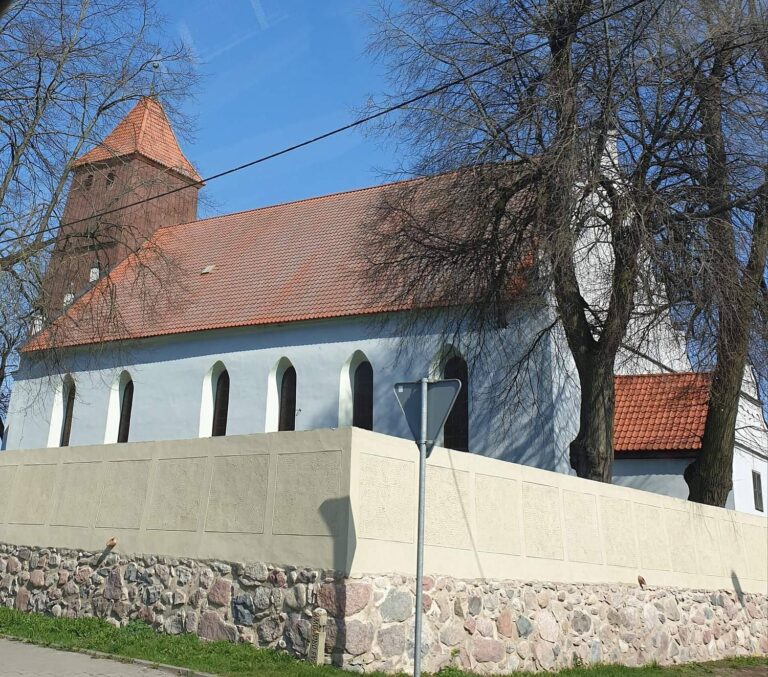
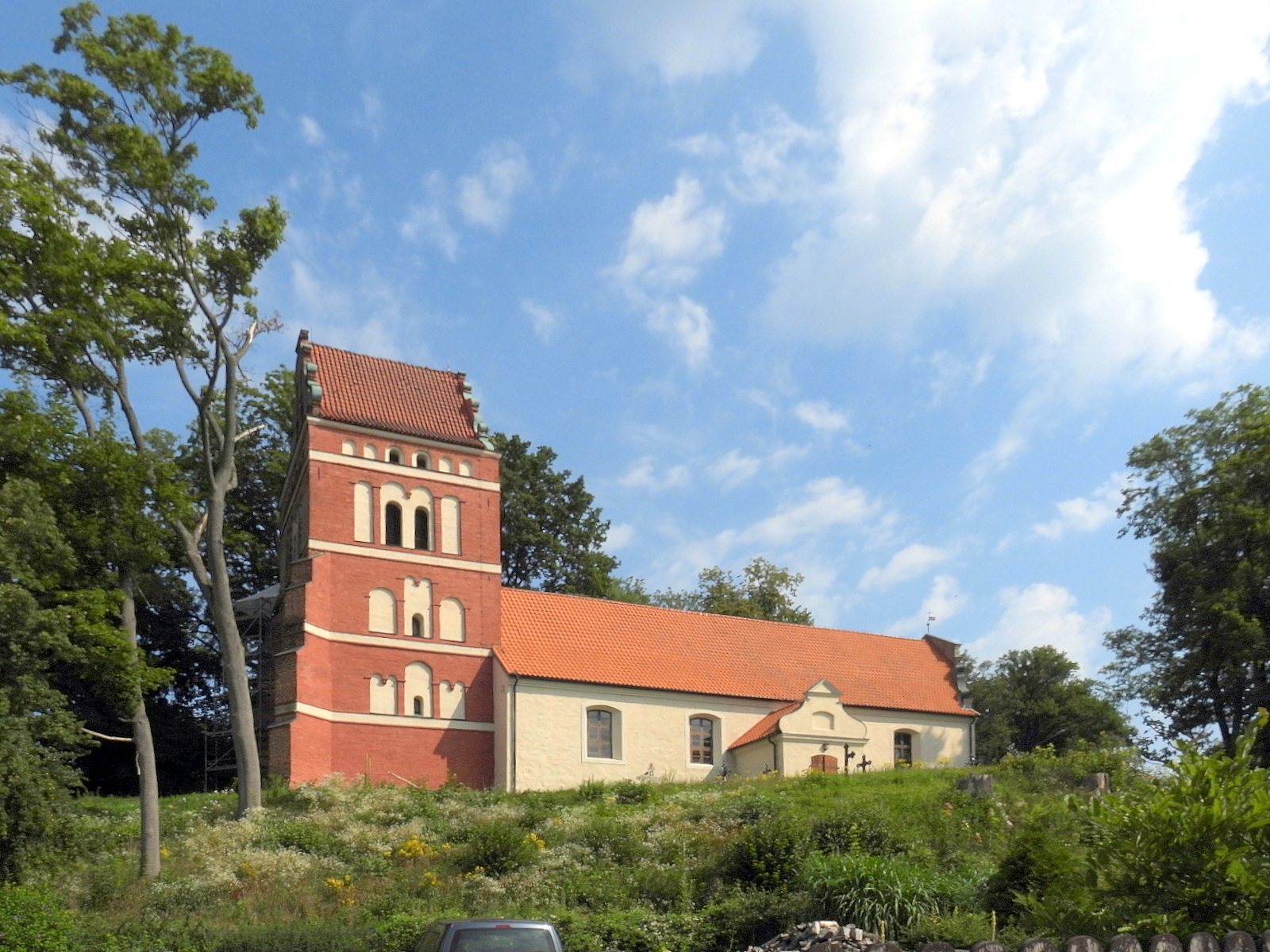
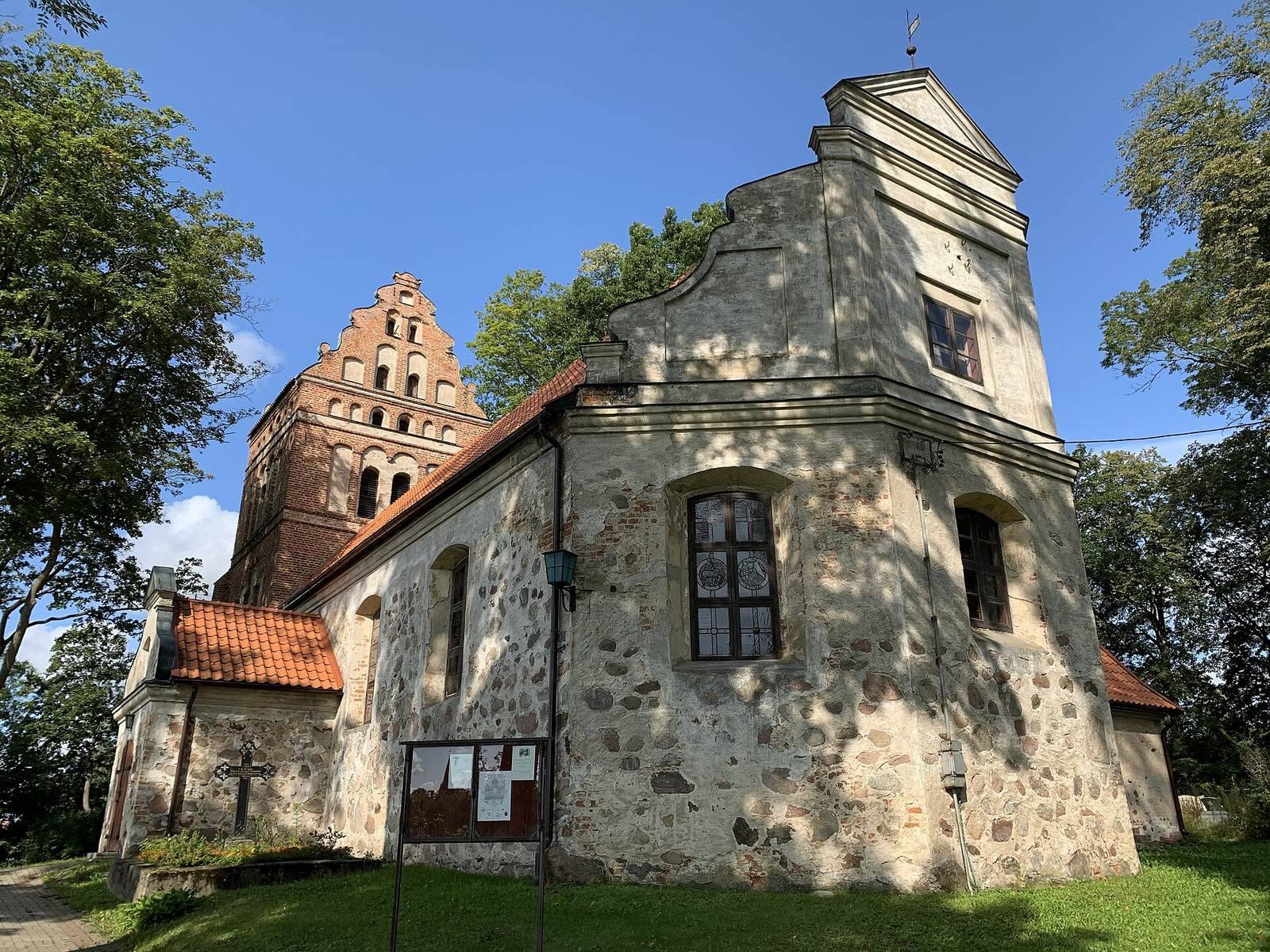
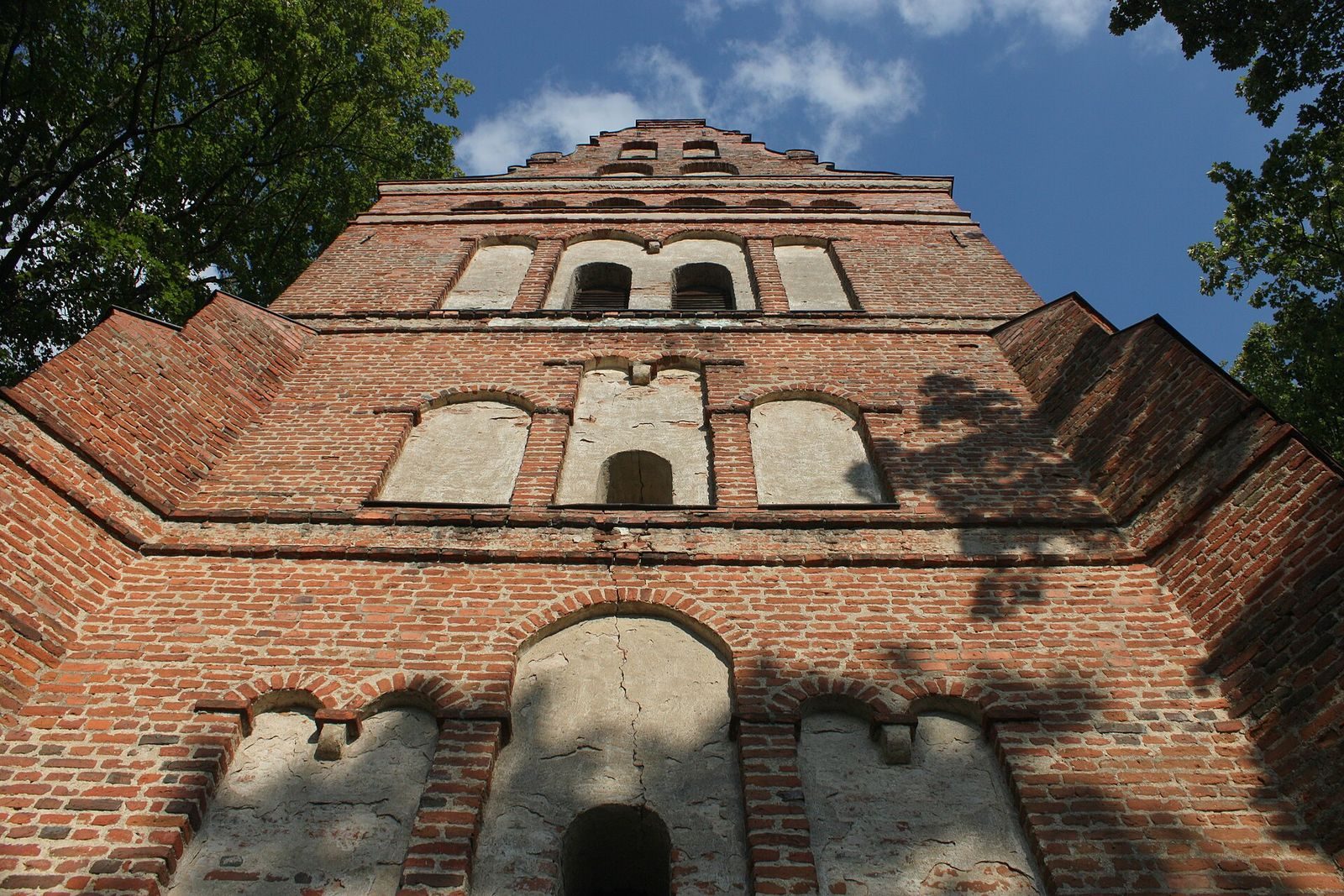
The east-facing church stands slightly above its surroundings among trees and an old cemetery, north of Pasymska Street. Built of brick and fieldstone and covered with plaster, it is a rectangular, single-nave hall with one main worship space. Its late Gothic form has later Baroque features. A massive square tower adjoins the west end, with corner buttresses, a lower entrance porch and stepped doorway. Above are shallow pointed-arch niches and curved gables; the tower’s upper wooden portion was later enclosed in masonry. At the east end, a three-sided polygonal altar area is marked by a curved, scroll-shaped gable. Baroque gables also frame the small south porch. A sacristy, a room for vestments and worship objects, stands on the north side. The otherwise plain exterior walls have a row of segmental-arched windows.
Interior layout
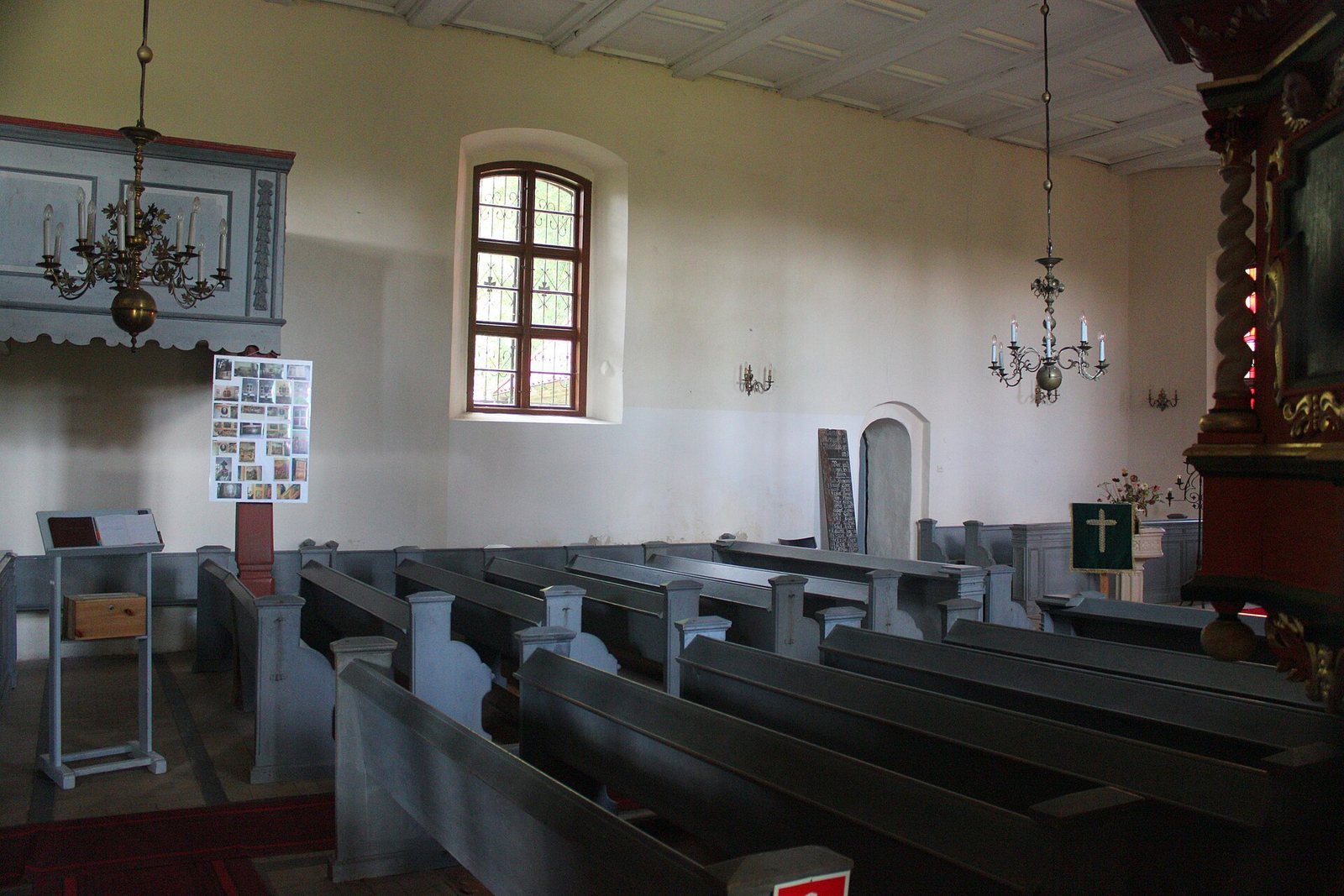
A flat wooden ceiling spans the hall, which has galleries along three sides and contains three altars. The church’s furnishings include works from several periods, from the late sixteenth century onward.
Furnishings and memorials
Altarpiece
The altar made in 1599 by Dutch maker Hans van der Heide has a carved Crucifixion group at its center. Mary and John were added later. Biblical scenes, including subjects from the life of Christ and the Old Testament, appear on its wings. Images of Martin Luther and Philipp Melanchthon, together with a Last Supper scene, decorate the base.
Pulpit and baptismal font
The Baroque pulpit dates to 1675. Its polygonal body carries painted figures of the four Evangelists. An octagonal baptismal font in the church dates from the nineteenth century.
Organ and bells
The organ case on the west gallery dates from the first half of the eighteenth century. The instrument itself was made in 1818 and has a pedal and 18 stops, controls for sets of pipes. The church’s two bells were cast in 1778 and 1794.
Stained glass and memorials
Congregation members donated the stained-glass windows in 1936. A wooden memorial board commemorates 1870–71, and an older plaque may commemorate participants in the Napoleonic Wars. The remains of a wall painting honor those killed in the First World War; a few names can still be identified from approximately 70 originally included. A plaque on the chancel wall commemorates Julius von Quies, owner of Małszewko, who was killed in Cameroon.
Communion chalice
Congregation member Gottliebe Liba donated an engraved communion chalice in 1897. Lost during the Second World War, it was later identified by its engraving while offered for sale at an auction house in Cologne. Several congregations and the leadership of the Evangelical Church in the Rhineland arranged its repurchase and restoration. On 18 August 2019, that church’s president, Manfred Rekowski, returned the chalice to the Dźwierzuty congregation. It is now part of the church’s altar equipment.
Cemetery
The adjoining evangelical cemetery retains several graves dating from before 1945.