Llandovery Castle: A Strategic Anglo-Norman Fortress in Wales


Site at a Glance
- Rating
- 4.2
- Popularity
- Low
- Country
- United Kingdom
- Primary era
- Medieval
- External website
- Open
- Eras represented
- Medieval
- Civilizations
- English, Norman
- Site type
- Military
- Remains
- Castle
On this page13 sections
History
Llandovery Castle is a ruined Anglo-Norman castle in Llandovery, Wales, United Kingdom, established at the beginning of the twelfth century as a motte-and-bailey fortress by Richard FitzPons. Its position in the upper Tywi valley gave it major strategic importance during the twelfth and thirteenth centuries, when Welsh and English forces repeatedly contested control of the site.
Anglo-Norman foundation and Welsh reconquest
Richard FitzPons, founder of the Clifford family, came to Wales as a follower of Bernard de Neufmarché. After the conquest of Brecon, he was permitted to establish a small lordship in Cantref Bychan, a Welsh territorial unit in the region. The castle’s first form was probably a raised defensive mound, or motte, with an adjoining bailey for occupation and service buildings.
Gruffydd ap Rhys attacked Llandovery Castle in 1116. His forces burned the bailey, while the Welsh constable retained control of the motte. In 1158, Rhys ap Gruffydd, prince of Deheubarth, a medieval Welsh principality in southwestern Wales, captured the castle. Following King Henry II’s campaign in Wales, Rhys was compelled to return it to Walter de Clifford, the son of Richard FitzPons. Rhys recaptured it in 1162.
The castle remained in Welsh hands for more than a century. After the death of Lord Rhys, it became the subject of fierce succession struggles involving Owain ap Gruffydd, Rhys Gryg, and Maelgwn ap Rhys. During the first four years of the thirteenth century, control changed five times. The 1216 Treaty of Aberdyfi awarded the castle to Rhys Gryg, who was forced to surrender it to his son Rhys Mechyll in 1227.
Edwardian conquest and later medieval conflicts
John Giffard captured Llandovery Castle in 1277 during Edward I’s campaign against Wales. Edward I was the English king who carried out the major conquest of Wales in the late thirteenth century. Giffard then developed the site as a stone fortification, although he was also expanding the much larger Carreg Cennen Castle, making the improvement of Llandovery a secondary undertaking.
Welsh forces briefly recovered the castle in 1282 during the second war between Edward I and Llywelyn ap Gruffydd, the last native Prince of Wales to be recognized by the English crown before Edward I’s conquest. Rhys ap Maredudd captured it again in 1287 during his revolt and had the English constable and most of the garrison massacred. On both occasions, English forces soon regained control.
In 1299, the castle passed to the Audley family. During the fourteenth century, it passed with the barony of Cemais, a feudal landholding and jurisdiction, to the Touchet family. Its military importance declined during that century, although a garrison was installed again in 1401 during the revolt led by Owain Glyndŵr against English rule. Glyndŵr unsuccessfully besieged the castle in 1403.
Decline and protection
Llandovery Castle fell into decay during the fifteenth century and was burned during a revolt in 1532. In later centuries, the ruins were used as a stone quarry. The surviving castle is now protected as a Scheduled Monument and designated as a Grade II* listed structure.
Remains
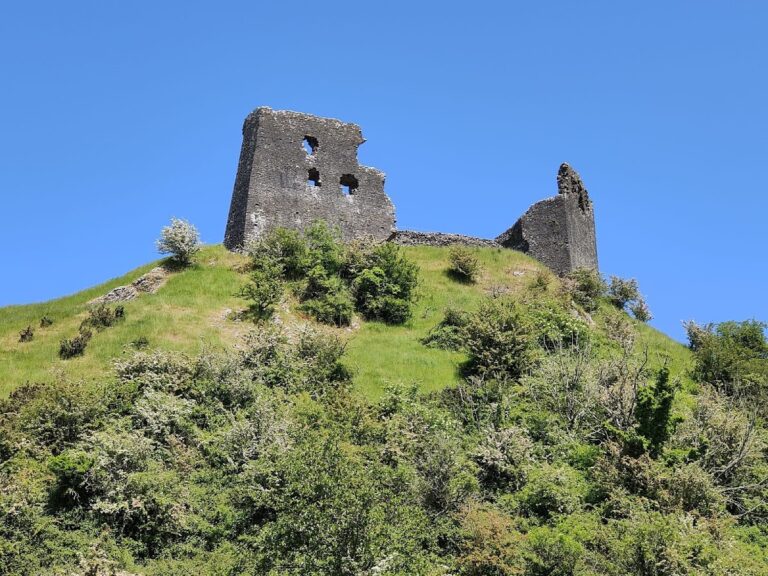
The ruins occupy a summit on the north bank of the River Brân, shortly before it joins the River Tywi. The site lies at about 67 metres above sea level, with hilly ground to the northeast and flatter terrain to the southwest. Its layout combines a twelfth-century motte on a rocky outcrop, a stone keep added after 1277, and a bailey extending northeast from the mound.
Motte and summit defenses
Mound and curtain wall
The twelfth-century castle mound was formed over a rock outcrop, with steep falls to the east and west. A stone curtain wall, meaning a surrounding defensive wall, enclosed the mound. Surviving remnants of this wall define part of the summit’s former defensive arrangement.
D-shaped keep
A D-shaped keep stands on the western edge of the summit. This principal fortified building was constructed after 1277, when the castle was being developed as a stone fortification. Its position formed the strongest built element on the elevated part of the site.
Bailey defenses and buildings
Twin-towered gate
The bailey lay northeast of the mound and retains the ruins of a twin-towered gate. The gate formed the principal surviving entrance feature of the outer area, which also contained service buildings.
Earthwork defenses
The bailey’s defenses consisted of an earthwork bank, a ditch, and palisades, or timber defensive barriers. These works protected the occupation and service area beyond the motte while complementing the stronger stone defenses on the summit.
Commemorative monument
Monument to Llywelyn ap Gruffudd Fychan
A steel monument erected in the bailey in 2001 commemorates Llywelyn ap Gruffudd Fychan. During Owain Glyndŵr’s revolt, he deliberately misled the forces of Henry IV, enabling Welsh troops to escape. Henry IV, the English king during the revolt, consequently ordered his execution as a traitor in front of the castle in 1401 by hanging, disembowelment, and quartering.