Dinefwr Castle: Medieval Stronghold and Seat of Deheubarth

Site at a Glance
- Rating
- 4.7
- Popularity
- Medium
- Country
- United Kingdom
- Primary era
- Medieval
- External website
- Open
- Eras represented
- Medieval, Early Modern
- Civilizations
- English
- Site type
- Military
- Remains
- Castle
On this page10 sections
History
Dinefwr Castle is a ruined medieval castle in Wales, United Kingdom, near Llandeilo, built and developed by the Welsh rulers of Deheubarth from the twelfth century onward. It was the chief seat of the Dinefwr dynasty and the principal political centre of Deheubarth, a medieval kingdom in south-west Wales. Tradition connects the earliest castle on the hill with Rhodri the Great, a ninth-century Welsh ruler, but neither written nor archaeological evidence demonstrates a castle there before the mid-twelfth century.
The Dinefwr dynasty and the rise of the castle
The site later became the principal residence of Hywel Dda, Rhodri the Great’s grandson. Hywel was the first ruler of Deheubarth and subsequently became king of much of Wales. The castle’s political importance grew under Rhys ap Gruffydd, also known as the Lord Rhys, who ruled Deheubarth from 1155 to 1197. He is regarded as the first builder of the present castle.
Around 1180, when Deheubarth reached its greatest importance under Rhys ap Gruffydd, he probably established a stone curtain wall around the site. A curtain wall is a fortified enclosing wall, and at Dinefwr it included two gates. Rhys used the castle as his residence, making it both a stronghold and the principal seat of his rule.
Succession struggles and Gwynedd’s authority
After Rhys ap Gruffydd died, Dinefwr eventually passed to his youngest son, Rhys Gryg. Rivalry among Rhys’s sons led to repeated changes of ownership. Rhys Gryg held the castle after 1208 and continued its development, probably constructing the powerful round keep before his death in 1234.
In 1213, following a siege and severe fighting, Dinefwr was captured by Rhys Ieuanc, a nephew of Rhys Gryg. Three years later, Llywelyn the Great, the leading ruler of Gwynedd, imposed the Agreement of Aberdyfi. This settlement divided Deheubarth into three lordships dependent on Gwynedd, with Dinefwr assigned to Rhys Gryg.
As Llywelyn extended his authority into Deheubarth, Rhys Gryg dismantled the castle because he could not resist Llywelyn’s power. Llywelyn later restored it. Dinefwr then returned to the descendants of Rhys Gryg, although it was temporarily held directly by Llywelyn.
English conquest and royal control
During the English conquest of Wales, Edward I’s forces defeated Welsh resistance near Carmarthen in 1277. Rhys Wyndod, a great-grandson of Rhys Gryg, surrendered Dinefwr to Payn de Chaworth in June of that year. Rhys ap Maredudd, the son of Maredudd ap Rhys, also assisted Edward I in capturing the castle. Edward later failed to honour an apparent promise to grant Dinefwr to Rhys ap Maredudd, who was executed in 1291.
After its capture, the castle remained in the hands of the English Crown. It became an administrative centre and a visible expression of royal authority. The English repaired the fortifications, built a new main gate, and added an outer barbican, a defended forecourt protecting the approach to the inner castle.
Dinefwr was briefly taken by Welsh rebels during the revolt of Rhys ap Maredudd in 1287. It was burned during the rebellion of Llywelyn Bren in 1316 and was granted to Hugh Despenser, a royal favourite, in 1317. By the late fourteenth century the castle had been neglected. Owain Glyndŵr, the Welsh leader who rebelled against English rule, laid siege to Dinefwr for ten days in 1403, but the attack failed. The southern wall was renewed after the siege, and further buildings were erected in the outer ward.
Later ownership, decline, and conservation
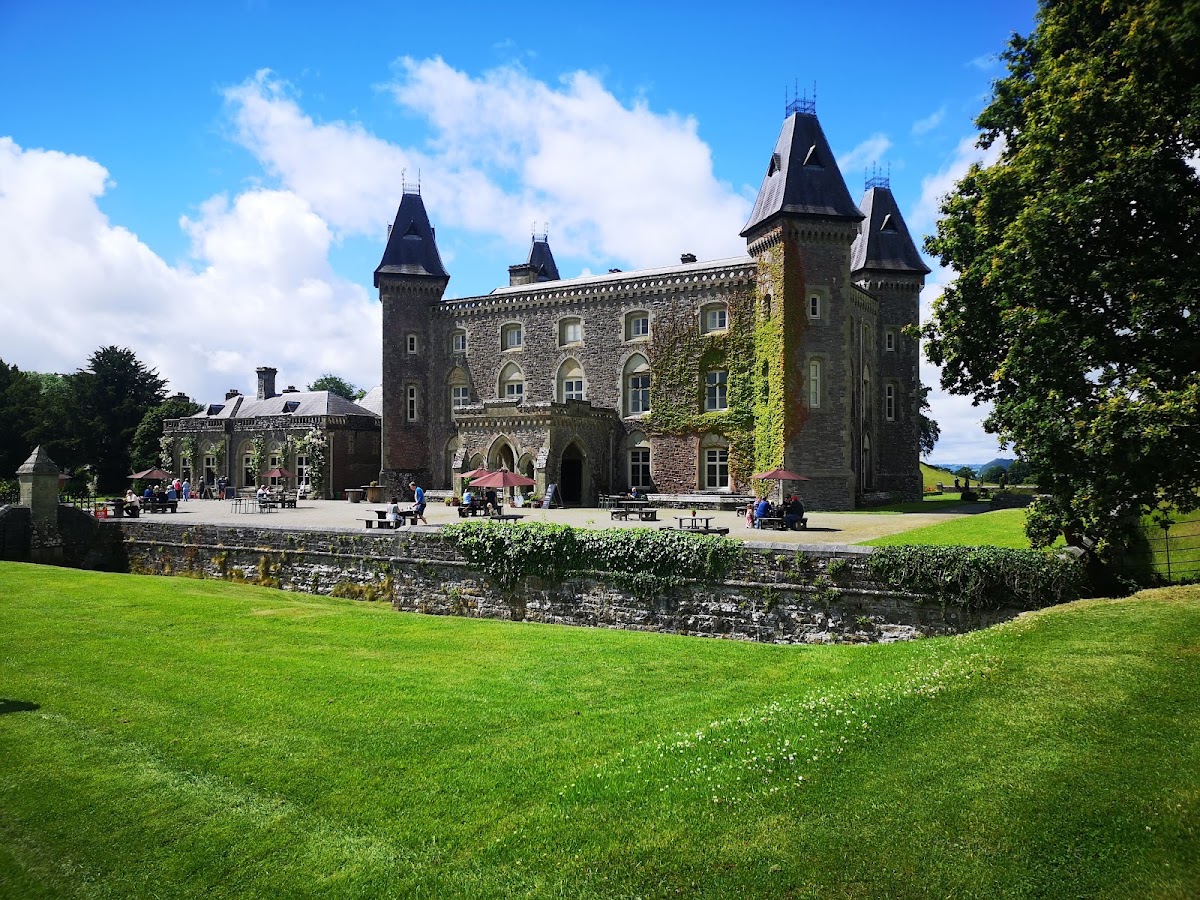
Gruffudd ap Nicolas acquired Dinefwr around 1425 but preferred Newton House, north of the castle, as his residence. His grandson, Sir Rhys ap Thomas, moved the family residence to Carew Castle in Pembrokeshire during the 1490s. Dinefwr consequently became increasingly neglected, although Sir Rhys held the castle toward the end of the fifteenth century and carried out extensive rebuilding.
In 1531, Sir Rhys ap Thomas’s grandson, Rhys ap Gruffydd, was executed for treason. The Crown confiscated Dinefwr, although the family later recovered it. During the late seventeenth century, the keep was converted into a picturesque summer house and picnic place. Newton House had been built nearby in 1660, and the summer-house conversion was destroyed by fire in the eighteenth century. The castle was then left once more to decay.
During the twentieth century, the Barons of Dynevor undertook partial restoration, although some medieval walls were destroyed during the work. Dinefwr is now owned by the Wildlife Trust of South and West Wales and managed on its behalf by Cadw, while the surrounding estate in Dinefwr Park is owned by the National Trust. The castle is a Grade I listed building, a designation for structures of exceptional architectural or historic interest in the heritage-protection system of England and Wales, and it is also a Scheduled Monument protected by law because of its archaeological and historic importance.
Remains
Hilltop setting and defensive layout
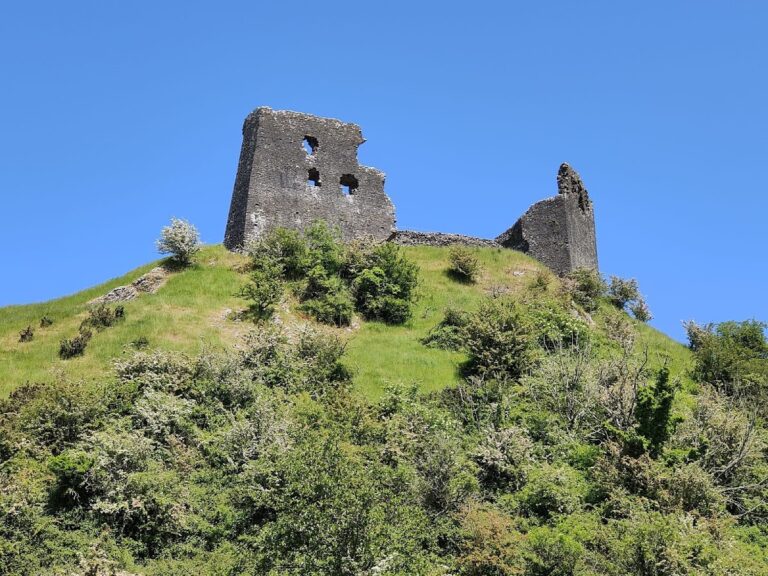
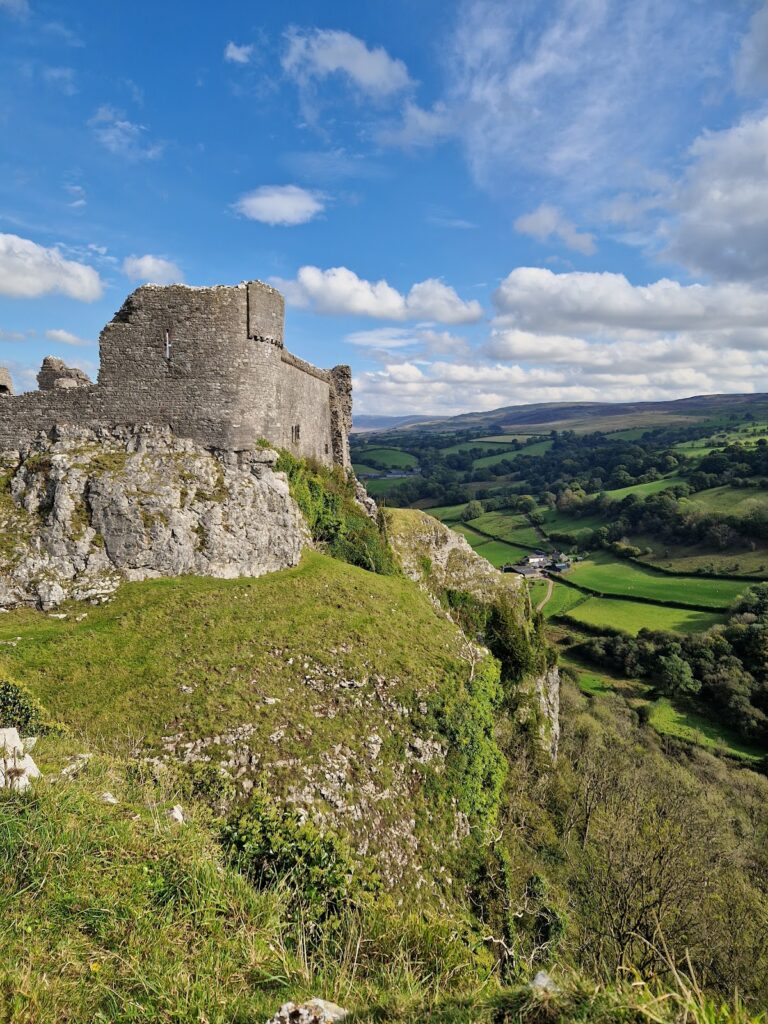
Dinefwr Castle occupies a ridge on the northern bank of the River Towy, west of Llandeilo. The south-west side of the ridge falls steeply toward the Towy valley by about 30 metres, or 100 feet. A deep ditch cut into the rock protects the other three sides of the inner castle. This combination of steep natural ground and artificial defenses shaped the castle’s compact layout.
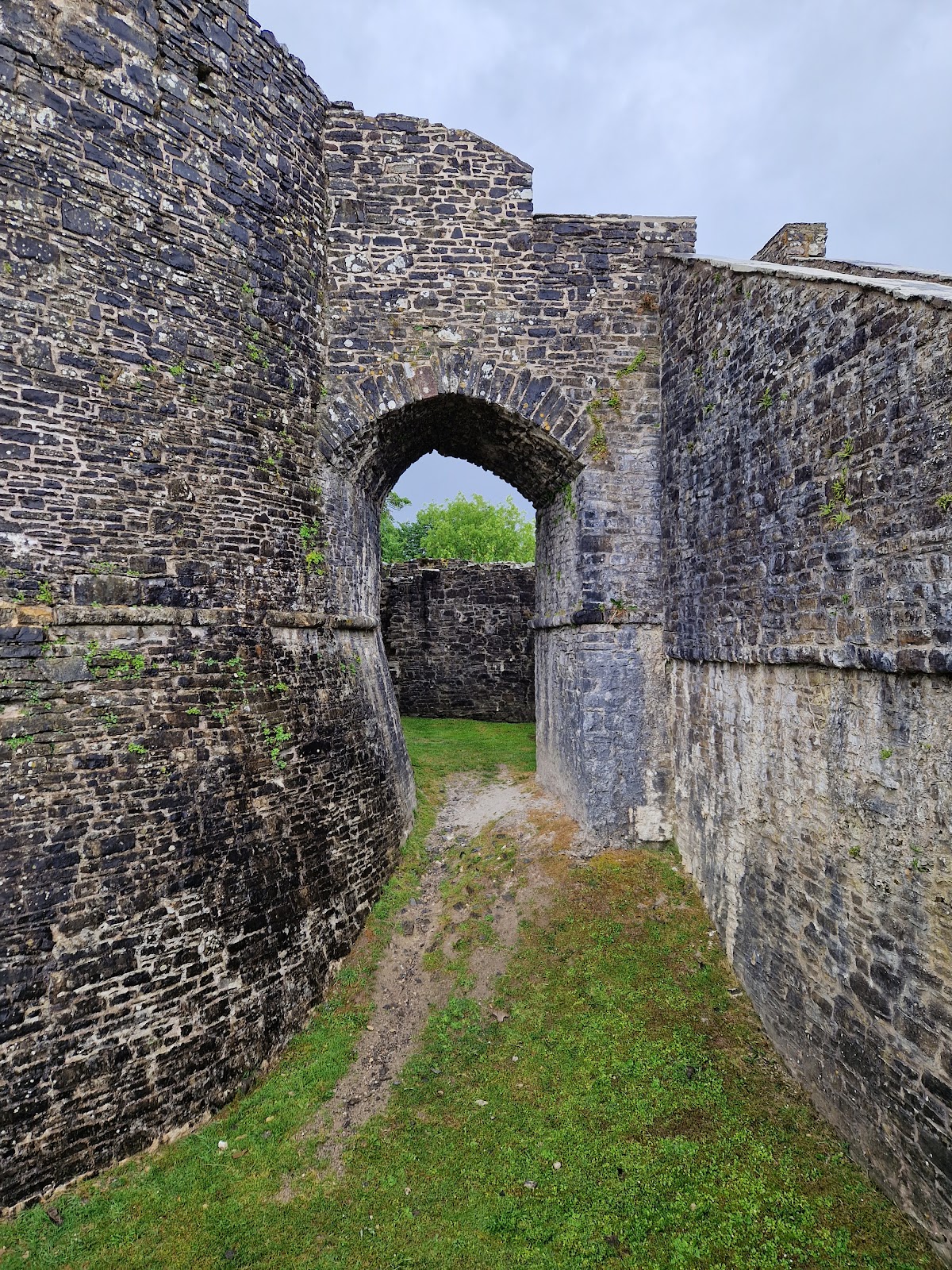
The eastern approach originally crossed a ditch through an outer gate and entered an eastern outer ward, of which only slight remains survive. A second gateway crossed the ditch surrounding the inner castle and led into a defended forecourt, or barbican, on the south side of the enclosure. From there, a simple main gate in the southern wall opened into the five-sided inner courtyard.
Curtain walls and towers
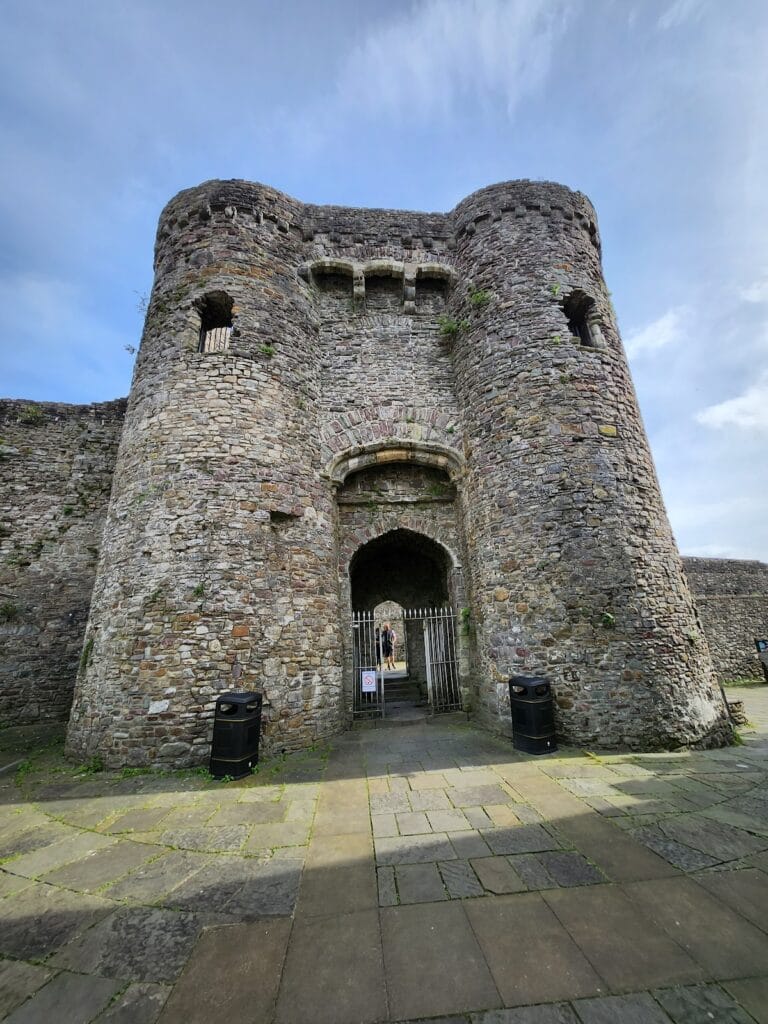
The inner castle is enclosed by an irregular curtain wall, with surviving sections dating from the early thirteenth century. The eastern side is dominated by the keep, while a second rectangular tower stands on the north-west side. The present entrance is approached through a fortified gateway protected by a restored stretch of battlement. Within the courtyard, stairs lead to the principal battlements and towers, while a narrow spiral stair provides access to a high tower.
The keep and summer house
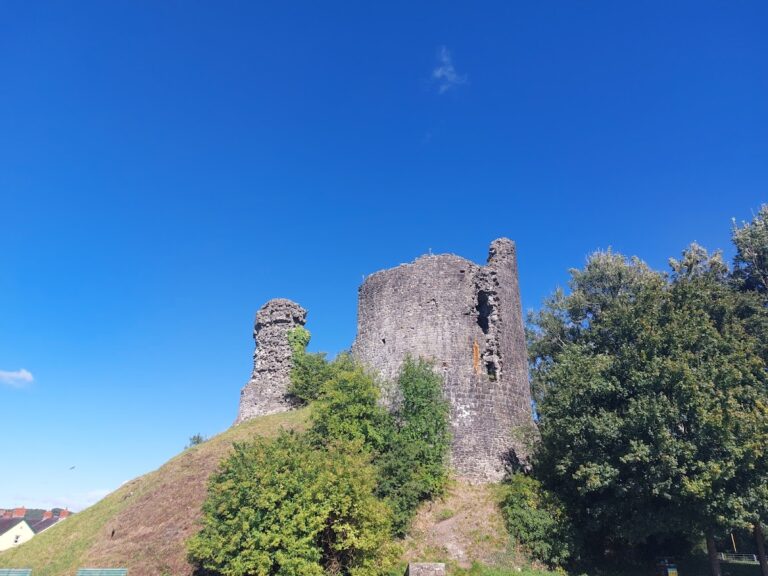
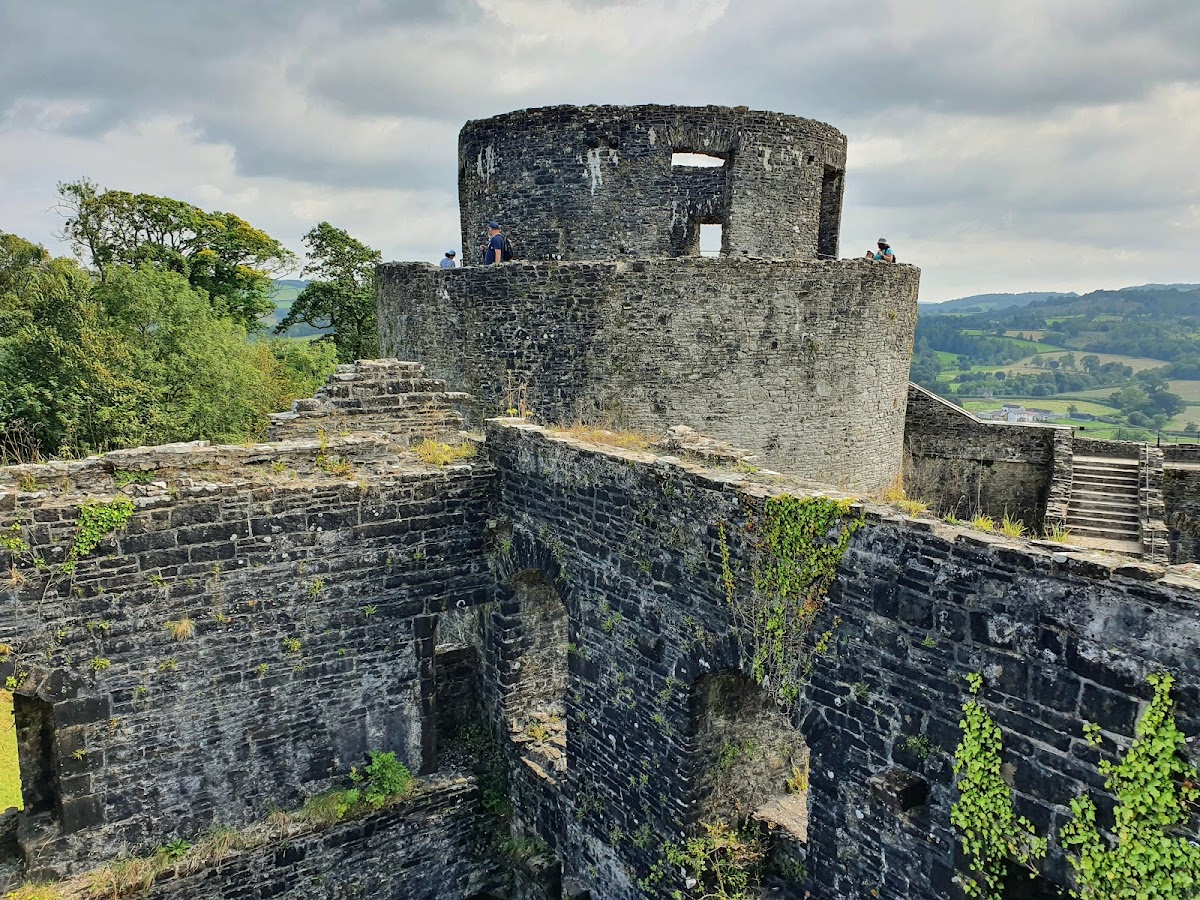
The keep is a two-storey round tower about 12 metres high. It has a broad base and a thick, compact form, with its earliest fabric thought to belong to the period of Rhys Gryg. Its construction is comparable to the keeps at Skenfrith Castle and nearby Dryslwyn Castle.
The original entrance was on the upper floor, while the ground-floor entrance visible today was added later. A stone stairway leading to the adjacent curtain wall, followed by a stone bridge to the top of the keep, was built in the seventeenth or eighteenth century to provide access to the summer house. Large window openings and other remains of that structure survive at the summit, although the summer-house conversion was destroyed by an eighteenth-century fire.
The keep also contains a well and several garderobes, medieval toilets built into the castle structure. A circular walkway at the top can be reached from the battlement walk, and a path runs around the northern base of the main structure.
Residential buildings and surviving views
Residential buildings in the north-east part of the inner castle were constructed toward the end of the thirteenth century. A rectangular hall was added to this group around 1326, expanding the domestic facilities within the fortified enclosure. Together with the courtyard, gateways, towers, and keep, these remains show how Dinefwr combined the functions of a political residence, administrative centre, and defended stronghold.
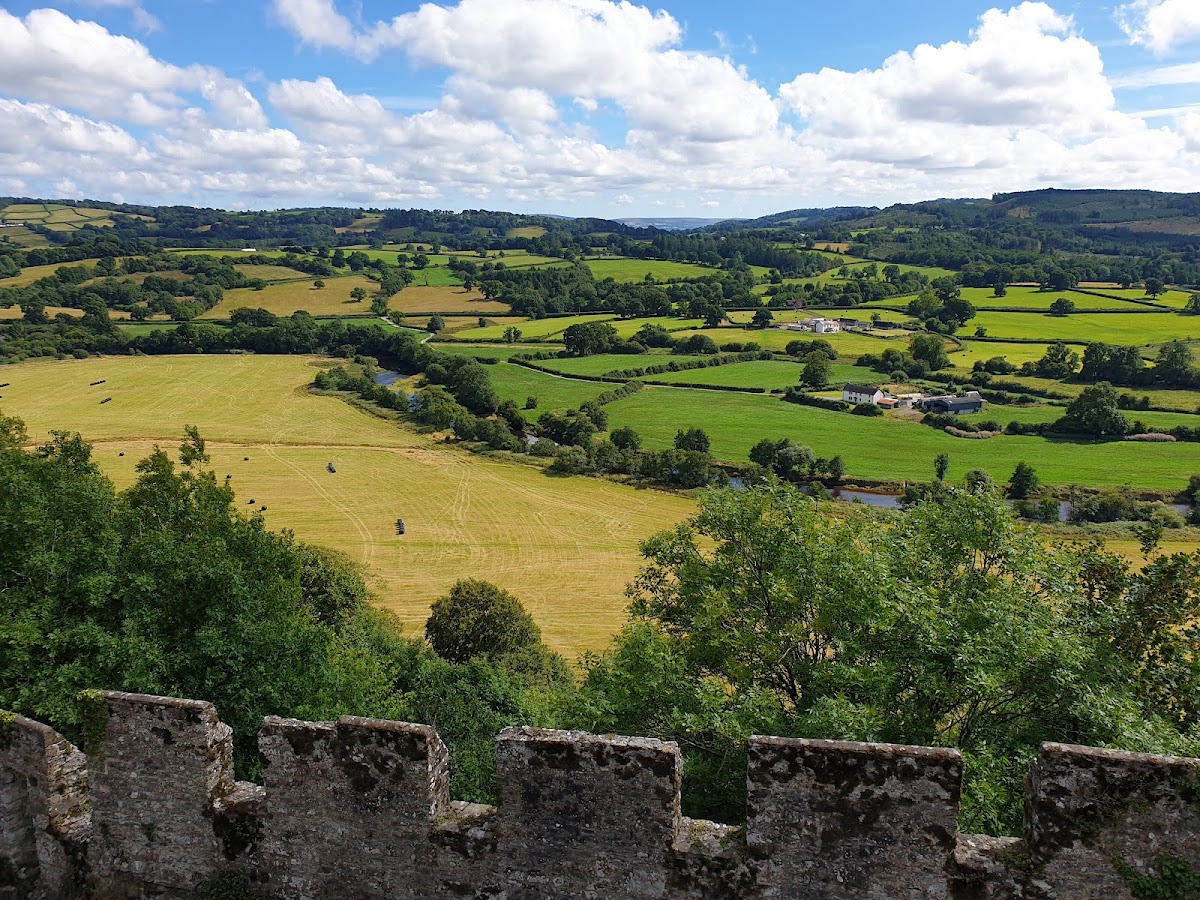
The elevated position looks toward the Towy valley on the south and west sides and toward the deer park to the north. Dryslwyn Castle stands on a hill to the south-west across the valley and is visible from Dinefwr. Carreg Cennen Castle, built farther south by Rhys ap Gruffydd, cannot be seen from the site.