Lesnovo Monastery: A Medieval Orthodox Monastic and Episcopal Center in North Macedonia



Site at a Glance
- Rating
- 4.9
- Popularity
- Medium
- Country
- North Macedonia
- Primary era
- Medieval
- Eras represented
- Medieval, Early Modern, Modern
- Civilizations
- Ottoman, Serbian
- Site type
- Religious
- Remains
- Monastery
On this page19 sections
History
Lesnovo Monastery is a medieval Orthodox monastery in North Macedonia, near Lesnovo village, founded in 1341 by the Serbian magnate and despot Jovan Oliver Grčinić. Its main church, dedicated to Saint Michael the Archangel, belongs to a Byzantine-influenced medieval tradition, while the complex is also closely associated with Saint Gabriel of Lesnovo. Today it belongs to the Macedonian Orthodox Church and is connected with the Bregalnica Diocese.
Hermits and the Earlier Monastery
The region around Lesnovo attracted hermits during the eleventh century. Saint Gabriel of Lesnovo lived and died in caves nearby, although the fate of his relics remains uncertain. It is also uncertain whether Gabriel founded the original monastery or whether a monastery was established later at his hermitage. Later hagiographies place Gabriel in the area with John of Rila, Prohor of Pcinja, and Joachim of Osogovo, and attribute the foundation to Gabriel.
The earliest written reference to the earlier monastery dates to 1330. In that year, the monk and writer Stanislav of Lesnovo copied a prologue there, a book containing readings for the liturgical year, and included a short Life of Gabriel of Lesnovo. The monastery’s literary activity therefore reached back before the foundation of the present complex.
The Foundation of the Fourteenth-Century Complex
Jovan Oliver controlled the territory around Lesnovo and founded the present complex in 1341. He built the church of Saint Michael the Archangel, established new monastic dwellings, and endowed the monastery with extensive possessions. In 1342 he transferred the monastery and all its property to Chilandar, a major Serbian Orthodox monastery on Mount Athos.
Lesnovo’s position changed in 1347, when Emperor Stefan Dušan established the Zletovo bishopric, an ecclesiastical territory administered by a bishop, and chose Lesnovo as its seat. The new bishopric replaced the inactive Morozvizd bishopric. A charter issued at a Serbian state assembly in Skopje released Lesnovo from Chilandar’s authority, granted it additional villages, and exempted the peasants of those villages from state obligations. Jovan Oliver retained the right to appoint the abbot and to attend the election of the Zletovo bishop. The church was enlarged to serve its new episcopal role.
During this period, about sixteen hermitages operated in caves around the monastery. Members of the large monastic fraternity also lived as hermits. Arsenije I, the first bishop of Zletovo, was buried in one of the caves, linking the episcopal institution with the older ascetic landscape.
Later Medieval and Ottoman-Era Changes
After the deaths of Stefan Dušan in 1355 and his son Stefan Uroš V in 1371, the monastery’s history becomes less clearly documented. In 1381, the local lord Konstantin Dejanović issued a charter returning Lesnovo to Chilandar and placing it under the supervision of the bishop of Velbužd.
Lesnovo survived the Ottoman conquest without destruction, although its fraternity may have been temporarily dispersed in the late fifteenth century. Its first recorded restoration began in 1558 under Abbot Neofit. Wealthy inhabitants of the prosperous mining town of Kratovo supported a continuing series of repairs. In 1581 Duke Nikola Bojčić covered the monastery with lead, and in 1588 Duke Nikola Pepić built the outer entrance hall, or narthex. The monastery also received new dwellings, books, and landed possessions.
Lesnovo again became an episcopal seat. During the seventeenth century and afterward, it was subordinated at different times to the bishops of Kratovo and Štip or to the bishop of Ćustendil. An Ottoman document from 1618 states that monks assisted brigands and that some monks joined them. From 1664, the monastery received aid from Russia.
Destruction, Renewal, and Literary Life
After a local uprising supporting the advancing Habsburg army was defeated, the monks fled Lesnovo and the monastery was looted. Renovation took place during the eighteenth century, but the monastery was abandoned again before the work was completed. Monastic life returned in 1805 through the efforts of the hieromonk Teodosije from Visoki Dečani Monastery. He was abbot by 1814, and the principal residential buildings and tower belong largely to this period of renewal.
Lesnovo was also an important center of manuscript production. Its scriptorium, the place where manuscripts were copied and produced, existed by the middle of the eleventh century. A formal copying and calligraphic school had been established by the thirteenth century. Until the 1840s, the monastery reportedly held one of the largest libraries in the Balkans, with books and manuscripts gathered from distant regions alongside works created there.
Manuscripts associated with Lesnovo include the Prologue of 1330, the Menaion of 1342, a liturgical book arranged by calendar month, and the Parenesis of 1353, a work of moral and spiritual instruction. Manuscripts from the library or written at the monastery later entered collections in Belgrade, Sofia, Plovdiv, and Saint Petersburg. Some valuable manuscripts were sold by monks during the nineteenth century. The monastery also historically controlled numerous churches, monasteries, and villages, and served as a refuge for revolutionaries and liberation groups seeking national freedom.
Continuing Religious Life
Lesnovo remains an active monastery with a small fraternity and continues to belong to the Macedonian Orthodox Church. Devotion to Gabriel of Lesnovo continues among local inhabitants, who regard him as the protector of the village and monastery and associate him with healing power.
Remains
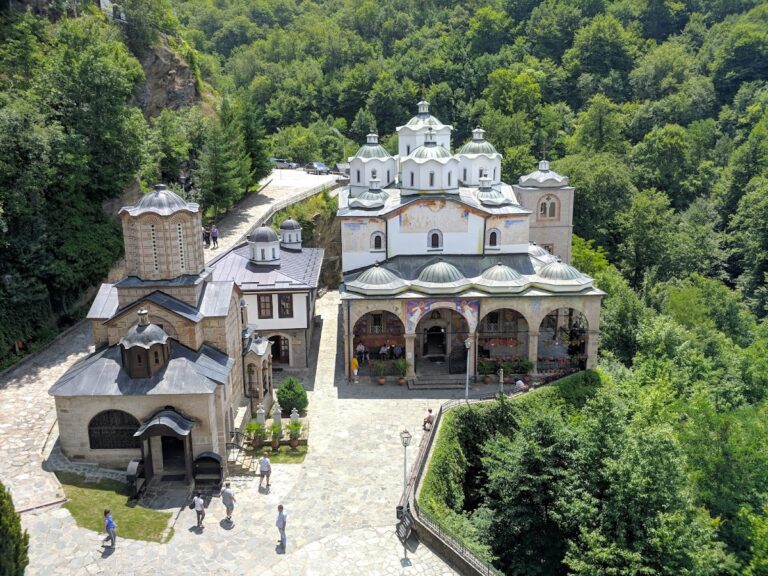
Lesnovo Monastery stands at an elevation of about 870 metres on the south-western slopes of Mount Osogovo, in a volcanic crater near the beginning of Lesnovo village. The complex contains six churches, monastic dwellings, and graves. Around it are cave churches and more than twenty former sketes, small rock-cut places of prayer, chapels, and hermit dwellings. Together, these features preserve the physical setting of the intensive ascetic life that gave Lesnovo the reputation of a “Great Lavra,” a large monastic complex associated with smaller hermit settlements.
The Main Church
Church of Saint Michael the Archangel
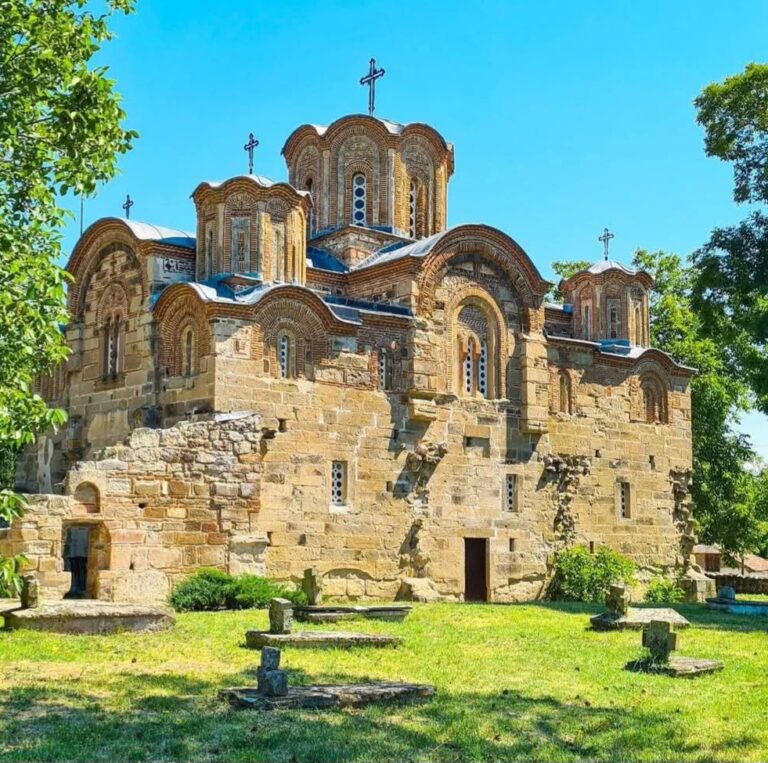
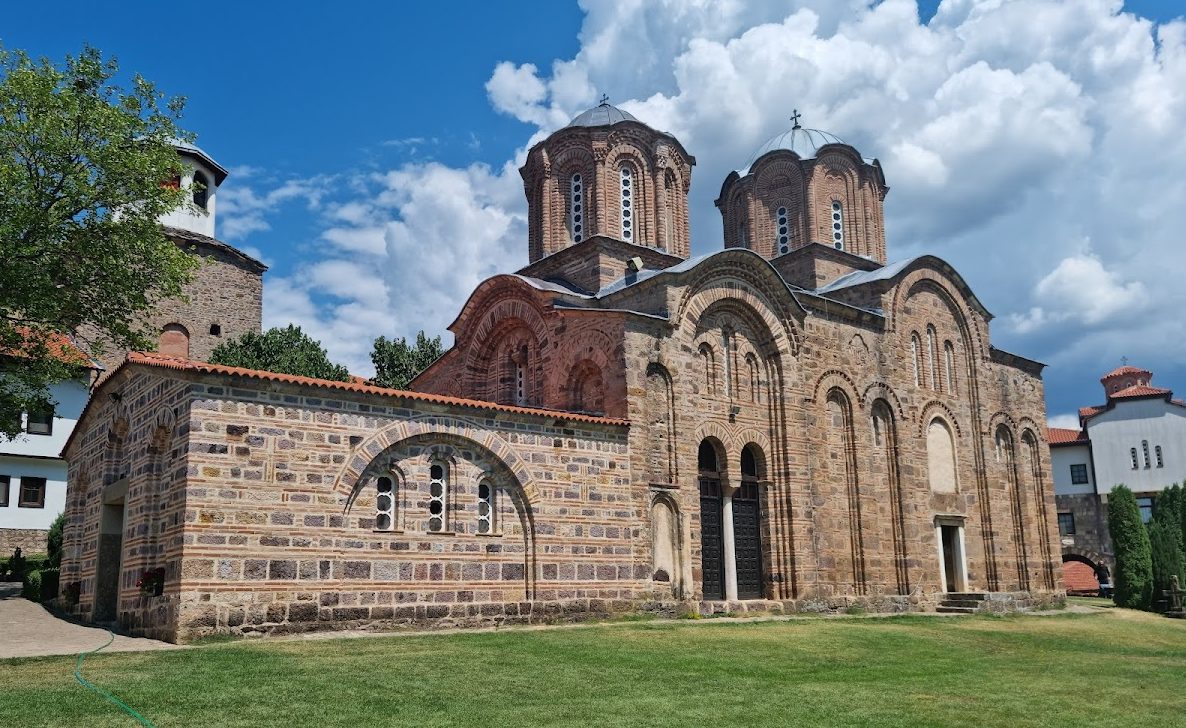
The oldest part of the main church dates from 1341. It has an inscribed-cross plan, meaning that cross-shaped internal arms are incorporated within a rectangular building, and a central dome. Its Byzantine-influenced construction uses alternating courses of brick and stone, with two levels of decorative arches.
The church was frescoed in 1346 and 1347. Four painters worked on the cycle, and three names, Sevasto, Mihail, and Marko, appear in medallions. One painter included a self-portrait showing him seated beside the River of Knowledge associated with the teaching of a Church Father. The paintings combine several artistic approaches. Some nave scenes use calm compositions and restrained colour contrasts associated with early fourteenth-century classicist models, while the cycle devoted to Saint Michael uses vigorous movement, dramatic action, and bright colours.
The frescoes include a red-painted Saint Michael on horseback as commander of God’s army and a cycle devoted to the archangels. Another major composition shows Saint Michael rescuing Constantinople from the Saracens. Scenes connected with the Psalms of King David include the sun, moon, and twelve signs of the zodiac, along with a round dance accompanied by drums and stringed instruments. Other scenes present aspects of fourteenth-century life.
The church walls also portray the local hermits Gabriel of Lesnovo, Joachim of Osogovo, and Prohor of Pcinja, together with Saint Simeon and Saint Sava, the principal founders of the independent Serbian Church. A founder’s composition shows Jovan Oliver in the elaborate dress of a Serbian magnate beside his wife. An adjacent inscription records his rise to the rank of one of Serbia’s most powerful lords and helps explain the hierarchy of baronial titles. Bulgarian soldiers scratched out Oliver’s eyes during the occupation of Macedonia from 1915 to 1918.
The Fourteenth-Century Narthex
The church’s narthex, an entrance or vestibule space attached to the western side, was added in 1347 and painted in 1349. It forms a harmonious architectural unit with the earlier church, shares its wall decoration, and has a smaller dome. Three pairs of double-bay entrances open through the structure. A three-metre-high portrait of Emperor Dušan with Empress Jelena occupies the narthex. The image is noted for its psychologically subtle treatment of the approximately forty-year-old ruler.
The Sixteenth-Century Western Extension
The westernmost section was added by Duke Nikola Pepić in 1588. It was lower and less accomplished architecturally than the earlier parts. The section was demolished in the mid-twentieth century and later rebuilt in its original form.
Iconostasis and Courtyard Buildings
Wooden Iconostasis
The large wooden iconostasis, the decorated screen separating the sanctuary from the main worship space in an Eastern Orthodox church, was carved between 1811 and 1814. Petre Filipović and his woodcarving group from the Mijak clan of western Macedonia created it as their first of four known iconostases. Its elaborate carving and decoration are complemented by icons painted by masters of the Samokov school, a nineteenth-century Orthodox icon-painting tradition associated with the Samokov region.
Chapel of Saint Naum of Ohrid
The Chapel of Saint Naum of Ohrid is housed within the monastic dwellings. It forms part of the courtyard complex alongside the other residential and religious buildings.
Chapel of Saint John the Baptist
The Chapel of Saint John the Baptist occupies the restored eastern dwelling. It was consecrated on 9 October 2016.
Cave Churches and Hermit Settlements
Three Cave Churches
Three cave churches lie close to the monastery complex. They are dedicated to the Dormition of the Virgin, the Holy Transfiguration, and Saint Elijah. Their rock-cut settings belong to the wider network of religious spaces associated with Lesnovo’s hermit tradition.
Sketes and Hermit Graves
More than twenty former sketes survive in the surrounding area. These small monastic or hermit settlements include rock-cut prayer places, chapels, and individual dwellings. Nearby caves also contain graves, including the burial place of Bishop Arsenije I. The remains give material form to Lesnovo’s long association with solitary ascetic practice and its wider monastic community.
Nineteenth-Century Residential Buildings
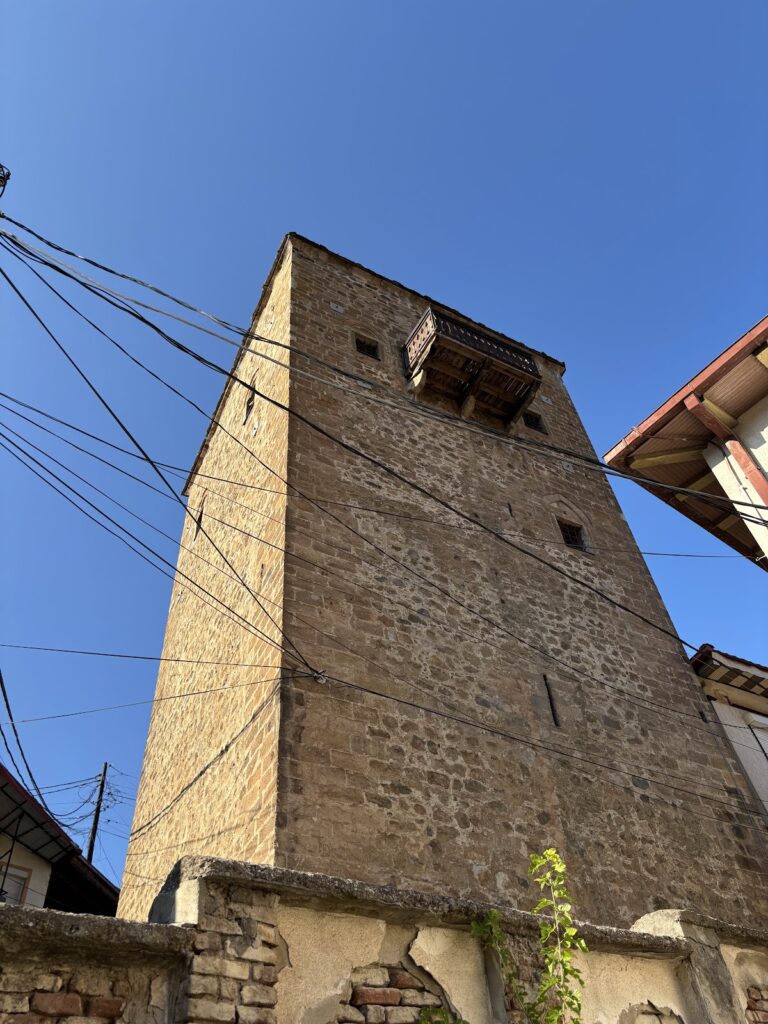
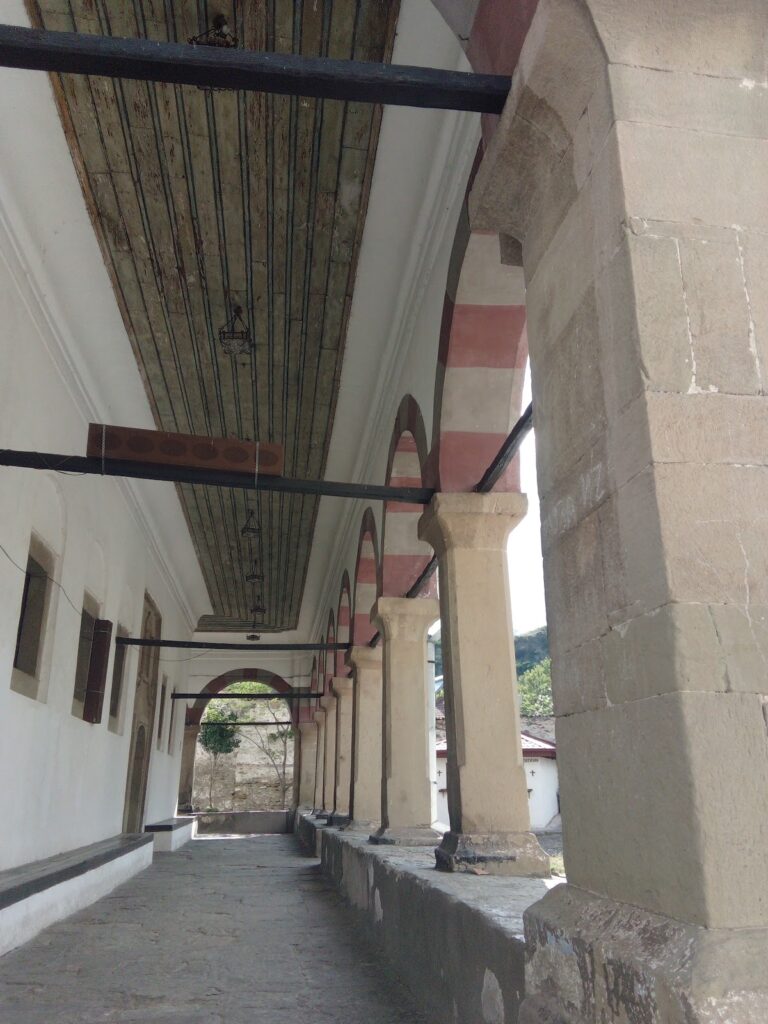
The monastery’s residential buildings were constructed mainly during the nineteenth century. They include the bell tower and a storage building, as well as the dwellings connected with the renewal led by Teodosije. The tower contains a bell cast in Kragujevac in 1860 and inscribed as a donation from Serbian Prince Mihailo Obrenović.
A centuries-old mulberry tree grows beside the church. Local tradition says that it was planted soon after the church was built in the fourteenth century.
Nearby sites