Nativity of the Theotokos Church (Kriva Palanka): A Medieval Orthodox Church


Site at a Glance
- Rating
- 4.9
- Popularity
- Medium
- Country
- North Macedonia
- Primary era
- Medieval
- External website
- Open
- Eras represented
- Medieval
- Civilizations
- Serbian
- Site type
- Religious
- Remains
- Church
On this page6 sections
History
The Nativity of the Theotokos Church (Kriva Palanka) is a medieval Orthodox church in North Macedonia, built in the fourteenth century during the reign of King Stefan II Milutin. Its name refers to the Nativity, or birth, of the Theotokos, a Christian title for Mary meaning “God-bearer.” The church stands within Osogovo Monastery, where it is the smaller of two churches and remains an active place of worship.
Medieval foundation
The church was constructed on the foundations of an older church dating from the eleventh or twelfth century. Its construction took place under Stefan II Milutin, a medieval Serbian king whose rule extended across the late thirteenth and early fourteenth centuries. This earlier ecclesiastical phase gives the present building a connection to the monastery’s medieval development.
Renewal and continuing use
The building was renewed from the end of the sixteenth century through the first half of the seventeenth century. It now belongs to the Macedonian Orthodox Church–Ohrid Archbishopric, within the Kumanovo-Osogovo Diocese and the Kriva Palanka Archpriesthood. Its continuing religious function preserves the church as part of the living worship of Osogovo Monastery.
Remains
Plan and construction
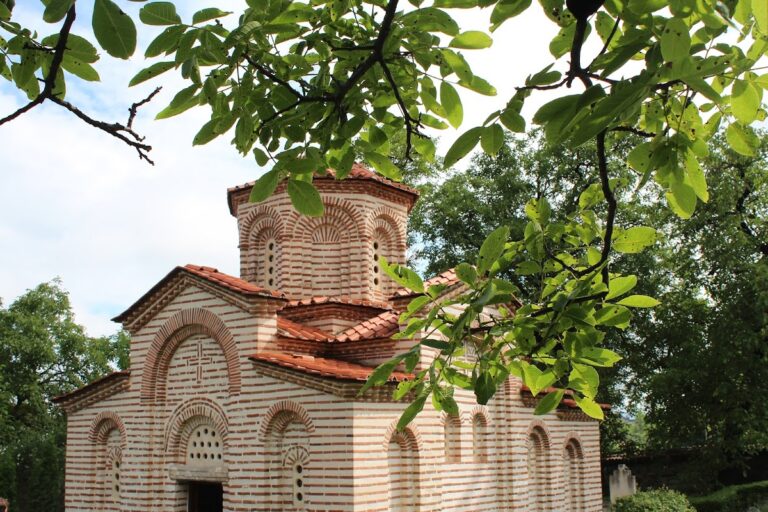
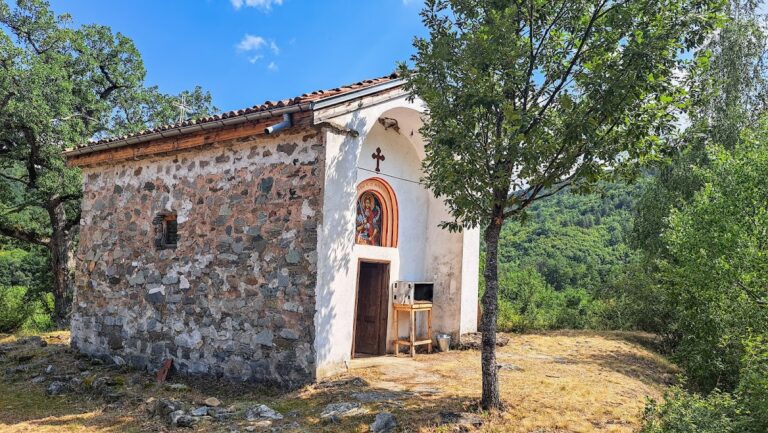
The church has a cross-shaped, single-domed plan organized around a central space. Semicircular vaults support the composition, while an octagonal dome rises above the middle of the building. A narthex, or entrance hall, forms part of the plan and carries a smaller dome. At the eastern end, the apse, the rounded sanctuary termination, is three-sided on the exterior.
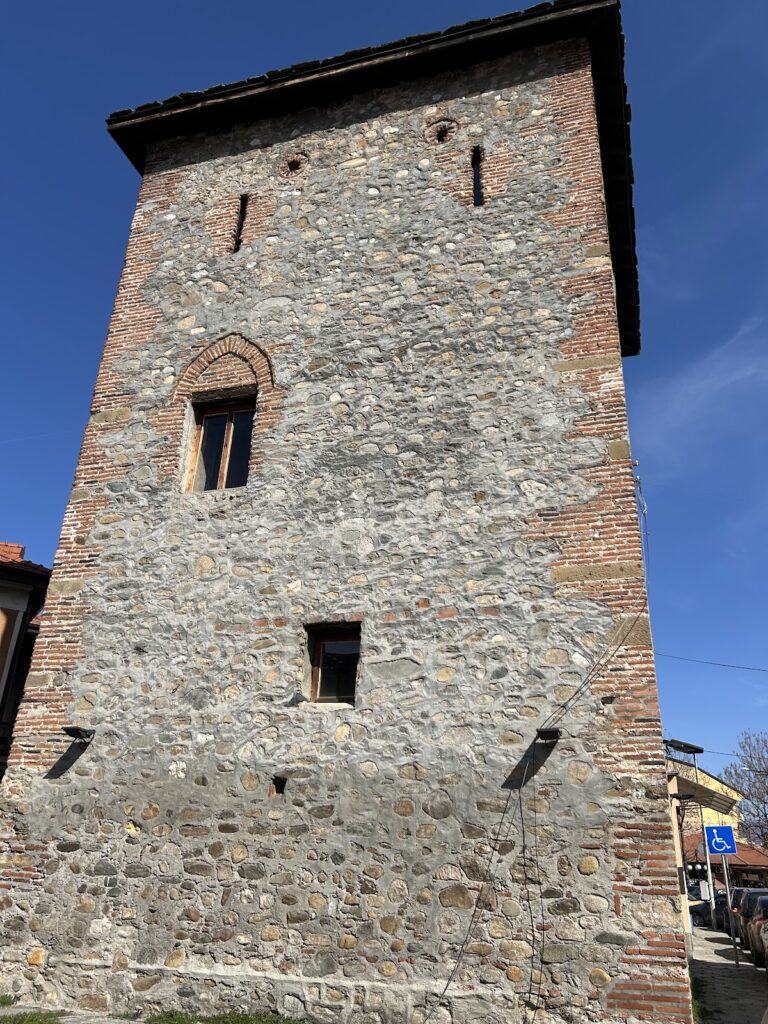
The masonry uses a Byzantine-style pattern of two horizontal courses of brick followed by one course of stone. Thick layers of mortar bind the courses together and remain a defining feature of the church’s construction. The combination of brick, stone, vaults, and domes gives the surviving building its characteristic medieval form.
Interior decoration and sacred features
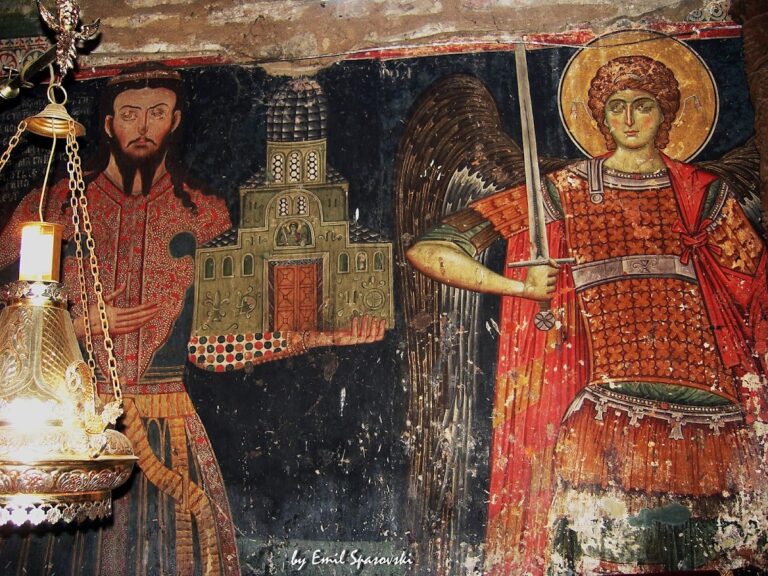
Fragments of the oldest fresco decoration survive on the north wall of the altar area. The iconostasis, the screen separating the sanctuary from the main worship area, contains two notable icons probably painted by Hristo Dimitrov. He is regarded as the founder of the Samokov icon-painting school, a major tradition of Orthodox religious painting associated with the town of Samokov and its painters.
A spring inside the church supplies water regarded as holy and healing. This feature remains part of the church’s religious character alongside its medieval plan, surviving fresco fragments, and later icons.