Clock Tower of Sighișoara: Gate Tower and Civic Landmark


Site at a Glance
- Rating
- 4.7
- Popularity
- High
- Country
- Romania
- Primary era
- Early Modern
- External website
- Open
- Eras represented
- Medieval, Early Modern
- Civilizations
- Hungarian, Ottoman, Principality of Transylvania
- Site type
- Military
- Remains
- Gate
On this page15 sections
History
The Clock Tower of Sighișoara is a medieval gate tower in Romania, built as the principal entrance and defensive work of the fortified upper city. Construction began at the end of the thirteenth century, and the tower was completed in the fourteenth century. It served as the town hall until 1556 and later became one of the historical symbols of Sighișoara and its citadel.
Medieval Gate and Civic Centre
The earliest tower was a simple gate structure with no more than two upper levels. Its first phase probably resembled the nearby Tailors’ Tower, which stands opposite it. The Clock Tower guarded the upper city’s principal gate while also serving as a public building. Unlike the other citadel towers, which were owned and defended by individual guilds, it belonged to the town as a whole.
The tower’s civic role extended beyond administration. It housed the local public authorities, and the city orchestra used it during holidays. Its balcony became the main observation point for the town. From there, fires could be detected at an early stage and teams directed toward the nearest of Sighișoara’s nine water sources. Water was scarce, and reaching a source could require digging 35 metres into the ground.
Sixteenth-Century Alterations and Reconstruction
During the sixteenth century, the original roof was demolished. Two brick-built floors were added, together with a balcony and a new roof. The form of that roof before the later fire is unknown.
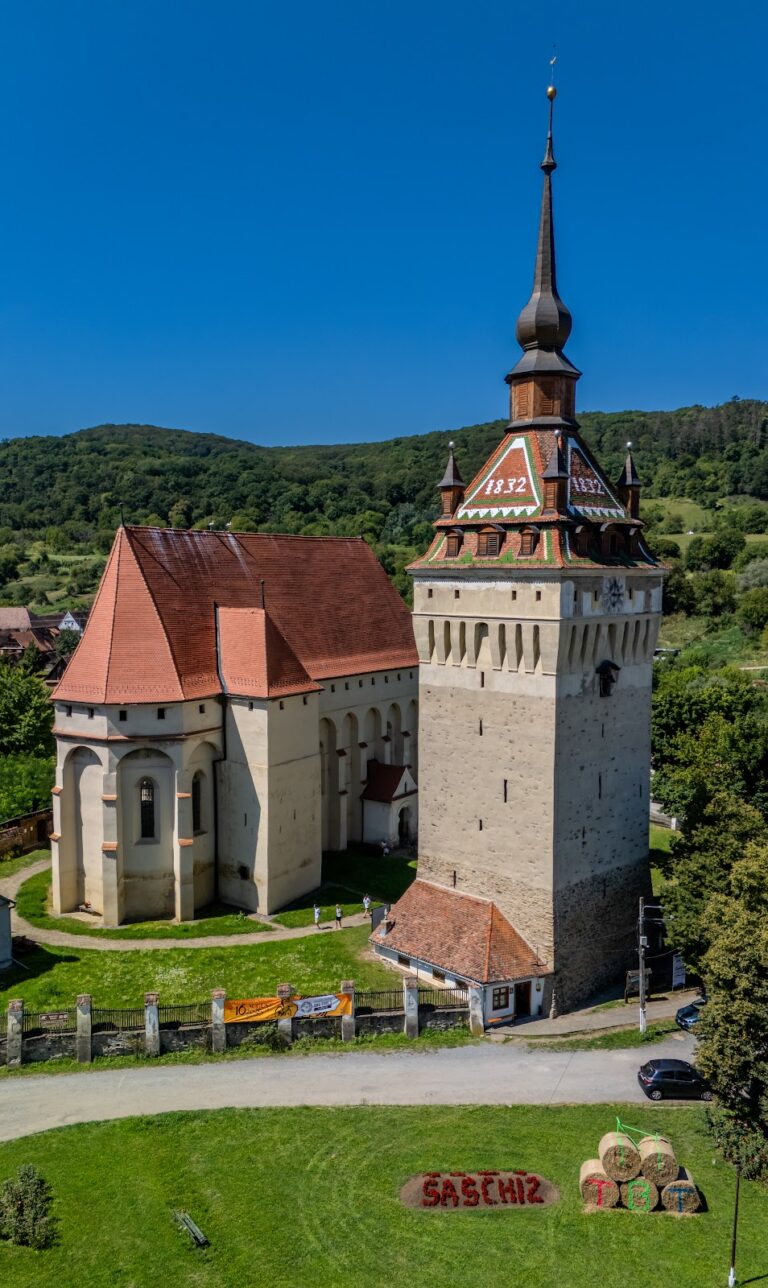
A major fire in 1676 required the tower to be rebuilt. Reconstruction took place from March to September 1677 and cost 650 florins. The travelling master craftsmen Veit Gruber of Tyrol and Philip Bong of Salzburg carried out the work with the carpenter Valentinus Auslander. The present roof belongs to this rebuilding phase and has a Baroque design, a seventeenth-century treatment marked here by an elaborate profile, several turrets, and onion-shaped domes.
Museum and Modern Clock
Since 1898, the tower has been associated with the History Museum of Sighișoara. In 1964, its clock was modernized by the installation of an electric motor, while the tower retained its archaic appearance. The building is included in the UNESCO World Heritage listing for the Historic Centre of Sighișoara and is regarded as one of the most important and representative clock towers in Transylvania.
Remains
The Clock Tower is a four-storey rectangular prism with massive walls, a rectangular base measuring 12 by 8.66 metres, and an observation gallery. It rises 64 metres overall. The tower body reaches 30 metres from the base to the roof line, while the roof rises another 34 metres, making it taller than the body below it. The ground floor and first two floors use sandstone and river rock. Foundation walls are 2.35 metres thick and narrow to 1.30 metres at the second floor, with basalt tiles placed at the corners.
Gate Passages and Roof
Thirteenth-Century Passages
Two parallel passages cross the tower’s base. Their vaulted ceilings are semi-cylindrical, meaning that each passage is covered by a roof shaped like half a cylinder. Dating from the thirteenth century, they once had solid oak doors and metal grilles. Traces of these defensive fittings remain partly visible.
Baroque Roof
The roof has five turrets and onion-shaped domes. Each of the four corner turrets is 12.5 metres high. Together, they expressed the city’s judicial autonomy and its authority to impose and carry out capital sentences. A golden sphere measuring one metre in diameter crowns the roof.
Clock Faces and Symbolic Figures
Clock Mechanisms and Faces
The clock contains two mechanisms, one older and made of wood and the other newer and made of metal. Two clock faces, one directed toward the upper city and the other toward the lower city, measure 2.3 metres in diameter. Their numerals are hand-painted in black and gold. Carved figures form a distinctive part of the clock’s design.
Upper-City Niche
A niche to the left of the upper-city clock face is arranged in three levels. At the top is Pax, the Roman personification of peace, holding an olive branch and a trumpet. Beneath her, a small drummer strikes a bronze drum with a hammer. Larger blue-clad figures represent Justice, blindfolded and raising a sword, and Righteousness, holding scales. At the lower level, Day and Night appear as angels on a metal balance. Day holds a flaming head and heart, while Night carries a torch in each hand.
The figures’ movements marked 6 a.m. and 6 p.m., the beginning and end of the twelve-hour working day of the citadel’s craftsmen. Their arrangement combines civic ideas of peace and judgment with the daily passage of time.
Lower-City Niche
The niche facing the lower city has two sections. It includes a second small drummer and a damaged figure that may represent an executioner, probably holding a whip and an axe as a warning to outlaws. Its central feature is a rotating platform carrying seven wooden figures for the days of the week. Only one figure can be seen from the lower city through a small ornamental window. At midnight, the platform turns a few degrees from left to right so that the figure for the next day appears.
Planets, Deities, and Metals
The seven figures also associate the days of the week with ancient deities, planets, and the seven metals of historical alchemy: gold, silver, iron, quicksilver, tin, copper, and lead. In alchemical thought, these metals were symbolically linked with the planets and with processes of transformation.
Sunday through Wednesday
Sunday is represented by a female solar figure associated with gold. Her feminine clothing reflects the feminine grammatical gender of the sun in German. The position of her arms is believed to refer to the sun’s movement and to the rise or decline of earthly wealth.
Monday appears as a female lunar figure with a bow, an arrow, and a crescent. She refers to Artemis or Diana, the Greek and Roman forms of a goddess associated with the moon and hunting, as well as with changing feminine nature. The figure is linked with silver.
Tuesday is a helmeted warrior associated with Ares or Mars, the Greek and Roman war gods, and with iron. Wednesday is Hermes or Mercury, shown with a caduceus, money bag, and wings. A caduceus is a staff associated in classical imagery with Hermes and Mercury. The wings identify the figure as the messenger of the gods, while the figure’s head symbol has been interpreted as hermaphroditic and as a reference to quicksilver’s ability to affect other elements. The German name for Wednesday, Mittwoch, means “midweek,” because Hermes and Mercury have no equivalent in German mythology.
Thursday through Saturday
Thursday is represented by Jupiter or Zeus, the Roman and Greek sky gods associated with thunder and lightning. The figure wears a crown and holds a globe, suggesting universal rule, while the head bears the alchemical symbol for tin. The Germanic Donnar is reflected in the German name Donnerstag.
Friday is shown as Aphrodite or Venus, the Greek and Roman goddess of beauty and love. She holds a mirror and wears a green skirt edged in red, with her chest and legs exposed. The figure carries the symbol of copper. Its red color signifies passion, while green is associated with beauty. The Germanic Freyja is also linked with Friday and love.
Saturday is represented by Saturn, identified with Cronos, the Roman and Greek figures of the older generation of gods. The figure is associated with lead and has a wooden leg. It formerly held a child, referring to the story of Cronos swallowing his children before Zeus was rescued by Rhea. The reason for the wooden leg is unknown; it may have resulted from a misunderstanding of older statues whose legs were wrapped in cloth coverings.