Altrosegg Castle Ruin: A Medieval Fortress in Austria


Site at a Glance
- Rating
- 4.3
- Popularity
- Very Low
- Country
- Austria
- Primary era
- Medieval
- Eras represented
- Medieval, Modern
- Civilizations
- Holy Roman Empire
- Site type
- Military
- Remains
- Castle
On this page13 sections
History
Rosegg Castle, also called Altrosegg, is a medieval hill castle ruin in Austria near Rosegg. The Lords of Ras probably built it in the second half of the twelfth or early thirteenth century as a Höhenburg, a castle placed on elevated ground for defence and control of the surrounding area. In the Carinthian Rosental, it became an inhabited and expanded seat of authority that remained in use until the early nineteenth century.
The Lords of Ras
The castle hill was probably the third seat of the Lords of Ras, an influential high-free Carinthian noble family. The term high-free referred to nobles with high social and legal status independent of service as ministerials. The family had earlier occupied a castle at Gratschitzen on the northern slope of the Karawanks, followed by the castle at Ras near Sankt Jakob in the Rosental. Ras was first recorded in 1171 and was abandoned between 1309 and 1317. In the same year of its first record, the family was already using the names Lords of Rosegg or Rasek. Rosegg Castle itself first appears in written evidence in 1239.
The Lords of Ras also served as ministerials of the Styrian rulers, holding land while carrying out military or administrative duties for a higher lord, and they supported the Carinthian dukes. Through feudal holdings acquired during the twelfth and thirteenth centuries, they built a substantial lordship with district-court jurisdiction. Their forceful use of safe-conduct rights brought them into conflict with the Bamberg bishops, whose extensive possessions surrounded the castle. The bishops attempted to discredit the family as robber knights.
Changing lordship and Ottoman attack
When the male line of the Lords of Ras ended in 1318, the castle and lordship passed among noble families from outside the region, which appointed local administrators. The Walsee-Graz line held part of the lordship until 1363. Hartnid of Pettau, a relative of the Lords of Ras, held another part and later inherited the remainder after the death of Eberhard VIII of Walsee. When the male line of the Pettau family ended in 1438, female heirs transferred the property to the Counts of Schaunberg.
The surrounding area was devastated by Ottoman forces in 1478, but the castle resisted the attack and sheltered local people behind its walls. In 1501, Count Georg of Schaunberg sold the complex to Lenart Hodiški, the Salzburg prince-archbishop. The property later passed to the Lords of Perkheim and, through marriage, to Georg Ahac of Losenstein.
Later owners and the move to the valley
By 1605, Rosegg Castle belonged to Rudolf, Count von Raitenau, the brother of Salzburg Archbishop Wolf Dietrich von Raitenau. The date of Rudolf’s acquisition is uncertain. Repairs took place in 1632, and an inscription tablet commemorating them is associated with Wolf Dietrich von Raitenau. Adam Seyfried, Baron of Aichelburg, owned the castle in 1656, while Georg Nikolaus, Count Rosenberg, acquired the estate in 1686. A major renovation followed a fire shortly before 1688.
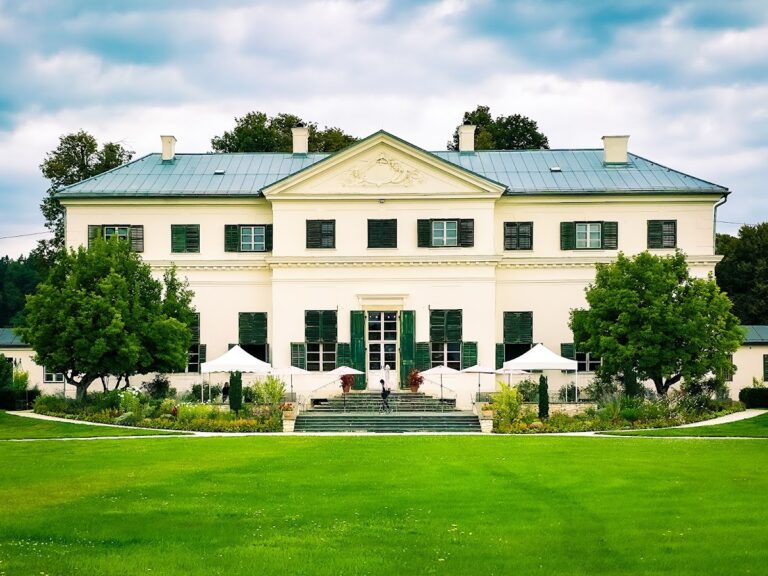
The Counts Orsini-Rosenberg continued to maintain the castle after Franz Xaver Wolfgang von Orsini-Rosenberg built Rosegg manor in the valley north of the castle hill from 1772. The new manor was intended to replace the castle as the seat of government, but the older complex was still inhabited in 1801 and was not immediately abandoned.
Dismantling and modern ownership
During the French Wars, a wall around the foot of the hill was built in 1801 using stone taken from the castle. In 1806 and 1807, Prince Orsini-Rosenberg allowed villagers to remove more stone for a new tower at the Rosegg parish church. French damage to the village in 1813 led to further dismantling of the castle remains.
Peter, Knight von Bohr, acquired Rosegg in 1829 and began establishing a zoological park there from 1830. The estate passed to Prince Johann von Liechtenstein in 1833. The ruin, manor, and zoological park remain with Liechtenstein’s descendants. The castle remains are under monument protection, and an archaeological excavation carried out in 2014 was documented in a report published in 2015.
Remains
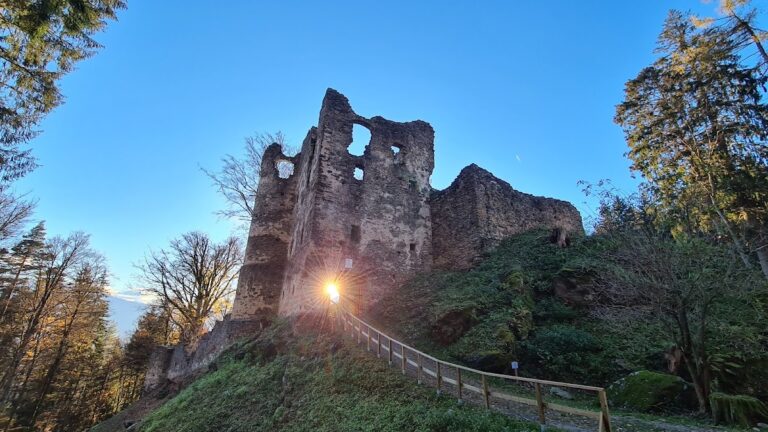
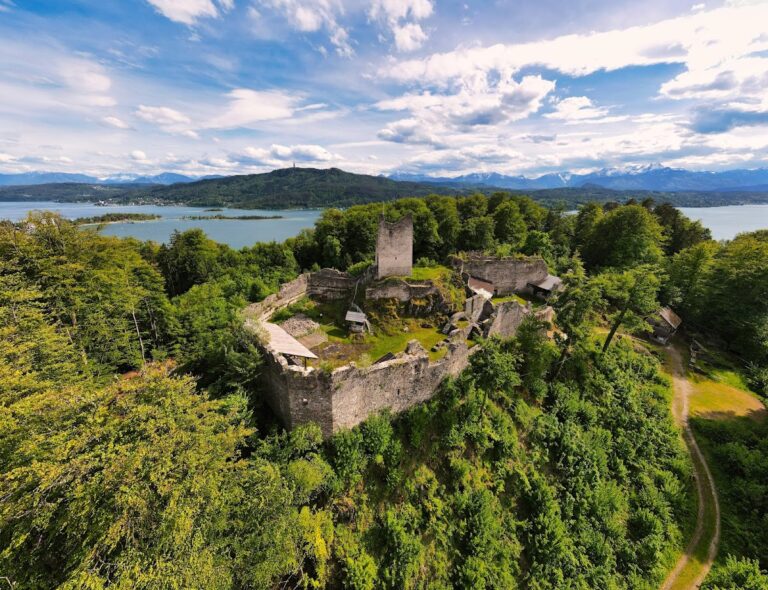
Altrosegg stands on a rocky hill southeast of Rosegg, within the Rosegg zoological park. The former complex was extensive and heavily fortified. Its surviving fabric includes sections of the enclosing defensive walls, small projecting towers, a Romanesque keep, fragments of the principal hall, and a wedge-shaped bastion.
Fortifications and defensive structures
Outer enceinte
Substantial sections of the outer enceinte, or continuous defensive wall enclosing the castle complex, survive around the hill. Its small semicircular towers project from the wall and date from the Late Gothic period, the later phase of medieval Gothic construction. The fortifications preserve the outline of the castle’s defensive enclosure, although the complex survives only in modest form.
Romanesque keep
On the northern side are remains of a Romanesque keep, a main defensive tower belonging to the medieval architectural period associated chiefly with the eleventh and twelfth centuries. The keep was abandoned at the end of the nineteenth century because of alleged structural deterioration. An attempt to demolish it by blasting reportedly failed, leaving its remains on the castle hill.
Wedge-shaped bastion
A projecting bastion, a projecting gun platform used in fortification, survives as part of the castle’s defensive fabric. Its wedge-shaped form reflects the later development of the complex’s military structures. Stone from surrounding service buildings was probably quarried to construct the enclosing wall of the zoological park, most of which still survives.
Central castle hill
Great hall and inner wall
A large hall once occupied the highest point of the castle hill. An inner circular wall protected it within the wider complex. The hall survives only in a few remains, while its position at the summit identifies the central area of the former seat of authority.
Gate stone and historical image
A heraldic stone commemorating the Rosenberg acquisition was originally placed above the first castle gate. It is now beside the parish church in Rosegg. An engraving produced by Valvasor in 1688 depicts the old Rosegg Castle and provides a historical image of the complex during the period of Rosenberg ownership.