Lateran Obelisk: An Ancient Egyptian Monument in Rome


Site at a Glance
- Rating
- 4.7
- Popularity
- Low
- Country
- Italy
- Primary era
- Bronze Age
- External website
- Open
- Eras represented
- Bronze Age, Classical, Modern
- Civilizations
- Egyptian, Papal States, Roman
- Site type
- Civic
- Remains
- Obelisk
On this page8 sections
History
The Lateran Obelisk is an ancient Egyptian monument in Rome, Italy, begun around 1400 BC during the reign of Pharaoh Thutmose III. Carved in the form of a tall, tapering, four-sided stone monument with a pyramidal top, it belonged to Egypt’s Eighteenth Dynasty and was intended for the temple complex at Karnak.
Egyptian origins
Thutmose III initiated the obelisk for himself, while beginning another for his father. Neither monument was finished before his death. His grandson, Thutmose IV, completed both and had them erected east of the Great Temple of Amun at Karnak. An inscription on the Lateran Obelisk states that it had remained unfinished for 35 years, preserving the memory of this prolonged construction.
Transfer to imperial Rome
In the early fourth century AD, the Roman emperor Constantius II arranged for the obelisk to be taken from Egypt to Alexandria. He intended to send it onward to Constantinople, but it remained in Alexandria for several decades. In AD 357, during Constantius II’s only visit to Rome, he transported it to the imperial capital.
At Rome, the obelisk was erected in the Circus Maximus, the city’s principal chariot-racing arena. It stood near another Egyptian monument, the Flaminian Obelisk, which Augustus had installed there in 10 BC. The Lateran Obelisk remained in the Circus Maximus until the arena was abandoned after the fall of the Western Roman Empire in the fifth century.
Collapse and re-erection
After the Circus Maximus fell out of use, the obelisk toppled, broke into pieces, and became buried beneath mud and accumulated debris. Parts were discovered during the fourteenth and fifteenth centuries, but substantial excavation took place under Pope Sixtus V in 1587. Three pieces were recovered and placed in the care of Domenico Fontana, an Italian architect and engineer known in Rome for major papal building and monument-moving projects.
Fontana restored the fragments and re-erected the monument near the Lateran Palace and the Archbasilica of Saint John Lateran in August 1588. Its erection on 3 August and consecration on 9 August made it the last ancient Egyptian obelisk erected in Rome. Sixtus V ordered a Christian cross to be placed at its summit. In this new setting, the pedestal carried inscriptions recounting the obelisk’s Egyptian origin, its movement through Alexandria to Rome, its installation in the Circus Maximus, and the baptism of Constantine the Great by Saint Sylvester.
The present site had previously been occupied by the equestrian statue of Marcus Aurelius. That statue was moved in 1538 to the Piazza del Campidoglio on the Capitoline Hill. The original Roman base reportedly remained in the Circus Maximus as late as 1589. Its four sides carried a long inscription describing Constantius II’s transport, raising, and dedication of the monument.
Remains
Obelisk and setting
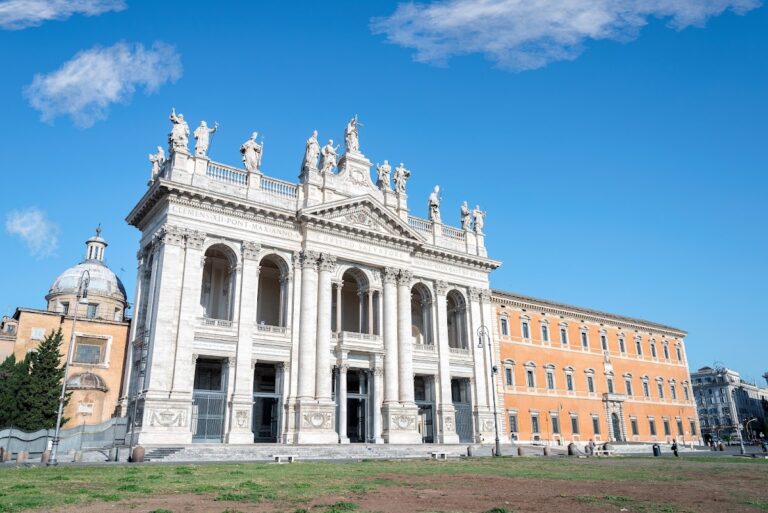
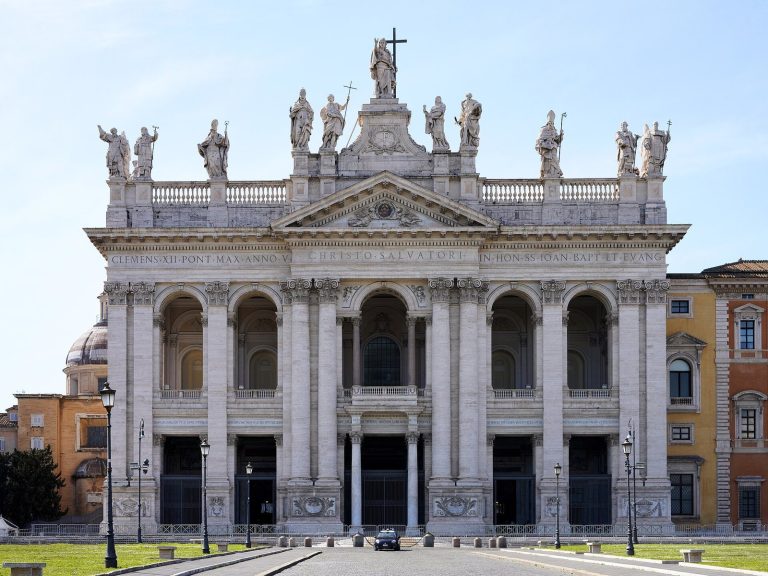
The Lateran Obelisk stands in Piazza di San Giovanni in Laterano, opposite the Archbasilica of Saint John Lateran and the San Giovanni Addolorata Hospital, near the Lateran Palace. Its main element is a single rose or red granite shaft. The shaft is given as 32.18 metres high, while the completed Egyptian obelisk was approximately 32 metres high. The reassembled monument is described as about four metres shorter than the original after its collapse and restoration, and the complete structure, including its base and crowning elements, reaches approximately 45.7 metres.
The stone originally weighed about 413 metric tonnes, or approximately 455 short tons. Following its collapse and re-erection, its weight is given as approximately 300 metric tonnes. The obelisk’s documented earlier settings were the temple complex at Karnak in Egypt and the Circus Maximus in Rome.
Pedestal and inscriptions
The restored shaft rises from a pedestal decorated with historical inscriptions. These texts describe the monument’s movement from Egypt through Alexandria to Rome and refer to Constantine’s baptism by Saint Sylvester. They preserve the Roman imperial history associated with the obelisk while framing the monument within the Christian landscape created around Saint John Lateran.
Cross at the summit
A Christian cross crowns the obelisk by order of Pope Sixtus V. The cross forms part of the monument’s present arrangement, alongside the inscribed pedestal and the restored granite shaft.