Villa Wolkonsky: A Diplomatic Residence and Historic Estate in Rome


Site at a Glance
- Rating
- 4.6
- Popularity
- Low
- Country
- Italy
- Primary era
- Modern
- Eras represented
- Classical, Modern
- Civilizations
- German, Papal States, Roman
- Site type
- Domestic
- Remains
- Elite Residence
On this page9 sections
History
Villa Wolkonsky is a historic estate in Rome, Italy, whose ancient remains originated under Roman rule and whose present villa and gardens were developed in the nineteenth century. The property occupies about 4.5 to nearly 5 hectares on the Esquiline Hill, just inside the Aurelian Walls and near the Basilica of Saint John Lateran. Its history brings together imperial water engineering, Lateran building projects, a Russian artistic salon, and the diplomatic use of the grounds by Germany and Britain.
Roman and Medieval Landscape
In antiquity, a branch of the Aqua Claudia crossed the area. This major Roman aqueduct supplied water to Rome, and the section at Villa Wolkonsky was constructed under Emperor Nero in AD 52 to serve the Domus Aurea, his vast imperial palace, and a nymphaeum near the Temple of the Divine Claudius. Roman tombs were also placed on the property.
The landscape changed during the fifth century, when Pope Hilary removed a mass of ancient ruins for the construction of the Oratory of the Holy Cross. Further leveling took place around the octagonal baptistery during Pope Sixtus III’s rebuilding approximately three decades later. From the early medieval period until the fourteenth century, the area remained largely undeveloped apart from the church and hospital of Saint Nicholas.
Vineyards and Lateran Expansion
A small building, probably used for agriculture, was inserted into one of the aqueduct’s arches around 1400. By 1551, the land belonged to Camillo Rustici and Lorenzo Corvini and was occupied mainly by vineyards. Excavation and leveling connected with the expansion of the Lateran complex brought additional earth fill from the Caelian Hill. A vineyard owned by Gherardo Ranghetti was purchased for this purpose in 1598.
Eighteenth-century records refer to the Falcone vineyard, while nineteenth-century documents mention gardens belonging to the heirs of Gian Giacomo Aquaroni. At the beginning of the nineteenth century, the land was still agricultural. It was acquired by Aleksandr Mikhailovich Beloselsky-Belozersky, a Russian ambassador at the court of Savoy in Turin, and later passed to his daughter, Zinaida Alexandrovna Volkonskaya.
Volkonskaya’s Villa and Salon
Volkonskaya married Prince Nikita Grigoryevich Volkonsky in Saint Petersburg in 1811. She lived in Rome from 1820 to 1822, then returned with her family in 1829 and acquired the property in 1830 after her final move from Moscow. She commissioned the Roman architect Giovanni Azzurri to create the villa and agreed with the papal government to repair the aqueduct ruins. The estate became a country retreat, separate from her residences in central Rome near the Trevi Fountain.
During the 1830s, Villa Wolkonsky became a literary and musical salon. Its visitors included Stendhal, Walter Scott, James Fenimore Cooper, Nikolai Gogol, Mikhail Glinka, Gaetano Donizetti, Karl Bryullov, Alexander Ivanov, and Bertel Thorvaldsen. Gogol conceived elements of Dead Souls in a garden grotto, while Volkonskaya performed music with Donizetti.
Volkonskaya converted to Catholicism shortly before 1830. The new Russian emperor would not exempt her from restrictions affecting Catholic ownership of property, but she refused to renounce her faith and spent most of the rest of her life in Rome, apart from a brief return to Russia in 1839. After her husband died in 1844, she withdrew from the villa and devoted herself to a more private and charitable life. She died in 1862 and was buried at the Church of Saints Vincent and Anastasius near the Trevi Fountain.
Ownership, Urban Expansion, and Diplomacy
The property passed to Volkonskaya’s son Alexander, who excavated further Roman tombs beyond the aqueduct. After his death in 1878, it passed to Marchesa Nadia Campanari, a descendant of Alexander’s adopted family. During Rome’s rapid urban expansion in the late nineteenth century, the Campanari family sold much of the land. Minister of Public Education Ruggero Bonghi acted in 1886 to prevent further subdivision, but the gardens lost much of their earlier splendor and new Umbertine buildings obscured the views.
A second villa was built south of the original one by the Campanaris around the end of the nineteenth century and was later rented to tenants. In 1922, the family sold the property to the German government. After diplomatic relations with Italy resumed following the First World War, the estate became the German embassy and the ambassador’s residence.
Over the following decade, the German authorities enlarged the main building with two wings and an additional floor, nearly doubling its floor area. They installed mechanical ventilation, expanded the secondary villa, constructed a staff residence near the entrance, and restored the gardens. The entrance, dining room, and ballroom were extensively remodeled with marble in 1942 and 1943. A closed swimming pool was also constructed in the lower garden.
During the German occupation of Italy in 1943, the property ceased to function formally as an embassy and was used for detention. The embassy annex in Via Tasso was also connected with imprisonment during the occupation. After Rome’s liberation in 1944, the Italian government seized Villa Wolkonsky because of its non-diplomatic use. After the war, it was treated as war booty and as part of reparations administered by the Allied Control Commission. The Swiss diplomatic mission and the Italian Red Cross occupied it temporarily, and Mafalda of Savoy was arrested there.
In 1946, a terrorist attack by the Irgun, a Zionist underground military organization active in Mandate Palestine before the establishment of Israel, destroyed the British embassy at Villa Bracciano near Porta Pia. The Italian government then made Villa Wolkonsky available to the British diplomatic mission, which formally purchased it in 1951. A new British embassy chancery designed by Sir Basil Spence was completed in 1971, and the embassy offices returned to the Porta Pia area. Villa Wolkonsky was retained as the official residence of the British ambassador, while other buildings continued to house embassy personnel.
The estate is used for diplomatic and institutional activities, including seminars, workshops, meetings, and selected academic or commercial events. Its gardens host British national celebrations, and the property remains connected with the cultural and diplomatic identity of the British embassy in Italy.
Remains
Roman Aqueduct and Tombs
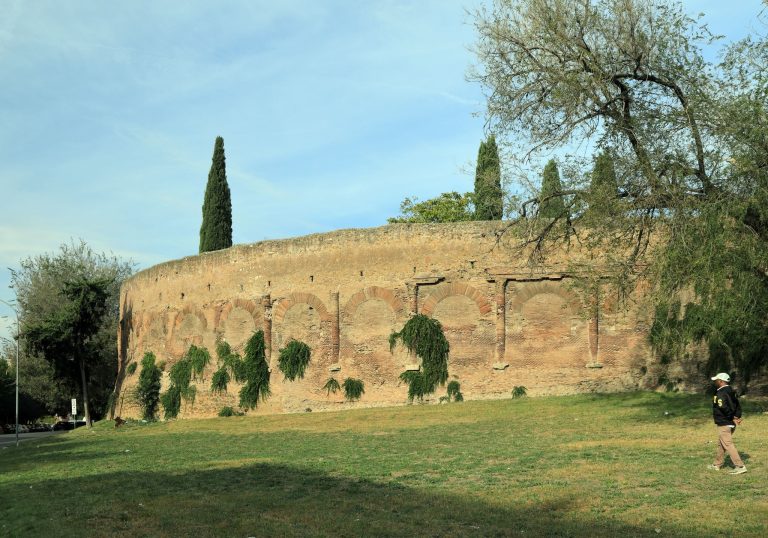
The principal archaeological feature is the surviving branch of the Aqua Claudia, which crosses the estate for about 366 metres through 36 arches. The aqueduct was incorporated into Volkonskaya’s villa and garden design. She repaired the arches and had artificial grottoes constructed below ground level around them, turning the ancient structure into a defining element of the nineteenth-century landscape.
Roman tombs are also present on the property, including additional tombs excavated beyond the aqueduct by Alexander Volkonsky. Together with the aqueduct, these remains preserve physical evidence of the area’s Roman use beneath the later villa and garden estate.
Villa Buildings
The original Villa Wolkonsky was a small building designed by Giovanni Azzurri and incorporated three arches of the aqueduct. The Campanari family later built a second villa south of it in the late nineteenth century. During the German embassy period, the smaller villa associated with the aqueduct was enlarged and later housed the British chancery.
The main building retains the additions made during the German period, including two wings and an extra floor. Mechanical ventilation was installed, and a staff residence was built near the entrance. The entrance, dining room, and ballroom received extensive marble remodeling in 1942 and 1943. The villa, the ambassador’s residence, and the smaller buildings have since been renovated and remain in diplomatic use.
Romantic Gardens
Volkonskaya developed both sides of the aqueduct as a Romantic garden, with rose beds, hedges, groves, ponds, trees, statues, large vases, urns, and Roman fragments. Fanny Mendelssohn described the garden as containing millions of roses, while other descriptions refer to hundreds of roses, shrubs, and trees. Two winding paths formed part of the original design, probably one near the aqueduct and another through the planted grove. The specially named Avenue of the Dead and Avenue of Memory were also features of the garden.
Among the plants and hedges stood a dark-red granite column carrying a bust of Tsar Alexander I. The bust survives, and the granite was associated with material used for Alexander I’s memorial column in Saint Petersburg. The estate’s plant collection includes approximately 200 species of trees and other plants, including an elm described as Rome’s oldest. Substantial elements of the garden created during Volkonskaya’s ownership remain within the diplomatic estate.