Kuwana Castle: A Tokugawa-Era Water Castle in Japan
Site at a Glance
- Country
- Japan
- Primary era
- Early Modern
- Eras represented
- Early Modern
- Civilizations
- Unclassified
- Site type
- Military
- Remains
- Castle
On this page14 sections
History
Kuwana Castle was a water castle on level ground in Kuwana, Japan, built from 1601 on the orders of Tokugawa Ieyasu. Its position beside the Ibi River and the Tōkaidō route made it strategically important: travelers between Edo and Kyoto passed through Kuwana and crossed by boat, since there were no bridges on the route to the Atsumi Peninsula in Owari Province.
Early fortifications and the port
Tradition places an early fortification in the Kuwana area in 1186, built by Kuwana Yukitsuna under an order from the Kamakura shogunate, Japan’s medieval military government. The castle’s closer predecessor was the Eastern Castle, where Ito Buzaemon is said to have built a fortified residence in 1513. The change from Eastern Castle to the name Kuwana Castle is generally placed in the late sixteenth century. The castle was also known as Ōgi-jō and Asahi-jō.
From the late Heian through the Muromachi period, Kuwana was a major port on Ise Bay, known as Jūraku-no-tsu and controlled by a merchant guild. In 1515, the poet Socho described a large town with more than a thousand houses, temples, and inns. Three local fortifications, Eastern, Western, and Misaki castles, were associated respectively with the Ito, Higuchi, and Yabe families.
Warfare and changing control
During the Sengoku period, an era of competing regional powers and warfare, the area came under the influence of the Ikkō-ikki, leagues linked to the Jōdo Shinshū Buddhist tradition and centered at Nagashima. After Oda Nobunaga conquered the area in 1574, he put Takigawa Kazumasa in control. Takigawa stationed retainers in local castles and, in 1576, ordered Hattori Kazumasa to repair the Eastern Castle. Takigawa later opposed Toyotomi Hideyoshi and lost his territories. Oda Nobukatsu held Kuwana for a time, but Hideyoshi dispossessed him after the Battle of Odawara.
Control changed repeatedly during the 1580s. In 1583, amid conflict involving Nobukatsu, Oda Nobutaka, Hideyoshi, and Shibata Katsuie, Hideyoshi’s retainer Amano Kagetoshi entered Kuwana as castellan. The next year, Tokugawa Ieyasu supported Nobukatsu against Hideyoshi in the Komaki–Nagakute conflict, and Sakai Tadatsugu and Ishikawa Kazumasa took command at Kuwana. Niwa Ujitsugu took control in 1587, followed by Hitotsuyanagi Naomori in 1591. Both were associated with renovations to the castle.
In 1595, Hideyoshi assigned Ujiie Yukihiro a domain assessed at 22,000 koku, a measure of productive capacity, at Kuwana. Ujiie sided with the Western Army, the coalition opposing Tokugawa forces, at the 1600 Battle of Sekigahara. Ieyasu took his domain after the battle.
Tokugawa stronghold and domain seat
Ieyasu recognized Kuwana’s strategic position near the mouth of the Nagara River and the western side of the Kiso–Nagara–Ibi delta. In 1601, he transferred Honda Tadakatsu from Otaki Castle, granted him a domain assessed at 100,000 koku, and ordered a major fortification beside the river, near the former Eastern Castle. A port and castle town developed alongside it, and Kuwana prospered as a post town on the Tōkaidō. An anecdote credits Tokugawa commander Ii Naomasa with sending retainers to assist in the construction.
Honda Tadakatsu’s grandson Tadatoki, son of Honda Tadamasa, married Senhime, daughter of shogun Tokugawa Hidetada, in 1616. The Honda family moved to Himeji in 1617, when Matsudaira Sadakatsu came to Kuwana. Over time, 19 lords from the Honda, Hisamatsu Matsudaira, and Okudaira Matsudaira houses governed the domain. The Hisamatsu line held it from 1617 to 1710 and again from 1823 to 1871. The lords included shinpan, Tokugawa-related houses, and fudai, hereditary Tokugawa retainers.
Fire, succession, and the final shogunate
A fire in 1701, during Matsudaira Sadashige’s tenure, destroyed the main tower and most of the surrounding town. The Tokugawa shogunate refused permission to rebuild the tower, and the rest of the castle was restored on a substantially reduced scale. Sadashige moved to Takada in 1710, and the Okudaira Matsudaira line took control. That line moved to Oshi in 1823, when the Hisamatsu family returned. In the same year, Matsudaira Sadanaga established a shrine within the castle honoring the domain’s founding ancestor, Matsudaira Sadatsuna, and Sadanaga’s biological father, Matsudaira Sadanobu.
In the Bakumatsu, the final years of the Tokugawa shogunate, Kuwana was ruled by Matsudaira Sadaaki, a younger brother of Aizu lord Matsudaira Katamori. Sadaaki supported the Tokugawa and served as Kyoto Shoshidai, an office responsible for Kyoto’s administration and security. After the shogunate’s defeat at the Battle of Toba–Fushimi in 1868, he went to Edo with former shogunate forces. While he was away fighting the Satchō Alliance, an alliance of the Satsuma and Chōshū domains against the Tokugawa, Kuwana’s leaders debated whether to resist or surrender. A shrine divination favored resistance, but lower-ranking retainers opposed it, and the castle was surrendered without battle. Meiji government forces burned the Tatsumi Turret as a sign of surrender. The Meiji Restoration established a new imperial government.
Dismantling and preservation
After the Meiji Restoration, castle stonework was dismantled and reused at Yokkaichi Port. The removal was viewed as punishment for the former Kuwana Domain and has also been criticized in connection with the government’s policies of military strengthening and industrial development. The Spouting Breakwater at Yokkaichi, which incorporates castle stones, later received designation as a National Important Cultural Property. The castle was abolished in 1873. In 1928, part of the former castle grounds became Kyūka Park, and the ruins were designated a Mie Prefectural Historic Site in 1942.
Remains
Kuwana was laid out on a roughly triangular plan at the eastern end of the town, facing the Ibi River. The river formed natural boundaries along the north and east, while a water moat protected the west, where an attack was anticipated. The Tōkaidō’s Shichiri no Watashi ferry crossing lay north of the castle.
Enclosures and defenses
The rectangular inner bailey, an enclosed central part of the castle, measured about 150 by 60 metres. The main bailey stood centrally within the plan, with the second bailey to the south, Asahi Bailey to the east, and the third bailey to the north. Smaller enclosures formed a defensive buffer rather than a residential area. The castle’s defenses included 51 towers and 46 long structures associated with its walls. A detailed description lists 24 two-storey towers and 12 single-storey towers, along with low stone walls; the western moat added another line of defense.
The inner bailey tower
The inner bailey contained a six-storey main tower with four tiers of roofs, dated to 1635, and three-storey defensive towers at its corners. During Ujiie Yukihiro’s renovation in 1595, a main tower was brought from Kambe Castle. The tower described in the inner bailey was destroyed in the 1701 fire and was not rebuilt.
Surviving and relocated fabric
Walls and moat at Kyūka Park
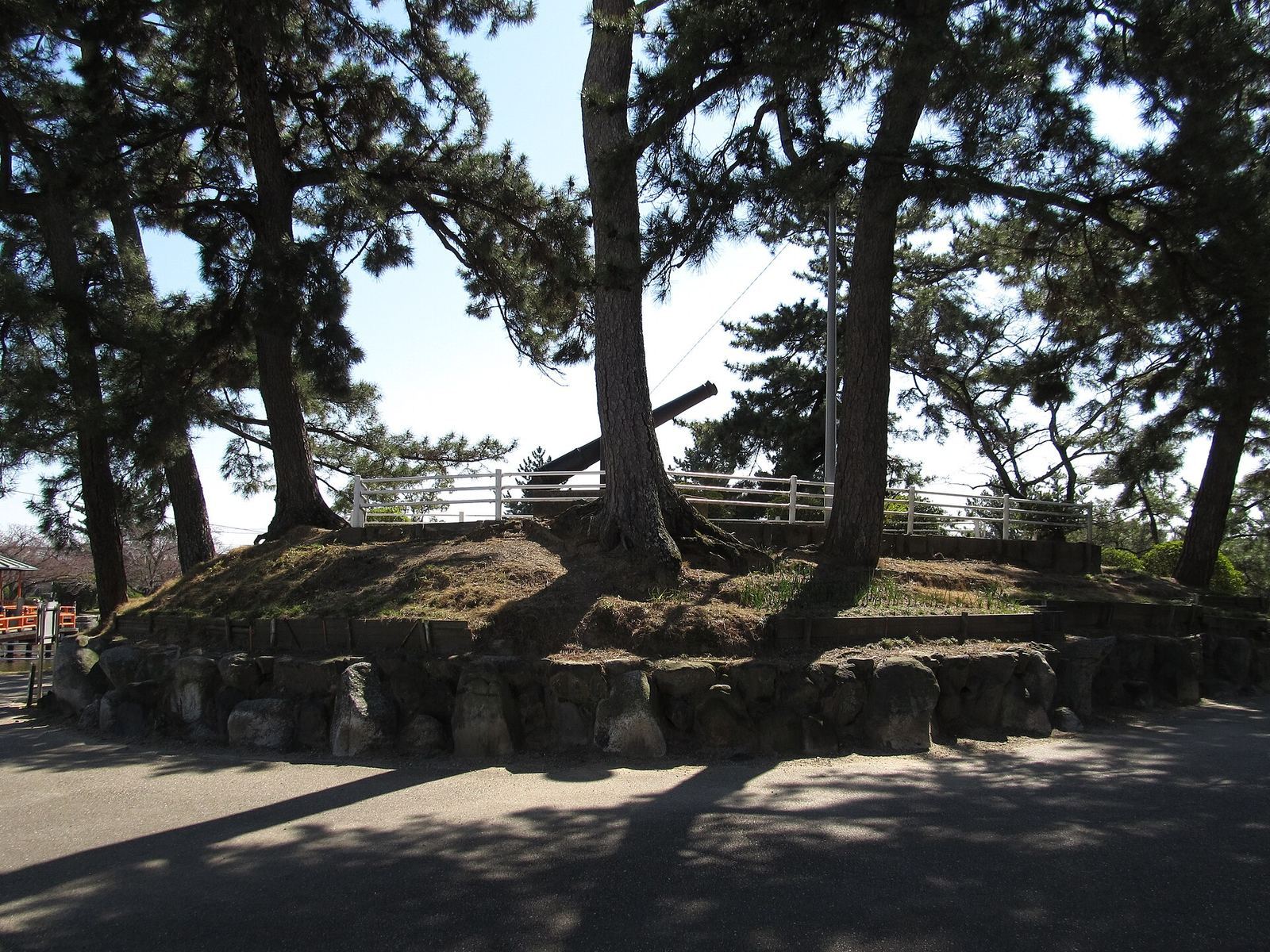
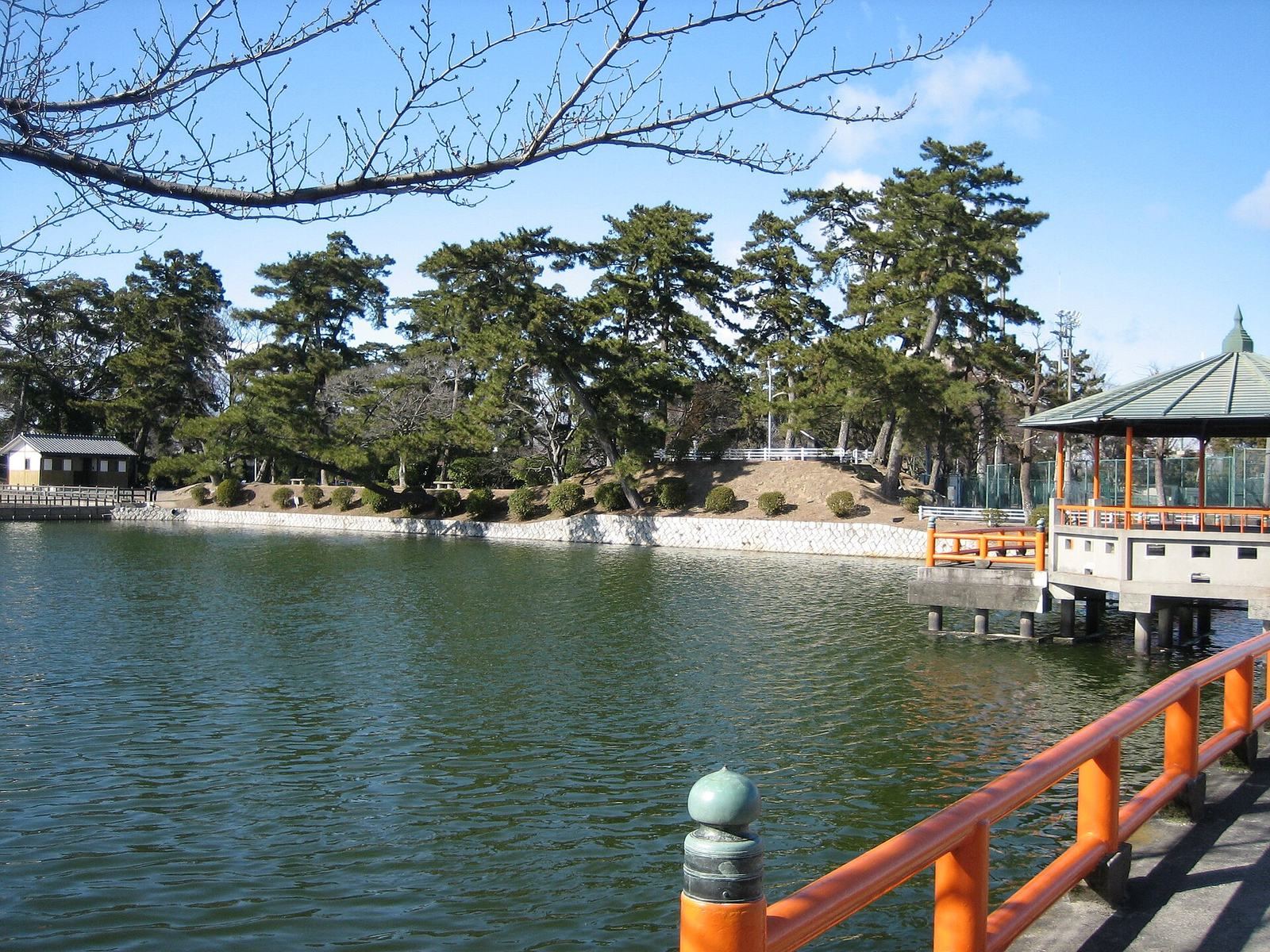
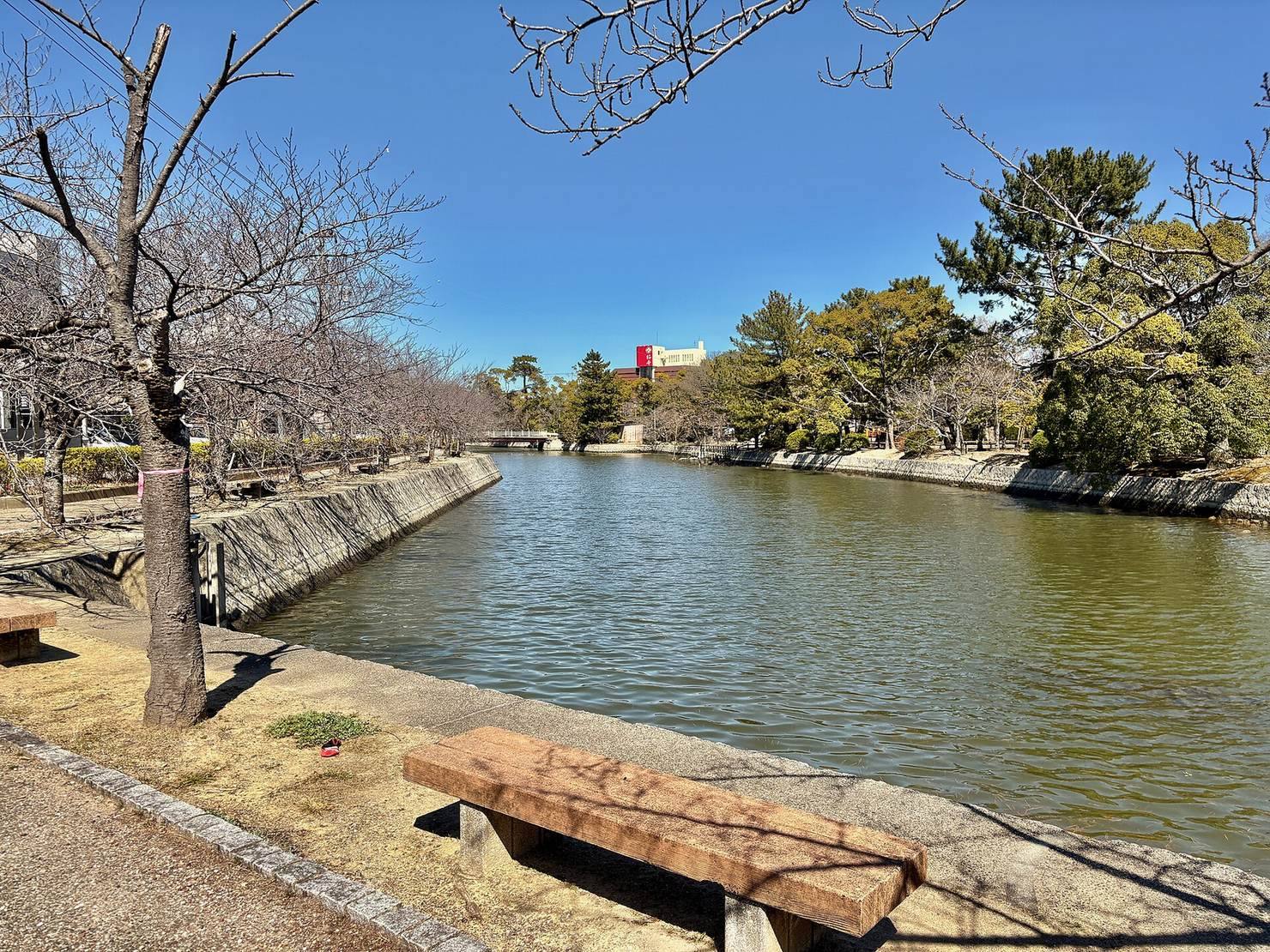
Sections of stone wall and moat survive at the former castle site, including stonework along the old waterfront. The inner bailey and part of the second bailey lie within Kyūka Park, where these remains preserve portions of the castle’s enclosed layout.
Relocated gate and palace
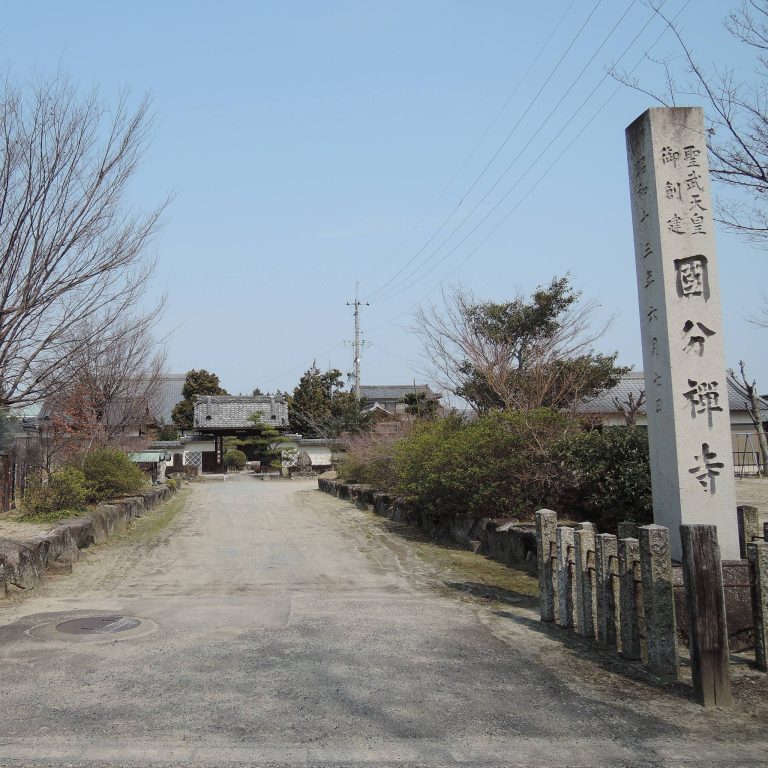
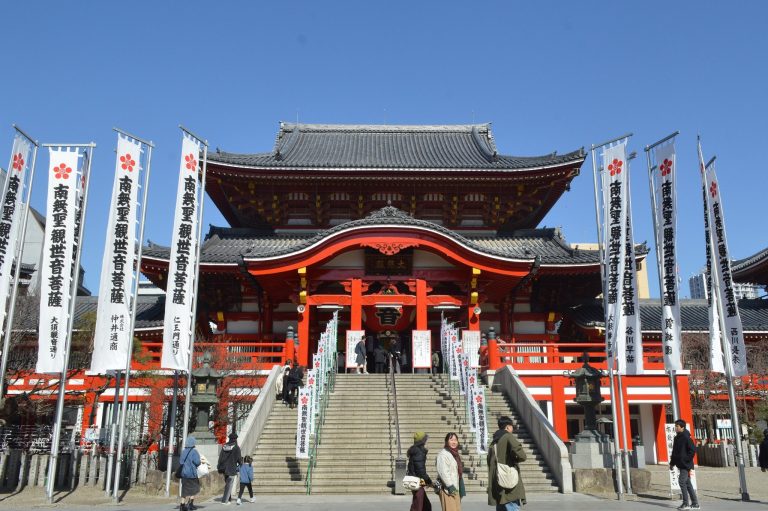
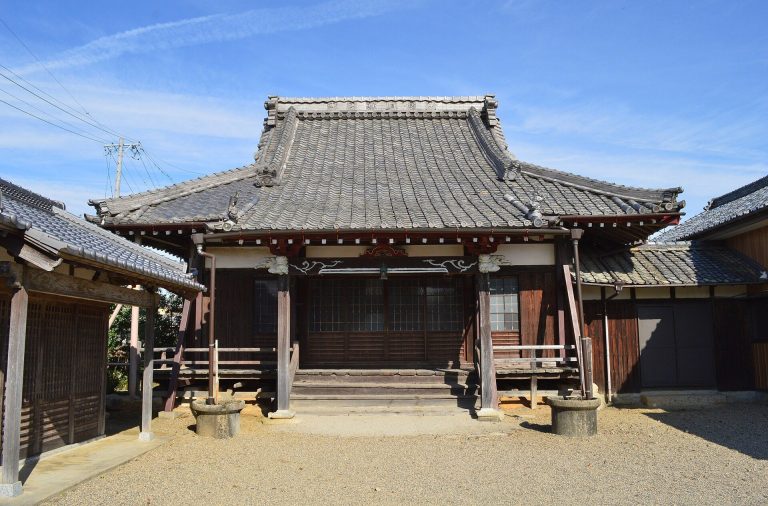
A gate at a temple in Kuwana is traditionally identified as a castle gate moved from its original position. The palace from the third bailey was relocated to a temple in Asahi and survives there.
Spouting Breakwater
Some castle stones were reused in Yokkaichi’s Spouting Breakwater. Holes in the structure were designed to reduce the force of waves.
Reconstructed tower and artistic depiction
Two defensive towers have been reconstructed at the castle site. The two-storey Coiled Dragon Turret was rebuilt externally in 2003 at its former location. Its first floor houses a water-gate management office, while its second floor contains an observation deck and reference room. Kuwana Castle also appears in Utagawa Hiroshige’s print Kuwana, part of The Fifty-three Stations of the Tōkaidō.