Tsushima Shrine: Head Shrine of the Tsushima Faith in Japan


Site at a Glance
- Rating
- 4.2
- Popularity
- Medium
- Country
- Japan
- Primary era
- Early Modern
- External website
- Open
- Eras represented
- Early Modern, Modern
- Civilizations
- Japanese, Tokugawa, Toyotomi regime
- Site type
- Religious
- Remains
- Sanctuary
On this page11 sections
History
Tsushima Shrine is a Shinto shrine in Tsushima, Japan, and the head shrine of the Tsushima faith. Its origins are traditionally placed in 540, during the reign of Emperor Kinmei, and its principal buildings represent the Owari-zukuri regional style. The shrine’s network is concentrated in the Tokai region of central Japan, including Aichi Prefecture, but extends to approximately 3,000 shrines across the country.
Origins and Early References
The shrine’s principal deity is Susanoo, a major Shinto kami associated with storms, the sea, and the slaying of the serpent Yamata-no-Orochi. Okuninushi, a kami associated with establishing and governing the land, is enshrined alongside him. The traditional foundation date is not certain. One account connects the arrival of Gozu Tenno, a medieval Buddhist-Shinto deity associated especially with protection from epidemics, with the semi-legendary Emperor Korei. It states that Gozu Tenno manifested at Tsushima in Owari, the historical province broadly corresponding to western Aichi, during the reign of Emperor Kinmei, at a sacred place suited to the four auspicious directions.
A copy of the Gozu Tenno Koshiki made in 1540 preserves this tradition, describing Gozu Tenno as coming from Tsushima Island to western Japan before appearing at Tsushima in Owari. A wooden tablet found at Asuka-kyo also refers to Tsushima in Owari, showing that a settlement with this name existed by the latter seventh century. The shrine itself is not listed in the Engishiki, a tenth-century compilation of court regulations that included officially recognized shrines, nor in official provincial records. Its possible identification with the “Kokutama Shrine” of Ama District remains unproven.
The earliest dated documentary reference to Tsushima Shrine appears in an appeal for contributions attached to a Great Perfection of Wisdom Sutra copied between January and July 1175. Some late-Heian manuscripts of the Register of the Names of the Gods of Owari Province also name a First-Rank Tsushima Gozu Tenno shrine, although this entry may have been added later. By the reign of Emperor Saga in the early ninth century, the shrine had received First Court Rank, a high honorific position in the historical court-ranking system. Emperor Ichijo later granted it the title Tenno Shrine.
Warrior Patronage and Religious Expansion
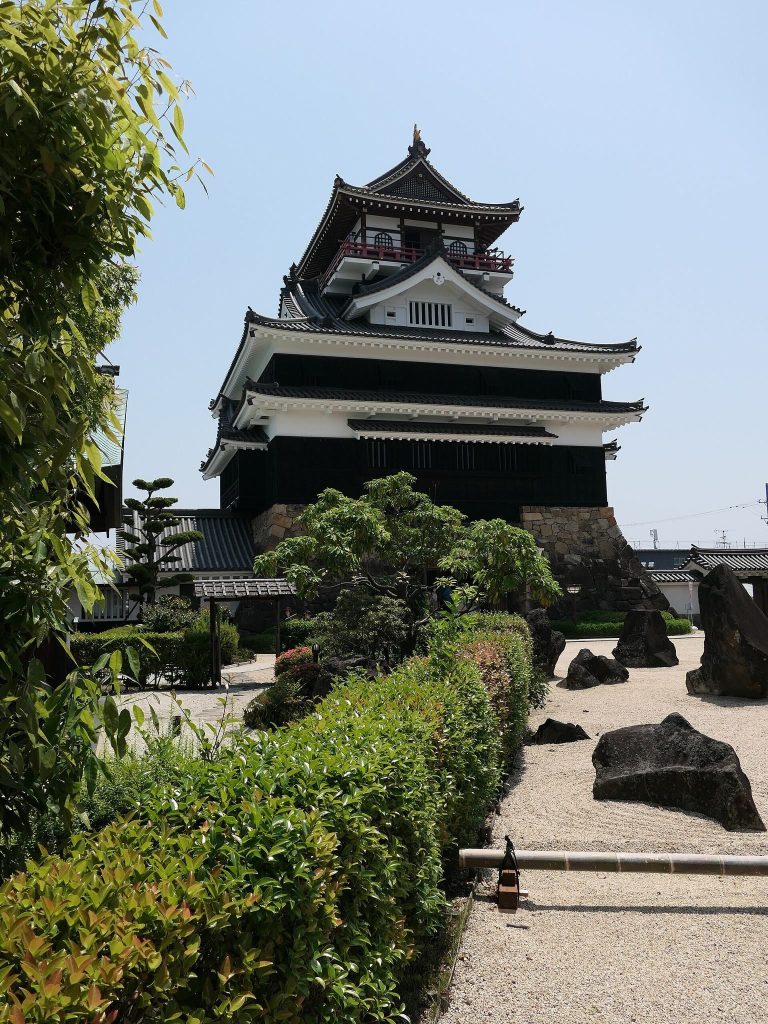
During the Sengoku period, a time of prolonged warfare among rival military powers, the Oda clan built Shobata Castle near the shrine. The clan crest was the same emblem used by Tsushima Shrine, pointing to a close connection between the shrine and the family. In the sixteenth century, the shrine was administered by the Tsushima-shu, an organization of related shrine families. It received assistance from Oda Nobunaga, Toyotomi Hideyoshi, and Tokugawa Ieyasu, while Hideyoshi later arranged repairs.
Tsushima priests and their agents also traveled as religious instructors known as Tsushima oshi. They distributed talismans and conducted prayers for communities that accepted the shrine’s worship. Such supporters were called danna, and the villages in which they lived were known as dannaba. Oda Nobunaga protected this activity, and the Owari domain later allowed the priests to preach beyond its own territory. This organization helped carry the shrine’s religious influence far beyond Tsushima.
Owari Tokugawa Patronage
During the Edo period, the Owari Tokugawa domain gave Tsushima Shrine official patronage and privileges. These included rights over shrine lands and permission to benefit from rice offerings connected with the Tsushima river festival. In 1647, Tokugawa Yoshinao, founder of the Owari branch of the Tokugawa family, issued a red-seal grant for 1,293 koku, 8 sho, and 9 go of land at Tsushima Mukojima. A koku measured land or agricultural yield, while sho and go were smaller traditional volume units. In 1665, Tokugawa Ietsuna, the shogun, recognized the grant as shogunal red-seal territory.
Owari patronage also established a hereditary shrine organization headed by the Himuro family. This arrangement reinforced the shrine’s institutional position and its role as the center of the Tsushima religious network. The annual cycle eventually included more than 100 observances, among them the Seven Herbs Festival, the regular festival, the Harvest Prayer Festival, the New Rice Festival, and the Tsushima Tenno Festival.
Religious Reorganization and Modern Status
Before the Meiji-period separation of Shinto and Buddhism, Tsushima Shrine was known as Tsushima Gozu Tenno Shrine and was associated especially with Gozu Tenno worship. In the syncretic religious tradition of the shrine, Gozu Tenno and Susanoo came to be treated as manifestations of one another. The Meiji separation removed Buddhist elements from the buildings and ceremonies, officially replaced Gozu Tenno with Susanoo as the principal deity, and removed “Gozu Tenno” from the formal name. The shrine nevertheless continued to be popularly called the Tenno-sama of Tsushima and remained the head shrine of the approximately 3,000-shrine Tenno network.
Tsushima Shrine became a prefectural shrine in 1873 and was elevated to a National Shrine of the third rank in 1926. This was a category in the prewar state system for classifying and supporting officially recognized Shinto shrines. It is now listed under the Association of Shinto Shrines and retains the traditional rank of Senior First Rank.
The Tsushima Tenno Festival continues the shrine’s historical “Tenno” identity despite the Meiji change in its official religious designation. The festival was historically held on the fifteenth day of the sixth lunar month. Its present major observance takes place on the fourth Saturday and the following Sunday of July, with decorated boats floating on the former Tenno River and reeds released into the water. The boat procession received designation as a national Important Intangible Folk Cultural Property in 1980.
The main hall was designated a nationally Important Cultural Property in 1920, and the Romon gate received the same designation in 1958. These protections recognize surviving historic buildings and the rarity of their architectural style. On 23 November 1970, a fire in a nearby private house spread to the shrine during strong winds and damaged its cypress-bark roofing.
Remains
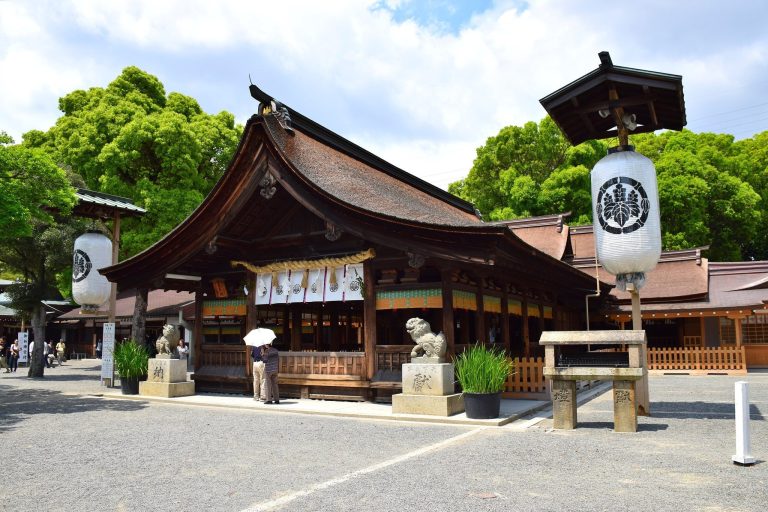
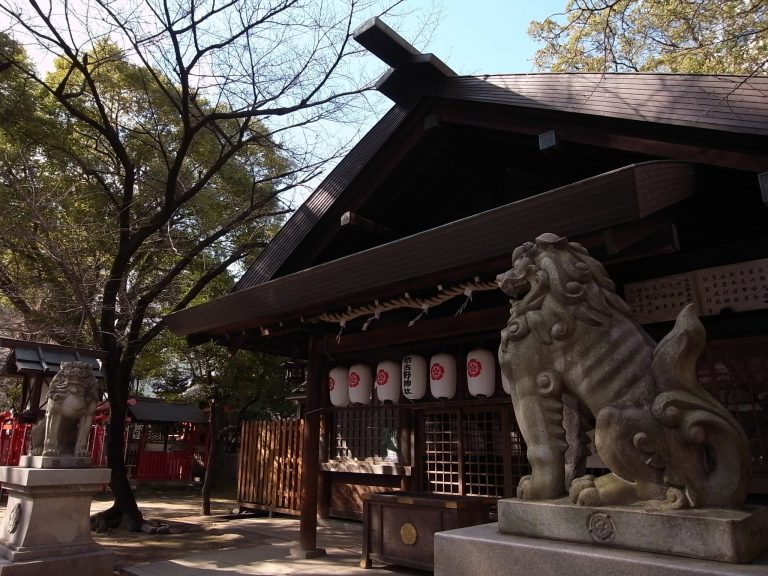
The shrine’s principal buildings form a complex in the Owari-zukuri style, a regional arrangement of sanctuary buildings and roof forms of which few historic examples survive. The precinct includes the main sanctuary, a worship hall, the Romon two-storied gate, and a south gate. Subsidiary shrines, an iron lantern, stone guardian dogs, and shrine documents are also associated with the complex.
Principal Shrine Buildings
Honden
The honden, or main sanctuary, was built in 1605 through a donation by Masako, the wife of Matsudaira Tadayoshi. It is an Owari-zukuri building, preserving the regional architectural arrangement that gives the complex much of its architectural distinction. The main sanctuary’s historic fabric includes cypress-bark roofing. A fire on 23 November 1970 completely destroyed the roof after flames spread from a nearby private house in strong winds, while the damage was concentrated in the roof area.
Romon Gate
The Romon is a two-storied gate built in 1591 through a donation by Toyotomi Hideyoshi. It forms one of the principal surviving structures of the precinct and received designation as a nationally Important Cultural Property in 1958. Its date and patronage place it within the period when the shrine benefited from support by major military leaders.
Worship Hall and Subsidiary Shrines
The haiden, or worship hall, and the south gate form additional parts of the shrine complex. The precinct and its associated external shrines include Kamado Shrine, a Mountain-Deity Shrine, Hakken Shrine dedicated to the fierce spirit of Susanoo, an Earth-Ancestor Shrine, a Stone Shrine, Kotohira Shrine dedicated to Omononushi, an Embankment-Below Shrine, and a City-Deity Shrine. The listed deities include fire-associated gods, Oyama-tsumi, the fierce and wondrous spirits of Susanoo, Otsuchi-no-mioya, Omononushi, Oichi-hime, Otoshi-no-kami, and Ukanomitama.
Watercourse and Archaeological Evidence
Maruike, an elliptical pond in the nearby Tenno River Park, preserves the former course of the Tenno River. The river once flowed between the shrine and its approach settlement and formed the terminal distributary of the Kiso River system. A long bridge called Tenno Bridge formerly crossed the watercourse in front of the shrine. After the Edo-period construction of the Kiso River embankment system, the raised beds of the Tenno and Saya rivers increased flooding. The opening of the Nikko River blocked the Tenno River near the shrine and turned it into an inlet. Later river-diversion work in the Meiji period eliminated the Saya River and left the elliptical pond.
Iron lanterns and a bronze bell from the medieval period carry inscriptions naming the shrine. These inscribed objects provide physical evidence for the shrine’s existence between the Kamakura and Muromachi periods. Together with the surviving buildings and the preserved former watercourse, they connect the present precinct with the shrine’s medieval history and its changing landscape.