Kuon-ji Temple: The Head Temple of Nichiren Buddhism in Japan


Site at a Glance
- Rating
- 4.5
- Popularity
- Medium
- Country
- Japan
- Primary era
- Modern
- External website
- Open
- Eras represented
- Early Modern, Modern
- Civilizations
- Japanese, Tokugawa
- Site type
- Religious
- Remains
- Monastery
On this page20 sections
History
Kuon-ji Temple is the head temple and principal ancestral temple of Nichiren Buddhism in Japan, founded as a Japanese Buddhist institution on Mount Minobu in 1274. Formally called Minobusan Myoho-in Kuon-ji, it is affiliated with the Nichiren sect, bears the mountain name Minobusan, and is dedicated to the Three Sacred Treasures, meaning the Buddha, the Buddhist teaching, and the Buddhist community. The site preserves both the memory of Nichiren’s first hermitage and the temple formally established there in 1281.
From Hermitage to Temple
After Nichiren, the thirteenth-century monk whose teachings gave rise to Nichiren Buddhism, returned from exile on Sado Island in 1274, Nanbu Sanenaga invited him to the Minobu area. Sanenaga was the local land steward of Hakii village in Kai Province and a follower of Nichiren. He established a hermitage for him at Nishitani, where Nichiren taught the Lotus Sutra, trained disciples and followers, and prayed for the defeat of the Mongol forces threatening Japan and for peace in the realm.
The community grew around Nichiren’s activities. His writings indicate that between 40 and 60 people lived at the hermitage at different times, and the community may have numbered about 100 by 1279. Minobu became Nichiren’s principal center of activity. Approximately two-thirds of his writings, along with most of his surviving hand-drawn mandalas, were produced there. A mandala is a sacred diagram or iconographic arrangement used in Buddhist practice.
By 1281, the original hermitage had become too small, so a large building measuring ten bays square was constructed nearby. Tradition holds that Nichiren named the institution Minobusan Myoho-in Kuon-ji. This history distinguishes the hermitage’s foundation in 1274 from the temple’s establishment in 1281.
Nichiren’s Death and Minobu’s Sacred Status
Nichiren left Minobu in 1282 to seek treatment at a hot spring in Hitachi and to visit his parents’ graves. His illness worsened at the residence of his follower Ikegami Munenaka in Musashi Province, where he died on October 13, 1282. Before his death, he appointed six senior disciples, who became his principal disciples and successors. In accordance with his wishes, his remains were returned to Minobu and enshrined near the hermitage. He had lived at Minobu for nearly nine years.
Nichiren regarded Minobu as a sacred mountain analogous to Vulture Peak, the setting associated with the preaching of the Lotus Sutra. Successive head priests guarded his remains there, and Minobu became the highest-ranking sacred site of the Nichiren tradition. Its importance therefore rests not only on the temple founded during Nichiren’s lifetime, but also on its continuing role as the place associated with his remains and memory.
Relocation and Growth
In 1475, the eleventh head priest, Nichi-cho, moved the temple complex from the constricted Nishitani area to its present location. During the Warring States period, the Takeda family, the military governors of Kai, and the Anayama family, rulers of the Kawachi domain, protected the temple. A temple town developed around the complex.
During the Edo period, Nichiren Buddhism expanded with the support of the Tokugawa family and other feudal lords. Priests including Nichiju, Nichiken, and Nichion consolidated Kuon-ji’s position after the Minobu-Ikegami Debate and the suppression of the opposing Fuju Fuse school. By 1712, the complex had reached a peak of 133 subtemples. A subtemple is a dependent temple or branch institution within a larger complex.
In 1706, Kuon-ji received the title Chokugan-ji, a designation for a class of temples associated with an imperial vow. The title was abolished in 1871. Kuon-ji later possessed more than 900 branch temples, although the formal head-temple and branch-temple system was dissolved in 1941.
Fire, Reconstruction, and Institutional Continuity
Fire repeatedly altered the complex. Eleven subtemples burned in 1744, buildings on Mount Shichimen burned in 1776, and the octagonal hall and worship hall at the Nishitani mausoleum burned in 1821. In 1824, a fire that began in the Founder’s Hall destroyed thirteen buildings. In 1829, a fire beginning at the five-story pagoda destroyed 28 buildings and most of the surrounding temple-town districts. Another fire from the Sendai-bo subtemple in 1865 destroyed 17 branch temples and eight smaller buildings, spread to neighboring districts, and destroyed more than 100 houses.
The complex was rebuilt after these disasters, but a fire beginning at Honshu-bo in Nishitani in January 1875 destroyed the temple buildings and treasures. Reconstruction followed through the efforts of the seventy-fourth head priest, Nichikan, and his successors. Many of the buildings standing today belong to this rebuilding, while other structures are earlier survivals, relocated components, or later additions.
Kuon-ji’s scriptures, books, Buddhist texts, archival documents, and other records form the Minobu Library collection, preserved in the Minobusan Treasure Museum. The collection also includes manuscripts copied or written by other Buddhist institutions and groups. In 1973, the temple established a priest-training institution offering about a year of residential preparation for aspiring Nichiren priests. Already ordained priests may also undertake further training in rituals and sermons, and a separate women’s program began in 2020.
Nineteen buildings were registered as Registered Tangible Cultural Properties in 2018, followed by eight more in 2020. This Japanese legal heritage category records and protects historically significant buildings through the national registration system. Kuon-ji also includes nationally and locally designated cultural properties, among them a National Treasure painting, Important Cultural Properties, prefectural cultural properties, and Minobu Town cultural properties.
The temple remains associated with the Kai 108 Sacred Sites pilgrimage and with the wider network of Nichiren memorial sites. The annual observance at Keishin-in on Mount Shichimen, held from the night of September 18 until the morning of September 19 under the direction of the Kuon-ji head priest, forms part of this continuing religious role.
Remains
The complex extends across Mount Minobu from the Somon and Sanmon entrances, along the 287-step Bodai Stairway, and into the main compound. The Nishitani mausoleum preserves the former hermitage and Nichiren’s grave, while the summit behind the temple contains the Okunoin Shishinkaku. The present physical complex combines buildings reconstructed after the 1875 fire with earlier survivals, relocated structures, and additions from the twentieth and twenty-first centuries.
Entrances and Approach
Somon and Sanmon
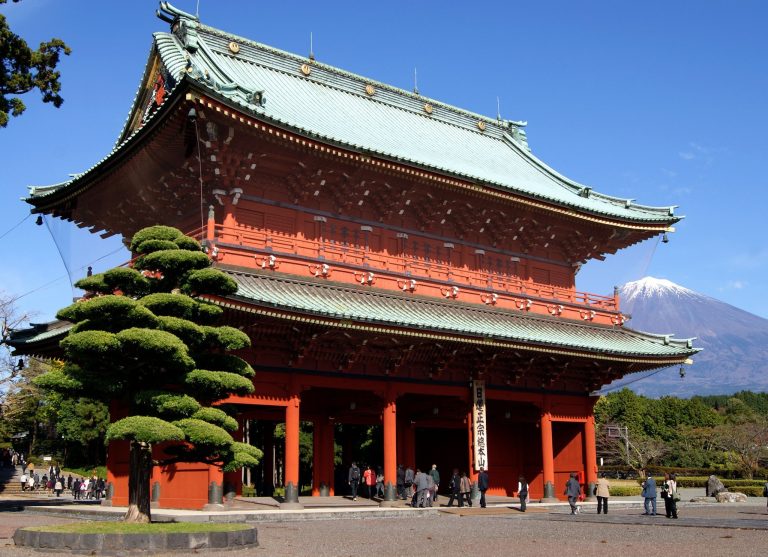
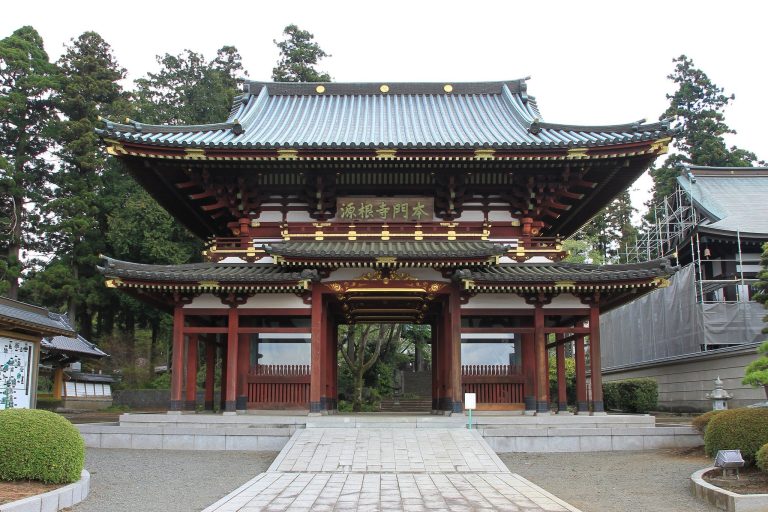
The Somon forms the first entrance to the temple precinct. Farther along the approach, the Sanmon is a three-gated entrance five bays wide and two bays deep, with a height of seven jo, a traditional Japanese length measure. Built in 1907, it houses Kongorikishi guardian figures on its lower level and the Sixteen Arhats above. The Sixteen Arhats are revered Buddhist disciples traditionally regarded as guardians and preservers of the Buddha’s teaching. Nearby stand a statue of Honda Nissei, a memorial stone bearing a verse by Miyazawa Kenji, a bronze statue of Nagata Kimi, and a Taishi-do dedicated to Prince Shotoku.
Bodai Stairway
The Sanmon connects with the Bodai Stairway through an avenue of cedars traditionally said to have been planted by Nichi-cho. The stone stairway has exactly 287 steps. Its name joins the Buddhist idea of awakening with the image of a ladder or bridge. A statue of Nanbu Sanenaga stands beside the stairs, with the Otoko-zaka and Onna-zaka slopes nearby.
Main Compound
Main Hall and Treasure Museum
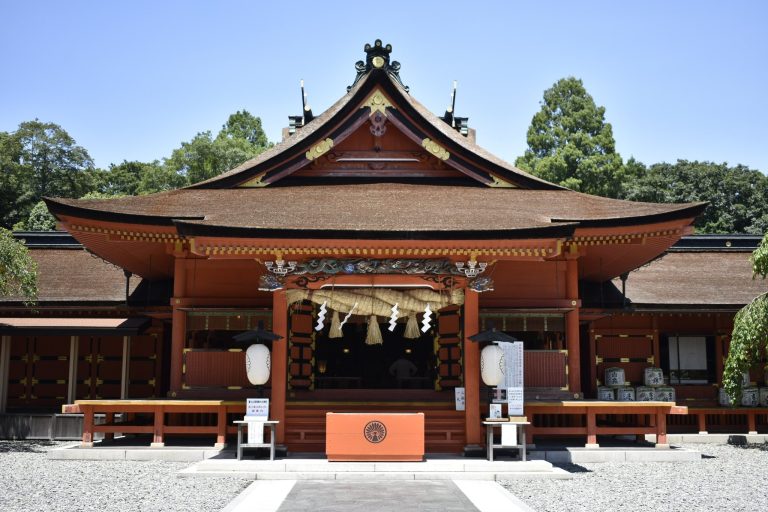
The present Main Hall was completed in 1985. Its principal image is a three-dimensional mandala, a sculptural arrangement based on a wooden rendering of a large mandala written by Nichiren. The ensemble includes Shakyamuni Buddha, Prabhutaratna Buddha, four bodhisattvas, Fudo Myoo, Aizen Myoo, the Four Heavenly Kings, Samantabhadra, Manjushri, and a seated image of Nichiren. Except for the Nichiren image, Eri Sohei and Eri Ko-ei made the sculptures in the tradition of the Kei school. Kayama Matazo painted the ink dragon on the ceiling.
The Treasure Museum occupies the Main Hall’s basement. Its displays include books, hanging scrolls, and implements used in Buddhist ceremonies. The Minobu Library collection preserves the temple’s wider body of scriptures, books, archival documents, and related records.
Five-Story Pagoda
The present five-story pagoda is the third built on the site. Taisei Corporation completed it in 2008, and its dedication ceremony took place in 2009. The first pagoda was erected in 1619 through the patronage of Jufukuin, a consort of Maeda Toshiie. It was moved in 1666 and burned in 1829. A second pagoda was begun in 1860, completed in 1865, and destroyed in the fire of 1875.
Founder’s Hall
The Seishinkaku Soshido, or Founder’s Hall, houses an image of Nichiren. Built in 1881 partly with timber from the former Kannoji temple, it contains an imperial plaque inscribed “Rissho,” presented by Emperor Showa. The Founder’s Hall and its offering building are among the structures registered in 2018.
Buddha Hall and Shakado
The Buddha Hall is used for morning, midday, and afternoon services and for special ceremonies. In front of it, the Shakado and Nohai-do form a six-story building. The Shakado occupies the sixth floor after being moved when the present Main Hall was built. The Nohai-do occupies the first through fifth floors and houses the ashes of followers’ ancestors from across Japan.
Relic and Memorial Buildings
The Goshinkotsudo enshrines Nichiren’s relic bones. Shichimen Daimyojin stands on its right and the Sanju Banjin on its left. The building was constructed in 1881. The Hoonkaku, built in 2002 to commemorate the 750th anniversary of the establishment of Nichiren’s teaching, includes a meeting room on its second floor.
The Kaikido enshrines Nanbu Sanenaga and is designated as a Minobu Town cultural property. The Suimeiro served as the residence of successive head priests. An Inari shrine stands above its waterfall, and the building is noted for its front garden.
Nishitani and the Mountain Summit
Nishitani Mausoleum
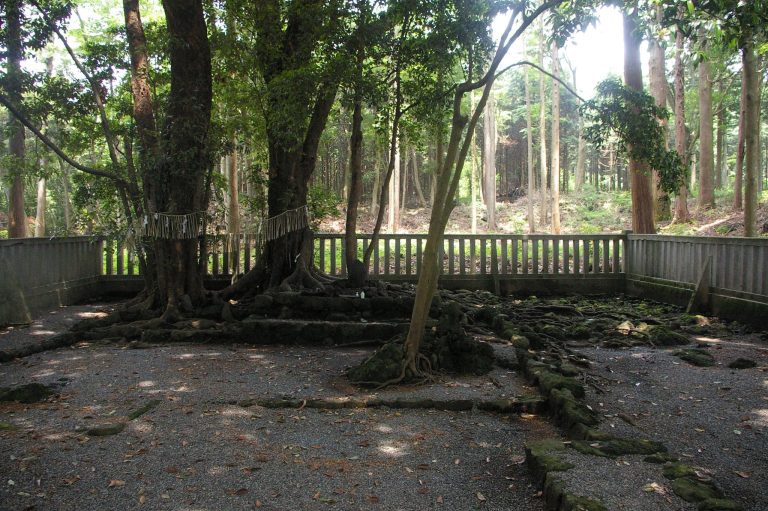
The Nishitani mausoleum contains Nichiren’s grave and the remains of his former hermitage. The mausoleum of successive Kuon-ji head priests stands to the right. To the left are graves and memorials associated with Nikkō, Tomiki Jonin’s mother, Abutsu-bo Nitoku, Hojaku-in Nichien, Jufukuin, and other historical figures. The mausoleum worship hall was built in 1942 and its water pavilion in 1944.
Okunoin Shishinkaku
Okunoin Shishinkaku stands at the summit of Mount Minobu behind the temple. It commemorates the place where Nichiren is traditionally said to have looked toward his home province of Awa and prayed for the spirits of his parents and his teacher, Dozen-bo. Built after Nichiren’s death with support from Jufukuin, the hall enshrines an image of Nichiren, images of the six senior disciples, the Sanju Banjin, two Inari deities, and Koyasu Hachiman.
Four cedars at Shishinkaku are traditionally regarded as having been planted by Nichiren. The precinct also contains the Motomasa mound, associated with the burial of hair belonging to the Kyoto priest Gensei Motomasa. Other features include the Shishinkaku bell tower, a Nio gate, a memorial associated with Ota Dokan, tombs of Warring States-period military figures, a Kishimojin hall, a Joroku-do, a Sanko-do, a well traditionally excavated by Nichiro, and a Toshogu shrine donated by the consort Omankata.
Subsidiary Precincts and Cultural Features
The grounds and approaches include branch temples and subsidiary buildings in the East, West, and Central valleys, the Shichimenzan pilgrimage route, and the approach to Okunoin Shishinkaku. Named institutions include Nuta-yama Jumanbuji, Shusetsubo, Myojo-in, Jinriki-bo, Myofukuji, Odaki Benten-do, Kanshin-bo, Chuteki-bo, Sei-un-bo, Jintsu-bo, and Anju-bo. Keishin-in stands near the summit of Mount Shichimen and enshrines Shichimen Daimyojin. The mountain was historically associated with Shugendo practice.
Numerous stone monuments and poetry inscriptions occupy the complex, including monuments associated with Basho and other poets. A memorial tower for victims of the Great East Japan Earthquake was erected in the Shishinkaku precinct in November 2011. The grounds contain weeping cherry trees, including one traditionally said to be about 400 years old, as well as several hundred other cherry trees around the complex. The temple grounds and surrounding mountain provide views toward Mount Fuji, western Izu, the Southern Alps, Mount Kitadake, Mount Shichimen, the Kofu Basin, and Mount Yatsugatake.
Registered Buildings and Collections
Registered historic buildings include the Daikyakuden, Hokido, Old Study, New Study, Great Bell Tower, Time Bell Tower, Kanromon and gatekeeper’s office, Taishi-do, Honjido, Sobyo-to, Jos houden, Sanmaido, Suigyodo, Zuimon, and the Shishinkaku Nio Gate. Their stated construction dates range from 1739 for the Hottchinkaku to 1958 for the Joshoden. Several were relocated or repaired, including the Kanromon in 1941 and the Sanmaido, originally built in 1823, in 1941.
The collections include a two-volume Song-dynasty copy of the Book of Rites, discovered in the Kuon-ji library by Tokutomi Soho; a 1276 manuscript of thirteen volumes of the Heian-period anthology Honcho Monzui, lacking its first volume; and three surviving original scrolls from an eight-scroll series depicting eight phases in the life of the Buddha. The National Treasure painting Summer Mountain, attributed to Hu Zhifu and dated to the thirteenth century, is a hanging color painting on silk measuring approximately 118.5 by 52.7 centimeters and is held by the Tokyo National Museum.
Prefectural cultural properties include a damaged medieval bronze bell bearing fire marks and an inscription linking it to Saisho-ji in the former Oi Estate. Its transfer to Kuon-ji has been interpreted in several ways. The collection also includes the only surviving Korean-style bell in the prefecture, an embroidered image of the Sixteen Arhats, a manuscript of the Guketsu Gaitensho, and a seven-volume Ming-period printed Lotus Sutra. The Lotus Sutra lacks the Devadatta chapter, is kept in paulownia boxes, and bears an inscription recording its dedication by Takeda Harunobu in 1550.
Local cultural properties include a Kamakura-period standing image of Shakyamuni Buddha, a large Shakyamuni image made during the Kan’ei era by Nichigo of Kyoto’s Sanpoji, a bronze seated Shakyamuni donated by Kyogoku Takakatsu, and the Sanmon’s two guardian figures. Those figures are traditionally attributed either to Unkei or Jocho, and a related tradition says that Nika transported them overnight from Shomyoji in Kamakura. The attribution to Unkei remains uncertain.